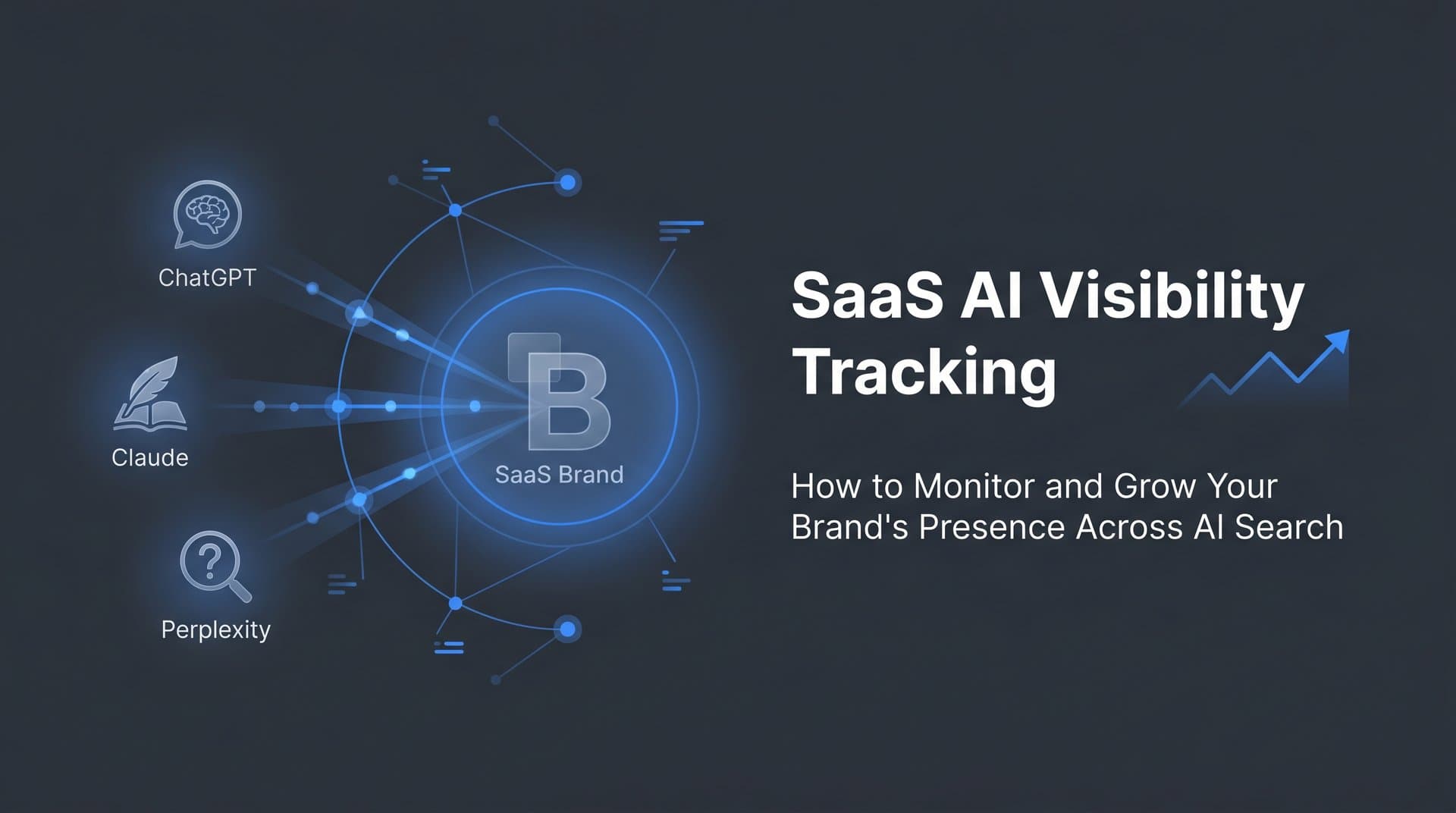
Something fundamental has changed about how people find products, services, and recommendations online. Users who once typed queries into Google are increasingly turning to AI-powered platforms like ChatGPT, Perplexity, Claude, and Gemini to get direct answers. Instead of scanning ten blue links, they ask a question and receive a synthesized response. And within that response, some brands get mentioned. Others don't.
Here's the uncomfortable reality: most brands have absolutely no idea which category they fall into. They're optimizing title tags, building backlinks, and monitoring keyword rankings, while an entirely separate discovery channel operates outside their visibility. If a potential customer asks ChatGPT for the best tools in your category and your brand doesn't appear in the response, that's a missed opportunity you won't find in your Google Search Console dashboard.
This is the problem that AI search engine presence tracking is designed to solve. It's the discipline of systematically monitoring how, when, and in what context AI platforms mention your brand, measuring the sentiment of those mentions, and identifying the gaps where you should be visible but aren't. For marketers, founders, and agencies serious about organic growth, it's becoming as essential as traditional SEO measurement.
By the end of this article, you'll understand exactly what AI search engine presence tracking involves, how AI platforms decide which brands to surface, how to build a tracking framework that generates actionable insights, and how to turn those insights into content that gets your brand cited. Let's start with why your current metrics aren't giving you the full picture.
The Visibility Gap Your SEO Dashboard Can't See
Traditional SEO dashboards are built around a specific model of search: a user types a query, a search engine returns ranked results, and success is measured by where your pages appear in that list. This model served marketers well for years. But it was always a proxy for the thing that actually matters, which is whether potential customers discover your brand when they're looking for solutions you provide.
AI answer engines have broken that proxy relationship. When someone asks Perplexity "what's the best project management tool for remote teams" or asks Claude "which CRM should a small agency use," they receive a direct, synthesized answer. The user may never visit a search results page at all. Your ranking position for those keywords becomes irrelevant if the AI's response doesn't include your brand.
The mechanics behind this are worth understanding. AI models generate responses based on training data and, in many cases, retrieval-augmented generation (RAG), a process where the model pulls in current web content to supplement its knowledge. Brand visibility in AI outputs is therefore shaped by the breadth and authority of content about your brand across the web, the clarity with which that content is structured, and how frequently credible sources reference you. These factors overlap with traditional SEO but don't map directly onto it.
You can rank first on Google for a competitive keyword and still be systematically absent from AI-generated recommendations in that same category. The two channels are related but distinct, and conflating them creates a strategic blind spot. A brand that appears to be performing well by conventional metrics may be losing ground in the channel where a growing share of high-intent discovery is now happening.
For marketers and founders, this creates a measurement gap that has real business consequences. If you're allocating content budget, evaluating channel performance, or benchmarking against competitors, and you're not accounting for AI search presence, you're working with an incomplete picture of your market position. AI search engine presence tracking exists specifically to close that gap, giving you the data layer that traditional tools were never built to provide.
What AI Search Engine Presence Tracking Actually Measures
Before you can build a tracking practice, you need to understand what you're actually measuring. AI search engine presence tracking isn't a single metric. It's a composite discipline built from several interconnected data points, each of which tells a different part of the story.
Brand Mention Frequency: The most foundational measurement is how often your brand appears in AI-generated responses. This involves running a defined set of prompts across multiple AI platforms and recording whether your brand is cited. Frequency alone doesn't tell you everything, but it establishes your baseline presence and allows you to track changes over time.
Sentiment Analysis: Not all mentions are equal. An AI model might recommend your brand enthusiastically, mention it neutrally as one of several options, or include it with qualifications and caveats. Sentiment analysis distinguishes between these cases. A brand that is mentioned but consistently described with reservations faces a different strategic challenge than one that is simply absent. Tracking sentiment gives you the nuance needed to craft the right content response.
Prompt Coverage: This is one of the most revealing metrics in AI presence tracking. Prompt coverage refers to the range of user queries that trigger your brand to appear in AI responses. A brand with narrow prompt coverage only appears when its name is directly mentioned in the query. A brand with broad prompt coverage surfaces in category-level queries ("best tools for X"), problem-solution queries ("how do I solve Y"), and comparison queries ("X vs. Y alternatives"). The wider your prompt coverage, the more discovery surface area your brand occupies in AI search.
Aggregating these individual data points produces what's often called an AI Visibility Score, a composite benchmark that gives brands a single, trackable number representing their overall presence across AI platforms. Rather than managing separate metrics for each AI model, an AI Visibility Score normalizes the data into a unified signal. It allows you to see whether your AI presence is improving or declining over time, and how you compare against competitors in your category.
It's also important to distinguish between two modes of tracking. Passive monitoring catches mentions that occur organically, alerting you when your brand appears in AI responses. Active prompt tracking is more systematic: you build a library of high-intent queries relevant to your category and run them deliberately across AI platforms on a regular cadence. Active tracking is more powerful because it surfaces not just where you appear, but where you're absent, which is where the most valuable insights live.
The Mechanics: How AI Platforms Decide Which Brands to Surface
Understanding why AI models mention certain brands and not others is essential for building a strategy that improves your presence. This isn't arbitrary. It follows patterns you can influence with deliberate content decisions.
AI models surface brands based on the quality, authority, and frequency of content about them across the web. When a model has encountered a brand mentioned consistently in credible, well-structured sources, it develops stronger associations between that brand and the relevant category or problem space. A brand that appears in authoritative guides, comparison articles, industry publications, and structured product descriptions across many sources is more likely to be cited than one whose web presence is thin or inconsistently structured.
This is where Generative Engine Optimization (GEO) enters the picture. GEO is the emerging discipline of optimizing content specifically for AI model citation, and it differs meaningfully from traditional SEO. While traditional SEO emphasizes keyword density, backlink volume, and page authority signals, GEO prioritizes something different: the clarity and extractability of your content. Understanding the core AI search engine ranking factors is the foundation for any effective GEO strategy.
AI models are looking for content they can confidently summarize and cite. That means content structured around direct answers to specific questions, clear definitions of what your product or service does, authoritative sourcing that establishes credibility, and logical organization that allows a model to extract a coherent, accurate summary. A well-structured explainer article that directly answers "what is [your product category] and who is it for" is more likely to influence AI responses than a keyword-optimized landing page that buries its key claims in marketing language.
Indexing speed is a factor that's easy to overlook but increasingly consequential. Content that gets discovered and indexed quickly is more likely to be incorporated into retrieval-augmented generation systems, where AI models pull current web content to supplement their responses. The faster your content moves from published to indexed, the sooner it can influence AI outputs. Tools like IndexNow allow you to submit content to search engines immediately upon publication, eliminating the lag that can delay discoverability by days or weeks. In fast-moving content categories where competitors are publishing regularly, this speed advantage in content discovery compounds over time.
The practical implication is that your content strategy and your AI visibility strategy are deeply connected. Every well-structured, authoritative article you publish on a relevant topic is an investment in your AI presence. Every piece of content that answers a specific question your target audience is asking increases the probability that AI models will reference your brand when that question comes up.
Building a Tracking Framework: From Data Collection to Actionable Insights
Knowing that AI search engine presence tracking matters is one thing. Building a systematic framework that generates reliable, actionable data is another. Here's how to approach it in practice.
Step 1: Build Your Prompt Library. Start by mapping the high-intent queries your target audience is likely to ask AI platforms. These fall into several categories: category discovery queries ("best tools for [use case]"), problem-solution queries ("how do I [specific challenge]"), comparison queries ("[your category] alternatives"), and direct brand queries ("[your brand name] reviews"). Your prompt library should cover all of these categories, with particular emphasis on the category and problem-solution queries where you want to be visible even when users aren't already aware of your brand.
Step 2: Establish Your Baseline. Run your prompt library across multiple AI platforms, including ChatGPT, Claude, Perplexity, and Gemini, and document the results systematically. Record whether your brand appears, where in the response it appears, the sentiment of the mention, and which competitors are cited alongside or instead of you. This baseline is your starting point for measuring progress. Understanding how competitors rank in AI search results at this stage will sharpen your gap analysis considerably.
Step 3: Set a Monitoring Cadence. AI models are not static. They update continuously, and their responses to the same prompts can shift as new content is indexed and training data evolves. A one-time audit tells you where you stand today but nothing about trajectory. Monthly tracking at minimum, with weekly tracking for competitive categories, allows you to detect changes in mention frequency, sentiment shifts, and competitor positioning before they become significant gaps.
Step 4: Translate Data Into Content Decisions. This is where tracking becomes genuinely valuable. Every gap in your AI presence maps to a content opportunity. If your brand is absent from responses to "best [category] tools for [use case]" queries, that's a signal to publish authoritative, GEO-optimized content specifically addressing that use case. If a competitor is being cited in comparison queries where you're absent, that's a priority topic for a structured comparison guide. The tracking data doesn't just tell you where you stand. It tells you exactly what to create next.
The discipline of connecting tracking data to content production decisions is what separates brands that systematically improve their AI visibility from those that audit once and move on. Building this feedback loop into your regular marketing operations is the goal.
Turning AI Visibility Data Into Content That Gets You Mentioned
Data without action is just noise. The real value of AI search engine presence tracking lies in what you do with the insights it generates. Here's how to convert visibility gaps into content that shifts AI responses in your favor.
Prompt Gap Analysis as a Content Brief: When your tracking reveals prompts where competitors are being cited and your brand is absent, you've identified a high-priority content opportunity. These gaps are more valuable than generic keyword research because they're directly tied to the queries that are already driving brand discovery in AI search. A prompt gap is essentially a content brief: it tells you the topic, the likely user intent, and the competitive context all at once.
Structuring Content for AI Extractability: Writing for AI citation requires a specific approach. Lead with clear, direct answers to the question your content addresses. Define key terms explicitly. Use descriptive headings that signal the content's relevance to specific queries. Include authoritative context that gives AI models confidence in citing your content. Avoid burying your key claims in long introductory paragraphs or wrapping them in promotional language that reduces their extractability. Following proven AI search engine optimization techniques will help ensure your content is structured for maximum citation potential.
Think about it this way: an AI model reading your content is looking for clear, confident claims it can summarize and attribute. A sentence like "Sight AI tracks brand mentions across six AI platforms and generates an AI Visibility Score" is highly extractable. A sentence like "our innovative, industry-leading solution provides comprehensive visibility into your brand's performance across the AI ecosystem" is not. Precision beats promotion when writing for AI citation.
Automating the Production and Publishing Pipeline: The brands that compound their AI visibility advantage fastest are those that can move from identifying a gap to publishing a response quickly. Manual content workflows introduce lag at every stage, from research to writing to editing to publishing to indexing. Automating key parts of this pipeline, using AI-assisted content generation to accelerate drafting, CMS auto-publishing to eliminate manual upload steps, and IndexNow integration to ensure immediate indexing, compresses the time between identifying an opportunity and acting on it. Optimizing your search engine indexing process is one of the highest-leverage steps you can take to accelerate this pipeline.
Platforms like Sight AI are built specifically for this workflow. The AI Content Writer uses specialized agents to generate SEO and GEO-optimized articles across formats, including the listicles, guides, and explainers that perform well in AI citation contexts. Combined with automatic indexing via IndexNow, content can move from gap identification to indexed publication in a fraction of the time a manual workflow requires. In a competitive content environment, that speed differential matters.
Your AI Presence Tracking Action Plan
Let's bring this together into a practical end-to-end workflow you can start implementing.
The sequence looks like this: audit your current AI mentions by running your brand name and key category queries through major AI platforms. Build a prompt library covering category, problem-solution, and comparison queries relevant to your market. Track those prompts systematically across multiple AI platforms on a regular cadence. Analyze the results to identify gaps where competitors are being cited and you're not. Publish GEO-optimized content targeting those gaps. Monitor changes in your AI Visibility Score over subsequent tracking cycles. Repeat.
The most important mindset shift is recognizing that AI search engine presence tracking is not a one-time project. It's an ongoing operational discipline. AI models evolve, competitors publish new content, and the landscape of what gets cited shifts continuously. Brands that build systematic monitoring into their regular marketing operations will compound their AI visibility advantage over time. Those that treat it as a one-off audit will find themselves perpetually catching up.
Sight AI is built to support this entire workflow in a single platform. It tracks brand mentions across six AI platforms, including ChatGPT, Claude, and Perplexity, and surfaces sentiment analysis and prompt coverage data in a unified dashboard. The AI Content Writer generates SEO and GEO-optimized articles using 13+ specialized agents, with Autopilot Mode to maintain publishing velocity. And IndexNow integration ensures every piece of content is indexed immediately upon publication, maximizing the speed at which new content can influence AI responses. Rather than stitching together separate tools for tracking, content creation, and indexing, Sight AI unifies the complete workflow.
The Bottom Line on AI Search Visibility
AI search engines are no longer a future consideration. They're a present reality, and for a growing share of high-intent discovery queries, they're the primary channel. Brands without a systematic approach to tracking and improving their AI presence are making strategic decisions based on incomplete information.
The good news is that the path forward is clear. Start with a simple audit: run your brand name and your key category queries through ChatGPT, Claude, and Perplexity today. Note what comes back. Are you mentioned? In what context? With what sentiment? Who else appears? That audit, however informal, will give you an immediate sense of where you stand and where the gaps are.
From there, the discipline of AI search engine presence tracking gives you the systematic framework to turn those observations into a compounding visibility strategy. Track consistently, publish deliberately, and index fast.
Stop guessing how AI models like ChatGPT and Claude talk about your brand. Start tracking your AI visibility today and see exactly where your brand appears across top AI platforms, uncover the content opportunities you're missing, and automate your path to organic traffic growth.