Something significant is happening in how buyers research software. Instead of opening Google and scanning a list of blue links, a growing number of SaaS buyers are typing their questions directly into ChatGPT, Claude, Perplexity, or Gemini and asking for recommendations. "What's the best project management tool for remote teams?" "Compare the top CRM platforms for startups." "Which analytics software integrates with Shopify?" These are real questions that real buyers are asking AI models right now, and the answers those models provide are shaping purchase decisions.
Here's the uncomfortable truth for most SaaS brands: they have no idea how AI models are representing them. They don't know if they're being mentioned at all, what context surrounds those mentions, or whether the information AI models share about their product is accurate and favorable. That blind spot is expensive.
SaaS AI visibility tracking is the discipline built to close that gap. It means systematically monitoring how AI platforms reference your brand, measuring the sentiment and accuracy of those references, identifying the prompts that trigger competitor mentions but not yours, and using that intelligence to optimize your content strategy. Think of it as SEO for the AI era, except the "search engine" is now a conversational model that synthesizes answers rather than returning a ranked list of links.
This article breaks down exactly how SaaS AI visibility tracking works, why it matters more than most marketing teams realize, and how to build a workflow that turns AI visibility data into concrete content and business results.
Why AI Models Have Become the Go-To Research Tool for SaaS Buyers
The behavioral shift is real and it's accelerating. SaaS buyers, particularly those in technical or marketing roles, have become comfortable using AI assistants as a first stop for vendor research. Instead of running multiple searches and clicking through review sites and comparison pages, they ask an AI model to synthesize the landscape for them.
This changes the discovery dynamic in a fundamental way. In traditional search, visibility means ranking on a SERP. Your brand appears in position three for "best email marketing software," someone clicks, they read your site, and the consideration process begins. The mechanism is transparent: you can see your ranking, track your traffic, and measure the impact of SEO work over time.
AI visibility works differently. When a buyer asks ChatGPT to recommend a project management tool, the model generates a response based on its training data, its retrieval mechanisms, and the patterns it has learned about which brands are authoritative in a given category. There is no rank position. There is no click-through. There is just whether your brand is mentioned, how it's described, and whether the framing is accurate and favorable enough to earn a spot on the buyer's shortlist.
The stakes are significant because AI-assisted research often happens before a buyer visits any vendor website. By the time someone lands on your homepage, they may already have a mental shortlist shaped by an AI conversation you had no visibility into. If your brand wasn't in that conversation, you're competing against a shortlist you weren't on. Understanding AI visibility for SaaS companies is becoming essential for any team that wants to stay competitive.
This is also where misrepresentation becomes a real risk. AI models sometimes describe products inaccurately, cite outdated pricing or features, or position a brand in the wrong category. A buyer who receives an inaccurate description of your product from an AI model may disqualify you without ever checking your actual website. You lose a deal you never knew was in play.
The contrast with traditional SEO is worth emphasizing. With SERP rankings, you can audit your position daily, run A/B tests on meta descriptions, and trace traffic back to specific keywords. With AI visibility, the outputs are conversational, dynamic, and vary by model, by prompt phrasing, and by the retrieval context the model uses at any given moment. That's exactly why dedicated AI brand visibility tracking tools exist: to bring the same rigor to AI-generated brand mentions that SEO tools brought to search rankings.
The Core Metrics Behind SaaS AI Visibility Tracking
Understanding what SaaS AI visibility tracking actually measures helps clarify why it's distinct from anything in the traditional marketing analytics stack. This isn't social listening, brand monitoring, or web analytics. It's a new category of measurement built specifically for the AI response environment.
Brand Mention Frequency: The most fundamental metric is simply how often your brand appears in AI-generated responses across a defined set of prompts. If you're tracking 50 prompts relevant to your product category and your brand appears in responses to 12 of them, your mention rate is 24%. Tracking this over time shows whether your AI visibility is growing or declining. Learning how to measure AI visibility metrics properly is the foundation of any effective tracking program.
Sentiment Analysis: Not all mentions are equal. An AI model might mention your brand while noting that it's expensive, difficult to onboard, or better suited to enterprise than SMB. Sentiment analysis categorizes AI mentions as positive, neutral, or negative, and surfaces the specific language models use to describe your product. This is where accuracy gaps often emerge: a model might be citing outdated information from a period before you revamped your pricing or launched a key feature.
Prompt-Level Tracking: This is one of the most actionable dimensions of AI visibility tracking. Rather than just knowing your overall mention rate, prompt-level tracking tells you which specific queries trigger your brand mention and which don't. If you're consistently mentioned when someone asks about "email automation for e-commerce" but never mentioned when they ask about "email marketing for SaaS," that's a content signal you can act on.
Competitive Share of Voice: AI visibility doesn't exist in isolation. The relevant question isn't just "do AI models mention us?" but "how often do they mention us compared to our competitors?" Share of voice across AI platforms gives you a competitive benchmark and helps you identify which rivals are winning the AI recommendation game and why.
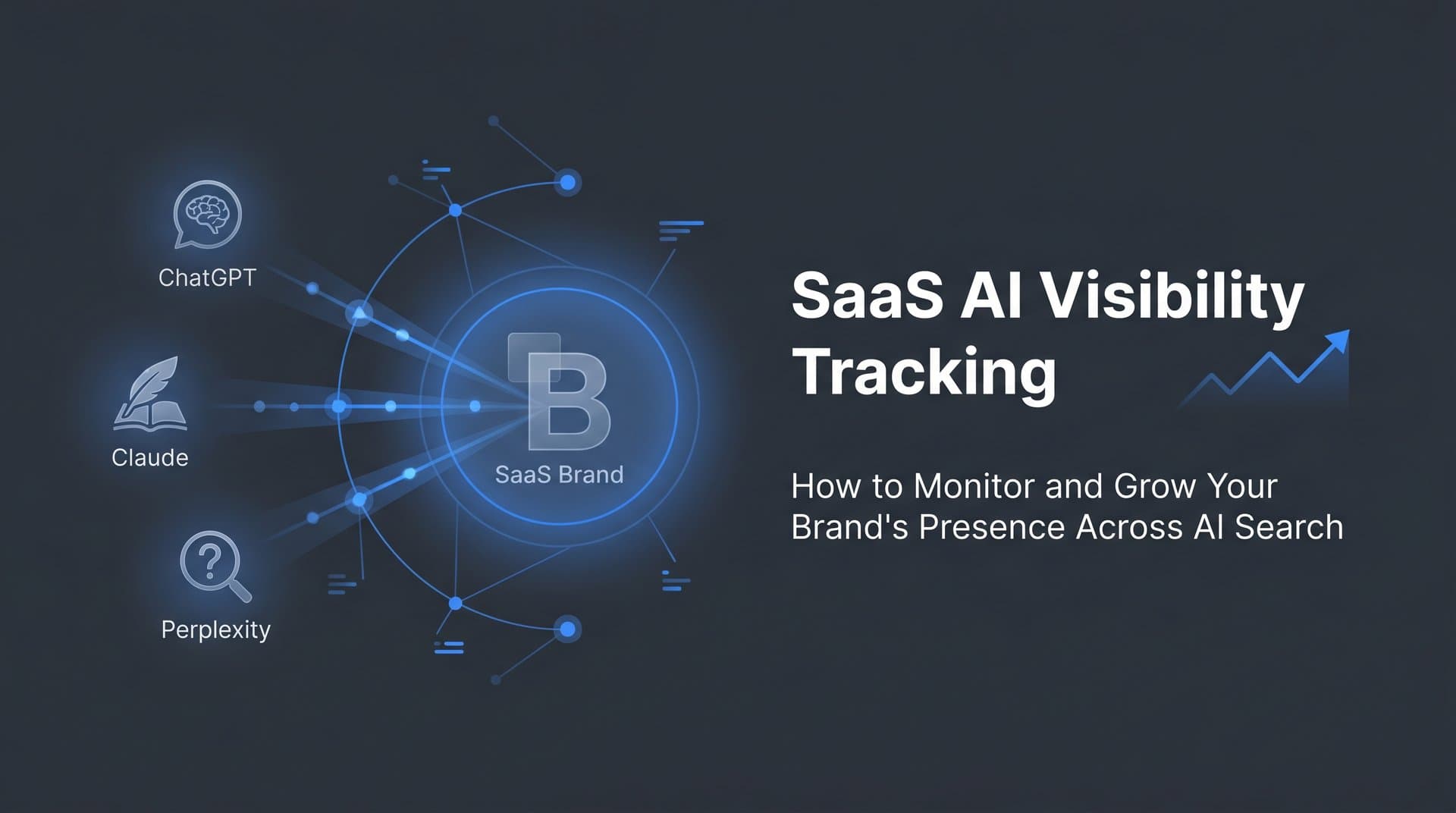
Technically, AI visibility tracking works by running a defined set of target prompts through multiple AI models, including ChatGPT, Claude, Gemini, and Perplexity, and systematically analyzing the responses. Dedicated AI model tracking software automates this process across platforms. Because AI model outputs can vary between sessions and update as training data and retrieval sources change, tracking must be run consistently over time rather than as a one-time snapshot.
This is what separates AI visibility tracking from conventional brand monitoring tools. Tools that scan social media, news sites, and forums for brand mentions don't capture what happens inside an AI-generated response. They're measuring the input side of the internet. AI visibility tracking measures the output side: what AI models actually say about you when buyers ask for recommendations.
The Content Gap: Why AI Models Aren't Mentioning Your Brand
If your brand isn't showing up in AI responses for prompts that should be squarely in your wheelhouse, there's almost always a content reason. Understanding how AI models build their knowledge is the first step to fixing it.
AI models learn from training data, which includes large volumes of web content, documentation, reviews, and publications. Many also use retrieval-augmented generation (RAG), a mechanism that allows them to pull from current web content when generating responses. This means the quality, structure, and authority of your web presence directly influences how AI models represent your brand.
Thin content is one of the most common culprits. If your website has a homepage, a features page, and a pricing page but lacks in-depth content that actually answers the questions buyers ask, AI models have very little to work with when trying to describe your product accurately. A model trying to answer "what's the best tool for [use case]?" needs substantive, well-structured content that demonstrates your product's fit for that use case. Investing in AI content generation for B2B SaaS can help teams scale the production of this kind of authoritative content.
Missing comparison pages are another significant gap. Buyers frequently ask AI models to compare products directly: "How does [Product A] compare to [Product B]?" If you don't have content that addresses these comparisons on your own terms, AI models will rely on whatever third-party content exists, which may not represent you favorably.
Third-party presence matters too. AI models weight authoritative external sources heavily. If your brand has minimal presence on G2, Capterra, Trustpilot, or industry publications, you're underrepresented in the data those models draw from. Building a presence on the platforms that AI models treat as authoritative is part of the visibility equation.
This is where Generative Engine Optimization (GEO) comes in. GEO is the practice of structuring and creating content specifically designed to be surfaced by AI models. It builds on traditional SEO principles but adds layers focused on how AI retrieval systems work: clear factual claims, structured answers to specific questions, content that directly addresses comparison and recommendation queries, and authoritative sourcing. Pairing GEO with the right AI visibility optimization tools gives AI models exactly what they need to cite your brand accurately in the responses that matter to your buyers.
Building a SaaS AI Visibility Tracking Workflow
Knowing that AI visibility matters is one thing. Building a systematic process to track and improve it is another. Here's how a practical SaaS AI visibility tracking workflow breaks down.
Step 1: Identify the prompts your buyers actually use. Start by mapping the questions your ideal customers are likely to ask AI models at different stages of research. These fall into a few categories: category-level prompts ("what are the best tools for [use case]?"), feature-specific prompts ("which platforms offer [specific capability]?"), and comparison prompts ("how does [your brand] compare to [competitor]?"). High-intent prompts, particularly those that include a specific use case or buyer context, should be prioritized. Effective AI model prompt tracking helps you identify exactly which queries matter most for your category.
Step 2: Benchmark your current AI visibility. Before you can improve, you need to know where you stand. Run your target prompts through the major AI platforms and document which responses mention your brand, what sentiment surrounds those mentions, and where competitors appear that you don't. This baseline is your starting point for measuring progress.
Step 3: Audit your content for GEO readiness. Map your existing content against your target prompts. Where do you have strong, authoritative content that directly addresses a prompt? Where do you have nothing? The gaps in this audit become your content priorities.
Step 4: Create and optimize content to fill the gaps. This is where content strategy and AI visibility tracking connect directly. For each high-priority prompt where you're absent or underrepresented, create content that addresses it authoritatively. Comparison guides, listicles, use-case explainers, and structured FAQ content tend to perform well in AI retrieval contexts because they directly answer the types of questions buyers ask.
Step 5: Monitor changes over time. AI model outputs are not static. As training data updates, as retrieval sources change, and as new content gets indexed, the responses models generate shift. This means AI visibility tracking is an ongoing discipline, not a one-time audit. A centralized AI visibility tracking dashboard helps you establish a regular cadence for running your target prompts and reviewing the results. Monthly tracking at minimum, with more frequent checks when you've published significant new content.
The cadence question is important because it shapes how quickly you can iterate. If you publish a major comparison guide and don't check AI responses for three months, you're flying blind on whether it moved the needle. Tighter feedback loops mean faster learning and faster improvement.
From Tracking Data to Content Strategy
AI visibility tracking data is only as valuable as the actions it drives. The real leverage comes from translating what you learn about your AI presence into a content calendar that systematically improves it.
The logic is straightforward. If your tracking reveals that competitors are consistently mentioned in responses to "best [category] tool for [specific use case]" and you're not, that prompt represents a content opportunity. Your job is to create content that gives AI models a reason to include you. Platforms focused on AI recommendation tracking for businesses can surface exactly which competitor mentions represent your biggest content gaps.
The content types that tend to perform well in AI retrieval contexts include: detailed comparison guides that address specific competitor matchups, listicles that position your product within a category, use-case explainers that answer the "best tool for X" format directly, and FAQ-style content that mirrors the conversational queries buyers use with AI models. These formats work because they're structured to answer specific questions, which is exactly what AI models are trying to do when they generate recommendations.
Publishing the content is necessary but not sufficient. Speed of indexing matters enormously. AI retrieval systems, particularly those used by models with web access like Perplexity, depend on content being crawled and indexed before they can surface it. Content that sits unindexed for weeks or months is invisible to these systems.
This is where indexing infrastructure becomes a competitive advantage. The IndexNow protocol allows you to notify search engines the moment new content is published, dramatically reducing the time between publication and indexing. Pairing IndexNow integration with automated sitemap updates ensures that every piece of content you publish enters the retrieval ecosystem as quickly as possible. For SaaS teams trying to move the needle on AI visibility, faster indexing means faster results from content investments.
Sight AI's platform connects these pieces directly: AI visibility tracking surfaces the content gaps, the AI content writer generates SEO and GEO-optimized articles to fill them, and the IndexNow integration ensures that new content gets indexed immediately. That end-to-end workflow is what separates a systematic AI visibility strategy from a patchwork of disconnected tactics.
KPIs That Prove AI Visibility ROI
Any new marketing discipline needs to justify its investment with measurable outcomes. SaaS AI visibility tracking is no different, and the good news is that it produces metrics that connect clearly to business results.
AI Mention Rate Growth: Track the percentage of your target prompts that generate a brand mention, and watch how that rate changes over time as you publish and optimize content. Consistent growth in mention rate is the most direct indicator that your AI visibility strategy is working. Dedicated AI mention tracking platforms make it easy to monitor this metric across ChatGPT, Claude, and Perplexity simultaneously.
Sentiment Improvement: Beyond being mentioned, track whether the sentiment around those mentions is improving. If early tracking reveals that AI models describe your product as "complex to set up," and subsequent content investments address that perception, sentiment scores should reflect the shift. Specialized sentiment tracking in AI responses helps you catch negative framing before it shapes buyer perceptions at scale.
Competitive Share of Voice: Monitor how your mention rate compares to direct competitors across the same set of prompts. Gaining share of voice in AI responses, particularly for high-intent queries, is a leading indicator of competitive positioning.
Correlation with Organic Traffic and Inbound Leads: As AI visibility improves, you should expect to see correlated movement in brand search volume, direct traffic, and inbound lead quality. Buyers who encounter your brand in an AI recommendation and then visit your site represent high-intent traffic. Tracking this correlation helps build the business case for continued AI visibility investment.
Building a reporting cadence that ties these metrics to outcomes SaaS leaders care about, specifically pipeline, demo requests, and brand search volume, is what elevates AI visibility from a marketing metric to a business metric. When leadership can see that an increase in AI mention rate correlates with an uptick in demo requests, the investment becomes easy to justify.
There's also a compounding dynamic worth understanding. AI models that consistently encounter well-structured, authoritative content about your brand tend to represent it more accurately and more frequently over time. The effect builds on itself: better content leads to better AI mentions, which reinforces your brand's authority in the category, which leads to even better mentions. Starting early gives you a compounding advantage over competitors who are slower to invest in this discipline.
Your Next Move in AI-Powered Search
The shift to AI-powered search isn't a future trend to prepare for. It's happening now, and SaaS brands that treat AI visibility as an afterthought are already losing deals to competitors who understand how to show up in these conversations.
The path forward is clear: track how AI models talk about your brand across the platforms your buyers use, identify the prompts where you're absent or misrepresented, create authoritative GEO-optimized content to fill those gaps, index that content fast so AI retrieval systems can access it, and measure the results with KPIs that connect to real business outcomes.
None of this requires guesswork. With the right tracking infrastructure, you can see exactly where your brand stands in AI-generated responses, understand what's driving competitor mentions, and build a content strategy that systematically improves your position.
Stop guessing how AI models like ChatGPT and Claude talk about your brand. Get visibility into every mention, track content opportunities, and automate your path to organic traffic growth. Start tracking your AI visibility today and see exactly where your brand appears across top AI platforms.