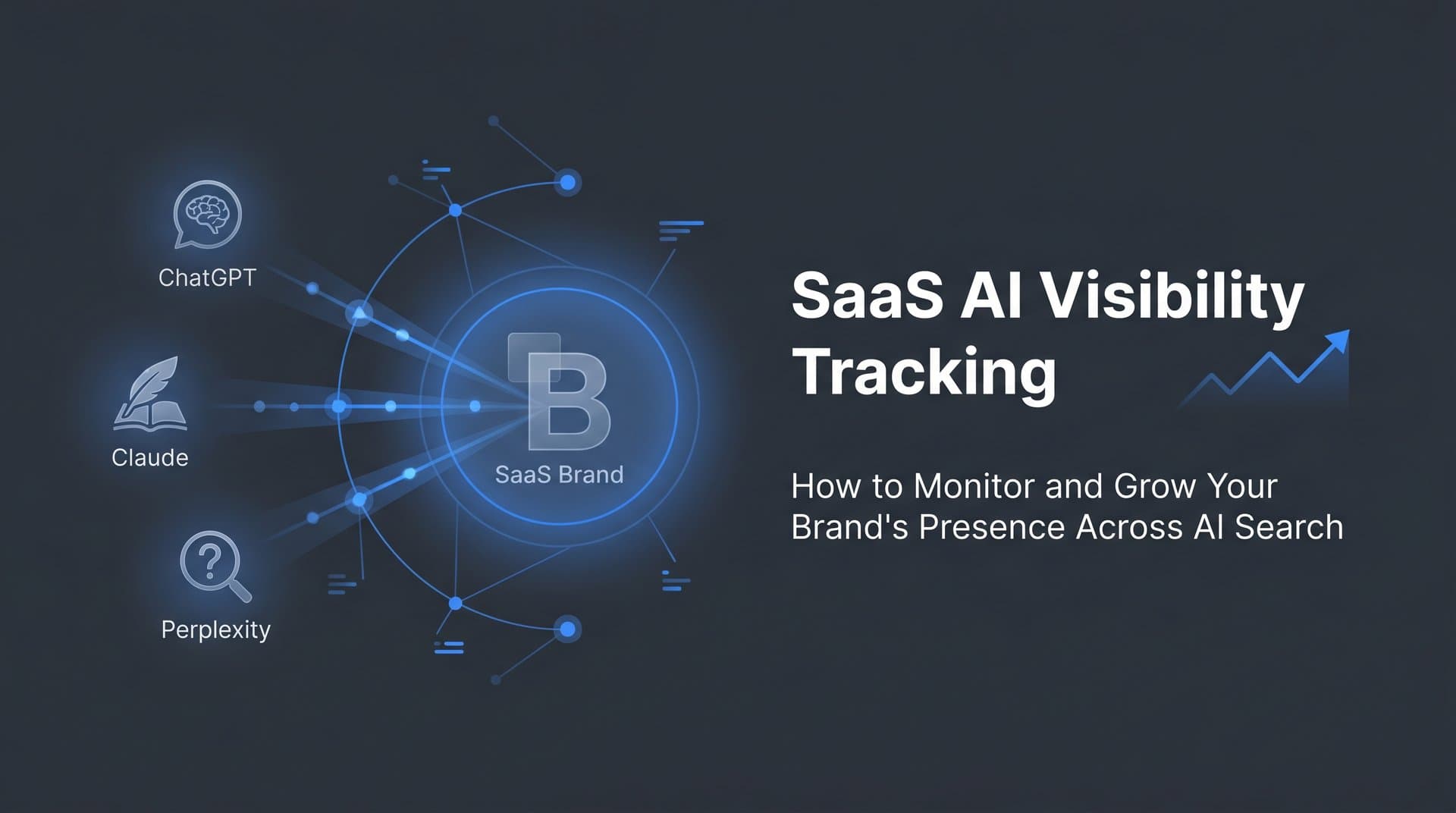
Something fundamental has changed about how people find brands online. A growing number of users now type a question into ChatGPT, Claude, or Perplexity and accept the synthesized answer they receive, without ever scrolling through a list of blue links. The implications for brand discovery are significant, and most marketing teams haven't fully reckoned with them yet.
You might hold a first-page ranking on Google for your most important keywords. You might have a technically sound website, a healthy backlink profile, and a content calendar running like clockwork. And yet, when a potential customer asks an AI model to recommend the best solution in your category, your brand may not appear at all. That gap between traditional search visibility and AI visibility is growing, and it's largely invisible to teams relying on conventional rank tracking tools.
This is where visibility tracking for brands becomes essential. In its modern form, visibility tracking means systematically monitoring where, how often, and in what context AI platforms mention your brand across the prompts your target audience is actually using. It's a discipline that sits at the intersection of SEO, content strategy, and the emerging field of Generative Engine Optimization (GEO). In this article, we'll break down what AI visibility tracking entails, the metrics that matter most, how to build a cross-platform strategy, and how to translate what you learn into content that earns more AI mentions over time.
The Shift from Search Rankings to AI Mentions
Traditional search visibility has always been about position. Where does your page appear on the results page? Are you capturing featured snippets? What's your click-through rate for a given keyword? These metrics made sense when the search experience was fundamentally about presenting a list of options for users to evaluate and click through.
AI-powered search works differently. When a user asks ChatGPT which project management tool is best for remote teams, or queries Perplexity for an explanation of the top CRM platforms for small businesses, the model synthesizes an answer. It doesn't return ten links and let the user decide. It makes a recommendation, often with confidence and authority. Your brand is either in that answer or it isn't.
This is why conventional rank tracking misses a growing share of brand exposure. A tool that monitors your position for "best CRM software" on Google tells you nothing about whether Claude recommends you when someone asks the same question in a conversational interface. These are increasingly separate ecosystems, and they require separate measurement frameworks. For a deeper dive into how these two approaches differ, see our guide on AI visibility tracking vs traditional SEO.
Visibility tracking for brands, in this new context, means building a systematic practice around monitoring AI mentions specifically. That includes tracking how frequently your brand appears in AI-generated responses, what sentiment surrounds those mentions, which prompts trigger your brand versus your competitors, and whether AI models are citing your actual content or simply referencing your name in passing.
The contrast with traditional SEO metrics is worth spelling out clearly:
Traditional SEO Metrics: Keyword rankings, SERP feature ownership, organic click-through rate, domain authority, backlink volume. These measure your visibility in a link-based discovery environment.
AI Visibility Metrics: Mention frequency across AI platforms, prompt coverage breadth, sentiment framing, citation presence, competitive share of voice in AI responses. These measure your visibility in a synthesized-answer environment.
Neither set of metrics makes the other obsolete. Traditional SEO remains important, partly because AI models often draw on content that ranks well in search. But treating traditional metrics as sufficient is a blind spot that compounds over time. Brands that add AI visibility monitoring to their measurement stack now are building an advantage that will be increasingly difficult for late movers to close.
The core insight is simple: if you're not measuring it, you can't manage it. And right now, most brands are not measuring their AI presence at all.
Core Metrics That Define AI Brand Visibility
Once you accept that AI mentions need to be tracked separately from search rankings, the next question is: what exactly should you be measuring? The discipline is still maturing, but several core metrics have emerged as the most actionable signals for brand teams.
AI Visibility Score: This is a composite metric that aggregates how prominently and frequently AI models reference your brand across a defined set of prompts and platforms. Rather than tracking raw mention counts, an AI Visibility Score weights factors like the prominence of the mention within a response (is your brand the primary recommendation or a passing reference?), the platform on which it appears, and the relevance of the prompt to your target use cases. Think of it as a single number that gives you a high-level read on your AI presence, similar to how domain authority functions as a shorthand for overall SEO strength.
Mention Sentiment: Not all mentions are created equal. An AI model might reference your brand in the context of a cautionary note, a comparison where you come out unfavorably, or a recommendation that's warm and specific. Sentiment analysis applied to AI mentions tells you whether your brand is being positioned positively, neutrally, or negatively in synthesized responses. This distinction matters enormously: a high mention count paired with negative framing can actually reinforce unfavorable perceptions at scale.
Prompt Coverage: This metric captures the breadth of user queries that trigger your brand in AI responses. A brand with narrow prompt coverage might appear reliably when someone asks specifically about their product category, but disappear entirely from adjacent queries around use cases, comparisons, or industry expertise. Expanding prompt coverage is one of the primary goals of a GEO content strategy, because it means your brand enters more conversations at the moment a potential customer is forming their opinion. Our guide on AI visibility metrics tracking covers how to measure and benchmark these signals in detail.
Citation Tracking: There's a meaningful difference between an AI model mentioning your brand name and an AI model citing one of your specific articles or pages. Citation tracking monitors whether AI responses link back to or directly reference your content. This distinction matters for two reasons. First, citations drive traffic in a way that passing name-drops do not. Second, they indicate that your content is being treated as a credible source, which tends to correlate with more favorable and prominent mentions over time.
Competitive Share of Voice: No visibility metric exists in a vacuum. Knowing that your brand appears in AI responses for a given topic cluster is more meaningful when you can benchmark it against how often competitors appear for the same prompts. Competitive share of voice in AI responses tells you whether you're winning, losing, or holding steady in the conversations that matter most to your business. It's the metric that turns visibility data into competitive intelligence.
Together, these metrics form a measurement framework that goes well beyond what traditional SEO dashboards can provide. They require a different kind of tooling, one built specifically to query AI platforms systematically and analyze the responses at scale.
Purpose-built AI visibility software tools make it possible to automate this monitoring across every major platform, replacing manual spot-checks with continuous, structured tracking.
Building a Cross-Platform Tracking Strategy
One of the most common mistakes brands make when they first approach AI visibility is treating it as a single-channel problem. They test their brand in ChatGPT, feel reassured by what they see, and move on. The reality is that different AI platforms surface different results, often dramatically so, and a complete visibility tracking strategy requires monitoring across all of them.
In 2026, the major platforms brands need to monitor include ChatGPT, Claude, Perplexity, Gemini, Microsoft Copilot, and Google's AI Overviews. Each of these models has different training data cutoffs, different retrieval mechanisms, and different tendencies around how they frame recommendations. A brand that appears prominently in Perplexity's responses for a given query might be absent from Claude's answer to the same question, because the two models weight different sources and apply different reasoning patterns. Monitoring only one platform gives you a partial and potentially misleading picture. For a comprehensive look at this challenge, explore our article on multi-platform AI visibility tracking.
Setting up a cross-platform tracking strategy involves several concrete steps.
1. Define your target prompts. Start by mapping the queries your potential customers are most likely to use when discovering brands in your category. These typically fall into a few types: product discovery prompts ("what's the best tool for X"), comparison queries ("X vs. Y for small businesses"), "best of" list prompts ("top platforms for Z"), and industry expertise questions ("how do leading companies approach X"). The more specifically you define these prompts, the more actionable your tracking data becomes.
2. Select platforms and establish a baseline. Run your target prompts across each major AI platform and document what you find. Does your brand appear? In what position within the response? With what sentiment? This baseline snapshot is your starting point for measuring progress. Without it, you have no way to know whether your content and optimization efforts are moving the needle.
3. Set a monitoring cadence. AI models update their knowledge and retrieval behavior regularly. A monthly review is a reasonable minimum for most brands; teams in fast-moving competitive categories may want to track weekly. The cadence should reflect how quickly your competitive landscape shifts and how actively you're publishing new content.
4. Segment by use case and business priority. Not all prompts carry equal commercial weight. A "best of" list prompt that precedes a purchase decision deserves more attention than a general awareness query. Segmenting your tracking by use case lets you prioritize the AI conversations that are most likely to influence revenue, rather than optimizing for visibility in conversations that don't drive business outcomes. Our prompt tracking for brands guide walks through this segmentation process step by step.
This structured approach transforms AI visibility from a vague aspiration into a measurable, manageable practice. It also surfaces the data you need to take the next step: turning visibility insights into targeted content action.
Turning Visibility Data into Content Action
Visibility tracking is only valuable if it informs what you do next. The most powerful application of AI visibility data is identifying content gaps: the specific prompts and topic areas where competitors appear in AI responses but your brand does not. Each of those gaps represents a content opportunity you can address with targeted, authoritative writing.
Here's how that process works in practice. Imagine your tracking data shows that for the prompt "best tools for content marketing automation," three competitors are consistently mentioned across ChatGPT, Perplexity, and Claude, but your brand is absent. That's a signal. It tells you that AI models either don't have sufficient information about your product's relevance to that use case, or the content you've published on the topic isn't authoritative or specific enough to be cited. Either way, you have a clear directive: create or improve content that directly and thoroughly addresses that prompt.
This is the core of Generative Engine Optimization. GEO-optimized content is written with AI citation in mind. It tends to be specific, well-structured, and authoritative on a narrow topic rather than broadly covering a wide subject. It answers the kinds of questions AI models are asked, uses the language of those queries naturally, and provides the kind of clear, citable claims that models can extract and include in synthesized responses. Understanding how AI citation tracking works helps you evaluate whether your content is earning the kind of references that drive real visibility.
The feedback loop this creates is one of the most valuable mechanisms in modern content strategy. You publish a GEO-optimized article targeting a specific prompt gap. You track whether AI models begin citing that content in their responses over the following weeks. If they do, your visibility score for that prompt cluster improves. If they don't, you analyze why: is the content not being indexed quickly enough? Is it not authoritative enough on the specific subtopic? Does it need more depth or better structure? You refine and iterate.
This is where fast content indexing becomes a critical factor. Even excellent content can't improve your AI visibility if it takes weeks for AI crawlers to discover it. Integrating IndexNow protocols into your publishing workflow means that when you publish or update an article, search engines and AI crawlers are notified immediately rather than waiting for the next crawl cycle. The faster your content is discovered and indexed, the faster it can begin influencing AI responses. Tools like Sight AI combine content generation with automatic IndexNow integration and sitemap updates, which means the gap between publication and potential AI citation is measured in hours rather than weeks.
The compounding effect of this loop is significant. Each piece of content that earns AI citations increases your prompt coverage, which improves your AI Visibility Score, which positions you more favorably in competitive analysis benchmarks. Over time, brands that run this loop consistently build a durable AI presence that's difficult for competitors to displace quickly.
Common Pitfalls and How to Avoid Them
As brands begin investing in visibility tracking for brands, several recurring mistakes tend to undermine the value of the practice. Being aware of them upfront saves significant time and misdirected effort.
Tracking mentions without sentiment context. A brand that celebrates a high mention count without examining the sentiment surrounding those mentions may be missing a serious problem. If AI models are referencing your brand primarily in the context of limitations, criticisms, or unfavorable comparisons, those mentions are working against you. Dedicated sentiment tracking for AI responses must accompany mention counting for visibility data to be genuinely useful. Raw frequency without qualitative context is a vanity metric.
Monitoring only one AI platform. As discussed in the tracking strategy section, AI platforms differ substantially in their outputs. A brand that monitors only ChatGPT and finds favorable mentions may be completely absent from Perplexity's responses, which is a platform many users rely on specifically for research and product discovery. Cross-platform monitoring isn't optional for brands that want an accurate picture of their AI presence. The variance across platforms is often surprising, and it frequently reveals both threats and opportunities that single-platform tracking would miss entirely.
Treating AI visibility as a one-time audit. Some teams approach AI visibility tracking as a project with a defined endpoint: run the audit, note the findings, implement some content changes, and consider the work done. This misunderstands the nature of the challenge. AI models update their knowledge bases, change their retrieval behaviors, and incorporate new content regularly. Competitors are publishing new content and optimizing for the same prompts you're targeting. A brand that stops tracking loses ground to competitors who keep iterating, often without realizing it until the gap has become significant. Choosing the right AI visibility tracking platform ensures you have the infrastructure for ongoing, automated monitoring rather than sporadic manual checks.
Optimizing for AI visibility in isolation from traditional SEO. AI models frequently draw on content that performs well in traditional search. Strong organic rankings often correlate with AI citations, because well-ranked content tends to be authoritative and well-structured. Treating AI visibility and traditional SEO as entirely separate workstreams misses the synergies between them. The most effective approach integrates both: create content that satisfies traditional SEO requirements while also being structured for AI citation, and track performance across both environments.
Avoiding these pitfalls keeps your visibility tracking practice grounded in data that's actually actionable rather than data that creates a false sense of security.
Your Visibility Tracking Roadmap
Pulling this all together, visibility tracking for brands in 2026 follows a clear progression. Define your target prompts across product discovery, comparison, and expertise categories. Run those prompts across all major AI platforms to establish a baseline. Measure your AI Visibility Score, mention sentiment, prompt coverage, and competitive share of voice. Identify the gaps where competitors appear and you don't. Create GEO-optimized content designed to fill those gaps. Publish with fast indexing protocols to minimize the discovery lag. Track whether AI models begin citing your new content. Refine and repeat.
This is not a one-time project. It's an ongoing practice, and the brands that treat it as such are building a compounding advantage in an environment where AI-mediated discovery is becoming the primary channel for a growing share of purchase decisions.
The shift from traditional search rankings to AI mentions is not a future development to prepare for. It's happening now, and the brands that establish their AI visibility tracking infrastructure today are the ones that will be consistently recommended by AI models tomorrow. Visibility tracking for brands is no longer an advanced tactic reserved for large enterprises with sophisticated analytics teams. It's the new foundation of discoverability, and the barrier to entry is lower than most teams assume.
If you're ready to move from guessing to knowing, start tracking your AI visibility today with Sight AI. Monitor your brand across six-plus AI platforms, get automated scoring and sentiment analysis, uncover content opportunities your competitors haven't found yet, and build the kind of AI presence that turns synthesized answers into real business growth.