If your brand isn't being mentioned by AI search engines, you're invisible to a growing segment of your audience — and your current reporting tools probably aren't telling you that.
This is the uncomfortable reality marketers, founders, and agencies are waking up to in 2026. Brand visibility used to mean one thing: where do you rank on Google? But the landscape has shifted dramatically. AI-powered answer engines like ChatGPT, Claude, and Perplexity now handle a significant and growing share of informational queries, synthesizing recommendations and brand references without users ever visiting a traditional search results page.
Brand visibility score reporting has had to evolve in response. Today, it's a multi-dimensional practice that spans traditional SEO dashboards, share-of-voice tools, and an entirely new category: AI visibility tracking. Each layer measures something different, relies on different data sources, and tells a different part of the story about where your brand stands in the minds of your audience.
This guide breaks down the main reporting options available to you, what each one actually measures, where each falls short, and how to build a reporting approach that reflects the full picture of brand visibility in 2026. Whether you're a solo marketer, an agency managing multiple clients, or a founder who needs clear signals without complexity, you'll leave with a clearer sense of what to track, what tools to consider, and how to turn visibility data into action.
Beyond Rankings: What Brand Visibility Score Reporting Actually Measures
The phrase "brand visibility score" sounds like it should refer to a single, standardized number. It doesn't. Different tools calculate it differently, weight different signals, and produce scores that aren't directly comparable to one another. Understanding this upfront saves a lot of confusion when you're evaluating reporting options.
At its core, a brand visibility score is a composite metric. Traditional SEO platforms typically define it as a weighted measure of how often your domain appears in search results for a tracked set of keywords, often normalized as a percentage of the maximum possible visibility for that keyword set. Some tools call this "search visibility," others call it "keyword visibility," and the underlying calculations vary. The common thread is that they're measuring your presence within search engine results pages.
But this is only one layer of the reporting picture.
The second layer, and the one most brands are currently missing, is AI visibility. This measures how often and how positively AI language models reference your brand when users ask relevant questions. When someone asks ChatGPT for the best project management tools, or asks Perplexity to recommend a marketing analytics platform, which brands come up? How are they described? Are they framed positively, neutrally, or negatively? Traditional SEO scores capture none of this.
These two reporting layers require fundamentally different data sources. Traditional SEO visibility pulls from search engine data: keyword rankings, indexed page counts, impression data from Google Search Console, and SERP feature presence. AI visibility requires directly querying AI models with relevant prompts and analyzing the outputs for brand mentions, sentiment, and competitive positioning.
Relying on only one layer gives you an incomplete picture of brand health. A brand could have strong keyword rankings and a healthy SEO visibility score while being entirely absent from AI-generated recommendations on the same topics. Conversely, a brand with modest search rankings might be consistently recommended by AI models due to strong content authority in a niche. Neither tool alone would surface this disconnect.
Effective brand visibility score reporting in 2026 means tracking both layers, understanding what each measures, and connecting the data to inform your content and optimization strategy. The sections below walk through the main options for each.
Traditional SEO Visibility Reporting Tools
Traditional SEO visibility reporting is a well-established category with a range of mature tools. Understanding what each type measures, and where each falls short, helps you build a more intentional reporting stack.
Rank Trackers: Tools like Semrush, Ahrefs, and Moz track keyword position changes over time across search engines. They calculate visibility scores based on how frequently your domain appears in results for a defined keyword set, weighted by search volume and position. These scores are useful for tracking directional trends and benchmarking against competitors, but they're limited to the keywords you've explicitly set up to monitor.
Google Search Console: This free tool from Google provides impression, click, and average position data directly from Google's index. It's one of the most reliable sources of actual performance data because it comes from the source rather than an estimate. The key limitation is that it's Google-only, it doesn't provide competitive benchmarking, and it doesn't capture anything happening on other search engines or in AI platforms.
SEO Dashboards and Aggregators: Platforms that aggregate multiple signals, including backlinks, rankings, technical health, and content performance, into a unified view give marketers a broader picture. These are useful for identifying correlations between technical improvements and visibility changes, but they still operate entirely within the traditional search engine paradigm.
Share of Voice Tools: These estimate what percentage of available search traffic your domain captures relative to competitors across a keyword set. Share of voice is a useful competitive metric, but like other traditional tools, it measures search engine presence only.
One foundational element that often gets overlooked in visibility reporting is indexing health. Pages that aren't crawled and indexed by search engines can't contribute to your visibility score, full stop. If your content publishing workflow doesn't include reliable indexing verification, your visibility reports may be understating your actual content investment. Tools that monitor crawl status, sitemap health, and indexing coverage are essential inputs to any serious visibility reporting setup.
The critical limitation across all traditional SEO tools is the same: they measure your presence within search engine results, and only search engine results. As AI-powered answer engines capture a larger share of informational queries, this gap between what traditional tools report and what's actually happening with brand discovery grows wider. Traditional SEO reporting remains necessary, but it's no longer sufficient on its own.
AI Visibility Reporting: The New Frontier in Brand Monitoring
AI visibility reporting is a newer category, but it's becoming essential for any brand that wants an accurate picture of how it's being discovered and described in 2026.
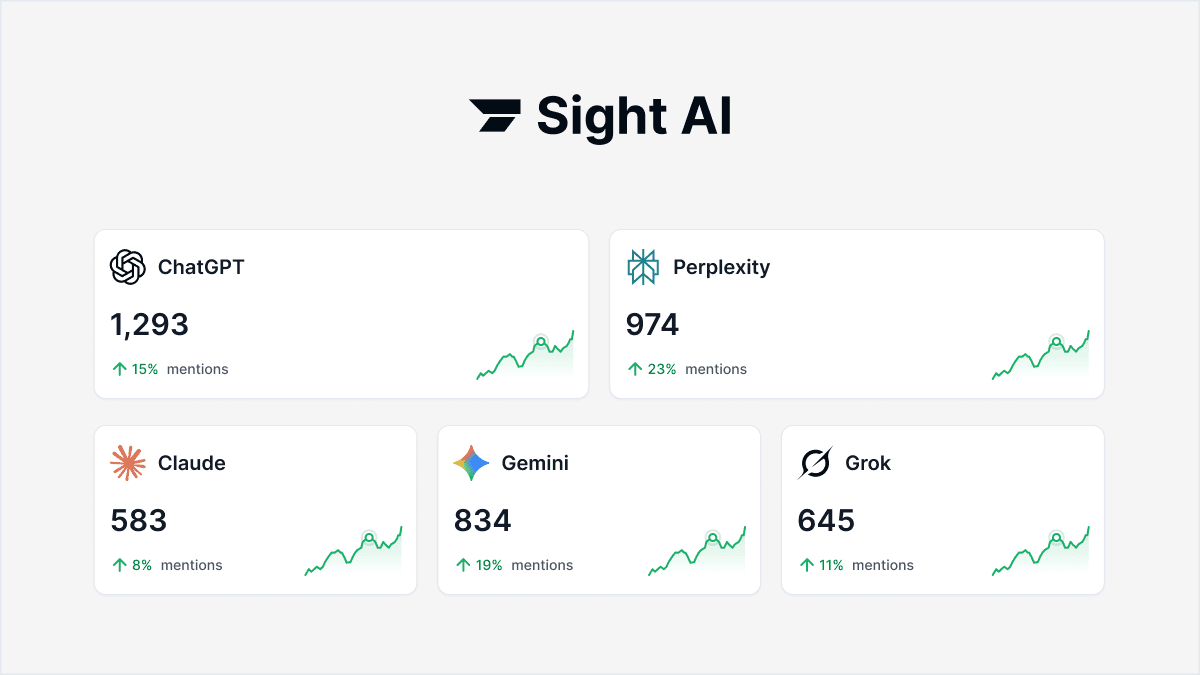
Here's what this type of reporting actually tracks: how AI language models, including ChatGPT, Claude, Perplexity, Gemini, and others, mention, describe, and recommend your brand when users ask relevant questions. These platforms synthesize answers from their training data and, in some cases, real-time retrieval, often citing or implying brand recommendations without users ever visiting a SERP. If your brand isn't being surfaced in these responses, you're missing a growing channel of brand discovery entirely.
A robust AI visibility report includes several distinct components. First, mention frequency: how often does your brand appear across AI-generated responses for relevant queries? Second, sentiment analysis: when your brand is mentioned, is it framed positively, neutrally, or negatively? A brand that's frequently mentioned but consistently framed with caveats has a different problem than a brand that isn't mentioned at all. Third, prompt-level data: which specific types of questions or query patterns trigger your brand to appear in AI responses? This is particularly actionable because it tells you exactly where your content authority is and isn't registering with AI models. Fourth, competitive share of voice: how does your brand's presence in AI responses compare to direct competitors across the same query set?
The emerging concept of an AI Visibility Score brings structure to this data. Think of it as analogous to a domain authority score, but for AI model presence rather than search engine authority. It gives marketers and founders a single, trackable number that reflects how prominently their brand appears across AI platforms, with trend data to measure whether visibility is improving or declining over time.
This connects directly to GEO, generative engine optimization, which is the discipline of optimizing content so that AI models are more likely to reference your brand accurately and positively. Unlike traditional SEO, GEO success can't be measured with keyword rank trackers. You have to monitor AI model outputs directly. This is what makes AI visibility reporting a distinct and non-substitutable category.
Sight AI's AI Visibility tracking is built specifically for this layer, monitoring brand mentions across ChatGPT, Claude, Perplexity, and other major AI platforms, with sentiment analysis and prompt tracking built in. For marketers and founders who've been flying blind on this dimension, it provides the visibility layer that traditional tools simply can't offer.
How to Evaluate and Choose a Reporting Option for Your Needs
Not every brand needs the same reporting setup. The right approach depends on who's using the data, how often, and what decisions it needs to support.
Solo Marketers: If you're a marketer managing visibility reporting for a single brand, you need a unified dashboard that consolidates both SEO and AI visibility signals without requiring you to manually reconcile data from five different tools. The priority is breadth of coverage and clarity of presentation. You want trend data, competitive context, and clear signals about where to focus content efforts, without spending hours on data assembly.
Agencies: Managing brand visibility reports across multiple clients introduces a different set of requirements. You need multi-client reporting capabilities, efficient workflows, and ideally the ability to customize reports for different client contexts. The time cost of stitching together multiple point solutions across a client roster adds up quickly, making an integrated platform significantly more valuable than it might appear on a per-feature comparison.
Founders: Founders typically need high-level signals that connect brand presence to business outcomes, without requiring deep SEO expertise to interpret. An AI Visibility Score alongside a basic SEO visibility trend gives a founder the directional clarity they need to make decisions, without requiring them to dig into keyword-level data.
When evaluating any brand visibility reporting tool, consider these criteria. First, breadth of AI platforms monitored: does the tool cover the major AI answer engines your audience actually uses? Second, depth of sentiment and prompt-level data: can you see not just whether you're mentioned, but how and in what context? Third, integration with content workflows: can you move directly from a visibility gap identified in the report to creating and publishing content to address it? Fourth, reporting frequency: how often is the data refreshed, and does that cadence match the pace at which you're making decisions?
The case for an all-in-one platform that combines AI visibility tracking, traditional SEO signals, and content performance is increasingly compelling. Every handoff between tools introduces friction and potential for data inconsistency. A platform that closes the loop between visibility reporting and content execution removes that friction and makes it easier to act on what the data is telling you.
Turning Visibility Reports Into Action: Content and Indexing Strategy
Visibility data is only valuable if it changes what you do. The most effective use of brand visibility score reporting is to close the loop between what the data reveals and what content you create and publish next.
Low AI mention rates on specific topics are a direct signal of content gaps. If your AI visibility report shows that your brand isn't appearing in AI responses to questions about a topic you should own, that's a content brief waiting to be written. The prompt-level data in a good AI visibility report tells you exactly which query types are triggering competitor mentions instead of yours, giving you a precise target for GEO-optimized content.
Similarly, low keyword visibility on specific terms signals optimization opportunities in the traditional SEO layer. If your SEO visibility score is declining for a cluster of terms, that's a signal to audit existing content, identify whether you have indexing issues, and prioritize new or updated content for that topic area.
This is where indexing speed becomes a critical operational variable. Content that isn't indexed quickly loses competitive ground. If you publish a piece of content designed to address a visibility gap and it takes weeks to be crawled and indexed, you're delaying the feedback loop that tells you whether the content is working. IndexNow integration and automated sitemap updates dramatically reduce this delay, ensuring that new content enters the indexing pipeline immediately after publication.
A practical workflow for turning visibility reports into action looks like this:
1. Run your visibility report across both SEO and AI dimensions to identify where your brand presence is weakest relative to your goals or competitors.
2. Prioritize gaps by business impact: which missing mentions or rankings would most directly affect how your target audience discovers and evaluates you?
3. Create GEO/SEO-optimized content specifically designed to address the identified gaps, using AI visibility prompt data to inform topic framing and SEO keyword data to inform on-page optimization.
4. Publish and auto-index the content immediately, using IndexNow integration to trigger rapid crawling and minimize the lag between publication and visibility impact.
5. Monitor score changes across both SEO and AI dimensions in subsequent reporting cycles to measure whether the content is closing the gap.
This workflow transforms visibility reporting from a passive measurement exercise into an active growth engine. The key is having tools that support each step of the loop, from gap identification through content creation to indexing and score monitoring, without requiring manual handoffs at every stage.
Building a Visibility Reporting Stack That Works
The clearest takeaway from everything above is this: brand visibility in 2026 is a dual-track effort. Traditional search presence and AI model mentions are both real, both measurable, and both consequential for how your audience discovers and evaluates your brand. A reporting stack that covers only one track is leaving a significant blind spot in place.
Start with a clear understanding of what you're measuring and why. If you're only tracking keyword rankings and Google Search Console data, you have strong coverage of one track and zero coverage of the other. If you're only monitoring AI mentions without tracking indexing health and keyword visibility, you're missing the technical foundation that supports both.
Choose tools that provide actionable data rather than vanity metrics. A visibility score that doesn't connect to specific content opportunities or competitive gaps is interesting but not useful. Prioritize platforms that close the loop between reporting and content execution, so that insights translate directly into action rather than sitting in a dashboard.
For marketers, founders, and agencies who want a unified approach, Sight AI brings together AI visibility tracking across ChatGPT, Claude, Perplexity, and more, alongside content generation tools built for GEO and SEO optimization, and automatic indexing via IndexNow. It's designed specifically to support the dual-track visibility approach this guide describes, without requiring you to stitch together multiple point solutions.
Brand visibility score reporting has evolved. The brands that recognize this early and build reporting stacks that reflect the full picture will have a meaningful advantage over those still relying on keyword rankings alone.
Start tracking your AI visibility today and see exactly where your brand appears across ChatGPT, Claude, Perplexity, and more. Stop guessing how AI models talk about you, and start using that data to drive content decisions that actually move the needle on brand discovery.