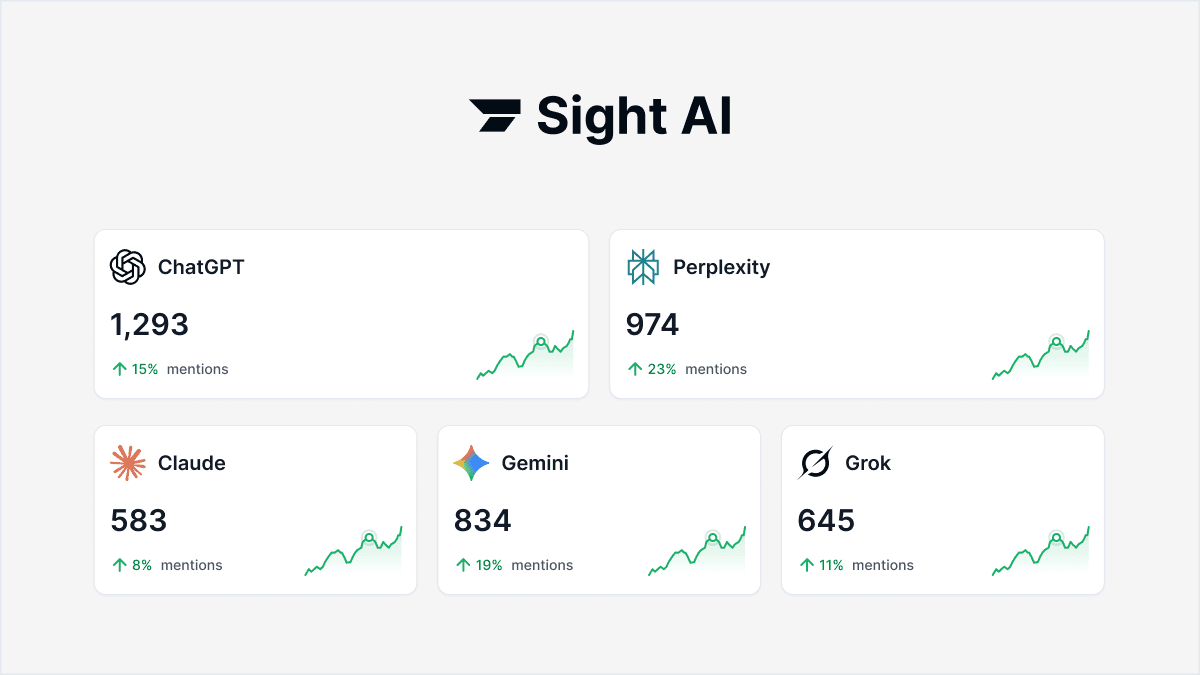
Your brand might be crushing it on Google, but what happens when someone asks ChatGPT, Claude, or Perplexity about solutions in your industry? Are you even part of the conversation?
Here's the uncomfortable truth: most marketers have zero visibility into whether their company exists in AI-powered search results. While you're tracking keyword rankings and monitoring SERP positions, potential customers are asking AI models for recommendations—and you have no idea if your brand makes the cut.
AI brand visibility measures how often and how favorably AI models mention your brand when users ask relevant questions. Unlike traditional SEO metrics that track where you rank on a results page, this emerging discipline reveals whether you're recommended at all when someone asks an AI assistant for help solving problems your product addresses.
The shift matters because AI-powered search is reshaping how buyers discover and evaluate brands. When someone asks "What's the best tool for X?" they're no longer clicking through ten blue links—they're getting a curated answer from an AI model that either mentions your brand or doesn't.
This guide walks you through a practical, repeatable process for measuring your AI brand visibility. You'll learn how to set up your tracking framework, conduct systematic tests across platforms, interpret results, and identify the content gaps holding you back. By the end, you'll have a clear methodology for understanding where your brand stands in the AI search landscape and what to do about it.
Step 1: Define Your AI Visibility Measurement Goals
Before you start testing prompts and recording mentions, you need clarity on what you're actually measuring and why it matters for your business.
Start by identifying which AI platforms matter most for your audience. The major players include ChatGPT, Claude, Perplexity, Google Gemini, and Microsoft Copilot. Each platform has different user demographics and use cases. If you're in B2B software, ChatGPT and Claude likely dominate your audience's research process. Consumer brands might prioritize Perplexity for its search-focused interface.
Pick three to five platforms for your initial measurement framework. Testing more than five becomes unwieldy fast, and you need consistent data before expanding your tracking.
Next, determine what "visibility" actually means for your brand. Are you tracking simple mentions—does your brand appear at all? Or are you measuring recommendation quality—does the AI actively suggest your solution? Perhaps you care most about sentiment—when mentioned, is the context positive, neutral, or negative? Understanding how to measure AI visibility metrics helps you establish the right framework from the start.
Most brands should track all three dimensions, but prioritize based on your current position. If you're rarely mentioned, focus on mention frequency first. If you appear regularly but alongside ten competitors, prioritize positioning and recommendation strength.
Set baseline expectations before you start. Most brands discover they have minimal AI presence initially, especially in newer or niche categories. AI models trained on historical data may not reflect recent product launches or positioning changes. This isn't a failure—it's your starting point.
Document your primary competitors for comparative analysis. Pick three to five direct competitors whose visibility you'll track alongside your own. This context matters enormously. Appearing in 30% of relevant prompts sounds mediocre until you discover your top competitor only appears in 45%.
Finally, connect these goals to business outcomes. Are you measuring AI visibility to inform content strategy? To benchmark against competitors? To track the impact of PR and thought leadership efforts? Clear goals shape which prompts you test and how you interpret results.
Step 2: Build Your Prompt Library for Testing
Your prompt library is the foundation of repeatable AI visibility measurement. Think of it as the AI equivalent of your target keyword list—except these are full questions and scenarios that mirror how real people seek information.
Create 15 to 25 prompts that represent how your target audience actually asks questions. Avoid the temptation to write prompts that obviously favor your brand. The goal is realistic testing, not vanity metrics.
Start with category-level queries that represent top-of-funnel research. These are broad questions where users haven't yet narrowed their options: "What are the best project management tools for remote teams?" or "How do I choose marketing automation software?"
Include comparison queries that pit your brand directly against competitors: "Asana vs Monday.com for creative teams" or "HubSpot vs Marketo for B2B companies." These prompts reveal whether AI models understand your competitive positioning.
Add problem-based queries that describe the pain point without mentioning solutions: "How do I track team productivity without micromanaging?" or "What's the easiest way to automate email campaigns?" These often generate the most valuable visibility insights because they mirror early-stage buyer research. If you're wondering why your brand isn't showing up in AI searches, problem-based prompts often reveal the gap.
Map your prompts to different stages of the buyer journey. Early-stage prompts focus on education and problem identification. Middle-stage prompts compare solutions and evaluate features. Late-stage prompts address implementation, pricing, and vendor selection.
Document the exact wording of each prompt. AI models are sensitive to phrasing—"best tools for X" can generate different responses than "top solutions for X." Consistency matters for tracking changes over time.
Here's a practical framework: Create five prompts per buyer journey stage across three stages. That gives you 15 core prompts. Add five to ten prompts based on specific features, use cases, or competitive scenarios unique to your market.
Test your prompts before committing to them. Run each one across two or three AI platforms to ensure they generate substantive responses. Prompts that consistently produce vague or generic answers won't provide useful visibility data.
Version your prompt library with dates. As you refine prompts or add new ones, maintain a record of what you tested when. This documentation becomes critical when you're analyzing visibility trends six months later.
Step 3: Conduct Systematic AI Platform Queries
Now comes the systematic testing phase. This isn't about casually asking ChatGPT a few questions—it's about creating controlled, repeatable conditions that generate comparable data.
Run each prompt across all target AI platforms within a defined time window. Ideally, complete all testing within 24 to 48 hours. AI models can update frequently, and you want to minimize variables between tests.
Use incognito mode or fresh sessions to avoid personalization bias. Many AI platforms learn from your conversation history and may adjust responses based on previous queries. Clear your session between prompt tests to ensure each query starts fresh.
Record full responses, not just brand mentions. Context matters enormously in AI visibility measurement. Your brand might appear in a list of ten options, as a primary recommendation, or as a cautionary example. Capture the complete response text for later analysis. Learning how to track brand mentions in ChatGPT systematically makes this process more efficient.
Note response variations by running the same prompt multiple times. AI models are non-deterministic—they don't always generate identical responses to identical inputs. Test each prompt two to three times per platform to understand response consistency.
If your brand appears in one test but not another for the same prompt, that's valuable data. It suggests your visibility is borderline—strong enough to sometimes appear but not authoritative enough for consistent mentions.
Create a simple spreadsheet to track results. Columns should include: Platform, Prompt, Test Date, Full Response, Brand Mentioned (Yes/No), Mention Type (Primary/Secondary/Comparison/Absent), Competitor Mentions, and Notes.
Time-box your testing sessions. Running 20 prompts across five platforms with multiple tests per prompt can take several hours. Schedule dedicated time rather than spreading tests across days, which introduces more variables.
Watch for platform-specific patterns. You might discover that Perplexity consistently mentions your brand while ChatGPT rarely does. These patterns reveal which platforms index and weight your content differently. Consider using AI brand visibility tracking tools to automate this process across multiple platforms.
Step 4: Analyze and Score Your Brand Mentions
Raw response data becomes actionable intelligence through systematic analysis. This step transforms hundreds of AI responses into clear visibility metrics.
Start by categorizing every brand mention using a consistent framework. Primary recommendations are responses where the AI explicitly suggests your brand as a top solution. Secondary mentions include your brand in a broader list without special emphasis. Comparison contexts mention your brand while evaluating it against alternatives. Absent means the prompt should have surfaced your brand but didn't.
Assess sentiment for each mention. Positive endorsements include language like "excellent choice for," "leading solution," or "highly recommended." Neutral mentions simply list your brand without evaluative language. Negative contexts pair your brand with caveats, limitations, or unfavorable comparisons.
Calculate your mention frequency as a percentage of relevant prompts. If your brand appears in 12 out of 20 category-level prompts, your visibility score for that prompt category is 60%. Track this metric separately for different prompt types—you might score high on comparison queries but low on problem-based prompts.
Compare your scores against competitors tested with identical prompts. This competitive context is crucial. A 40% mention rate looks weak until you discover your top competitor only achieves 35%. Understanding how LLMs select brands to recommend helps you interpret why certain competitors outperform others.
Create a simple scoring system for overall visibility. Here's one approach: Primary recommendation = 3 points, Secondary mention = 2 points, Comparison context = 1 point, Absent = 0 points. Apply this across all prompts and platforms to generate a total visibility score.
Track sentiment separately from frequency. You might appear in 70% of prompts but with neutral or negative sentiment—that's a different problem than low mention frequency.
Look for prompt patterns where you consistently appear or consistently miss. If you show up in all feature comparison prompts but zero problem-based prompts, that reveals a content gap. AI models understand what your product does but don't connect it to the problems it solves.
Document response quality beyond simple mentions. Does the AI accurately describe your product? Are the use cases and benefits correct? Mentions with inaccurate information represent a different challenge than simple absence.
Calculate platform-specific visibility scores. Your overall visibility might be 50%, but that could mean 80% on Perplexity and 20% on ChatGPT. Platform breakdowns guide where to focus optimization efforts.
Step 5: Identify Content Gaps and Opportunities
Your visibility data reveals exactly where you're missing from AI conversations—and what to do about it.
Start by mapping which prompts generate zero brand mentions. These represent your highest-priority content opportunities. If AI models never mention your brand for "best tools for remote team collaboration," you likely lack authoritative content that addresses this use case. If you're experiencing zero brand visibility in AI responses, this analysis becomes even more critical.
Analyze what competitors do differently in prompts where they appear and you don't. Run their websites through your research process. What content do they publish that you're missing? What topics do they cover in depth while you only mention in passing?
Look for patterns in the content AI models cite when they do mention competitors. Often you'll find comprehensive guides, comparison pages, or case studies that establish topical authority. These content types signal what AI models value when forming recommendations.
Identify topics where AI models lack authoritative information you could provide. Sometimes you'll notice AI responses are vague, outdated, or incomplete. These knowledge gaps represent opportunities to become the definitive source.
Prioritize gaps based on search intent value and competitive difficulty. High-intent prompts from buyers close to a decision deserve priority over early-stage educational queries. Similarly, prompts where no competitor dominates are easier wins than categories where one player owns 90% of mentions.
Create a content roadmap that directly addresses your top visibility gaps. If you're absent from problem-based prompts, develop content that connects customer pain points to your solution. Learning how to improve brand mentions in AI starts with understanding exactly where those gaps exist.
Map content opportunities to your existing assets. Sometimes you have the content but it's not optimized for AI discovery. A buried FAQ section might contain valuable information that needs elevation to a comprehensive guide.
Consider the buyer journey gaps in your visibility. If you appear in early research prompts but disappear in comparison and evaluation prompts, you're losing buyers mid-funnel. That suggests you need stronger differentiation content and competitive positioning.
Step 6: Establish Ongoing Tracking and Benchmarks
AI visibility measurement isn't a one-time audit—it's an ongoing discipline that reveals how your content efforts translate into AI recommendations over time.
Set a monthly or bi-weekly measurement cadence depending on your content publishing velocity. If you're publishing multiple AI-optimized articles weekly, bi-weekly tracking shows impact faster. If content production is slower, monthly measurement provides sufficient trend data without excessive overhead.
Create a tracking dashboard with visibility scores, sentiment trends, and competitive positioning. Simple spreadsheets work fine initially, but consider dedicated tools to track brand visibility in AI as your program matures. Your dashboard should show visibility percentage by platform, mention frequency by prompt category, sentiment distribution, and competitive comparison metrics.
Document AI model updates that may affect visibility. Models retrain periodically, and major updates can shift which sources they prioritize. When ChatGPT or Claude releases a new version, note it in your tracking log. Visibility changes immediately after model updates reflect the platform's evolution, not necessarily your content's performance.
Connect visibility metrics to business outcomes when possible. Track demo requests, signups, or revenue from traffic sources that indicate AI referral. Some analytics platforms now identify ChatGPT or Perplexity as referral sources. Monitor these channels for correlation with visibility improvements.
Establish baseline benchmarks for each prompt category and platform. Your initial measurement becomes the baseline against which you measure progress. A 15% visibility score in month one and 28% in month three shows clear improvement, even if you're not yet dominating the category.
Set realistic improvement targets based on your content production capacity. If you're publishing two comprehensive guides monthly, expect gradual visibility gains over three to six months. AI models don't instantly recognize new content—authority builds over time as multiple sources reference and validate your expertise. Understanding how AI chooses which brands to mention helps you set appropriate expectations.
Review prompt library relevance quarterly. Market language evolves, and the questions buyers ask shift with trends and new competitors. Refresh your prompts to ensure they still represent real user queries.
Track which content pieces correlate with visibility improvements. When you publish a comprehensive guide and see visibility increase for related prompts, document that connection. These insights refine your content strategy and prove ROI for AI visibility efforts.
Your Path to AI Visibility Starts Now
Measuring AI brand visibility requires a structured approach that goes beyond traditional SEO thinking. You can't just optimize for keywords and hope AI models notice—you need systematic measurement that reveals exactly where you appear, how you're positioned, and what's missing.
Start by defining clear goals and identifying which AI platforms matter most for your audience. Build a prompt library that reflects real user queries across the buyer journey. Conduct systematic testing with controlled conditions and consistent methodology. Analyze mentions for both frequency and sentiment, always comparing against competitors tested with identical prompts.
Most importantly, identify the content gaps holding you back. Your visibility data tells you exactly which topics, use cases, and buyer journey stages need attention. Create content that addresses these gaps with authority and depth—the kind of comprehensive resources AI models cite when forming recommendations.
Establish ongoing tracking because AI models evolve and your visibility will shift over time. What works today might change when platforms retrain on new data. Regular measurement keeps you ahead of these shifts and shows whether your content efforts translate into improved visibility.
Here's your quick-start checklist: Define three to five target AI platforms based on where your audience searches. Create 20 test prompts spanning category queries, comparisons, and problem-based questions. Run initial baseline tests across all platforms and prompts. Score and document results using a consistent framework. Identify your top three content opportunities based on visibility gaps. Set a monthly tracking schedule and commit to it.
The brands that measure and optimize for AI visibility now will have a significant advantage as AI-powered search continues to grow. This is a new frontier, and you should expect to iterate on your approach as the field matures. But waiting for established best practices means ceding ground to competitors who start measuring today.
Stop guessing how AI models like ChatGPT and Claude talk about your brand—get visibility into every mention, track content opportunities, and automate your path to organic traffic growth. Start tracking your AI visibility today and see exactly where your brand appears across top AI platforms.