Automated SEO software handles the repetitive parts of search optimization (keyword discovery, drafting, on-page metadata, publishing, indexing, and rank or AI-visibility tracking) so your team can focus on strategy and editorial judgment. In 2026, the best tools also monitor how ChatGPT, Perplexity, Claude, and Google's AI Mode mention your brand. Sight AI is the only tool on this list that covers AI visibility, content generation, and IndexNow indexing in one workflow. Writesonic and AirOps specialize in content, while Profound, Peec, and Promptwatch focus on AI search monitoring.
The six tools below were selected for automation depth, AI-era capabilities, content output quality, and indexing efficiency. Each fits solo founders, in-house marketers, or agencies differently, and the right choice depends on where your biggest gaps are.
What Automatic SEO Software Actually Automates
Every article follows the same production chain: research, brief, draft, optimization, publishing, indexing, and measurement. Each manual handoff adds delay and context switching. Automated SEO software targets the rule-based, repetitive steps in that chain so your team can concentrate on strategy and editorial judgment. In practice, the best tools automate some or all of the following:
- Topic and keyword discovery: Surfacing prioritized opportunities from search demand, competitor gaps, and AI prompt data instead of manual spreadsheet work.
- Content generation: Producing first drafts that follow your templates, brand voice, and search intent.
- On-page optimization: Generating meta titles within roughly 60 characters, meta descriptions of 150–160 characters, internal links, schema markup, and image alt text.
- Publishing: Pushing approved drafts directly into the CMS with formatting and metadata intact.
- Indexing: Notifying search engines via IndexNow and updating sitemaps the moment content goes live, rather than waiting days or weeks for a crawl.
- Performance and AI visibility tracking: Monitoring rankings, clicks, and how AI models mention your brand, then feeding that data back into topic selection.
Most tools cover one or two of these stages. That distinction drives the recommendations below.
Quick Comparison
| Tool | Primary Function | AI Visibility Tracking | Content Generation | Automated Indexing | Pricing Model |
|---|---|---|---|---|---|
| Sight AI | All-in-one SEO/GEO automation | Yes | Yes (13+ agents) | Yes (IndexNow) | Tiered, free trial |
| Writesonic | High-volume AI writing | No | Yes | No | Free tier + paid plans |
| AirOps | No-code LLM workflows | No | Yes (custom pipelines) | No | Tiered by workflow runs |
| Profound | Enterprise AI search analytics | Yes | No | No | Enterprise quote |
| Peec | GEO monitoring | Yes | No | No | Accessible entry tiers |
| Promptwatch | Prompt-level auditing | Yes | No | No | Verify on site |
1. Sight AI
Best for: Teams needing AI visibility tracking, automated content generation, and fast indexing in one platform.
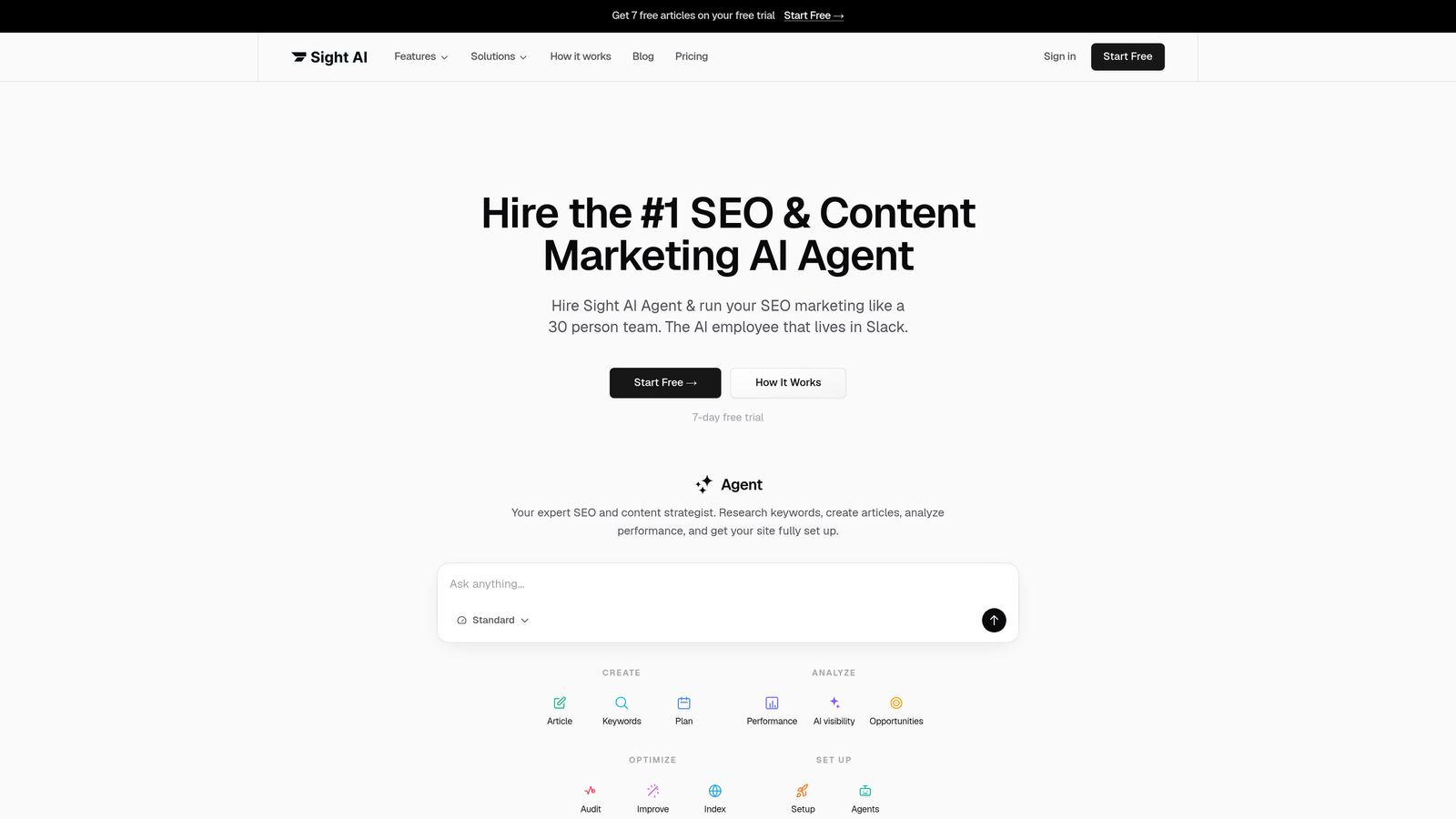
Sight AI is an all-in-one automatic SEO platform combining AI visibility tracking, a multi-agent content writer, and automated website indexing with CMS publishing.
Where This Tool Shines
Most SEO tools solve one problem well. Sight AI is built around the idea that modern SEO automation requires three pillars working together: knowing how AI models talk about your brand, producing optimized content at scale, and getting that content indexed fast. No other tool on this list covers all three simultaneously.
The AI Visibility Score is particularly valuable for teams entering the Generative Engine Optimization (GEO) era. Instead of guessing whether ChatGPT or Claude mentions your brand favorably, you get structured data on exactly how each model responds to relevant prompts, complete with sentiment analysis and competitive context. Content opportunity discovery then flags prompts where your brand should appear but doesn't, which turns visibility data directly into a content roadmap.
Key Features
AI Visibility Score: Tracks brand mentions and sentiment across ChatGPT, Claude, Perplexity, and 3+ additional AI platforms in one unified dashboard.
Prompt-Level Monitoring: Monitors specific branded and category-level prompts to show exactly how AI models describe your brand and products.
13+ Specialized AI Writing Agents: Generates SEO and GEO-optimized listicles, guides, and explainers tailored to different content formats and search intents.
Autopilot Mode: Runs hands-free content production, from topic selection to CMS publishing, so your pipeline keeps moving without manual intervention.
IndexNow Integration: Automatically submits new and updated content to search engines via IndexNow with automated sitemap updates for faster discovery.
CMS Auto-Publishing: Pushes finished content directly to your CMS, eliminating the copy-paste bottleneck between writing and live pages.
Best For
Sight AI is the strongest fit for marketers, founders, and agencies who want a single platform that handles the full SEO automation loop: monitor AI visibility, generate optimized content, and get it indexed without stitching together separate tools. It's especially valuable for teams investing in GEO alongside traditional SEO, and for programmatic or high-volume campaigns where indexing lag on hundreds of new pages would otherwise delay traffic.
Pricing
Check trysight.ai for current plans and free trial availability. Pricing tiers vary based on usage volume and feature access.
2. Writesonic
Best for: High-volume content teams needing fast, keyword-targeted article and copy generation.
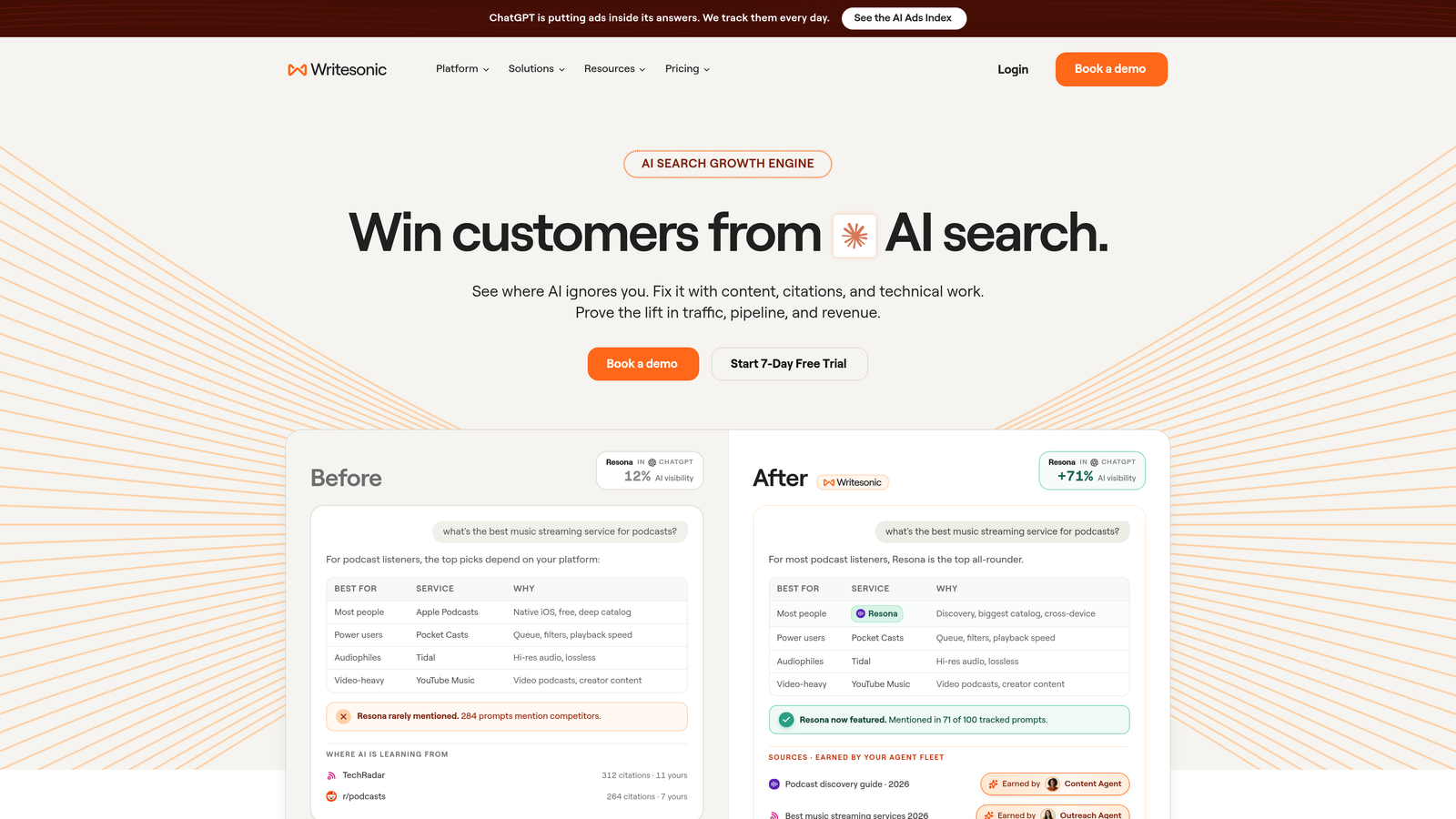
Writesonic is an AI-powered content generation platform with SEO-focused writing modes, keyword integration, and brand voice customization built for scale.
Where This Tool Shines
Writesonic's core strength is speed and volume. If your primary bottleneck is producing large quantities of blog posts, landing pages, and ad copy consistently, it handles that workflow efficiently. The keyword integration features help ensure generated content aligns with your target terms rather than drifting into generic territory, and real-time web search grounding helps keep outputs current rather than relying on stale training data.
Brand voice customization is a meaningful differentiator here. Teams that need consistent tone across dozens of pieces per month can train the platform to match their style, reducing the editing overhead that often kills the efficiency gains from AI writing tools.
Key Features
AI Article and Blog Generation: Produces full-length articles with keyword targeting built into the generation process.
Brand Voice Customization: Trains the platform to maintain a consistent tone and style across all content outputs.
Chatsonic AI Assistant: An AI research and ideation assistant for brainstorming topics, outlines, and angles before writing.
Landing Page and Ad Copy: Extends beyond long-form content into conversion-focused copy formats.
Multi-Language Support: Generates content in multiple languages, useful for teams targeting international audiences.
Best For
Writesonic suits content-heavy teams and agencies that need to produce articles, blogs, and marketing copy at volume. It's a strong content generation tool, though teams that also need AI visibility tracking or automated indexing will need to supplement it with additional platforms.
Pricing
A free tier is available. Paid plans scale by usage and unlock advanced features. Verify current pricing at writesonic.com before committing.
3. AirOps
Best for: SEO and content teams building custom, no-code LLM automation pipelines at scale.
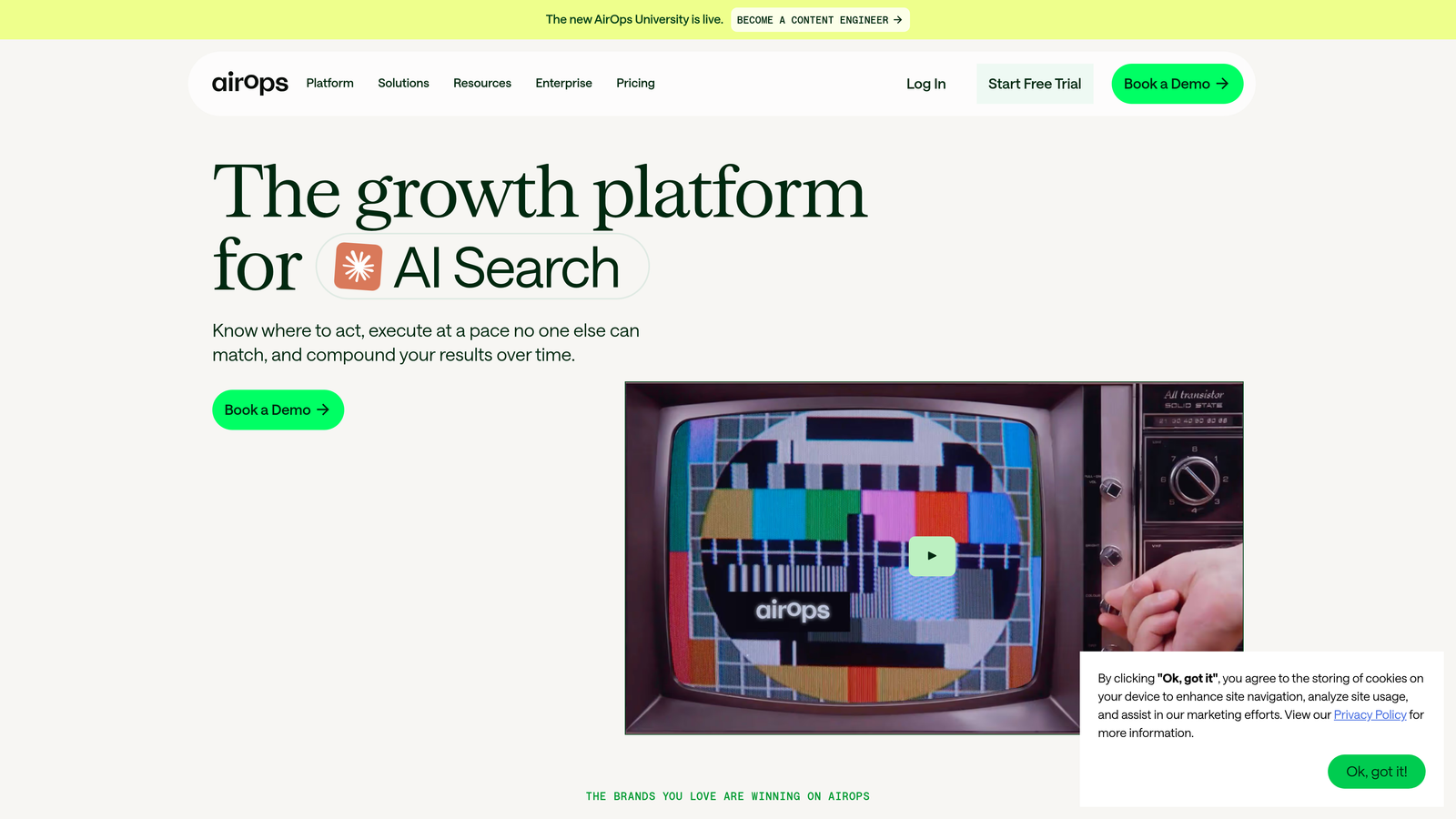
AirOps is a no-code LLM workflow automation platform that lets teams build custom pipelines connecting keyword research, AI content generation, and publishing without engineering resources.
Where This Tool Shines
AirOps is for teams with complex, custom content operations that don't fit neatly into off-the-shelf tools. The no-code workflow builder lets you connect multiple LLMs, data sources, and outputs into a single automated sequence. Think of it as the plumbing layer for SEO content production: you define the logic, it executes at scale.
The ability to pull structured data inputs and pass them through LLM steps makes it particularly useful for programmatic SEO use cases, where you might be generating hundreds of location pages, product descriptions, or comparison articles from a structured dataset. It's equally practical for operational chores such as regenerating meta descriptions across thousands of URLs during a migration or producing FAQ blocks in bulk.
Key Features
No-Code Workflow Builder: Constructs custom SEO content pipelines visually, without writing code.
Multi-LLM Connectivity: Connects GPT-4, Claude, and other models within a single workflow for flexible generation.
Bulk Content Generation: Processes structured data inputs to produce large content batches in one run.
SEO Data Source Integrations: Connects with external SEO data sources and CMS platforms to close the research-to-publish loop.
Team Collaboration Features: Supports shared workflows and collaborative content operations for larger teams.
Best For
AirOps is the right choice for technically-minded SEO teams and content operations leads who want full control over their automation logic. It requires more setup than plug-and-play tools but rewards that investment with flexibility. It does not offer native AI visibility tracking or indexing automation.
Pricing
Plans are tiered by workflow runs and usage volume. Verify current pricing and plan details at airops.com.
4. Profound
Best for: Enterprise teams measuring brand presence and citation share across AI-generated search results.
Profound is an AI search analytics platform focused on tracking brand citations within AI-generated answers and helping enterprise teams measure their share of AI voice.

Where This Tool Shines
Profound addresses a question that traditional SEO tools simply cannot answer: when someone asks an AI search engine a question in your category, is your brand being cited? That "share of AI voice" metric is becoming as strategically important as organic search rankings, and Profound is built specifically to measure it.
The competitive benchmarking layer adds useful context. Knowing your brand appears in AI answers is valuable; knowing you appear less frequently than three key competitors is actionable. Profound's dashboard is designed to surface that gap clearly for enterprise reporting workflows.
Key Features
Brand Citation Tracking: Monitors how often and where AI-generated search results cite your brand across major platforms.
Share-of-AI-Voice Analytics: Quantifies your brand's presence relative to competitors in AI-generated answers.
Content Optimization Recommendations: Surfaces suggestions for improving content to increase AI citation frequency.
Enterprise Reporting Dashboards: Provides structured views designed for stakeholder reporting and team-level analysis.
Cross-Platform Monitoring: Tracks AI search presence across multiple major AI search platforms simultaneously.
Best For
Profound is best suited for enterprise marketing and SEO teams that prioritize analytics and competitive intelligence over content production. It's a monitoring and measurement platform, not a content creation or indexing tool, so it typically works alongside a content generation solution rather than replacing one.
Pricing
Enterprise-tier pricing, typically quoted after a demo. Verify current plan details at profound.co.
5. Peec
Best for: SEO teams tracking brand visibility and trends across AI answer engines with a GEO focus.
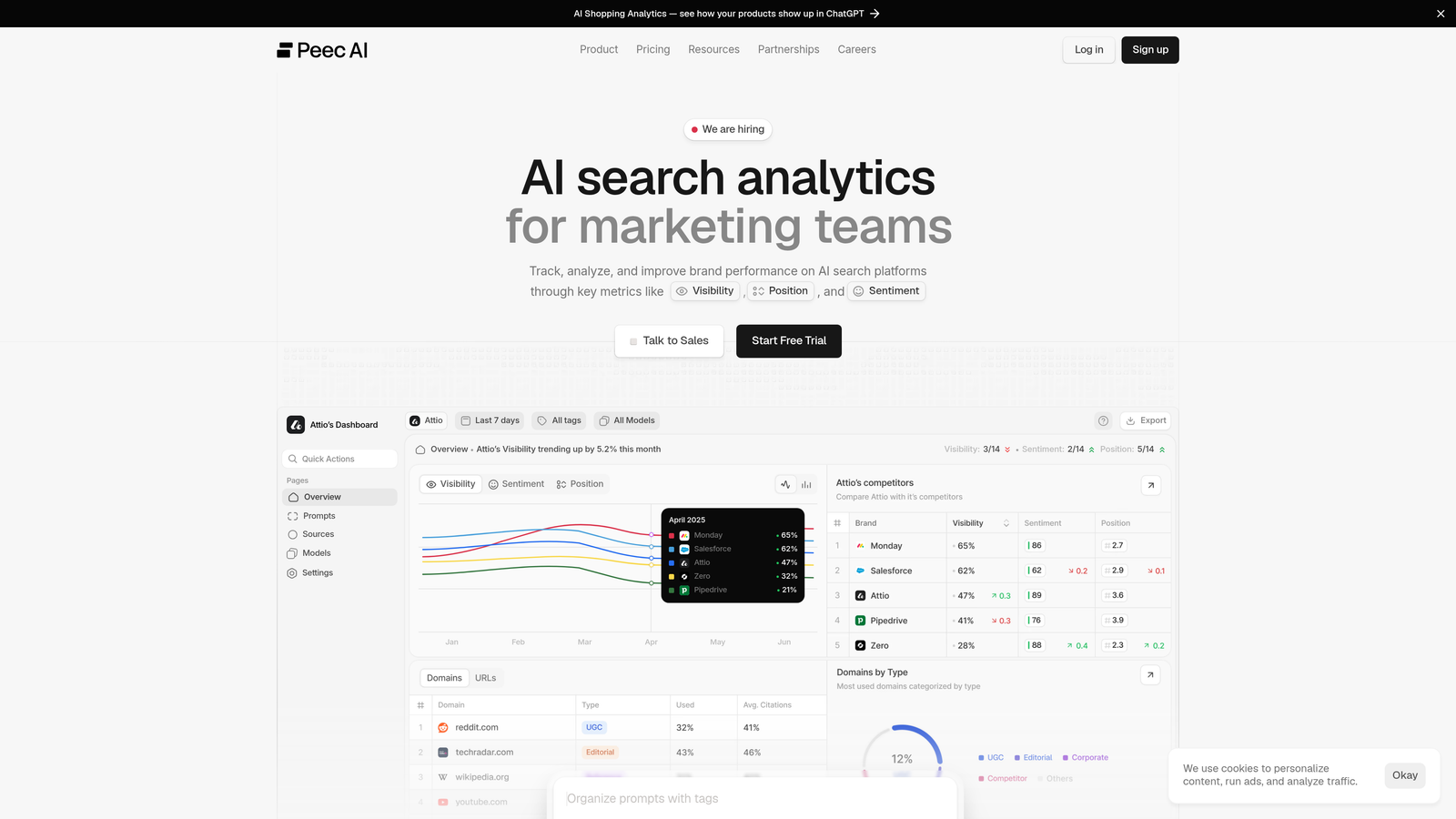
Peec is a Generative Engine Optimization monitoring tool that tracks how brands appear in AI answer engines, giving SEO teams structured visibility into LLM-driven search surfaces.
Where This Tool Shines
Peec is built around the GEO discipline: understanding not just whether you rank in traditional search, but whether you appear in the AI-generated answers that increasingly sit above organic results. Its visibility scoring and trend analysis help teams track movement over time, which is critical when AI model behavior can shift with model updates.
The competitive comparison features make it practical for teams that need to report on AI search presence alongside traditional SEO metrics. Its lighter interface and quick setup also make it a sensible first step for startups that want a straightforward read on AI visibility before committing to enterprise analytics spend.
Key Features
Brand Mention Tracking: Monitors brand appearances across AI answer engines in a structured, trackable format.
GEO Visibility Scoring: Assigns visibility scores and trend data to help teams understand their AI search presence over time.
Competitive AI Presence Comparison: Benchmarks your brand's AI visibility against competitors across the same surfaces.
Prompt-Level Monitoring: Tracks specific keyword and prompt queries to understand exactly which questions surface your brand.
Actionable Content Insights: Identifies content gaps and opportunities to improve brand presence in AI-generated answers.
Best For
Peec fits SEO teams, growth-stage startups, and digital marketers who are actively investing in GEO and need dedicated monitoring for AI answer engine presence. Like Profound, it is a monitoring and analytics tool rather than a content generation or indexing platform.
Pricing
Verify current pricing at peec.ai.
6. Promptwatch
Best for: Brand and SEO teams auditing exactly how AI language models respond to branded and category-level queries.
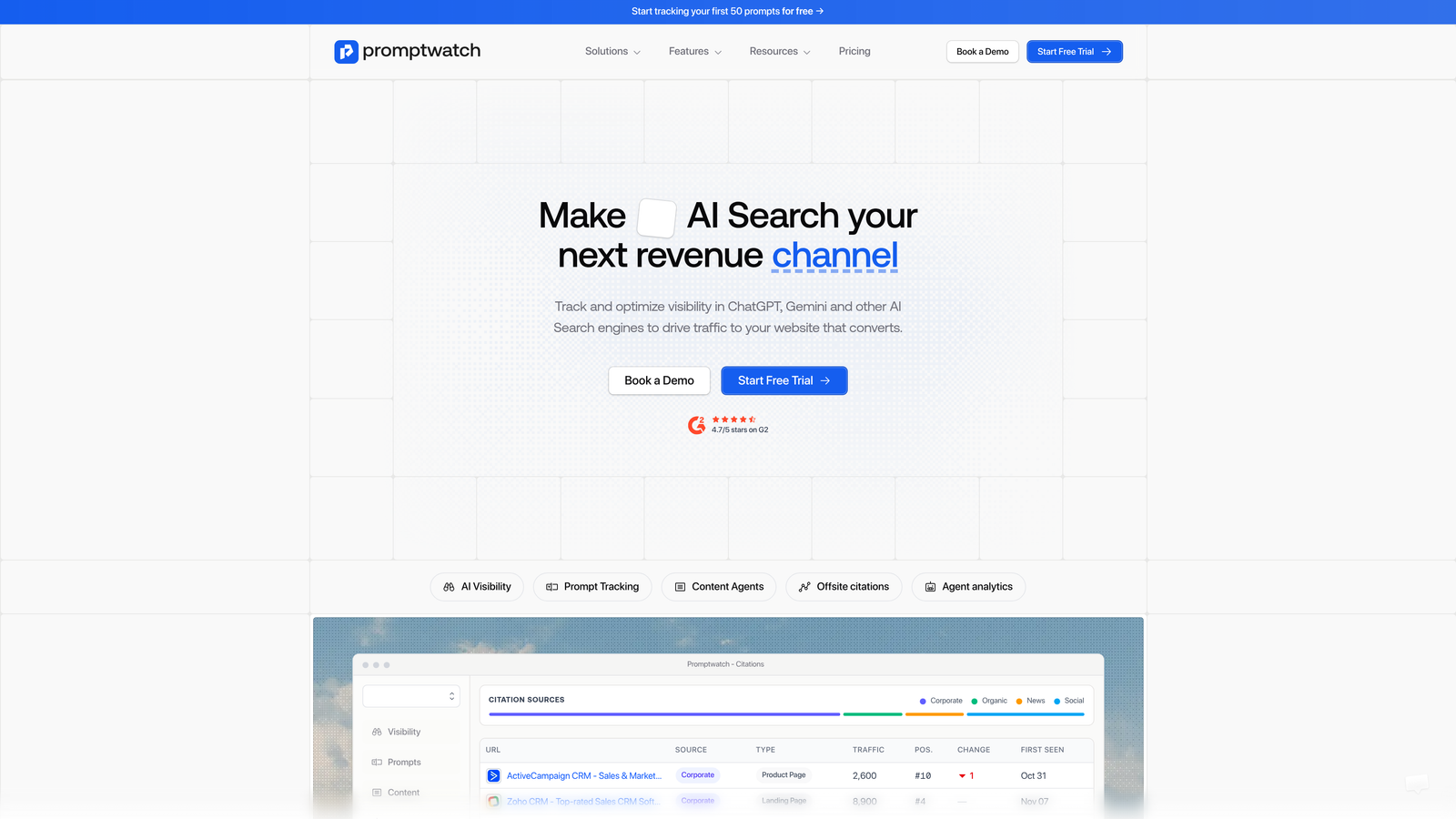
Promptwatch is a prompt monitoring tool that tracks how AI language models respond to specific branded prompts, enabling SEO and brand teams to audit their AI model representation systematically.
Where This Tool Shines
Promptwatch operates at the most granular level of AI visibility monitoring: the individual prompt. Instead of aggregate visibility scores, it shows you the exact text an AI model produces when asked about your brand, product category, or competitors. That specificity is useful for brand teams that need to understand the narrative AI models are building around their company, and for competitive research into which prompts steer users toward a rival.
The scheduled monitoring with change alerts is a practical feature for ongoing brand management. AI model behavior isn't static, and knowing when a model's description of your brand shifts, for better or worse, gives teams the information they need to respond with updated content strategy.
Key Features
Prompt-Level Response Tracking: Captures the exact AI model output for branded and category queries on a scheduled basis.
Competitive Side-by-Side Comparison: Shows how AI describes your brand versus competitors in response to the same prompts.
Change Alerts: Notifies teams when AI model responses to monitored prompts shift meaningfully over time.
Multi-LLM Auditing: Supports monitoring across multiple AI language models for cross-platform brand consistency checks.
Exportable Reports: Produces shareable reports for brand and SEO team review and stakeholder communication.
Best For
Promptwatch is the right fit for brand managers and SEO teams who need prompt-level clarity on their AI representation rather than broad visibility scores. It's a focused auditing tool, best used alongside a content generation platform rather than as a standalone SEO solution.
Pricing
Verify current pricing at promptwatch.io.
Complementary Automation Tools for Technical SEO and Reporting
The six tools above focus on content and AI visibility. Many teams pair them with established platforms that automate the traditional monitoring layer:
- Semrush: Scheduled site audits, daily position tracking with alerts, and white-label PDF reporting. Pro starts at $139.95/month.
- Ahrefs: Automated alerts for new and lost backlinks, rank tracking, and scheduled audits. Lite starts at $129/month.
- Surfer SEO: Real-time content scoring and automated briefs based on top-ranking pages. Essential starts at $89/month.
- Screaming Frog SEO Spider: Scheduled crawls via the command line, crawl comparison for change detection, and custom extraction. Free up to 500 URLs; paid annual license for unlimited crawling.
- ContentKing, Botify, and Lumar: Enterprise options for real-time change alerts, log file and crawl budget analysis, and pre-deployment SEO checks in CI/CD pipelines.
- Zapier and Looker Studio: Zapier connects tools that don't integrate natively (for example, a ranking drop triggering a Slack alert and a ticket); Looker Studio offers free automated dashboards on top of Search Console and Analytics data.
How to Implement SEO Automation Without Sacrificing Quality
- Audit your current workflow. Document every task from idea to indexed page, with time spent and owner. A team spending 15 hours per article at a $75 blended rate is paying $1,125 per piece before distribution; that figure becomes your ROI baseline.
- Automate rule-based tasks first. Meta tags, internal linking, sitemap updates, and IndexNow submissions are quick wins with low setup cost. Full draft generation pays off more but needs calibration.
- Encode your standards. Turn brand voice, structure, word count targets, and SEO benchmarks into templates and prompts so automated output meets your quality bar.
- Pilot before scaling. Generate 10–15 articles, measure editing time against writing from scratch, and refine prompts. If editors are rewriting rather than refining, the inputs need work.
- Keep human checkpoints. Review for factual accuracy, original insight, and intent match before publishing. Thin, unreviewed AI pages are increasingly filtered out by search engines.
- Close the feedback loop. Feed rankings, clicks, and AI mention data back into topic prioritization, and scale volume gradually while watching quality metrics.
Choosing the Right Tool for Your SEO Goals
Each tool on this list serves a distinct purpose, and the best choice comes down to where your biggest gap actually is right now.
Sight AI is the strongest option if you need a single platform that covers all three pillars of modern SEO automation: AI visibility tracking, content generation, and fast indexing. It's the only tool here that does all three natively, which matters if you're trying to consolidate your stack rather than add to it.
Writesonic is the right pick if content volume is your primary bottleneck and you already have visibility monitoring covered elsewhere. It's fast, scalable, and handles brand voice consistency well for high-output teams.
AirOps earns its place for teams with complex, custom content operations. If your SEO workflow requires stitching together multiple data sources, LLMs, and publishing targets in a specific sequence, its no-code pipeline builder gives you that control without engineering overhead.
Profound and Peec both address AI search analytics, with Profound leaning toward enterprise share-of-voice reporting and Peec focusing on GEO trend monitoring with a lower barrier to entry. If your priority is understanding competitive AI visibility over time, either is worth evaluating depending on your reporting needs and team size.
Promptwatch fills a specific niche: prompt-level auditing of how AI models describe your brand in their own words. It's a precision tool for brand teams that need that granularity, particularly useful when a broader visibility score isn't telling you enough about the actual narrative AI models are building around your company.
The clearest decision framework looks like this: if you need AI visibility plus content generation plus indexing in one workflow, Sight AI is the natural choice. If you need only content at volume, Writesonic or AirOps covers that. If you need monitoring and analytics without content production, Profound, Peec, or Promptwatch each offer a distinct angle on AI search presence. Technical auditing and client reporting are best handled by one of the complementary platforms above.
Frequently asked questions
Can SEO be fully automated?
Most of the mechanical work can: research, drafting, on-page elements, publishing, indexing, and reporting. Strategy, fact-checking, original insight, and final editorial approval still benefit from human review, especially for high-value pages. The implementation steps above show where to place those human checkpoints so automation speeds up production without letting thin or inaccurate pages go live.
What is the best SEO software for AI Mode and AI search?
Look for software that tracks brand mentions and sentiment inside AI-generated answers, including Google's AI Mode, at the prompt level, and that produces content structured for AI extraction: clear definitions, explicit key points, and well-organized lists. Sight AI combines that tracking with content generation and indexing; Profound, Peec, and Promptwatch focus on monitoring only.
What is the best SEO platform for tracking progress during an AI SEO project?
Choose a platform that tracks classic rankings and AI visibility against a baseline set before the project starts: keyword positions, Search Console clicks and impressions, indexed pages, and brand mention rate and sentiment across a fixed prompt set in ChatGPT, Perplexity, and AI Mode. Sight AI combines these in one dashboard. Re-check rankings weekly and prompts at least monthly, since AI answers fluctuate. Our framework for measuring AI visibility performance details which metrics to report.
How much does automated SEO software cost, and are there free options?
Free options exist but are limited: Writesonic has a free tier, Screaming Frog crawls up to 500 URLs free, and Looker Studio dashboards on Search Console data cost nothing. Paid writing and optimization tools typically start under $100/month, Semrush and Ahrefs start at roughly $129–$140/month, and enterprise AI-analytics platforms such as Profound are custom-quoted. Compare cost against hours saved per article rather than subscription price alone.
Is automatic SEO software suitable for programmatic SEO?
Yes, provided it handles structured data inputs, templated generation, and fast indexing. AirOps suits custom data pipelines, while Sight AI's agents and IndexNow integration help large batches of pages get discovered quickly. Quality controls matter more as page counts grow: sample-review each batch and watch indexation rates in Search Console before scaling further.
Stop guessing how AI models like ChatGPT and Claude talk about your brand. Start tracking your AI visibility today and see exactly where your brand appears across top AI platforms, which content opportunities you're missing, and how to automate your path to faster organic traffic growth.