SEO automation platforms have evolved well beyond keyword tracking and rank monitoring. Today's leading tools handle content generation, AI visibility tracking, indexing, and publishing, often within a single workflow. But not every platform is built for the same job.
Some focus on traditional search signals. Others are designed for the AI-driven search landscape where ChatGPT, Claude, and Perplexity increasingly determine brand visibility. This comparison covers six platforms evaluated on automation depth, AI search readiness, content capabilities, and indexing speed.
Whether you're a founder trying to scale organic traffic, a marketer managing multiple content streams, or an agency handling clients across industries, this breakdown will help you find the right fit. We've included Sight AI as the top pick because its combination of AI visibility tracking, content generation, and indexing automation is genuinely distinct from the other tools on this list.
1. Sight AI
Best for: Teams that want AI visibility tracking, SEO content generation, and indexing automation in one platform.
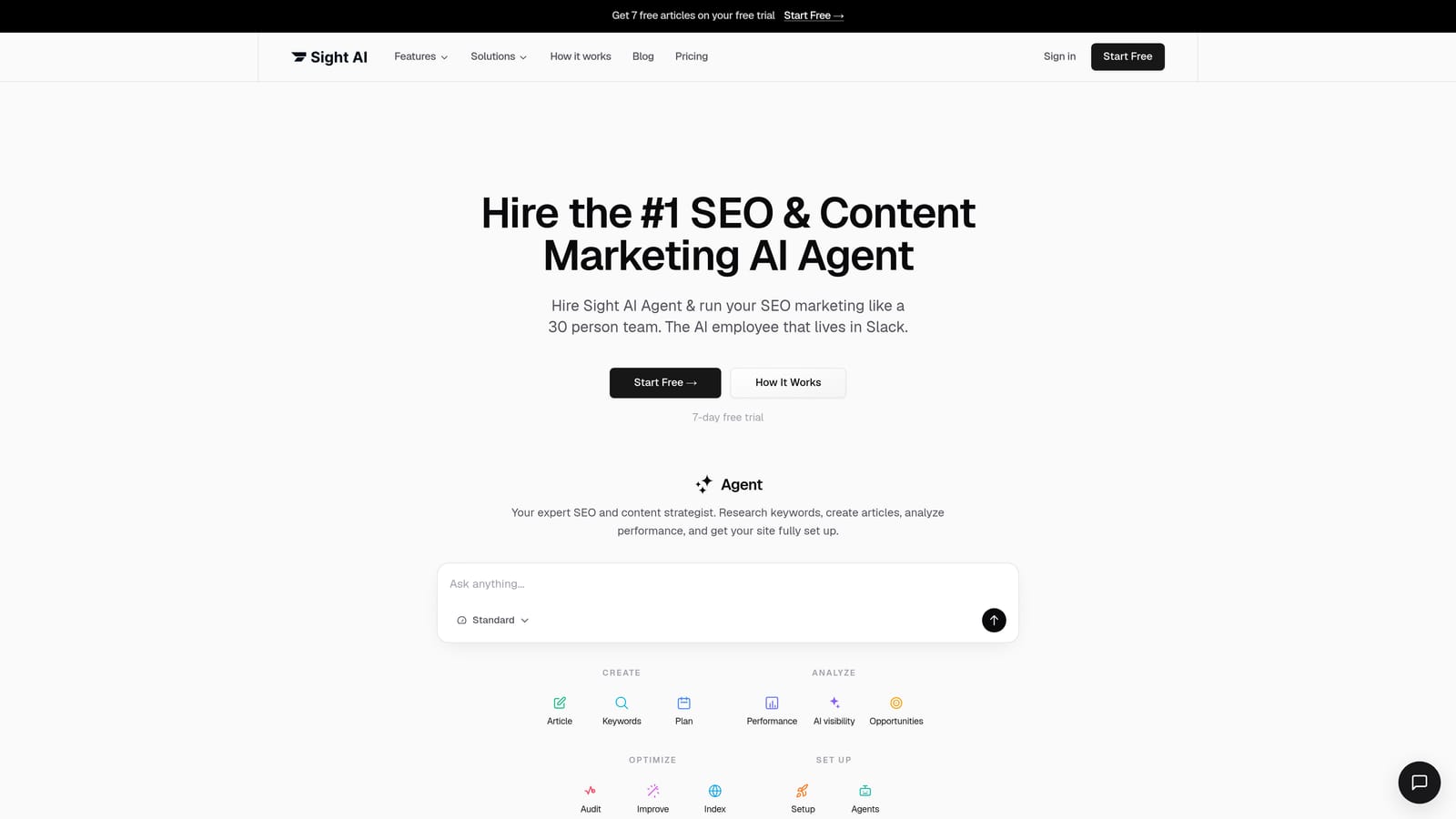
Sight AI is an all-in-one AI visibility and SEO automation platform that tracks brand mentions across AI models, generates GEO/SEO-optimized content with specialized AI agents, and automates content indexing and publishing.
Where This Tool Shines
What makes Sight AI genuinely different from every other tool on this list is scope. It's the only platform here that covers AI visibility monitoring, content generation, and automated indexing within a single workflow. Most teams currently stitch together three or four separate tools to accomplish what Sight AI handles end to end.
The AI visibility layer is particularly compelling. As ChatGPT, Claude, and Perplexity become primary discovery surfaces for many audiences, knowing how your brand appears in those answers, and being able to act on that data through content, is a meaningful advantage. Sight AI connects that intelligence directly to its content creation pipeline.
Key Features
AI Visibility Score: Tracks brand mentions across ChatGPT, Claude, Perplexity, and three or more additional AI models with sentiment analysis and prompt-level tracking.
13+ Specialized AI Agents: Purpose-built agents for generating listicles, guides, explainers, and other SEO/GEO-optimized content formats at scale.
IndexNow Integration: Automated content indexing using IndexNow protocol ensures newly published content is discovered faster by search engines.
CMS Auto-Publishing: Autopilot Mode handles hands-off content publishing directly to your CMS, reducing manual steps in the content workflow.
Prompt-Level Tracking: Monitors which specific prompts surface your brand across AI platforms, giving you actionable intelligence on where to focus content efforts.
Best For
Sight AI is the strongest fit for growth-focused founders, content marketers, and agencies who need to compete in both traditional and AI-driven search simultaneously. If you're managing multiple content streams and want a unified system rather than a patchwork of tools, this platform is built for that workflow.
Pricing
Sight AI offers tiered plans. Verify current pricing at trysight.ai before committing, as plans are updated regularly.
2. Writesonic
Best for: High-volume content teams prioritizing AI-assisted article generation with SEO optimization.
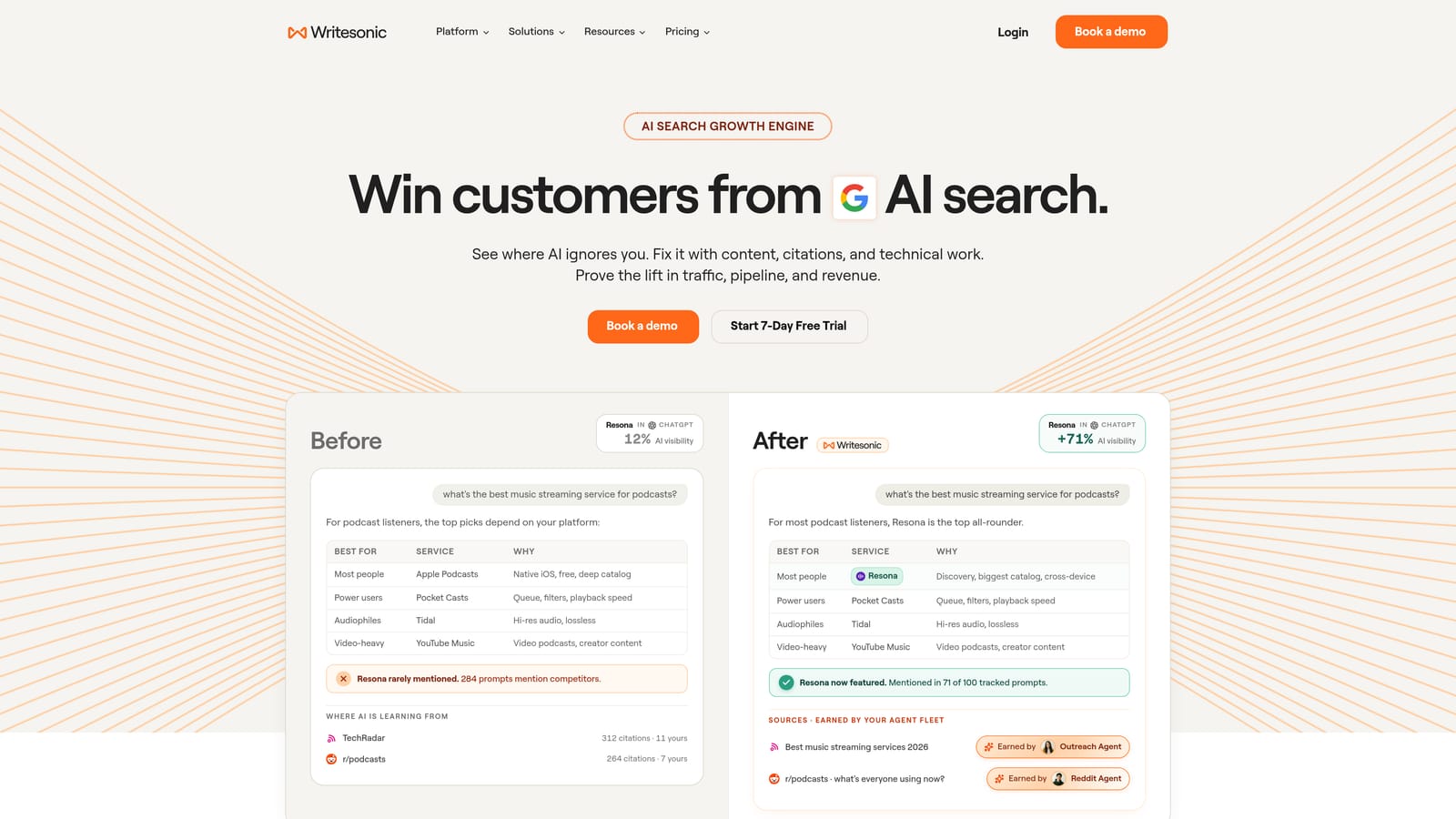
Writesonic is a well-established AI writing platform with SEO-focused article generation, brand voice controls, and integrations with SEO data sources for content production at scale.
Where This Tool Shines
Writesonic has built a strong reputation for long-form content generation. Its article writer is designed with SEO in mind, pulling in keyword data to inform structure and coverage. For teams whose primary bottleneck is content volume, it removes a significant amount of manual writing work.
The brand voice feature is genuinely useful for agencies and larger teams. You can set tone and style guidelines so that AI-generated content stays consistent across writers and campaigns, which matters when you're producing content at scale.
Key Features
Long-Form Article Generation: Produces SEO-optimized articles with keyword-informed structure and coverage built into the generation process.
Brand Voice Customization: Lets teams define tone and style guidelines so AI outputs stay consistent across all content produced.
SEO Data Integrations: Connects with SEO data sources to inform keyword targeting and content strategy during generation.
Multi-Format Output: Generates articles, ads, social posts, and landing pages from the same platform, making it versatile for content teams with varied needs.
Team Collaboration Tools: Supports multi-user workflows with features designed for content teams working across projects simultaneously.
Best For
Writesonic is a strong choice for content marketers and agencies focused on traditional SEO content production. It's less suited for teams that need AI visibility monitoring or automated indexing, as those capabilities fall outside its core focus.
Pricing
Writesonic offers credit-based and seat-based plans. Check current pricing at writesonic.com for the most up-to-date tiers.
3. AirOps
Best for: Technically capable growth teams and agencies building custom LLM-powered content pipelines.
AirOps is an AI workflow automation platform that lets teams build custom LLM-powered pipelines for content operations, SEO metadata generation, and structured content at scale.
Where This Tool Shines
AirOps is fundamentally a workflow infrastructure tool. Rather than offering a fixed set of content outputs, it gives you the building blocks to design exactly the automation you need. That flexibility is its core strength: if your content operation has specific, non-standard requirements, AirOps can likely accommodate them in ways that more opinionated platforms cannot.
The tradeoff is setup time. AirOps rewards teams with technical capacity and clear process documentation. If you know exactly what you want to automate and have someone capable of building the pipeline, it can be very powerful. If you need something that works out of the box, the learning curve may slow you down.
Key Features
Custom AI Workflow Builder: Lets teams design bespoke content and SEO automation pipelines tailored to their specific operational needs.
LLM-Powered Pipelines: Automates metadata generation, content briefs, and structured content production using large language model integrations.
Bulk Content Processing: Handles large-scale content operations efficiently, making it practical for agencies managing high content volumes.
Flexible Tool Integrations: Connects with existing content and SEO tools in your stack, fitting into workflows rather than replacing them entirely.
Template Library: Pre-built templates for common SEO content tasks reduce setup time for standard automation use cases.
Best For
AirOps is best suited for growth engineers, technical marketers, and agencies that want to build custom automation infrastructure rather than use a turnkey platform. Teams without technical resources may find the configuration demands challenging.
Pricing
AirOps offers usage-based and team plans. Verify current pricing at airops.com before making a decision.
4. Profound
Best for: Enterprise teams tracking brand share of voice across AI-generated search answers.
Profound is an AI search monitoring platform designed to track how brands appear in LLM-generated answers, giving enterprise teams visibility into their AI search presence and competitive positioning.
Where This Tool Shines
Profound is purpose-built for enterprise-level AI search intelligence. Its share of AI voice analytics gives brand and SEO teams a structured way to measure how often they appear in AI-generated answers relative to competitors, which is increasingly relevant as AI search surfaces reshape how audiences discover brands.
The competitive benchmarking capabilities are particularly useful for enterprise teams managing brand presence across multiple product lines or markets. Profound gives them a structured way to monitor AI search performance at a level of granularity that general analytics tools don't offer.
Key Features
Brand Mention Tracking: Monitors how your brand appears across major AI answer engines with detailed reporting on frequency and context.
Share of AI Voice Analytics: Measures your brand's presence in AI-generated answers relative to competitors, providing a clear competitive benchmark.
Prompt Performance Monitoring: Tracks which query categories surface your brand and how that changes over time.
Sentiment and Context Analysis: Evaluates the tone and framing of AI-generated brand references, not just whether you're mentioned.
Enterprise Reporting Dashboards: Provides structured reporting tools suited to large teams with multiple stakeholders and reporting requirements.
Best For
Profound is built for enterprise marketing and SEO teams that need sophisticated AI search analytics and competitive intelligence. It does not offer content generation or indexing automation, so teams looking for a full-stack platform will need to pair it with other tools.
Pricing
Profound uses an enterprise pricing model. Contact their team or check current details at profound.io for accurate pricing.
5. Peec
Best for: Marketers focused on measuring and improving brand citation rates in AI-generated search results.
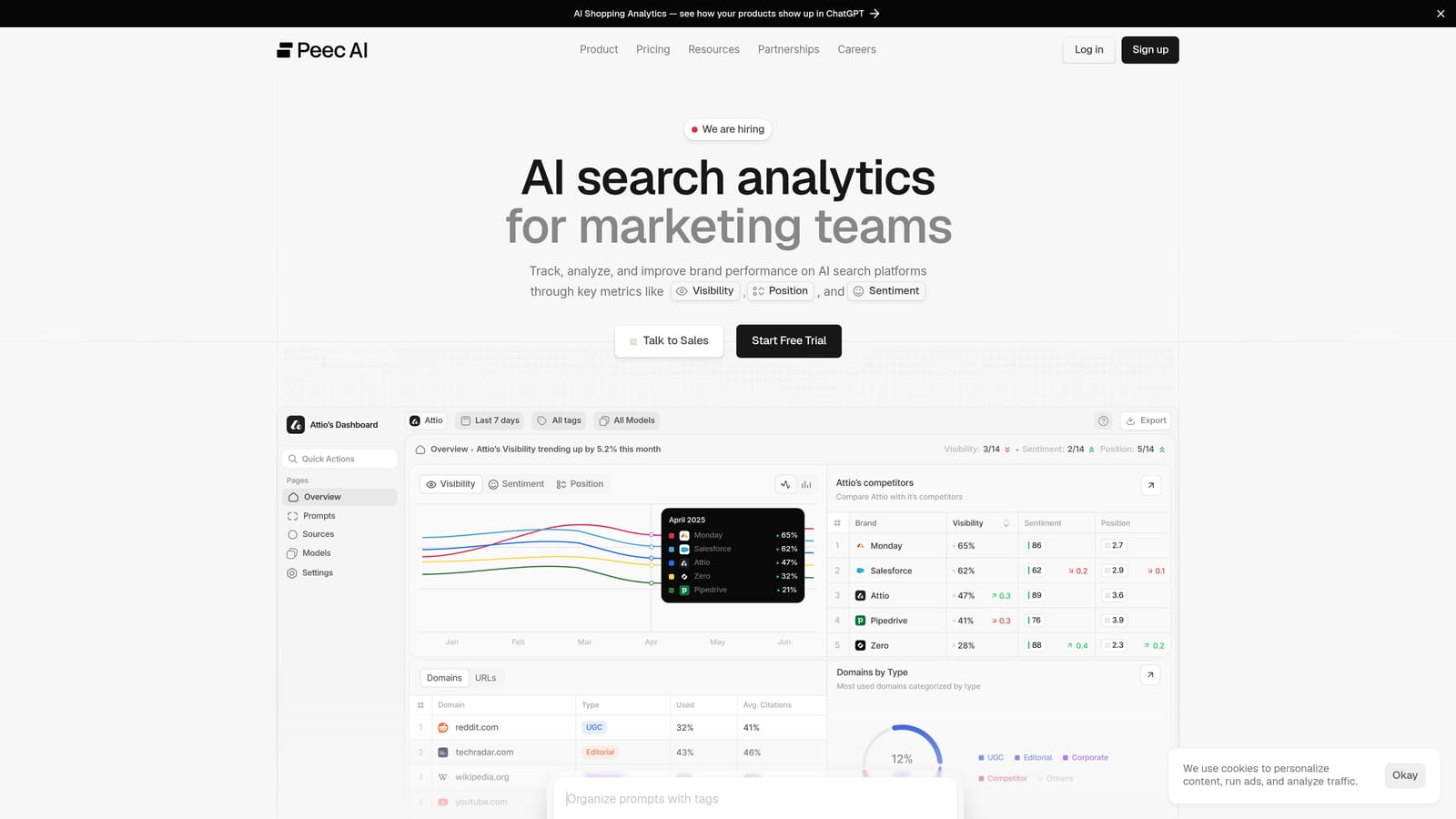
Peec is an AI answer engine optimization tool focused on tracking brand citation rates in AI-generated search results and providing actionable recommendations for improving GEO performance.
Where This Tool Shines
Peec takes a focused approach to generative engine optimization. Rather than trying to cover the full SEO automation stack, it zeroes in on the specific challenge of making sure your brand gets cited when AI models answer relevant queries. That focus makes it easier to interpret and act on the data it surfaces.
The actionable recommendations feature is worth noting. Many monitoring tools surface data without clear guidance on what to do next. Peec attempts to bridge that gap by connecting citation performance metrics to specific content and optimization actions, which is useful for teams that are newer to GEO strategy.
Key Features
Brand Citation Tracking: Monitors how often your brand is cited in AI-generated answers across major LLM platforms.
GEO Performance Metrics: Provides structured metrics for evaluating generative engine optimization performance over time.
Competitive Visibility Benchmarking: Compares your AI search citation rates against competitors operating in the same query categories.
Prompt Category Monitoring: Tracks performance across different query types and surfaces trends in how AI models reference your brand.
Actionable Recommendations: Translates citation performance data into specific suggestions for improving AI search visibility.
Best For
Peec is well-suited for marketers and SEO teams who want a focused GEO monitoring tool without the complexity of a broader platform. Like Profound, it does not include content generation or indexing features, so it works best as part of a broader tool stack.
Pricing
Verify current pricing at peec.ai, as plans may vary by usage and team size.
6. Promptwatch
Best for: Teams that need prompt-level intelligence on brand mentions and competitor positioning across AI model outputs.
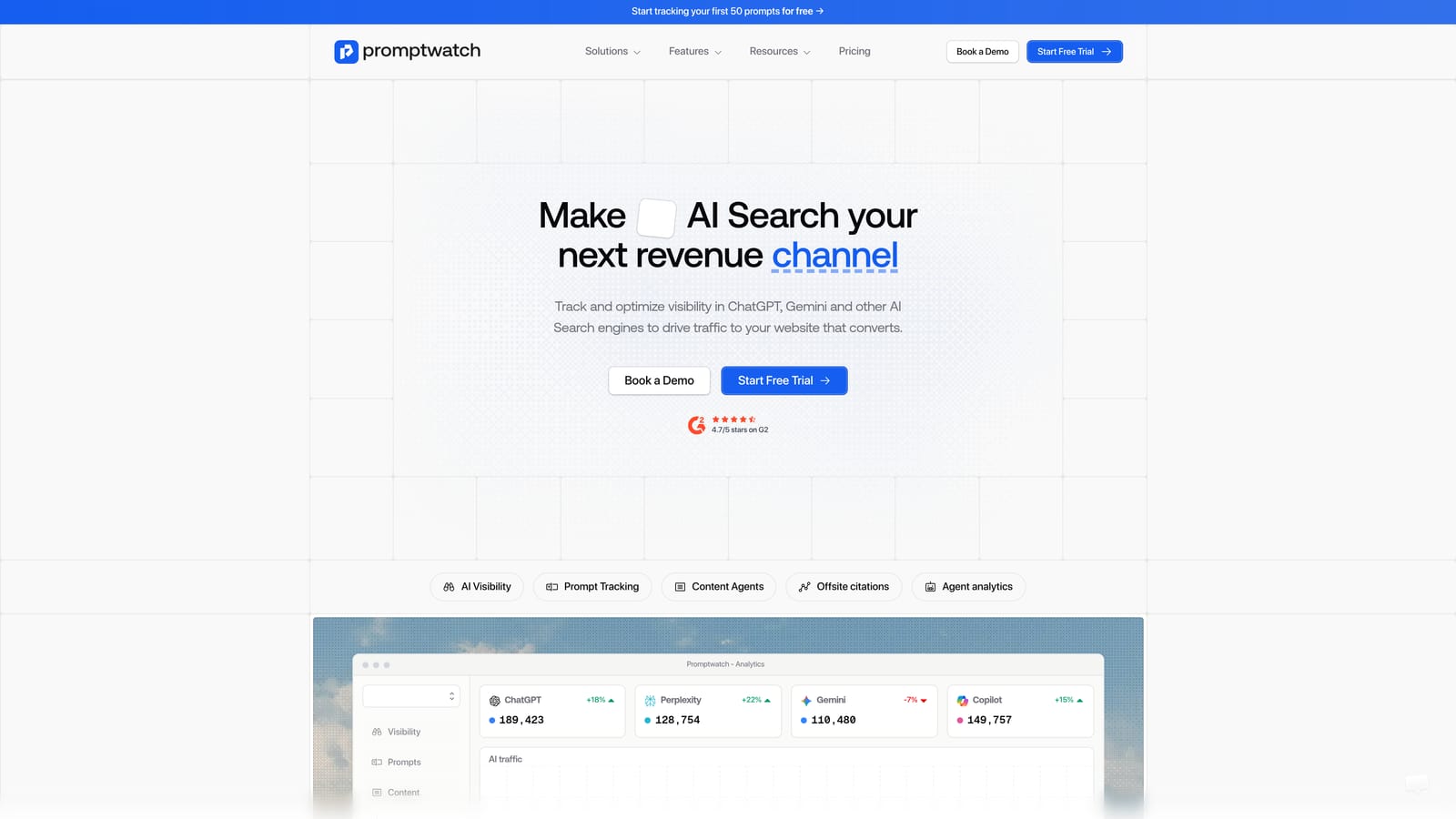
Promptwatch is a prompt-level AI monitoring tool that tracks how and when brands are mentioned across AI model responses, with analytics on sentiment, context, and competitive positioning.
Where This Tool Shines
Promptwatch operates at the most granular level of AI search monitoring. Instead of just telling you whether your brand appears in AI answers, it tracks the specific prompts that surface your brand, how sentiment varies across those prompts, and where competitors appear within the same query space. That level of detail is valuable for teams running sophisticated AI search strategies.
The alert system is a practical feature for ongoing brand management. When your mention frequency or sentiment shifts, Promptwatch surfaces that change proactively rather than requiring you to check dashboards manually. For teams managing brand reputation across AI platforms, that kind of early warning is useful.
Key Features
Prompt-Level Brand Tracking: Identifies the specific prompts and query types that surface your brand in AI model outputs, not just aggregate mention counts.
Sentiment and Context Analysis: Evaluates the tone and framing of AI-generated brand references across different prompt categories.
Competitor Mention Monitoring: Tracks where competitors appear across shared prompt categories, giving you a side-by-side view of AI search positioning.
Alert System: Notifies teams when brand mention frequency or sentiment changes, enabling faster response to shifts in AI search visibility.
AI Search Visibility Reporting: Provides trend reporting on AI search visibility over time, useful for tracking the impact of content and optimization efforts.
Best For
Promptwatch is a good fit for brand managers, SEO strategists, and agencies that want deep prompt-level intelligence on AI search presence. Like the other monitoring-focused tools on this list, it does not include content generation or indexing automation capabilities.
Pricing
Verify current pricing at promptwatch.io before committing to a plan.
Which Platform Is Right for Your Team?
The clearest way to think about this list is by scope. The six platforms here fall into two broad categories: monitoring-focused tools and full-stack automation platforms.
Profound, Peec, and Promptwatch are all strong choices if your primary need is AI search intelligence. They each offer detailed analytics on brand mentions, sentiment, and competitive positioning across AI model outputs. The key limitation is that none of them include content generation or indexing automation, so you'll need additional tools to act on what they surface.
Writesonic and AirOps address the content production side of the equation. Writesonic is the better fit for teams that want a straightforward AI writing tool with SEO optimization built in. AirOps is more powerful but requires technical setup, making it better suited for growth engineers and agencies with custom workflow requirements.
Sight AI is the only platform on this list that covers all three layers: AI visibility monitoring, SEO and GEO-optimized content generation, and automated indexing and publishing. If you're currently running separate tools for monitoring, content, and indexing, consolidating into a single platform can meaningfully reduce operational overhead and keep your content strategy connected to real AI search data.
For founders and marketers who want to understand how AI models like ChatGPT and Claude talk about their brand, generate content that improves that positioning, and get that content indexed faster, Sight AI is built specifically for that workflow. Start tracking your AI visibility today and see exactly where your brand appears across top AI platforms.