When a potential customer asks ChatGPT to recommend project management software, does it describe your product as "powerful and intuitive" or "complicated but feature-rich"? When someone queries Claude about the best CRM options, does your brand appear with enthusiastic endorsement or cautious hedging? For most companies, these questions remain unanswered—even as millions of users now consult AI assistants before making purchase decisions.
The invisible shift is already happening. AI models have become trusted advisors, and the language they use to describe your brand directly shapes perception before prospects ever visit your website. A subtle difference in tone—the presence of qualifying phrases like "some users report" versus confident statements like "known for"—can mean the difference between a warm lead and a lost opportunity.
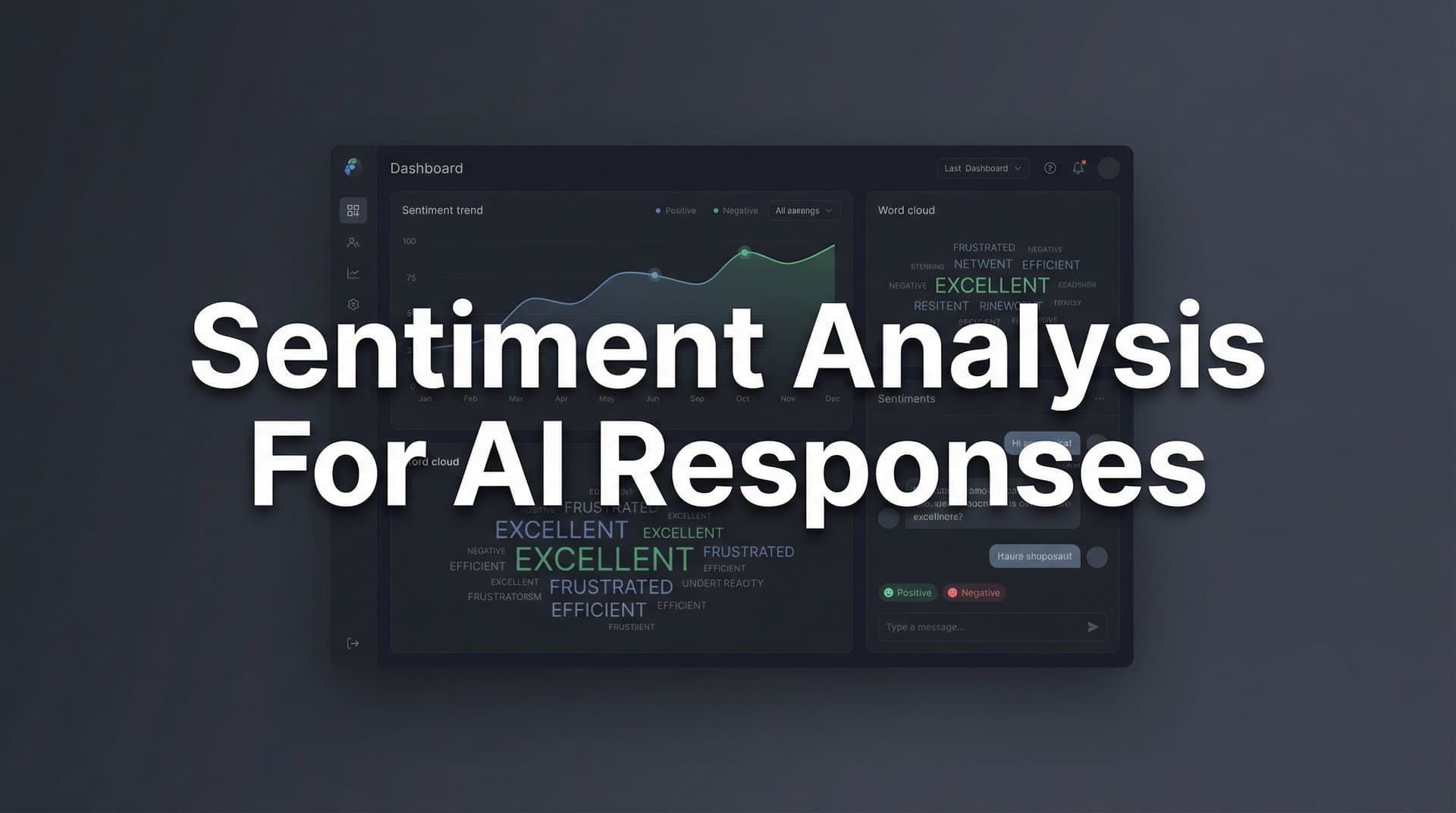
This is where sentiment analysis for AI responses enters the picture. It's the systematic practice of evaluating the emotional tone, perception signals, and bias indicators embedded in how AI models talk about brands. Unlike traditional sentiment monitoring that tracks social media mentions or customer reviews, AI sentiment analysis decodes the aggregated perceptions that models synthesize from their training data—revealing how your brand reputation translates into AI-generated recommendations at scale.
For marketers navigating the emerging landscape of AI-driven discovery, understanding AI sentiment isn't just another analytics metric. It's a window into how millions of potential customers encounter your brand through their most trusted new information source.
The Hidden Language of AI Brand Perception
Sentiment analysis for AI responses is the systematic evaluation of emotional tone, bias indicators, and perception signals in AI-generated content about brands. Think of it as reading between the lines of what AI models say when they mention your company—capturing not just whether you're mentioned, but how you're characterized.
Here's what makes AI sentiment fundamentally different from traditional social media sentiment analysis. When you track Twitter mentions or review site comments, you're capturing individual opinions expressed in the moment. Each tweet represents one person's experience, one data point in a sea of reactions.
AI sentiment works differently. When ChatGPT or Claude describes your brand, it's not expressing a personal opinion—it's synthesizing patterns from vast amounts of training data. The model has encountered thousands of articles, reviews, comparisons, and discussions about your brand, and it distills that information into a response. An AI's characterization of your company represents aggregated perception, not individual sentiment.
This distinction matters because it changes what you're actually measuring. AI sentiment reveals how your brand's digital footprint translates into machine understanding—the collective impression left by your content ecosystem, media coverage, customer discussions, and competitive positioning.
The three core sentiment categories—positive, negative, and neutral—manifest differently across AI platforms. Picture a marketing automation platform being described by different AI models. ChatGPT might say: "This platform offers robust automation features that streamline complex workflows." That's positive sentiment with strong, confident language. Claude might describe the same brand as: "While the platform includes automation capabilities, users often mention a learning curve." That's neutral-to-negative sentiment, introducing qualification and potential friction. Perplexity might present it as: "The platform provides automation tools, though alternatives like [Competitor] may offer more intuitive interfaces." That's comparative negative sentiment—your brand appears, but positioned unfavorably.
The same company, three different sentiment expressions, each shaping user perception in distinct ways. Understanding these variations across AI platforms becomes crucial because users don't consult just one AI assistant—they might ask ChatGPT for initial recommendations, verify with Claude, and cross-reference with Perplexity. If sentiment inconsistencies exist across platforms, you're creating mixed signals that erode trust.
What makes AI sentiment particularly challenging to decode is its subtlety. Traditional sentiment analysis often relies on obvious emotional markers—words like "love," "hate," "terrible," or "amazing." AI models rarely use such explicit language. Instead, they signal sentiment through structural choices: the presence or absence of qualifiers, the strength of recommendation language, the positioning relative to competitors, and the confidence level expressed in assertions.
Why AI Sentiment Matters More Than You Think
The influence chain starts long before a prospect lands on your website. Someone searches for solutions to their problem, but instead of clicking through ten blog posts, they ask an AI assistant for recommendations. The AI responds with a curated list, complete with characterizations of each option. Your brand appears—but the language used to describe you has already begun shaping perception.
This is the silent moment of truth. If the AI uses enthusiastic, confident language about your competitors while hedging its description of your brand with cautious qualifiers, you've lost ground before the prospect even knows your name. The user absorbs these perception signals unconsciously, forming initial impressions that color every subsequent interaction with your brand.
Here's what makes this particularly dangerous: negative or neutral AI sentiment operates below the radar of traditional monitoring systems. Your social media alerts stay quiet. Your review site notifications show no new activity. Your brand mention tools might flag that you appeared in an AI response, but they don't tell you how you were characterized. Meanwhile, thousands of potential customers receive lukewarm or qualified descriptions of your brand, silently eroding trust at scale.
The business impact compounds over time. When AI models consistently use hedging language about your brand—phrases like "may be suitable for," "some users find," or "worth considering if"—they're signaling uncertainty to users. This uncertainty translates into longer sales cycles, more competitive evaluations, and higher customer acquisition costs. Users who might have been warm leads arrive as skeptics, already primed to scrutinize your offering more critically than your competitors'.
Think about the traditional customer journey. A prospect discovers your brand through search or social media, visits your website, engages with your content, and eventually converts. You can track each stage, optimize each touchpoint, and measure the impact of your efforts.
Now consider the AI-mediated journey. A prospect asks an AI assistant for recommendations. The AI synthesizes its response based on training data you can't directly control. The characterization happens in a black box, invisible to your analytics. By the time the prospect reaches your website—if they reach it at all—perception has already been shaped by language you never saw.
This is why AI sentiment connects directly to business outcomes. When AI models use lukewarm language about your brand, it's not just a perception problem—it's a signal that something deeper is misaligned in your content ecosystem. The AI's training data includes your website content, your media mentions, your customer discussions, and your competitive positioning. If the model expresses uncertainty or qualified enthusiasm, it means the aggregate picture of your brand across these sources lacks clarity, consistency, or compelling differentiation.
The competitive implications become stark when you consider that your competitors are being described alongside you. AI assistants don't just answer "Tell me about Brand X"—they answer "What's the best solution for Y problem?" Your brand's sentiment is always relative, always comparative. If competitors receive stronger, more confident characterizations while your brand gets hedged descriptions, you're losing competitive positioning in the most influential discovery channel to emerge in years.
Anatomy of AI Response Sentiment
Understanding AI sentiment requires breaking down the linguistic and structural components that signal perception. Start with word choice analysis—the specific adjectives, verbs, and descriptors AI models use when characterizing your brand. Strong positive sentiment appears in words like "leading," "comprehensive," "intuitive," and "powerful." Negative sentiment surfaces in terms like "limited," "complicated," "basic," or "outdated." But the most revealing sentiment often lives in the middle ground—the qualifiers and hedging language that signal uncertainty.
Comparative positioning reveals how AI models place your brand relative to competitors. This goes beyond simple ranking—it's about the framing of comparisons. Does the AI say "Brand X offers features similar to industry leaders" or "While Brand X provides basic functionality, competitors like Y and Z offer more advanced capabilities"? The first positions you as comparable to leaders; the second positions you as a lesser alternative. Same competitive landscape, drastically different sentiment.
Recommendation strength measures how enthusiastically or cautiously AI models suggest your brand. Strong positive sentiment appears in phrases like "highly recommended for," "excellent choice when," or "stands out for." Weak or neutral sentiment shows up as "may be worth considering," "could work for," or "one option to explore." The difference in conversion impact between "highly recommended" and "worth considering" is substantial—one signals confidence, the other suggests the AI model has reservations it's not explicitly stating.
Qualifier usage is where AI sentiment gets particularly nuanced. AI models use qualifiers to express uncertainty or hedge their statements. Phrases like "some users report," "according to reviews," "it appears that," or "may offer" all signal that the model is not fully confident in its characterization. High qualifier density in AI responses about your brand indicates weak or conflicting signals in the model's training data—your digital footprint isn't creating a clear, consistent perception.
Here's what makes AI sentiment indicators unique: AI models have specific ways of expressing confidence levels that differ from human communication patterns. When a human writes a review saying "This product is okay, I guess," the hedging is obvious. When an AI model says "The platform provides functionality for most common use cases," it sounds neutral and factual—but that phrasing actually signals limited enthusiasm. The model could have said "comprehensive functionality" or "powerful capabilities," but it chose more restrained language.
Hedging language in AI responses takes several forms. Temporal hedges like "traditionally" or "historically" suggest your brand's strengths may be outdated. Conditional hedges like "if you need basic features" or "depending on your requirements" imply limitations. Source attribution hedges like "some sources suggest" or "according to user feedback" indicate the AI is distancing itself from the claim rather than stating it confidently.
Context and prompt framing dramatically affect how AI models express sentiment. Ask "What's the best email marketing platform?" and you might get enthusiastic recommendations with strong positive sentiment for top brands. Ask "What are the limitations of [Your Brand]?" and even if your brand is excellent, the AI will focus on weaknesses—that's what the prompt requested. This is why systematic sentiment monitoring requires testing multiple prompt variations and contexts. A brand might receive positive sentiment in broad recommendation prompts but neutral or negative sentiment in specific comparison prompts.
The same AI model can express different sentiment about your brand depending on how the question is framed, what specific use case is mentioned, or what competitive context is established in the prompt. This variability isn't inconsistency—it's the model responding to different aspects of your brand's digital footprint. Comprehensive sentiment analysis must account for this contextual variation by monitoring how your brand is characterized across diverse prompt types and scenarios.
Building Your AI Sentiment Monitoring Framework
Establishing systematic AI sentiment monitoring starts with strategic prompt design. You need a diverse set of prompts that mirror how real users actually query AI assistants about solutions in your category. This isn't about testing one generic question—it's about building a prompt library that covers recommendation requests, comparison queries, problem-solution searches, and specific use case explorations.
Your prompt library should include broad discovery prompts like "What are the best tools for [your category]?" and specific comparison prompts like "Compare [Your Brand] vs [Competitor]." Add problem-focused prompts that mirror user pain points: "What's the easiest way to [solve specific problem]?" Include use-case-specific queries: "Best [category] tool for [specific industry or scenario]." This variety ensures you're capturing sentiment across the full range of contexts where your brand might appear in AI responses.
Response collection requires querying multiple AI platforms systematically. ChatGPT, Claude, Perplexity, and other AI assistants each have different training data and may express different perceptions of your brand. Run your prompt library across all major platforms on a regular cadence—weekly or biweekly for active monitoring, monthly for baseline tracking. Document not just whether your brand appears, but the exact language used to characterize it in each response.
Sentiment classification is where you analyze the collected responses to categorize the emotional tone and perception signals. For each mention of your brand, evaluate word choice, qualifier density, recommendation strength, and comparative positioning. Assign a sentiment score: strongly positive, moderately positive, neutral, moderately negative, or strongly negative. Track specific indicators like the presence of hedging language, the strength of action verbs, and whether the characterization includes limitations or caveats.
This is where AI visibility tools become essential for scaling the process. Manual sentiment analysis works for initial exploration, but monitoring sentiment across six AI platforms, dozens of prompt variations, and weekly collection cycles quickly becomes unsustainable. Automated tracking systems can query AI platforms systematically, extract brand mentions, and apply sentiment classification at scale—turning what would be hundreds of hours of manual work into continuous monitoring that runs in the background.
Establishing sentiment baselines gives you the reference point for measuring change over time. Run your initial sentiment analysis across all platforms and prompt types to understand your current AI reputation. Calculate baseline metrics: percentage of mentions with positive vs. neutral vs. negative sentiment, average qualifier density, recommendation strength distribution, and comparative positioning patterns. These baselines become your starting point for tracking improvement as you optimize your content and digital presence.
Trend tracking reveals how your AI sentiment evolves as you publish new content, earn media coverage, or adjust your positioning. Monitor sentiment changes week over week and month over month. Look for patterns: Did positive sentiment increase after publishing a comprehensive guide? Did neutral mentions shift to positive after a major product update? Did negative sentiment decrease as you addressed common pain points in your content? These trends connect your content strategy directly to AI perception outcomes.
Cross-platform sentiment comparison highlights where your brand perception is consistent versus where it varies across AI assistants. If ChatGPT consistently expresses stronger positive sentiment than Claude, investigate what training data differences might explain the gap. If Perplexity positions you more favorably in comparisons than other platforms, understand what sources it's weighting more heavily. These platform-specific insights inform where to focus your content optimization efforts for maximum sentiment improvement.
From Sentiment Insights to Strategic Action
Sentiment patterns reveal content opportunities hiding in plain sight. When AI models use hedging language about your brand's capabilities in a specific area, that's a signal that your existing content doesn't clearly establish authority or provide compelling information in that domain. The AI has encountered your brand in its training data, but the information wasn't strong enough to generate confident characterizations.
Map each sentiment gap to a content solution. If AI responses describe your brand with qualifiers like "may be suitable for small teams," but you actually serve enterprise clients effectively, you have a content gap around enterprise use cases and capabilities. Create comprehensive content that demonstrates enterprise-level features, includes relevant case studies, and uses clear, authoritative language about your enterprise capabilities. As this content gets indexed and incorporated into future AI training cycles, sentiment should shift toward stronger, more confident characterizations.
When AI models position your brand unfavorably in comparisons—"While Brand X offers basic features, competitors provide more advanced functionality"—investigate what specific capabilities or differentiators aren't being recognized. This often indicates that your competitive advantages aren't clearly articulated in your digital footprint. Develop content that explicitly addresses these differentiators, provides evidence of advanced capabilities, and positions your strengths in context of competitive alternatives. Understanding how to do competitive analysis in SEO becomes essential for identifying these positioning gaps.
This is where sentiment analysis connects directly to GEO strategy. Generative Engine Optimization is the practice of optimizing content to improve how brands appear in AI-generated responses. Sentiment tracking naturally feeds into GEO by identifying exactly which perception issues need addressing. Instead of guessing what content might improve your AI visibility, sentiment analysis tells you precisely where your AI reputation is weak and what topics require stronger content foundation.
The framework for prioritizing sentiment issues starts with business impact assessment. Not all sentiment gaps matter equally. Focus first on sentiment issues that appear in high-intent prompts—queries where users are actively seeking recommendations or making purchase decisions. A negative sentiment signal in a broad informational query matters less than lukewarm sentiment in a direct comparison with your top competitor.
Prioritize sentiment gaps that appear consistently across multiple AI platforms. If all major AI assistants express similar hesitation or qualification about a specific aspect of your brand, that's a systemic perception issue requiring immediate attention. Platform-specific sentiment variations might indicate training data quirks, but cross-platform patterns indicate real weaknesses in your content ecosystem.
Consider the effort required to address each sentiment gap. Some issues can be resolved with targeted content creation—a comprehensive guide, a detailed comparison page, or a use-case-focused resource. Others might require broader changes to your messaging, product positioning, or content strategy across your entire digital presence. Start with high-impact, manageable fixes that can demonstrate sentiment improvement quickly, building momentum for larger strategic initiatives.
Track sentiment improvement as a key performance indicator alongside traditional metrics. Monitor how your content initiatives affect AI characterizations over time. This creates a feedback loop: sentiment analysis identifies gaps, content strategy addresses those gaps, sentiment monitoring confirms improvement, and the cycle continues with new optimization opportunities. This systematic approach transforms AI sentiment from a mysterious black box into a measurable, improvable aspect of your digital marketing strategy.
Putting AI Sentiment Analysis Into Practice
Implementing sentiment tracking as part of your AI visibility strategy starts with establishing your monitoring infrastructure. Set up systematic querying across ChatGPT, Claude, Perplexity, and other relevant AI platforms using your prompt library. Create a regular collection schedule that balances comprehensiveness with practical resource constraints—weekly tracking for competitive categories, biweekly for most brands, monthly for baseline monitoring.
Document your sentiment classification methodology so analysis remains consistent over time. Define what constitutes strong positive versus moderate positive sentiment, establish clear criteria for identifying hedging language, and create a standardized scoring system for recommendation strength. Consistency in classification is crucial for tracking meaningful trends rather than measurement noise.
Integrate sentiment insights into your content planning process. Use sentiment gaps to inform editorial calendars, guide topic selection, and prioritize content development. When sentiment analysis reveals that AI models express uncertainty about your capabilities in a specific area, that becomes a content brief—create authoritative resources that address the perception gap directly. Leveraging AI-powered long form article writing can help you scale this content production efficiently.
Connect sentiment tracking to your broader GEO strategy. Monitor not just sentiment changes but also visibility improvements—are you appearing in more AI responses as you address sentiment gaps? Are you moving up in AI-generated recommendation lists as your characterizations become more positive? Sentiment improvement should correlate with visibility gains, creating a virtuous cycle where better content drives better AI perception, which drives more prominent AI mentions.
The key is making sentiment monitoring continuous rather than episodic. AI models update, training data evolves, and your competitive landscape shifts. A one-time sentiment audit provides a snapshot, but ongoing monitoring reveals trends and enables proactive optimization. Build sentiment tracking into your regular marketing operations, just as you monitor search rankings, social media engagement, and website analytics.
Your AI Reputation Starts Now
The transformation is already underway. AI assistants have moved from experimental novelty to essential information source for millions of users making purchase decisions, researching solutions, and seeking recommendations. How these AI models characterize your brand—the specific language they use, the confidence they express, the positioning they create—directly shapes perception before prospects ever reach your website.
Sentiment analysis for AI responses is no longer optional for brands serious about their digital presence. It's the difference between understanding how AI models actually talk about your brand versus assuming they present you favorably. It's the difference between proactive optimization based on real perception data versus reactive scrambling when you discover AI assistants have been expressing lukewarm sentiment about your brand for months.
For marketers navigating this new landscape, the competitive advantage goes to those who move first. While competitors remain blind to their AI reputation, you can systematically monitor brand sentiment across platforms, identify perception gaps, and create content that improves how AI models characterize your brand. This isn't about gaming AI systems—it's about ensuring your actual strengths, capabilities, and differentiators are clearly represented in the digital footprint that AI models synthesize into their responses.
The connection between monitoring sentiment and creating content that improves brand perception in AI responses creates a powerful optimization loop. Sentiment tracking reveals where your AI reputation is weak. Content strategy addresses those weaknesses with authoritative, comprehensive resources. As that content gets incorporated into AI training data and knowledge bases, sentiment improves. Continuous monitoring confirms the improvement and identifies the next optimization opportunity.
Stop guessing how AI models like ChatGPT and Claude talk about your brand—get visibility into every mention, track content opportunities, and automate your path to organic traffic growth. Start tracking your AI visibility today and see exactly where your brand appears across top AI platforms, complete with sentiment analysis that reveals not just if you're mentioned, but how you're characterized in the responses shaping millions of purchase decisions.