
To really get a handle on competitive analysis in SEO, you have to look beyond your direct business rivals. It’s about figuring out who your true SERP competitors are—the domains actually winning your target audience's attention in the search results—and then digging into their strategy. You need to analyze their keyword gaps, deconstruct their content, pick apart their backlink profile, and use all that intel to build a smart, prioritized action plan. This whole process is designed to ground your strategy in real-world data, not just assumptions about who you think you're competing against.
Why Your Old SEO Playbook Is Obsolete

If your competitive analysis still just involves tracking a handful of keywords against your known business competitors, you're operating with an outdated map. The search landscape has shifted dramatically.
Your biggest threat in the SERPs often isn't the company you're trying to outsell. More likely, it’s a high-authority blog, a savvy affiliate site, or a niche publisher that has absolutely mastered content for your audience.
Today’s SEO battlefield is a complex mix of traditional organic results and a rapidly growing AI presence. Knowing how to do competitive analysis in SEO now means looking at this complete picture. It demands a modern approach that accounts for new content formats, evolving search intents, and the undeniable impact of AI on rankings and visibility.
The Rise of AI in Search Competition
The competitive environment has fundamentally changed. AI-generated content now appears in a whopping 17.3% of Google's top 10 results, which is a staggering 660% increase over the last six years. That alone shows you how much AI is reshaping the game.
It's no surprise, then, that 58% of SEOs report a major spike in competition due to AI adoption. This makes it absolutely essential to monitor how your competitors are using AI to create and rank content. A modern analysis has to go way beyond surface-level metrics.
It’s about building a comprehensive intelligence file on your true search competitors. You're no longer just trying to catch up; you're actively identifying weaknesses in your competitors' strategies and creating a plan to exploit them.
Core Components of Modern SEO Competitive Analysis
To build that intelligence file, you need to investigate a few essential pillars. Here’s a quick breakdown of what a modern analysis covers.
| Analysis Pillar | What to Look For | Key Metric |
|---|---|---|
| Keyword & Content Gap | High-value keywords they rank for that you don't; content formats that dominate your niche. | Keyword Overlap, Ranking Distribution |
| Backlink Profile | Authoritative domains linking to them; patterns in their link acquisition (e.g., guest posts, PR). | Referring Domains, Domain Authority |
| On-Page & Technical SEO | Site speed, mobile-friendliness, internal linking structure, schema markup usage. | Core Web Vitals, Crawl Errors |
| SERP Feature Ownership | Their presence in Featured Snippets, People Also Ask, Image Packs, and other non-traditional results. | SERP Feature Visibility % |
| AI Visibility & Mentions | How and where they are cited or mentioned in AI-powered search results (like SGE, Perplexity, etc.). | AI Snapshot Mentions, Source Citations |
Focusing on these areas helps you move from a reactive stance to a proactive one. For instance, you’ll want to dive deeper into our guide on AI search engine optimization to get a real edge on that last pillar.
To truly master the current landscape, a comprehensive understanding of modern Search Engine Optimisation is non-negotiable. This guide will walk you through each of these pillars, giving you a clear roadmap to start dominating the SERPs.
Finding Your True Competitors in the SERPs

Before you can dive into any meaningful analysis, you have to answer a fundamental question: who are you actually competing against? So many businesses get this wrong. They assume their direct business rivals are their only SEO competitors, and it's a flawed—and costly—assumption.
Your biggest competitor in the search results might be a niche blog, an affiliate site, or an industry publication that doesn't sell a single product like yours. The key is that they're capturing the attention of your target audience for the keywords that really matter to your bottom line. This is why any good SEO competitive analysis starts by identifying these SERP competitors.
These are the domains that consistently pop up on page one for your core topics and commercial keywords. If you ignore them, you’re fighting the wrong battle. You'll be busy focusing on a brand you want to beat in sales while a content-heavy site quietly siphons away all your potential traffic.
Differentiating Business Rivals from SERP Competitors
First things first: you need to draw a clear line between the companies you compete with for customers and the websites you compete with for rankings. A business competitor sells a similar product or service to your audience. A SERP competitor, on the other hand, just ranks for the same keywords you’re targeting, no matter what they sell.
Think about a boutique coffee roaster. Their main business rival is another local roaster down the street. But in the SERPs for "best pour-over coffee techniques," their true competitors could be:
- A major food blog like Bon Appétit.
- A coffee gear review site.
- A popular YouTuber with a detailed video tutorial.
None of them sell coffee beans, but they own the search traffic for a query that signals high interest from potential customers. Recognizing this distinction is crucial. The strategies you'll need to outrank a massive media company are completely different from those for outmaneuvering a direct business rival. This clarity is what lets you build a realistic and effective SEO strategy.
Identifying and Segmenting Your Competitors
The most reliable way to find your true SERP competitors is to let the data lead the way. Kick things off by compiling a list of your top 20-30 most important keywords, making sure to cover different stages of the buyer’s journey.
Next, fire up your favorite SEO tool to see which domains consistently rank for these terms. Most platforms have a "Competitors" or "Market Explorer" report where you can plug in your domain and see who you share the most keyword overlap with. This data-driven approach removes all the guesswork and reveals the domains that are truly winning in your space.
Your goal isn't just to make a long list. It's to segment these competitors into logical categories to understand the landscape and tailor your strategy accordingly. A practical analysis requires this level of organization.
Once you have your list, it's time to group them into three main buckets:
- Direct Competitors: These are your classic business rivals who also have a strong SEO presence. They’re targeting the same keywords and the same customer base.
- Indirect Competitors: These sites offer a different product or service but solve a similar problem for the same audience. For a project management tool, this might be a company selling time-tracking software.
- Content Competitors: These are the publishers, blogs, news sites, and affiliates that create content for your audience but don't sell a competing product. Honestly, they are often your biggest challenge in the SERPs for informational keywords.
This segmentation is what helps you prioritize your efforts. Analyzing a direct competitor can reveal insights into their product-led content, while digging into a content competitor shows you what it takes to build real topical authority. Monitoring these different players is fundamental, and a deeper dive into competitor rank tracking can give you the ongoing visibility you need to stay ahead.
Uncovering Your Competitors' Keyword and Content Gaps
Once you’ve figured out who you’re really up against in the search results, the detective work truly begins. This is the fun part. We're moving beyond just listing competitors and starting to deconstruct their entire strategy to find the cracks.
And trust me, the biggest opportunities are almost always hiding in plain sight within their keyword profiles and content.
Finding these gaps is a two-step dance. First, you've got the keyword gap—all those valuable, high-intent keywords your competitors are ranking for that you've completely missed. Then, there's the content gap, which comes from analyzing why their top pages are winning so you can create something lightyears better.
Pinpointing the Keyword Gap
A keyword gap analysis is so much more than just dumping a list of terms into a spreadsheet. The real goal is to find the hidden gems: keywords with solid search volume, clear commercial intent, and a difficulty level you can actually compete for. These are the queries your audience is using that you aren't even on the radar for yet.
To get started, plug your domain and up to three of your main SERP competitors into your favorite SEO tool’s keyword gap feature. You’ll get a massive, messy list of keywords where they rank, but you don’t. The real skill isn't in generating this list; it's in filtering it down to what actually matters.
Here’s a practical filtering process I use that works every time:
- Filter by Ranking Position: Zero in on keywords where your competitors are already on page one (positions 1-10). This tells you you're targeting terms they are actively succeeding with. No guesswork involved.
- Filter by Intent: Isolate keywords that scream commercial or high-value informational intent. I look for modifiers like "best," "review," "alternative," "vs," or question-based phrases like "how to."
- Filter by Keyword Difficulty (KD): Be realistic. Set a KD range based on your site's current authority. If you’re a newer site, targeting keywords with a KD below 30 is a smart place to start.
This process transforms an overwhelming data dump into a clean, prioritized list of targets. If you're looking to scale this up and identify opportunities in bulk, you can even find ways to automate your keyword research.
The Shifting Search Landscape
Understanding keyword opportunities also means looking at where search is headed. Traditional organic search still drives a massive chunk of website traffic—somewhere between 46.98-53%—but things are changing fast.
For instance, AI search traffic has exploded by an incredible 527% year-over-year. This kind of growth hints that AI-sourced traffic could become the dominant channel by 2028, completely redrawing the competitive map. For your analysis, this means you can't just look at standard Google rankings. You have to monitor how competitors show up in AI platforms like Google's AI Overviews, which already reach 2 billion monthly users.
Deconstructing Competitor Content
Keywords tell you what to target. Content analysis tells you how to win. It's not enough to just go after a keyword; you need to create a piece of content that is undeniably better than what’s currently ranking. That means you have to roll up your sleeves and dissect your competitors' top pages, piece by piece.
For each high-priority keyword on your list, open up the top-ranking pages in a few tabs and start asking some critical questions:
- What’s the content format? Is it a monster guide, a simple listicle, a comparison page, a video tutorial, or a straightforward landing page?
- What search intent are they satisfying? Are they answering a direct question, comparing products, or guiding a purchase? The format is often a dead giveaway.
- How deep is their coverage? Did they cover the topic exhaustively, or are there obvious subtopics they completely missed? This is where you can swoop in.
- What’s their unique angle or hook? Are they using original data, expert interviews, or a fresh perspective to make their content stand out?
The goal is to spot patterns. If every single top-ranking page for a keyword is a 2,500-word "ultimate guide" packed with custom graphics, your short 800-word blog post is dead on arrival. You have to meet—and then decisively beat—the established SERP standard.
If you want to go deeper on this, we've put together a full guide on how to perform a thorough SEO content gap analysis. It walks you through turning these observations into a concrete content plan.
When you combine a sharp keyword analysis with a methodical deconstruction of their content, you’re not just guessing anymore. You’re building a precise blueprint for success. You’ll know exactly which keywords to target, what kind of content to build, and how to structure it to smoke the competition from day one.
Decoding Your Competitors' Backlink Strategy
Backlinks are basically votes of confidence from other websites. Think of them as digital handshakes that signal to search engines your content is credible, valuable, and worth paying attention to. Your competitors' backlink profile is more than just a list of links; it’s a strategic roadmap you can reverse-engineer to build your own authority.
The real magic happens when you move beyond just counting domains. You're looking for patterns. Are your rivals earning high-quality links by guest posting on industry blogs? Are they showing up on podcasts or running slick digital PR campaigns? Analyzing their approach shows you what's actually working in your niche right now.
This whole process is called a backlink gap analysis. It's all about pinpointing authoritative websites that link to your competitors but not to you. These are your warmest prospects for link-building.
Finding Replicable Link Patterns
First, you need a high-level view of what your competitors are doing. Grab your favorite SEO tool and pull the backlink profiles for your top three SERP competitors. You'll immediately be hit with a massive list of referring domains, but the raw data isn't the prize here. You need to find the common threads.
Pay close attention to the context of their links. As you dig in, ask yourself a few questions:
- What kind of content is earning the links? Are they getting links to huge research reports, free tools, deep-dive blog posts, or straight to their product pages?
- What's the nature of the sites linking to them? Are we talking news publications, niche blogs, business directories, or review sites?
- What does the anchor text tell you? If you see a lot of keyword-rich anchor text, that might scream "guest posting." On the other hand, branded or "naked URL" anchors often point to more natural, editorial links.
For instance, if you spot a competitor with dozens of links from different tech blogs all pointing to their "Annual State of the Industry" report, you've just uncovered a winning strategy. They built a valuable, linkable asset and promoted it well. Now it's your job to create something even better.
Analyzing the Quality of Their Links
Let's be clear: not all links are created equal. A single link from a high-authority, super-relevant website can be worth more than hundreds of spammy, low-quality ones. As you sift through your competitors' profiles, you need to separate the wheat from the chaff.
A common mistake I see is people blindly chasing every single link a competitor has. Your time is way better spent focusing on the high-impact opportunities from websites that are genuinely respected and have a real audience.
To figure out if a link is any good, focus on these factors:
- Domain Authority/Trust: Use metrics like Domain Trust (DT) or Domain Rating (DR) as a starting point. I generally prioritize domains with scores of 40 or higher, as they tend to be more established.
- Website Traffic: A site with decent organic traffic (say, over 5,000 monthly visitors) is a great sign. It means they have a real audience, and a link from them could actually send referral traffic your way.
- Topical Relevance: Is the linking site even relevant to your industry? A link from a top marketing blog is gold for a SaaS company. A link from a random car forum? Not so much.
Once you have a list of high-quality domains, you can dig deeper into how they got those links. For a little more guidance on choosing the right tools for this job, you might want to explore our breakdown of sites like Semrush that are pros at backlink analysis.
Executing Your Backlink Gap Analysis
Now that you have a clear picture of what a quality link looks like, you can perform a proper backlink gap analysis. This is simply a systematic way of finding sites linking to your competitors but not to you.
Most modern SEO platforms have a dedicated "Backlink Gap" tool. Just plug in your domain alongside two or three of your top competitors. The tool will spit out a list of domains linking to one or more of them, but not to you. This list is your starting point for outreach.
From there, filter this list using the quality metrics we just talked about—domain authority, traffic, and relevance. What’s left is a highly qualified list of prospects. These websites have already shown they're willing to link to sites like yours, which dramatically increases your chances of success when you reach out. This targeted approach is how you build a backlink profile that actually moves the needle on your rankings.
All the data you've gathered—keyword gaps, competitor content breakdowns, backlink profiles—is just interesting trivia until you turn it into a concrete plan. This is where your hard work doing competitive analysis actually starts paying off in real SEO wins. It’s time to pull all those findings together into a prioritized roadmap that will guide your every move.
The goal here isn't to create some massive, overwhelming to-do list that just sits in a spreadsheet gathering digital dust. Instead, you're building a living, breathing plan that focuses on the highest-impact activities first. This approach is what ensures your efforts lead directly to measurable bumps in your rankings and organic traffic.
Prioritizing Opportunities With an Impact Effort Matrix
Let's be real: the sheer number of potential actions you've uncovered can be paralyzing. You've likely identified dozens of keyword gaps, a ton of content ideas, and a long list of backlink targets. So, where on earth do you start?
The simplest and, in my experience, most effective way to bring order to this chaos is with an Impact versus Effort matrix.
This simple framework forces you to evaluate every potential task against two straightforward criteria:
- Impact: How much will this action actually move the needle on our SEO goals (rankings, traffic, conversions)?
- Effort: How much time, money, and resources will this task realistically require?
By plotting your opportunities on this grid, you can immediately see which initiatives are the most strategic ones to tackle first. This is how you escape analysis paralysis and start making real progress.
Action Plan Prioritization Matrix
This matrix is your best friend for sorting through the noise and focusing your team on what truly matters. It helps categorize every idea, from minor tweaks to massive campaigns, into a clear action plan.
| Effort Level | Low Impact | High Impact |
|---|---|---|
| Low Effort | Incremental Gains: Do these if you have spare time. (e.g., minor on-page tweaks, fixing broken internal links). | Quick Wins: Prioritize these immediately. (e.g., updating an existing article to match competitor depth, claiming an easy unlinked brand mention). |
| High Effort | Thankless Tasks: Avoid these unless absolutely necessary. (e.g., building a complex tool with low search demand). | Major Projects: Plan these for the long term. (e.g., creating a massive pillar page, launching a large-scale digital PR campaign). |
Your absolute top priority should always be the Quick Wins. These are the golden nuggets sitting in the high-impact, low-effort quadrant. For example, refreshing an underperforming blog post with new sections you found during your content gap analysis is often a fast track to page-one rankings.
Insight without action is a wasted investment. The Impact Effort matrix is your bridge from data collection to meaningful execution, ensuring you don’t get lost in analysis paralysis. Focus on the quick wins to build momentum and prove the value of your work.
Turning Insights Into a Tangible Content Calendar
With your priorities straight, you can now build a content calendar that actually reflects your strategic decisions. This isn’t just about scheduling blog posts; it’s about systematically closing the gaps you've worked so hard to uncover.
Your calendar should detail a lot more than just topics and publish dates. A strong, actionable content calendar built from competitive analysis includes:
- Target Keyword: The primary term you’re going after.
- Content Format: Is it a guide, a listicle, a comparison, or a tool?
- Key Competitor Page: The URL of the top-ranking piece you’re aiming to beat.
- Required Angle/Depth: Notes on what it will take to win (e.g., "Must include original data," "Needs expert quotes").
This level of detail makes sure that every single piece of content is created with a clear competitive purpose. If you want to dive deeper into structuring this, check out our guide on creating an effective SEO content strategy.
Operationalizing Your Backlink Strategy
Your backlink analysis also needs to feed directly into your action plan. The whole process of finding, filtering, and then trying to replicate competitor backlinks is a core part of this.
This infographic breaks down a simple flow for turning your backlink gap analysis into actual outreach opportunities.
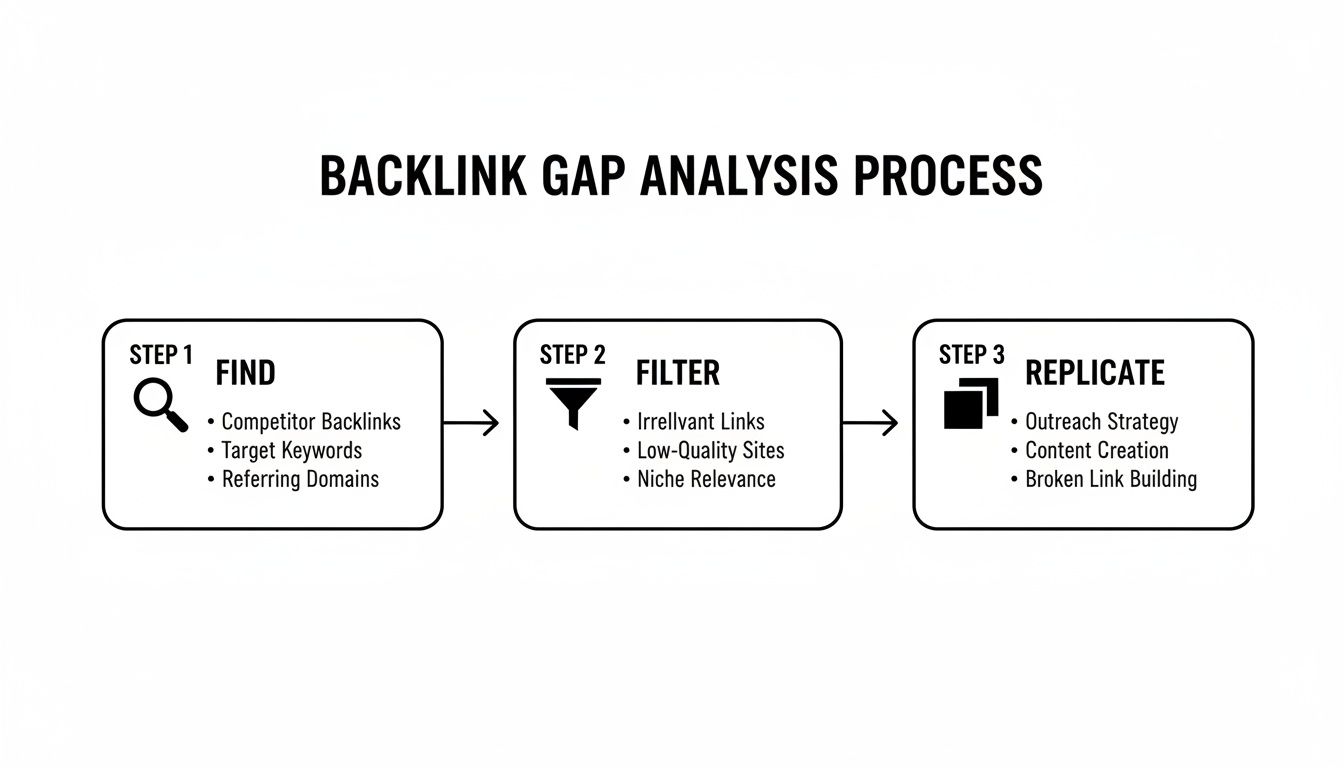
As the visual shows, it’s a streamlined process moving from discovery to replication—the very heart of an effective link-building campaign. Take your filtered list of high-quality link prospects and create a targeted outreach schedule.
A great way to do this is by grouping similar opportunities together. For instance, create one campaign for all the "best of" listicles you found and another for all the guest post targets. This kind of systematic approach makes your link-building efforts far more efficient and, ultimately, more successful.
Common Questions About SEO Competitive Analysis
Even with a solid game plan, you're bound to hit a few snags or second-guess yourself when you're buried in competitor data. It happens to everyone. Let's walk through some of the most common questions that pop up, so you can push forward with confidence.
Getting these details right is what separates a decent analysis from one that actually drives results.
How Often Should I Perform a Competitive Analysis?
There’s no magic number here, but a full-blown, deep-dive analysis is something you should tackle quarterly. This cadence is the sweet spot—frequent enough to catch major strategic shifts, like a competitor's big new content hub or a sudden surge in their link building, without getting lost in the noise of daily ranking fluctuations.
That said, you can't just set it and forget it for three months. Some things need a closer eye:
- Keyword Rankings: Keep tabs on your most important keywords weekly. This is your early warning system for sudden drops or new players creeping into the top results.
- New Backlinks: A monthly check-in on your competitors' new links is perfect. It keeps your own outreach efforts fresh and clues you into new PR or guest posting tactics they're trying.
Reserve the massive, everything-under-the-microscope audit for once or twice a year, or right before you’re about to make a big strategic pivot. This ensures you're always working with current intelligence.
What Are the Best Tools for This Analysis?
Look, you can try to piece some of this together manually, but dedicated SEO tools are pretty much non-negotiable if you want to be efficient and thorough. The reality is, no single tool is perfect at everything, which is why most pros I know use a stack of two or three to get the full picture.
Here’s how I think about the tool landscape:
- All-in-One Suites: These are your workhorses. Platforms like Semrush, Ahrefs, and Moz give you solid data on keywords, backlinks, content, and technical SEO. They're the foundation of any good analysis, especially for finding gaps.
- Specialized Tools: Sometimes you need to dig deeper in one specific area. Tools like SpyFu are fantastic for looking at historical keyword data, while Majestic has a legendary backlink index that can uncover links others miss.
- AI Visibility Platforms: This is a newer, but absolutely essential, category. With the rise of generative search, you need to know how AI models are talking about you and your competitors. A platform like Sight AI tracks these mentions and citations, which is a critical piece of the puzzle today.
The best tool stack is the one you'll actually use consistently. Start with an all-in-one suite and add specialized tools only when you have a specific need that isn't being met.
How Do I Handle Huge Competitors Like Forbes or Wikipedia?
It’s easy to feel defeated when you see a behemoth like Forbes or Wikipedia squatting on the first page for a keyword you want. Don’t panic. You're not going to outrank them for a massive, broad-term keyword, and frankly, you shouldn't even try. The game isn't about brute force; it's about being smarter.
Instead of going head-to-head, get specific. Your advantage lies in the long-tail keywords where their broad authority is actually a weakness. These longer, more niche phrases ("best project management software for small creative agencies") have lower competition and are usually packed with buyer intent. A giant site like Wikipedia is almost never going to create a deep, nuanced article for a query that specific. That's your opening.
Treat these mega-domains as a research library, not a direct competitor. See what their top pages do well—look at the structure, the topics they cover, the depth of the information—and then apply those lessons to your own hyper-focused, niche content. You win by being more relevant, not bigger.
Sight AI helps you turn competitive insights into action. Our platform monitors how AI models talk about your brand and competitors, uncovering high-value content gaps and opportunities. Then, our AI agents research, write, and publish SEO-optimized articles directly to your CMS, helping you dominate the topics that matter most. See how it works.