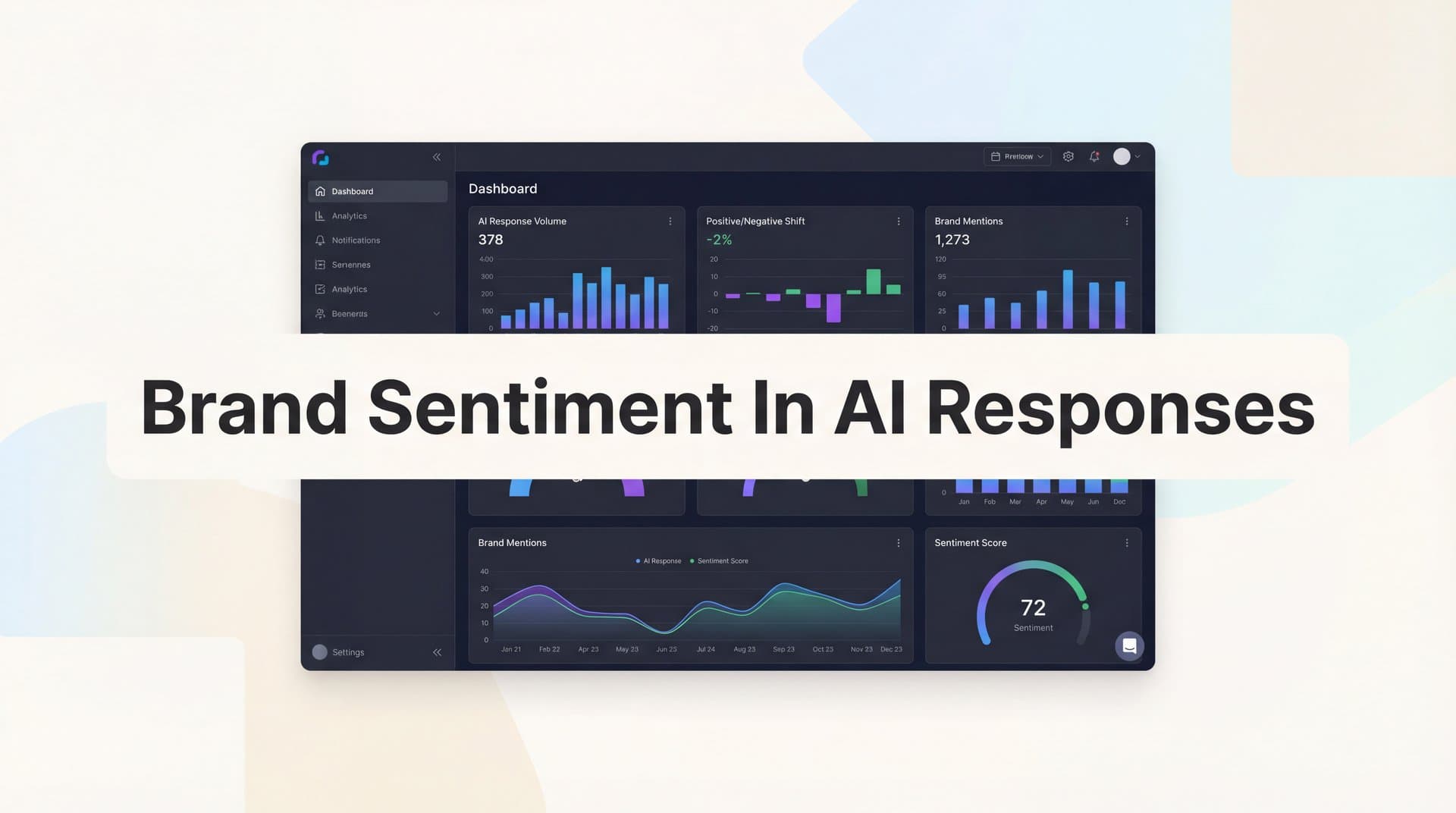
Your potential customer just asked ChatGPT, "What's the best project management tool for remote teams?" Within seconds, they receive a confident, conversational response recommending three specific brands—complete with reasons why each one excels. Your company isn't mentioned.
This scenario is playing out millions of times daily across ChatGPT, Claude, Perplexity, and Gemini. The paradigm shift in brand discovery is already here. Users who once typed keywords into Google now ask AI assistants for product recommendations, service comparisons, and buying advice. They're not clicking through search results anymore—they're receiving synthesized, authoritative-sounding answers that shape their perception of brands before they ever visit a website.
Here's the critical question most marketing teams haven't asked: What happens when an AI model describes your brand to a potential customer? Is the description accurate? Positive? Does your brand get mentioned at all? For most companies, the honest answer is unsettling: they have absolutely no idea.
Brand perception in AI responses has emerged as a crucial factor in modern marketing strategy, yet it remains a massive blind spot. While businesses obsess over Google rankings and social media sentiment, they're completely unaware of how AI models—now serving as trusted advisors to millions—actually talk about their products and services. This isn't a future concern. It's happening right now, influencing purchasing decisions in real-time.
This guide will walk you through everything you need to understand, monitor, and influence brand perception in AI responses. You'll learn how AI models form opinions about brands, what metrics actually matter, and how to build a proactive strategy that ensures AI assistants represent your company accurately and favorably.
The New Gatekeepers: Why AI Models Now Control Brand Narratives
AI assistants have fundamentally changed how information flows to consumers. Unlike traditional search engines that present a buffet of options, AI models serve a single, synthesized answer. When a user asks Claude about CRM software or queries Perplexity about email marketing platforms, they receive what feels like expert advice—not a list of links to evaluate themselves.
This shift carries profound implications for brand perception. The AI's response becomes the definitive statement about your brand in that moment. There's no competing headline to click, no meta description to optimize, no opportunity to present your own narrative alongside competitors. The AI has already made the selection, formed the opinion, and delivered the verdict.
How do AI models form these brand descriptions? They synthesize information from multiple sources: training data (which may be months or years old), real-time web crawls, indexed content from authoritative sites, and structured data embedded in websites. Different models employ varying approaches—ChatGPT relies heavily on its training data supplemented by browsing, Claude draws from its knowledge cutoff and retrieval systems, while Perplexity specializes in real-time web synthesis. Understanding how AI models select brands to mention is essential for any modern marketing strategy.
The authority problem compounds the impact. Users don't approach AI assistants with the same skepticism they apply to advertisements or even search results. A conversational interface creates psychological trust. When ChatGPT confidently states, "For enterprise-level security, companies typically choose X over Y," users internalize that as expert guidance rather than algorithmic output that might be outdated, incomplete, or influenced by whatever content the model happened to encounter.
Think of it like this: Google was the librarian who pointed you to relevant books. AI models are the consultant who's already read those books and is now giving you their professional recommendation. The difference in influence is staggering.
This creates an asymmetric risk for brands. Positive mentions can drive qualified leads who arrive already convinced of your value. But negative mentions—or worse, complete absence from relevant recommendations—mean losing customers before they even know you exist. You're not just competing for visibility anymore. You're competing for the AI's endorsement.
Anatomy of AI Brand Perception: What Gets Said About You
Brand perception in AI responses operates across three critical dimensions. Understanding each one reveals where your reputation stands—and where vulnerabilities lurk.
Sentiment: The emotional tone AI models use when discussing your brand. Does the AI describe your product with enthusiasm ("excellent choice for") or caution ("may work for some users")? Sentiment isn't just positive versus negative—it's the subtle difference between being recommended first versus mentioned as an afterthought. Many companies discover their brand gets technically accurate mentions but with lukewarm language that positions competitors as the superior choice. Implementing AI model brand sentiment analysis helps you understand these nuances.
Accuracy: The factual correctness of what AI models say about you. This is where many brands encounter shocking problems. AI responses might cite outdated pricing, describe discontinued features, reference old positioning, or state incorrect information about your company's capabilities. Because AI models don't always access your latest website content, they might confidently tell users things about your brand that haven't been true for months or years.
Positioning: How AI models compare you to competitors and in what contexts they recommend you. This dimension reveals your perceived market position. Are you mentioned alongside premium competitors or budget alternatives? Do AI models recommend you for enterprise use cases or small business needs? The positioning in AI responses often reflects how the broader web talks about your brand—which may or may not align with your actual target market.
Common scenarios emerge when companies first audit their AI brand perception. Some brands discover they're consistently recommended—a validating win that indicates strong content presence and positive web sentiment. Others find they're completely ignored in relevant queries, suggesting either weak content footprint or failure to rank for the topics AI models associate with their category. If you're experiencing this, explore why your brand might be missing from AI responses.
The most concerning scenario is inaccurate mentions. Your brand appears in AI responses, but with wrong information that actively damages perception. A SaaS company might be described with pricing from two years ago. A service business might be positioned for the wrong industry. A product might be characterized with features it never had or no longer offers.
Different AI models vary significantly in their brand responses. ChatGPT's answers reflect its training data cutoff plus selective browsing. Claude tends toward balanced, cautious descriptions. Perplexity pulls heavily from recent web content, making it more current but also more susceptible to whatever content ranks well in traditional search. Gemini integrates Google's knowledge graph, creating yet another variation in how your brand gets described.
This fragmentation means your brand perception isn't uniform—it shifts depending on which AI platform a user happens to ask.
Measuring Your AI Visibility Score: From Blind Spots to Clarity
Traditional brand monitoring tools were built for a different era. Social listening platforms track Twitter mentions and Reddit threads. SEO tools measure search rankings and backlinks. Neither captures what happens inside AI conversations—the closed loop where users ask questions and receive synthesized answers without leaving a public trace.
This creates a massive blind spot. Your brand could be recommended thousands of times daily by ChatGPT, or it could be consistently overlooked in favor of competitors, and you'd have no way to know. The conversations happen in private chat windows, invisible to conventional monitoring. Learning how to track brand in AI responses is now essential for competitive intelligence.
Measuring AI brand perception requires tracking specific metrics that reveal both visibility and quality of mentions. Mention frequency establishes baseline visibility—how often does your brand appear in AI responses for relevant prompts? This metric varies dramatically by prompt type. You might appear frequently for branded searches ("tell me about [your company]") but never for category searches ("best marketing automation platforms"). Understanding AI model brand mention frequency helps establish your baseline.
Sentiment analysis goes beyond simple positive/negative classification. It examines the language AI models use when discussing your brand. Are you described as a "leader" or merely "an option"? Do responses highlight your strengths or qualify recommendations with caveats? Sentiment in AI responses is often subtle—the difference between "X is excellent for enterprise teams" and "X works for enterprise teams" carries meaningful perception weight.
Prompt context reveals when and why your brand gets mentioned. This metric maps the specific questions and scenarios that trigger brand mentions. You might discover your brand appears in technical implementation questions but not in initial buying decision prompts—suggesting strong content for existing users but weak positioning for prospects.
Competitive share of voice measures your presence relative to competitors across AI platforms. If users ask about project management tools and your brand appears in 15% of responses while competitors dominate the other 85%, you've quantified the visibility gap. This metric becomes especially valuable for tracking changes over time as you implement optimization strategies.
Systematic tracking requires testing diverse prompt types across multiple AI platforms. Category questions ("what are the best..."), comparison prompts ("X vs Y"), use case queries ("tools for [specific need]"), and buying decision questions ("should I choose...") each reveal different aspects of your AI brand perception. The pattern of where you appear—and where you don't—maps your current positioning in the AI ecosystem.
The goal isn't just measurement for its own sake. These metrics identify specific opportunities for improvement. Low mention frequency signals content gaps. Negative sentiment points to reputation management needs. Inaccurate information demands content updates. Each metric translates to actionable strategy.
The Content Connection: How Your Website Shapes AI Responses
Your website isn't just a destination for users anymore—it's training material for AI models. Every page, every product description, every piece of published content potentially influences how AI assistants describe your brand. The connection between your content strategy and AI brand perception is direct and measurable.
AI models pull from your published content to form brand descriptions, but they don't consume information the way humans do. They prioritize clear, structured, factual content that can be easily synthesized. A well-organized "About" page with specific value propositions performs better than vague marketing copy. Detailed product descriptions with concrete features outweigh aspirational brand storytelling when AI models need to explain what your company actually does.
Structured data plays an increasingly important role. Schema markup that explicitly defines your products, services, pricing, and company information gives AI models unambiguous signals about your brand. While traditional SEO has long recommended structured data, its importance multiplies in the AI context—it's the difference between an AI model guessing what you offer versus knowing with certainty.
The clarity of your value proposition directly impacts AI brand perception. If your website requires three pages of exploration to understand what problem you solve and for whom, AI models will struggle to accurately represent you. They'll either default to generic descriptions or, worse, infer positioning from whatever external sources discuss your brand. Companies with crystal-clear, prominently displayed value propositions see more accurate and favorable AI mentions. This directly affects your brand visibility in AI responses.
Authoritative content creation influences how AI models position your brand. Comprehensive guides, detailed case studies, and technical documentation signal expertise. When AI models synthesize information about your category, they're more likely to reference and recommend brands that demonstrate depth of knowledge. This is where content marketing directly translates to AI visibility—not through backlinks or search rankings, but through being the authoritative source AI models cite.
GEO (Generative Engine Optimization) has emerged as the essential framework for this work. Unlike traditional SEO that optimizes for search engine rankings, GEO optimizes for being accurately cited by AI models. This means creating content that's structured for synthesis, factual rather than promotional, comprehensive rather than keyword-focused, and updated frequently to ensure AI models access current information.
The feedback loop matters here. As you publish GEO-optimized content, monitor how it influences AI brand perception. Track whether new product pages lead to more accurate feature descriptions in AI responses. Measure if comprehensive guides result in your brand being recommended for specific use cases. The content-to-perception connection becomes visible and actionable.
Correcting Negative or Inaccurate AI Brand Mentions
Discovering negative or inaccurate AI brand mentions triggers an urgent question: how do you fix this? The answer requires understanding where the problematic perception originated and implementing targeted content strategies to provide AI models with better information.
Start by identifying the source of negative perception. Outdated content is the most common culprit. Your own website might contain old pricing, discontinued product descriptions, or legacy positioning that AI models continue citing. Competitor content can also shape perception—if rivals publish comparison pages that misrepresent your offerings or highlight weaknesses, AI models may incorporate those claims into their responses. Genuine issues reflected in reviews, news coverage, or public discussions create perception challenges that require addressing root problems, not just content optimization. Understanding negative brand sentiment in AI responses is the first step toward correction.
Strategic content creation becomes your primary correction tool. If AI models cite inaccurate pricing, publish clear, current pricing pages with structured data. If product capabilities are misrepresented, create detailed feature documentation that explicitly states what your product does and doesn't do. If positioning is wrong, develop comprehensive content that demonstrates your actual target market and use cases.
The key is providing AI models with authoritative, factual alternatives to whatever information currently shapes their responses. This isn't about promotional content—it's about creating the most accurate, comprehensive, and current information available about your brand. AI models gravitate toward authoritative sources, so your goal is to become the definitive source for information about your own company.
Address competitor content strategically. If comparison pages on competitor sites spread inaccurate information, create your own detailed, factual comparison content. Focus on objective differentiation rather than defensive corrections. AI models synthesizing from multiple sources will incorporate your perspective alongside competitor claims, leading to more balanced representations. Learn more about how to improve brand mentions in AI through strategic content development.
For genuine issues reflected in AI responses, content alone won't solve the problem. If negative reviews or legitimate criticisms shape AI perception, you need to address the underlying issues while also publishing content that demonstrates improvement. Case studies showing problem resolution, updated product documentation highlighting fixes, and transparent communication about changes all contribute to shifting perception over time.
Timeline reality matters. Unlike updating your website where changes appear instantly, influencing AI model responses requires patience. Training data updates occur on model-specific schedules. Web crawls happen at varying frequencies. The lag between publishing corrective content and seeing that content reflected in AI responses can span weeks or months. This makes early action critical—the sooner you identify and address perception problems, the sooner corrections begin propagating through AI systems.
Track correction progress systematically. Monitor the same prompts that initially revealed negative or inaccurate mentions. Document when and how AI responses begin incorporating your updated content. This creates a feedback loop that validates your content strategy and identifies where additional optimization is needed.
Building a Proactive AI Brand Strategy
Reactive correction addresses existing problems, but long-term success requires proactive strategy. Building systematic AI brand perception management means creating content designed for AI citation, implementing ongoing monitoring workflows, and integrating AI visibility into your broader marketing approach.
Content specifically designed to be cited by AI models follows different principles than traditional marketing content. Clarity beats cleverness—straightforward, factual statements about what you do and who you serve outperform creative brand storytelling when AI models need to synthesize information. Structure enables synthesis—well-organized content with clear headings, bullet points for key features, and logical information hierarchy makes it easy for AI models to extract and cite accurate details.
Create comprehensive resource pages that answer common questions in your category. When users ask AI assistants about your industry, you want your content to be the source AI models reference. This means developing guides, documentation, and educational content that demonstrates expertise while clearly positioning your brand within that context. The goal isn't just ranking in search—it's being the authoritative source AI models cite when explaining your category. This builds lasting brand authority in LLM responses.
Monitoring workflows transform AI brand perception from a one-time audit into ongoing intelligence. Set up systematic tracking for brand mentions across AI platforms. Test core prompts weekly or monthly: category questions, competitor comparisons, use case queries, and buying decision prompts. Document how responses evolve over time. This creates trend data that reveals whether your optimization efforts are working and where new perception challenges emerge. Consider implementing AI model brand perception tracking as part of your regular marketing operations.
Integrate different prompt types to capture the full picture. Branded prompts ("tell me about [your company]") establish baseline accuracy. Category prompts ("best tools for X") measure competitive visibility. Comparison prompts ("X vs Y") reveal positioning. Use case prompts ("tools for [specific scenario]") show where you're recommended and where you're overlooked. The pattern across prompt types maps your complete AI brand perception landscape.
Integrating AI brand perception into broader marketing and SEO strategy creates compounding benefits. Your content calendar should include GEO-optimized pieces designed for AI citation alongside traditional SEO content. Product launches should include structured content updates that ensure AI models access accurate information about new features. Competitive positioning should account for how AI models currently describe you relative to rivals.
The strategic advantage belongs to early movers. While most companies remain unaware of their AI brand perception, implementing systematic monitoring and optimization now builds a foundation that competitors will struggle to match later. AI models increasingly influence purchasing decisions, and brands that proactively manage their perception in AI responses will capture disproportionate share of AI-driven traffic and conversions.
This isn't a separate marketing channel—it's a fundamental shift in how potential customers discover and evaluate brands. Your AI brand strategy should be as sophisticated and well-resourced as your SEO and social media efforts, because that's where your next customers are forming their first impressions.
Taking Control of Your AI Brand Narrative
Brand perception in AI responses is no longer optional to monitor—it's where many customers form their first impression of your company. While you've been optimizing meta descriptions and tracking social sentiment, AI assistants have been describing your brand to millions of users in private conversations you can't see.
The competitive advantage belongs to companies that recognize this shift early. Every day you operate without visibility into AI brand perception is a day competitors could be capturing recommendations you don't even know you're missing. Every inaccurate mention that goes uncorrected is a potential customer receiving wrong information about your capabilities. Every absence from relevant AI recommendations is revenue flowing to brands that prioritized AI visibility.
The framework is clear: measure your current AI brand perception across platforms and prompt types, identify gaps and inaccuracies, create authoritative content that provides AI models with accurate information, and implement ongoing monitoring to track progress and catch new issues. This isn't experimental marketing—it's fundamental brand management for an AI-driven discovery landscape.
Start by auditing your current state. What do major AI platforms actually say about your brand? Where do you appear in category recommendations? How accurate are the descriptions? Where are you completely absent? These questions have specific, measurable answers that reveal your starting point.
The timeline for influence is measured in weeks and months, not days. The content you publish today shapes AI responses tomorrow—but "tomorrow" might be four weeks from now. This makes early action essential. Competitors who start building AI visibility now will dominate AI recommendations while others are still figuring out they have a perception problem.
Stop guessing how AI models like ChatGPT and Claude talk about your brand—get visibility into every mention, track content opportunities, and automate your path to organic traffic growth. Start tracking your AI visibility today and see exactly where your brand appears across top AI platforms.
Your brand narrative is being written by AI models right now. The only question is whether you'll shape that narrative or let it form without you.