Right now, while you're reading this, AI models are answering thousands of questions about your brand. ChatGPT is recommending solutions to potential customers. Claude is comparing you to competitors. Perplexity is summarizing your company's strengths and weaknesses. And here's the unsettling part: you have absolutely no idea what they're saying.
Unlike social media mentions or review sites you can monitor, these AI-generated responses happen in a black box. When someone asks "What's the best project management tool for remote teams?" and gets a response that positions your competitor as the enthusiastic first choice while mentioning your product with phrases like "also worth considering, though some users report..." you've just lost a customer before they ever visited your website.
This is where sentiment tracking for AI responses becomes essential. It's not just about knowing whether AI models mention your brand—it's about understanding the emotional weight, the enthusiasm level, the caveats and qualifications that shape how millions of users perceive you. Because in the age of AI search, sentiment is everything. A neutral mention with hesitation carries vastly different impact than an enthusiastic recommendation, and most brands are operating completely blind to this distinction.
The Hidden Conversation: Why AI Responses Need Sentiment Analysis
AI models don't just retrieve information—they form narratives. When ChatGPT responds to a query about your brand, it's not pulling from a database of facts. It's generating language based on patterns it learned from millions of documents, and those patterns carry emotional weight.
Think about how this plays out in practice. Someone asks, "Should I use Brand X for my marketing automation?" The AI might respond with genuine enthusiasm: "Brand X offers robust features and users consistently praise its intuitive interface." Or it might hedge: "Brand X provides marketing automation capabilities, though you'll want to carefully evaluate whether it fits your specific needs." Same brand, completely different sentiment, radically different impact on the user's decision.
Here's what makes this challenging: traditional brand monitoring tools miss this entirely. They're built for social media posts, news articles, and review sites—content created by humans that you can track with conventional methods. AI-generated responses exist in a different dimension. They're created on-demand, they're never indexed by search engines, and they disappear the moment the conversation ends.
This creates a massive blind spot in reputation management. You might have stellar reviews on G2, positive press coverage, and glowing social media sentiment—but if AI models describe your brand with subtle hesitation or unfavorable comparisons, you're hemorrhaging potential customers without ever knowing why your conversion rates are suffering. Understanding sentiment analysis for AI responses is critical for closing this visibility gap.
The trust factor amplifies everything. When someone reads a negative tweet, they understand it's one person's opinion. When an AI model presents information with the authoritative tone of synthesized knowledge, users treat it as objective truth. A cautious or negative sentiment embedded in an AI response carries disproportionate weight because it sounds like consensus rather than opinion.
The landscape has shifted fundamentally. AI models now handle millions of brand-related queries daily across platforms like ChatGPT, Claude, Perplexity, Gemini, Copilot, and Meta AI. Each interaction shapes brand perception, and the cumulative effect of sentiment across these conversations determines whether AI becomes your most powerful marketing channel or your biggest liability.
How Sentiment Tracking for AI Responses Actually Works
Sentiment tracking for AI responses is fundamentally different from traditional sentiment analysis. You're not analyzing static content—you're systematically querying AI models and evaluating the emotional tone of dynamically generated responses.
The process starts with prompt engineering. You need to ask the right questions to reveal how AI models truly characterize your brand. This isn't as simple as typing "What do you think about Brand X?" into ChatGPT. You need a structured approach that covers different query categories, which is why AI prompt tracking for brands has become essential.
Direct brand queries: These are straightforward questions about your company. "Tell me about Brand X" or "What are the key features of Brand X's product?" The sentiment here reveals baseline perception—how AI models introduce and describe your brand when asked directly.
Category comparison queries: This is where sentiment becomes critical for conversion. "What are the best email marketing platforms?" or "Compare Brand X to Brand Y for small businesses." The emotional weight AI assigns when positioning you against competitors directly impacts purchase decisions.
Problem-solution queries: Users often approach AI with challenges: "I need to improve my team's collaboration" or "How can I reduce customer churn?" Whether AI recommends your brand enthusiastically, hesitantly, or not at all reveals your position in the solution landscape.
Recommendation requests: "Should I choose Brand X or Brand Y?" These queries force AI models to take a stance, and the sentiment in their reasoning exposes exactly how they weigh your strengths against alternatives.
Once you've queried AI models systematically, sentiment classification begins. This goes far beyond simple positive/negative/neutral scoring. Effective AI sentiment tracking captures nuance that traditional tools miss.
Look for enthusiasm indicators in the language. Does the AI use words like "excellent," "standout," "particularly strong"? Or does it lean on qualifiers like "adequate," "suitable," "may work for some use cases"? The difference between "Brand X excels at automation" and "Brand X offers automation features" is the difference between winning and losing customers.
Conditional recommendations reveal hidden sentiment. When AI says "Brand X is great if you have a large budget" or "Brand X works well for technical users," it's introducing barriers to consideration. These conditionals signal hesitation even when the overall mention seems neutral.
Comparative positioning exposes relative sentiment. AI models often structure responses as "Brand A is ideal for X, while Brand B excels at Y." Your position in this hierarchy—whether you're the enthusiastic first choice or the cautious alternative—determines conversion outcomes.
The technical implementation requires systematic coverage. You can't just check ChatGPT and call it done. Different AI platforms have different training data, fine-tuning approaches, and output characteristics. A brand might receive enthusiastic mentions on Claude but cautious positioning on Perplexity. Comprehensive sentiment tracking means querying across all major platforms and identifying platform-specific perception gaps.
Key Metrics That Reveal Your AI Brand Perception
Tracking AI sentiment isn't about collecting data—it's about extracting actionable intelligence. The right metrics transform raw AI responses into strategic insights that drive real business decisions.
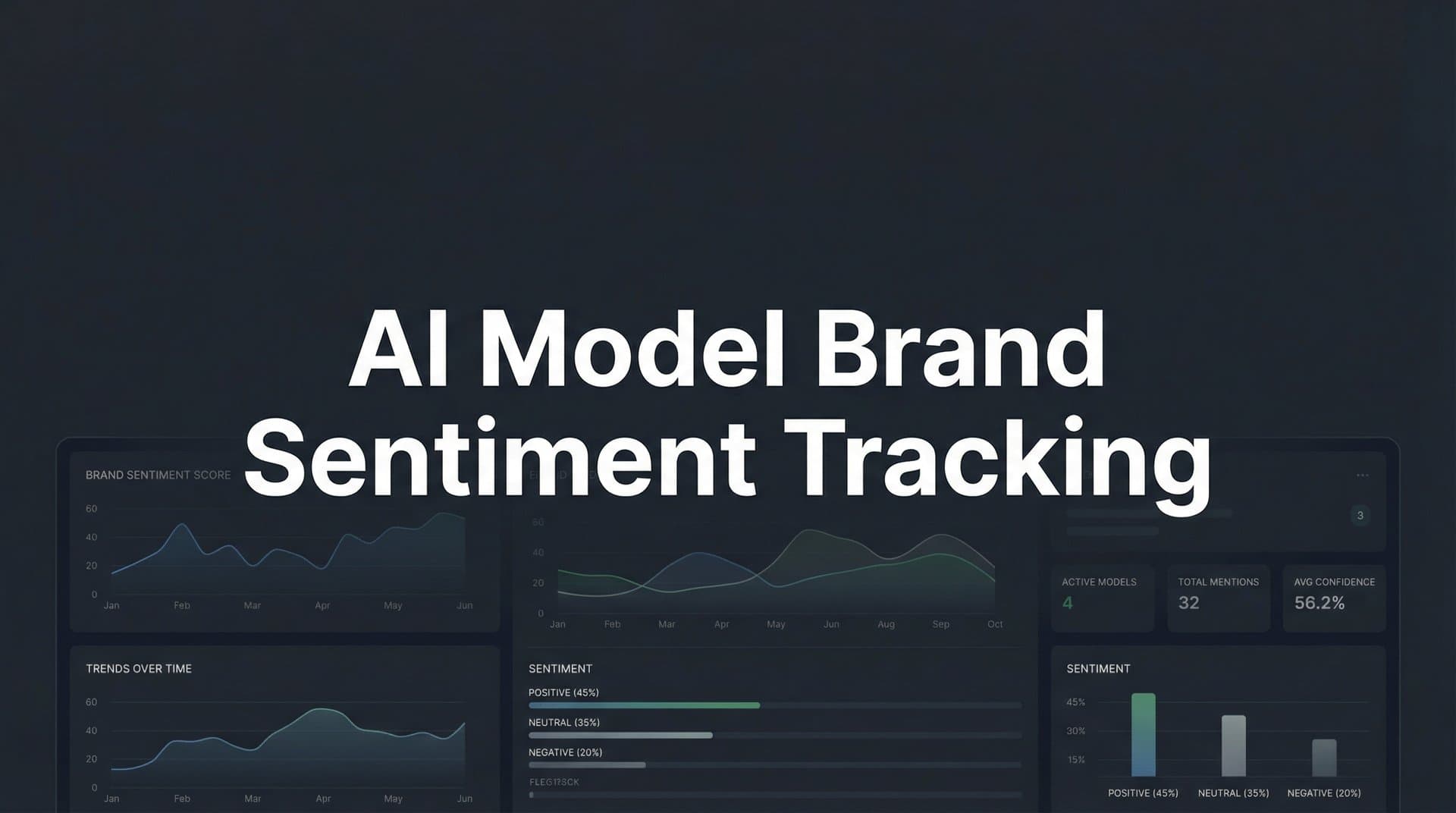
Sentiment score distribution: This foundational metric shows the ratio of positive, neutral, and negative mentions across all tracked AI platforms. But here's the critical nuance: a 70% positive score means nothing without context. What matters is the trend over time and how your distribution compares to competitors. If your positive mentions are declining while competitors are improving, you're losing ground in AI perception even if your absolute numbers look acceptable.
Platform variance: Your brand might receive enthusiastic mentions on ChatGPT but hesitant positioning on Claude. This variance reveals training data differences and helps you understand where perception gaps exist. When you identify that Perplexity consistently uses cautious language about your brand while Gemini is more positive, you've found a specific platform to target with content strategy. Implementing tracking brand sentiment across platforms helps you identify these critical differences.
Contextual sentiment: This metric measures whether your brand appears in aspirational contexts versus problem-focused discussions. There's a massive difference between AI mentioning your brand when users ask "What's the best tool for scaling my business?" versus "How do I fix issues with my current platform?" The first positions you as a growth solution, the second as a problem remediation tool. Track which contexts dominate your AI mentions.
Recommendation strength: Beyond simple positive/negative classification, measure how strongly AI models recommend your brand. Does the AI say "Brand X is an excellent choice" or "Brand X is worth considering"? Quantify the intensity of positive sentiment, not just its presence. Strong recommendations drive conversions; weak ones get ignored.
Comparative sentiment gap: This is perhaps the most actionable metric. When AI models compare you to competitors in the same response, measure the emotional differential. If AI describes Competitor A with enthusiasm and your brand with neutral language in the same answer, that sentiment gap directly translates to lost market share. Track this gap across your top three competitors to understand your relative AI positioning.
Caveat frequency: Count how often AI responses include qualifications when mentioning your brand. Phrases like "though some users report," "may require," "depending on your needs," or "with some limitations" signal underlying hesitation. High caveat frequency indicates your brand carries perceived risk or uncertainty in AI training data.
Feature sentiment attribution: Break down sentiment by specific product features or brand attributes. AI might be enthusiastic about your pricing but hesitant about your user interface. This granular view reveals exactly which aspects of your brand need content reinforcement or product improvement.
Building Your AI Sentiment Monitoring System
Effective AI sentiment tracking requires a systematic approach. Random spot-checks won't reveal meaningful patterns—you need structured monitoring that captures comprehensive data across platforms and time.
Start by defining your prompt library. This is your foundation: the specific questions and scenarios that matter most for your brand and industry. Your library should include at least 20-30 prompts across all query categories we discussed earlier. A comprehensive prompt tracking for brands guide can help you build this foundation.
For direct brand queries, include variations like "What is [Brand Name]?", "Tell me about [Brand Name]'s approach to [core value proposition]", and "What are [Brand Name]'s main features?" These establish your baseline perception.
For competitive comparisons, craft prompts that mirror real user research behavior: "Compare [Your Brand] to [Competitor A] for [specific use case]", "What are the best [product category] tools?", and "Should I choose [Your Brand] or [Competitor B]?" These reveal your relative positioning.
Problem-solution prompts should reflect actual customer pain points: "How can I [solve specific problem]?", "I'm struggling with [challenge], what should I use?", and "What's the best way to [achieve desired outcome]?" Track whether AI recommends your brand as a solution.
Establish monitoring frequency based on your brand's AI visibility maturity. If you're just starting, run your full prompt library across all platforms weekly. This captures baseline data and reveals volatility. As patterns emerge, you can adjust to bi-weekly or monthly monitoring for stable metrics while maintaining weekly checks on high-priority competitive comparisons.
Platform coverage is non-negotiable. At minimum, track sentiment across ChatGPT, Claude, Perplexity, Gemini, Microsoft Copilot, and Meta AI. These platforms represent the majority of AI-assisted search and information discovery. Each platform requires separate queries because training data, fine-tuning, and output characteristics differ significantly. Investing in multi-platform AI tracking solutions ensures you don't miss critical perception gaps.
Create sentiment baselines before you start optimizing. Run your initial monitoring cycle and document current state across all metrics. This baseline becomes your reference point for measuring improvement. Without it, you can't distinguish signal from noise when sentiment shifts.
Set up alerts for significant changes. Define thresholds that trigger investigation: a 15% drop in positive sentiment, emergence of negative mentions on a platform where you had none, or a widening competitive sentiment gap. These alerts help you catch perception problems before they compound.
Document everything in a centralized tracking system. For each prompt and platform combination, record the full AI response, sentiment classification, key phrases, and any notable changes from previous monitoring cycles. This historical data reveals trends that single snapshots miss.
From Insights to Action: Improving Negative AI Sentiment
Identifying negative sentiment is only valuable if you know how to fix it. The good news: AI sentiment is malleable because AI models learn from content that exists on the web. Strategic action can shift perception over time.
The most powerful intervention is publishing authoritative, positive brand content that AI models will learn from. AI training data includes web content, documentation, case studies, and published articles. When you consistently publish high-quality content that positions your brand positively, you're literally feeding better information into the system that shapes future AI responses.
Focus on depth and authority. A single blog post won't move the needle. You need comprehensive resources: detailed product documentation, in-depth guides that showcase your expertise, case studies that demonstrate real outcomes, and thought leadership content that establishes category authority. This content should be technically accurate, well-structured, and optimized for the problems your target audience actually searches for.
Address root causes, not just symptoms. If AI models consistently mention user interface complexity as a caveat when recommending your product, you have two options: improve the actual interface or publish extensive resources that help users navigate it successfully. Ideally, do both. AI sentiment often reflects real product or service issues that models detect in user-generated content like reviews and forum discussions.
GEO optimization—Generative Engine Optimization—specifically targets how AI models understand and present your brand. This involves structuring content with clear, factual statements that AI models can easily extract and summarize. Use definitive language: "Brand X provides [specific capability]" rather than marketing fluff. Include concrete examples and quantifiable outcomes when possible. Make it easy for AI to understand what you do and why it matters.
Competitive differentiation content helps AI models position you accurately. If sentiment tracking reveals that AI consistently recommends competitors for use cases where you excel, publish detailed comparison content that clearly articulates your advantages. Leveraging brand tracking for competitive analysis helps you identify exactly where these positioning battles need to be fought.
Respond to the specific language AI uses. If you notice AI models repeatedly use phrases like "may require technical expertise" when describing your product, publish content that directly addresses this: beginner guides, video tutorials, simplified documentation. Over time, as this content gets indexed and potentially incorporated into training data, the hesitation in AI responses should diminish.
Monitor sentiment changes as you publish. Track whether new content correlates with improved AI perception. This feedback loop helps you understand which content strategies actually influence AI sentiment versus which are just noise. The lag time can be significant—changes in web content don't instantly affect AI model outputs—so maintain consistent effort over months, not weeks.
Putting It All Together: Your AI Sentiment Strategy
Building an effective AI sentiment tracking practice isn't about perfection—it's about systematic progress. Start with a comprehensive sentiment audit across the six major AI platforms using your initial prompt library. This establishes your baseline and reveals immediate opportunities.
The audit will likely surface surprises. You might discover that AI models are enthusiastic about features you barely market, or that they associate your brand with use cases you've never targeted. These insights are gold—they reveal organic perception that exists independent of your messaging.
Integrate AI sentiment tracking into your existing workflows rather than treating it as a separate initiative. Your content team should review AI sentiment data when planning topics. Your product team should see it alongside traditional customer feedback. Your executive team should track it as a leading indicator of brand health. Using dedicated AI model sentiment tracking software makes this integration seamless.
Treat AI sentiment as predictive, not just descriptive. Shifts in how AI models characterize your brand often precede changes in organic search rankings, customer perception, and market position. When you notice AI sentiment improving for a specific feature or use case, that's your signal to double down. When sentiment declines, it's an early warning system that something needs attention.
The competitive intelligence value is enormous. By tracking not just your sentiment but also how AI positions competitors, you gain visibility into perception gaps that traditional market research misses. When AI consistently recommends a competitor with stronger enthusiasm for a use case you both serve, you've identified a specific positioning battle to fight with content and product improvements.
Build feedback loops between AI sentiment data and content creation. The prompts that reveal negative or hesitant sentiment should directly inform your content roadmap. If AI hedges when asked about your pricing model, publish transparent pricing content. If it's uncertain about your enterprise capabilities, create detailed enterprise case studies.
Remember that AI sentiment is a marathon, not a sprint. Meaningful shifts in how AI models characterize your brand require sustained effort over months. But the brands that start tracking and optimizing now will build insurmountable advantages as AI becomes the primary interface for information discovery.
Your Next Steps in AI Brand Perception
Sentiment tracking for AI responses isn't optional for brands serious about the future of search and customer acquisition. As AI platforms become the primary interface between consumers and information, the emotional tone of AI-generated brand mentions becomes as critical as search rankings, review scores, and social media presence combined.
The brands winning in this new landscape aren't necessarily those with the best products—they're the ones AI models describe with enthusiasm, recommend without caveats, and position favorably against alternatives. They're the brands that understand AI sentiment as a strategic asset and invest in tracking and improving it systematically.
Every day you operate without visibility into AI sentiment is a day competitors can gain perception advantages that compound over time. When AI models learn to describe Competitor A as the innovative leader while characterizing your brand with neutral or hesitant language, closing that gap becomes exponentially harder as more users receive those recommendations.
The opportunity window is still open. Most brands aren't tracking AI sentiment yet, which means early movers can establish dominant positions in AI-generated recommendations before markets become saturated. But that window is closing as awareness grows and tools become more accessible.
Stop guessing how AI models like ChatGPT and Claude talk about your brand—get visibility into every mention, track content opportunities, and automate your path to organic traffic growth. Start tracking your AI visibility today and see exactly where your brand appears across top AI platforms, what sentiment those mentions carry, and which content gaps you need to fill to improve how AI recommends you to millions of potential customers.
The future of brand perception is being written in AI responses right now. The question is whether you'll shape that narrative or let it form without you.