Picture a potential customer opening ChatGPT and typing: "What's the best project management tool for remote teams?" They're not scrolling through ten blue links. They're reading a curated answer that names three or four tools—and your brand either made that list, or it didn't. This moment represents a fundamental shift in how buyers discover products, and most companies have no idea whether they're winning or losing these invisible recommendation battles.
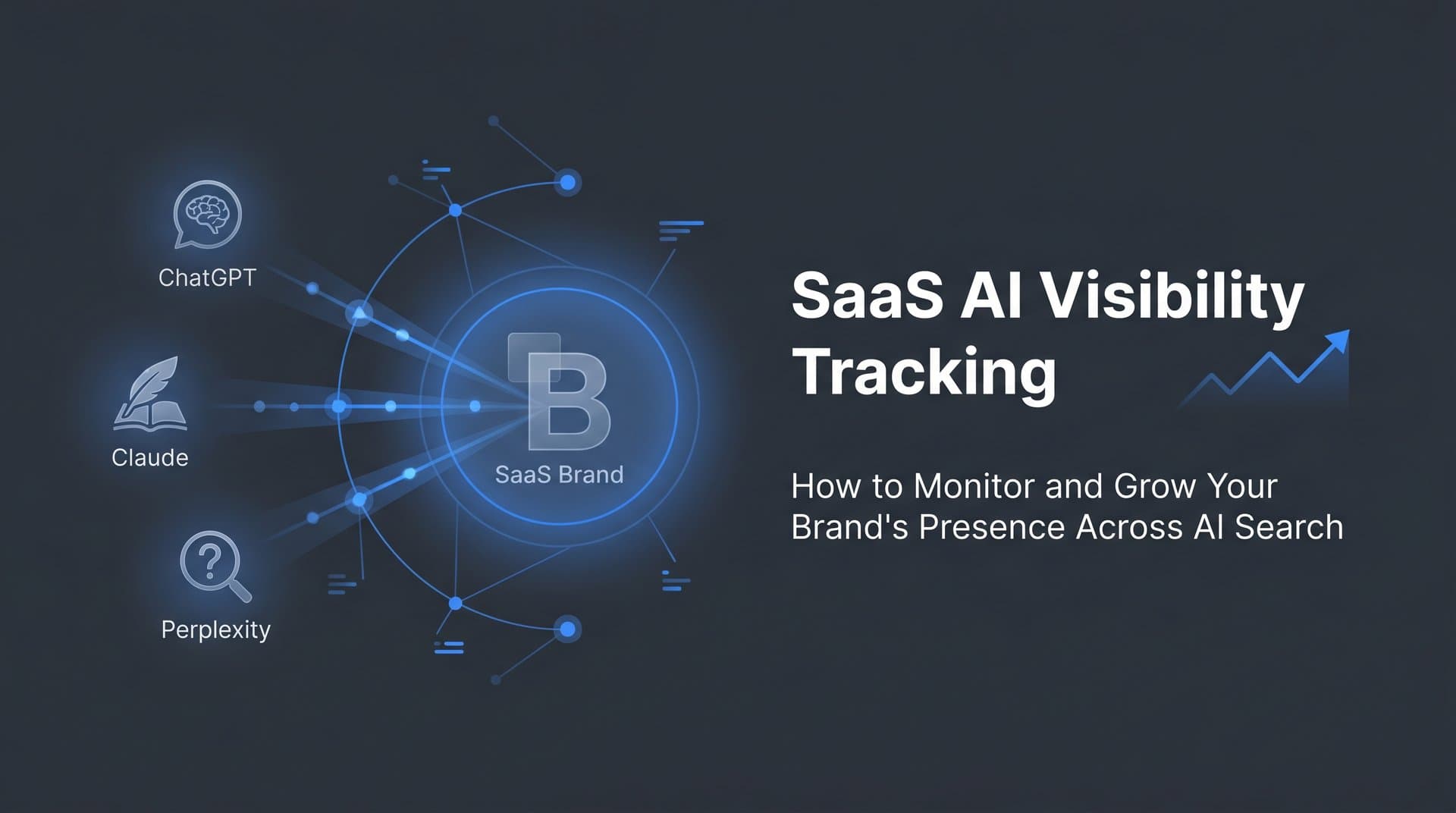
The rise of AI-powered search through ChatGPT, Claude, Perplexity, and Gemini has created an entirely new discovery layer that sits alongside traditional search engines. When someone asks an AI model for recommendations, they're bypassing Google's search results page entirely. The question that should keep every marketer awake at night: when your ideal customer asks an AI for solutions in your category, does your brand get mentioned?
AI visibility score tracking answers this question with systematic data collection and analysis. Instead of guessing whether AI models recommend your brand, you monitor actual responses across multiple platforms, track sentiment, and identify which prompts trigger your mentions. This emerging discipline gives you the same clarity about your AI presence that Google Analytics provides for your website traffic—turning a black box into actionable intelligence.
The New Discovery Layer: Why AI Models Are Your Next SEO Frontier
Traditional search engine optimization operates on a straightforward premise: rank higher in Google's results, get more clicks. The relationship between position and traffic is well-documented, and entire industries have built themselves around moving up those rankings. But AI-powered search engines fundamentally change this equation.
When users interact with ChatGPT, Claude, Perplexity, or Gemini, they're not comparing search results—they're receiving synthesized answers that blend information from training data, real-time retrieval, and contextual understanding. These models don't show ten blue links. They craft narratives that weave together sources, and your brand either becomes part of that narrative or gets left out entirely.
Think of it like this: traditional SEO is about being on the shelf where customers can find you. AI visibility is about being the product the knowledgeable store clerk recommends when someone asks for advice. The clerk doesn't show customers every option—they highlight the ones that come to mind based on their knowledge and recent information.
The mechanics matter here. Search engines index pages and rank them based on relevance signals and authority metrics. AI models, by contrast, draw from vast training datasets and increasingly from real-time web retrieval to formulate responses. ChatGPT and Claude have training data cutoffs but can access current information through browsing capabilities. Perplexity actively searches the web for every query. Gemini integrates with Google's knowledge graph and search infrastructure.
Each platform synthesizes information differently, which means your brand might appear prominently in Claude's recommendations but get overlooked by ChatGPT for the same query. This fragmentation is precisely why tracking becomes essential—you can't optimize what you don't measure.
The strategic implication cuts deep: your Google Analytics dashboard tells you nothing about whether AI models recommend your brand. Your search rankings don't predict your AI visibility. A company could dominate traditional search results while remaining completely invisible in AI-generated recommendations, missing an entire channel of potential customers who never make it to Google.
Breaking Down the AI Visibility Score: What It Actually Measures
An AI visibility score distills complex data into actionable metrics, but understanding what you're actually measuring prevents misinterpretation and guides optimization efforts. The score typically combines four core components, each revealing different aspects of your AI presence.
Mention Frequency: The foundation of visibility tracking is simple counting—how often does your brand appear when relevant prompts are submitted to AI models? If you run a CRM platform, you'd track how frequently your name comes up when users ask about customer relationship management tools, sales automation software, or contact management solutions. High mention frequency indicates strong recall within the AI model's knowledge base.
Sentiment Analysis: Not all mentions carry equal value. Being named in a list of "tools to avoid" obviously differs from appearing in "top recommended solutions." Sentiment analysis classifies mentions as positive recommendations, neutral references, or negative associations. A brand might have high mention frequency but poor sentiment—appearing often as a cautionary example rather than a recommendation. The most valuable mentions combine frequency with positive sentiment.
Prompt Coverage: This metric tracks which types of queries trigger your brand mention. Do you only appear when users ask specifically about your brand name, or do you surface in broader category queries? A strong AI visibility score shows presence across multiple prompt types: direct brand queries, category searches, use-case questions, and comparison requests. Gaps in prompt coverage reveal opportunities—if you appear in "best email marketing tools" but not "email automation for e-commerce," you've identified a content gap.
Competitive Positioning: AI models often present multiple options when answering recommendation queries. Your position within these lists matters enormously. Being mentioned first in a list of three carries more weight than appearing fifth in a list of ten. Competitive positioning tracks where you rank relative to alternatives, which competitors appear alongside you, and whether you're framed as a premium option, budget alternative, or specialized solution.
The technical challenge of tracking stems from platform differences. ChatGPT might recommend your brand based on information from its training data combined with recent web searches. Claude might draw from different sources entirely. Perplexity will cite specific web pages it retrieved. Gemini integrates Google's knowledge graph. Each platform's unique approach means you need multi-platform tracking to understand your complete AI visibility picture.
Distinguishing between brand queries and category queries proves particularly important. When someone asks "What is Salesforce?" and gets an accurate answer, that's brand awareness confirmation. When someone asks "What CRM should I use for a small business?" and Salesforce appears in the response, that's category visibility—the more valuable metric because it represents new customer discovery rather than existing awareness.
Setting Up Your AI Visibility Tracking System
Building an effective tracking system starts with identifying which prompts actually matter for your business. Random sampling won't cut it—you need systematic coverage of the queries your potential customers are actually asking AI models.
Begin by mapping your product category to natural language queries. If you offer accounting software, potential customers might ask: "best accounting software for freelancers," "how to manage business finances," "QuickBooks alternatives," or "accounting tools that integrate with Stripe." Create a comprehensive prompt library that covers direct product searches, use-case questions, competitor comparisons, and problem-solution queries.
Your prompt library should include three tiers. Core prompts directly relate to your primary product category—these get tracked most frequently because they represent your main discovery opportunities. Secondary prompts cover adjacent use cases and integration scenarios where your product might be recommended as part of a solution stack. Tertiary prompts track broader industry questions where thought leadership and brand authority matter more than direct product recommendations.
Tracking cadence determines how quickly you spot trends and changes. Daily tracking might seem excessive, but AI models update their knowledge bases and retrieval systems regularly. Weekly sampling provides a reasonable balance for most businesses—frequent enough to catch significant shifts without generating overwhelming data volumes. Monthly tracking works for baseline monitoring but risks missing important changes during the gap periods.
The technical implementation requires systematic prompt submission and response logging. You'll need to query each AI platform with your prompt library, capture the complete responses, and store them in a structured format that enables analysis. Some companies build custom scripts using API access where available. Others use specialized AI visibility tracking platforms that automate the entire workflow across multiple AI models.
Response logging needs to preserve context. Don't just record whether your brand was mentioned—capture the full response text, the position of your mention, surrounding context, and any citations or sources the AI model provided. This contextual data becomes crucial when you're analyzing why visibility changed or how sentiment shifted.
Consistency matters enormously for trend analysis. If you change your prompt wording, tracking schedule, or platforms midstream, you'll struggle to identify whether changes in your visibility score reflect actual shifts in AI model behavior or just measurement inconsistencies. Establish your methodology, document it thoroughly, and maintain consistency even when it feels tedious.
Reading the Data: From Raw Metrics to Strategic Insights
Raw visibility scores mean little without context and interpretation. A score of 47 out of 100 might be excellent in a highly competitive category or concerning in a niche market with few alternatives. Learning to read the data transforms numbers into strategic guidance.
Start by establishing your baseline. Run your complete prompt library across all tracked platforms and record the results. This baseline becomes your reference point for measuring improvement. Many brands discover during baseline assessment that their AI visibility is weaker than assumed—they rank well in Google but rarely appear in AI recommendations.
Strong visibility typically shows three characteristics: consistent mentions across multiple platforms, presence in category queries (not just brand searches), and positive sentiment in the majority of mentions. If ChatGPT, Claude, and Perplexity all recommend your brand when users ask about your product category, you've achieved strong cross-platform visibility. If mentions only occur when users specifically ask about your brand name, you're visible but not discoverable.
Weak visibility reveals itself through absence and inconsistency. Your brand might appear occasionally in responses from one platform but remain completely absent from others. Mentions might cluster around negative sentiment or appear only in historical contexts ("tools that used to be popular"). These patterns indicate that AI models don't strongly associate your brand with current, positive solutions in your category.
The real insight comes from correlating visibility changes with your marketing activities. Did your visibility score jump after publishing a comprehensive industry report that got cited by major publications? Did it drop after a competitor launched a well-publicized feature? Track these correlations systematically—they reveal which activities actually influence how AI models perceive and recommend your brand.
Content updates often show delayed impact on AI visibility. You publish a detailed guide, and it might take weeks before AI models incorporate that information into their knowledge base or retrieval systems. This lag means you need patience when evaluating content initiatives. Quick wins are rare; sustained improvement comes from consistent effort over months.
Sentiment tracking deserves special attention because it reveals positioning nuances that mention frequency misses. You might appear in 80% of relevant prompts but with mixed sentiment—sometimes recommended, sometimes mentioned as an option with caveats, occasionally cited as an example of what not to do. Improving sentiment often requires addressing specific pain points, competitive weaknesses, or outdated perceptions that persist in the information ecosystem.
Competitive analysis provides crucial context. If your visibility score is 62 and your main competitor scores 58, you're in a tight race. If they score 89, you're significantly behind. But raw scores don't tell the whole story—look at which prompts each brand dominates, where you have unique visibility advantages, and which queries remain up for grabs with no clear leader.
Improving Your Score: Content Strategies That Influence AI Recommendations
Understanding your visibility metrics only matters if you can improve them. The connection between content strategy and AI visibility operates through several mechanisms, each requiring different optimization approaches.
AI models learn from the information ecosystem—the collective body of web content, authoritative sources, and structured data that exists about your brand and category. When you publish high-quality content that gets cited, linked, and referenced by authoritative sources, you're feeding the information pool that AI models draw from when formulating recommendations.
Structured data helps AI models understand your offerings clearly. Implement schema markup that explicitly defines your product category, features, use cases, and relationships to other tools. While AI models don't read schema markup the same way search engines do, the clarity it provides often gets reflected in how your brand appears in knowledge bases and retrieval systems that AI platforms access.
Authoritative citations matter enormously. When respected industry publications, review sites, and expert blogs mention your brand positively, AI models weight those references heavily. A mention in TechCrunch or Harvard Business Review carries more influence than a hundred mentions on unknown blogs. This means your PR and content distribution strategy directly impacts AI visibility—getting featured in authoritative sources becomes even more valuable in an AI-powered discovery landscape.
GEO (Generative Engine Optimization) has emerged as the practice of optimizing specifically for AI model comprehension and recommendation. Unlike traditional SEO which focuses on keywords and backlinks, GEO emphasizes clear explanations, comprehensive coverage, and consistent messaging across multiple authoritative sources.
Create AI-Friendly Content Formats: AI models excel at processing well-structured information. Comprehensive guides, comparison articles, and detailed documentation help models understand exactly what your product does and who it serves. Format content with clear headings, concise explanations, and explicit statements about use cases and benefits.
Maintain Consistent Brand Messaging: Inconsistency confuses AI models. If different sources describe your product category differently or emphasize conflicting value propositions, models struggle to form a coherent understanding. Develop clear, consistent messaging about what you do, who you serve, and why customers choose you—then ensure that messaging appears consistently across your website, documentation, press releases, and third-party coverage.
Update Knowledge Bases and Directories: Many AI models access structured knowledge bases as part of their retrieval systems. Ensure your brand appears accurately in Wikipedia (if you meet notability criteria), Crunchbase, industry-specific directories, and product databases. Keep information current—outdated entries create outdated AI recommendations.
Build Topical Authority: Publish consistently on topics related to your product category. When AI models see your brand associated with comprehensive, authoritative content about your industry, they're more likely to recommend you as a knowledgeable solution provider. This means maintaining an active blog, publishing research, contributing expert commentary, and participating in industry conversations.
Earn Quality Backlinks: While AI models don't use backlinks the same way Google does, the content that earns quality backlinks tends to be authoritative and comprehensive—exactly the type of content AI models value when forming recommendations. Focus on creating linkworthy resources that other sites naturally reference.
The timeline for improvement runs longer than most marketers expect. Traditional SEO changes can show results in weeks. AI visibility improvements often take months because you're influencing how information about your brand propagates through the ecosystem and eventually gets incorporated into AI model knowledge bases and retrieval systems.
Putting It All Together: Building an Ongoing Visibility Practice
AI visibility tracking works best as an ongoing practice integrated into your marketing operations, not a one-time audit. The tracking-to-action workflow creates a continuous improvement cycle: monitor your current visibility across platforms, analyze patterns and changes, optimize based on insights, then repeat.
Start with weekly monitoring of your core prompt library across your primary AI platforms. This cadence catches significant changes without overwhelming your team with data. Monthly deep dives examine trends, competitive shifts, and the impact of your optimization efforts. Quarterly reviews adjust your prompt library, refine tracking methodology, and set visibility goals for the next period.
Integrate AI visibility metrics into your marketing dashboard alongside traditional SEO rankings, organic traffic, and conversion rates. When leadership asks about brand awareness and discovery channel performance, you should be able to report both Google rankings and AI visibility scores. This integration ensures AI visibility doesn't become a side project—it gets the attention and resources it deserves.
The competitive advantage of early adoption cannot be overstated. Most brands aren't tracking AI visibility yet. They don't know whether AI models recommend them, how their visibility compares to competitors, or which content initiatives actually improve their AI presence. You can build significant advantages while competitors remain blind to this channel.
Early adopters gain several years of baseline data and optimization learning before AI visibility tracking becomes standard practice. When your competitors finally start paying attention to this channel, you'll already understand which strategies work, how long improvements take, and where your unique visibility advantages lie.
Implementation within existing workflows requires minimal disruption. Your content team already creates blog posts and guides—they just need guidance on AI-friendly formats and messaging consistency. Your PR team already pursues media coverage—they just need to prioritize authoritative sources that influence AI model knowledge. Your SEO team already tracks rankings—they just need to add AI visibility metrics to their reporting.
The next steps are straightforward: establish your baseline by running your prompt library across major AI platforms, set up systematic tracking to monitor changes over time, and begin optimizing your content and authority-building efforts with AI visibility in mind. Start small if needed—even tracking a dozen core prompts across two platforms provides valuable insights and builds the foundation for more comprehensive monitoring later.
Your Next Steps in the AI Visibility Era
AI visibility tracking isn't optional for brands serious about organic discovery—it's becoming as essential as traditional SEO monitoring. The shift toward AI-powered search isn't slowing down. More users every day bypass Google entirely and ask ChatGPT, Claude, or Perplexity for recommendations. If your brand doesn't appear in those recommendations, you're invisible to a growing segment of potential customers who never make it to your website.
The good news: you don't need to guess whether AI models recommend your brand. Systematic tracking reveals exactly where you stand, which platforms favor you, and where optimization opportunities exist. Start with a baseline assessment of your current AI visibility across the prompts that matter most for your business. You might discover you're stronger than expected in some areas and completely absent in others—both insights guide your optimization priorities.
Build systematic tracking into your marketing operations now, while it still provides competitive advantages. The brands that establish strong AI visibility before it becomes standard practice will dominate discovery in this channel for years. Those who wait will spend years playing catch-up, wondering why competitors appear in AI recommendations while they remain invisible.
Stop guessing how AI models like ChatGPT and Claude talk about your brand—get visibility into every mention, track content opportunities, and automate your path to organic traffic growth. Start tracking your AI visibility today and see exactly where your brand appears across top AI platforms.