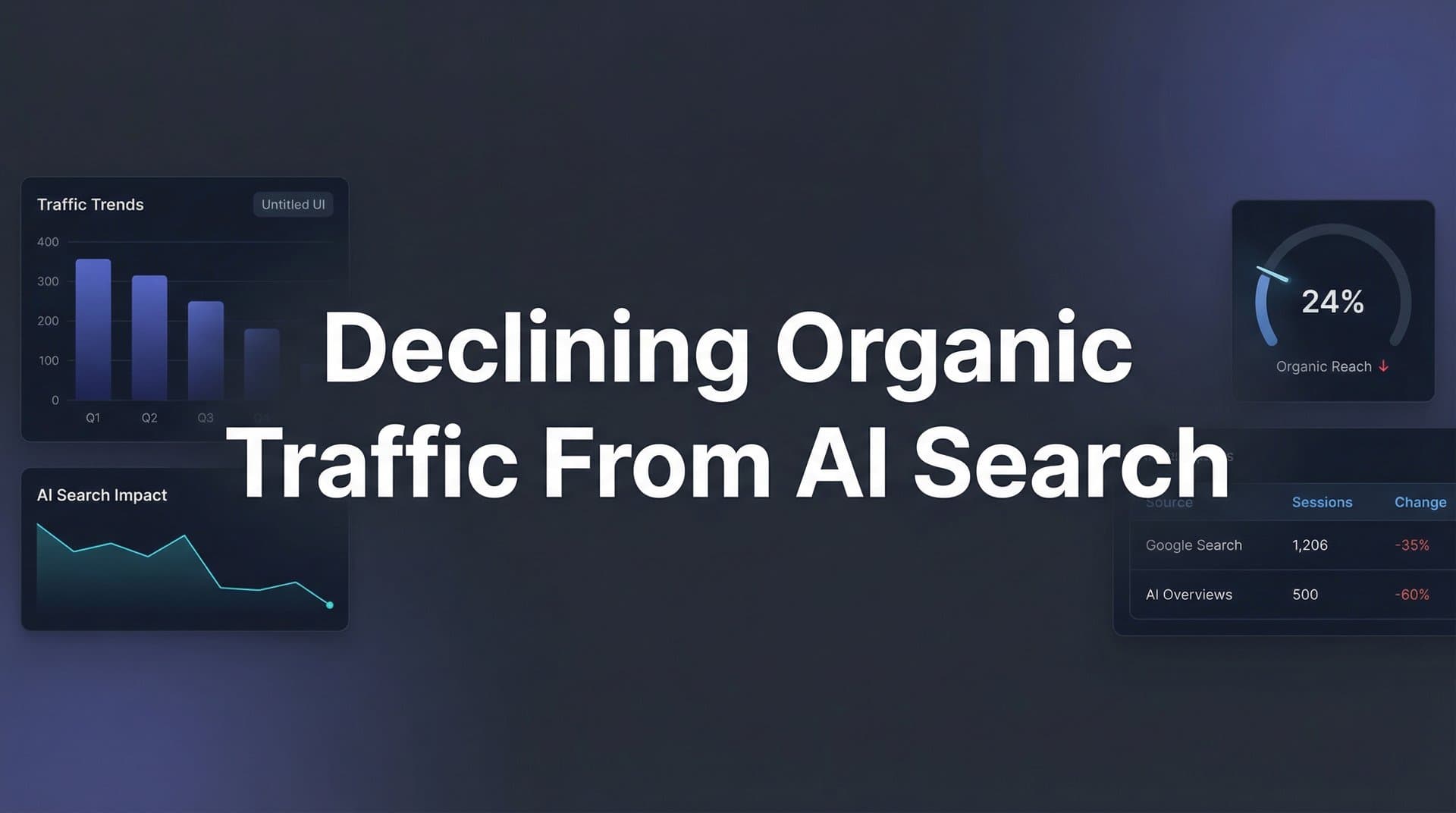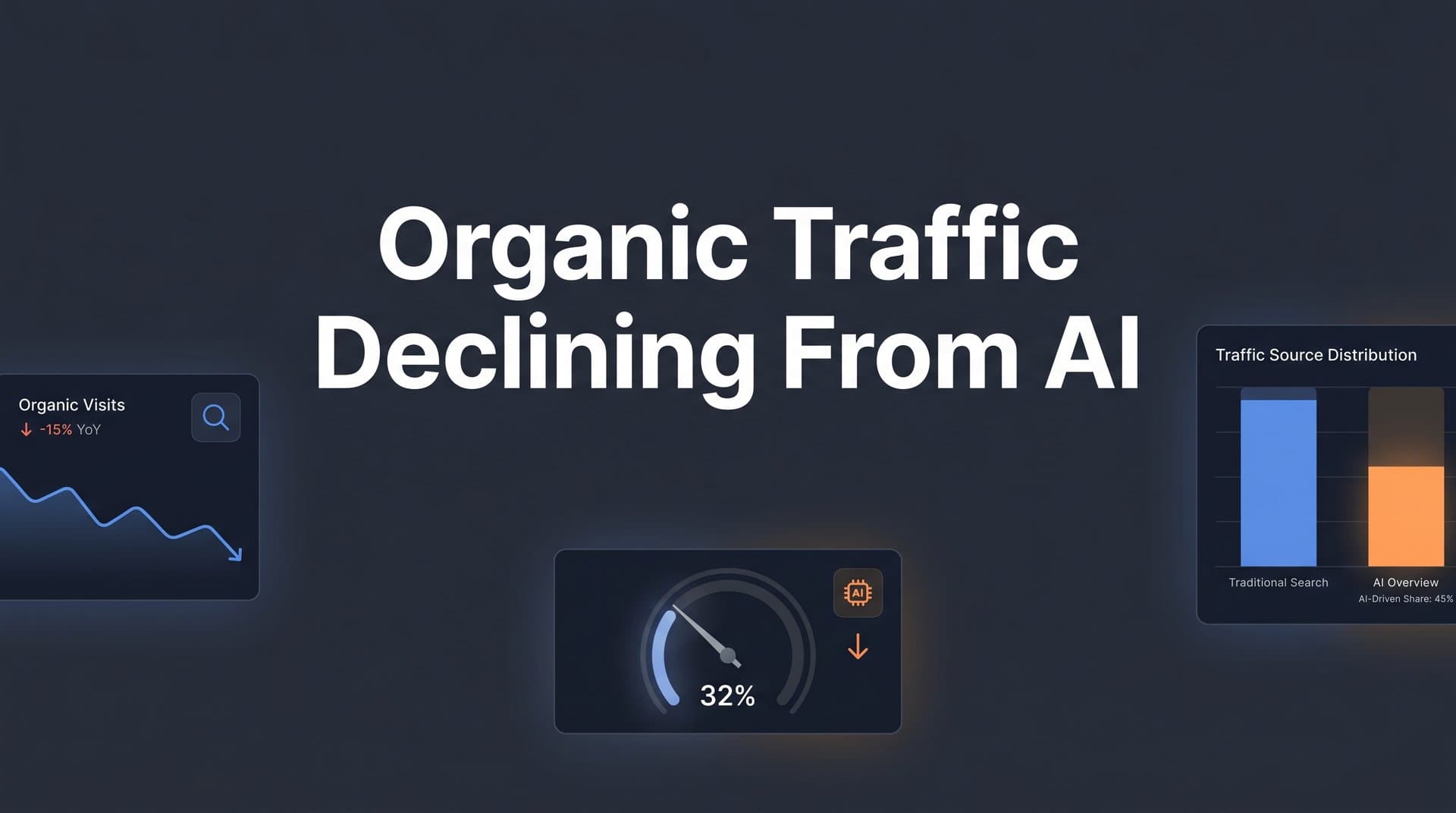
There's a particular kind of anxiety that comes from opening Google Analytics and watching a number you used to trust start moving in the wrong direction. Your rankings haven't changed. Your content is still indexed. You haven't been hit by a manual penalty. And yet, organic traffic is flat or falling, quietly and persistently, like air leaking from a tire you can't find the puncture in.
This is the situation many marketers and founders are navigating right now. The culprit isn't a Google algorithm update or a technical SEO regression. It's something more structural: AI-powered search experiences are intercepting queries before users ever click a link. ChatGPT, Perplexity, Google's AI Overviews, and Claude are synthesizing answers directly in the interface, and a growing share of your potential visitors are getting what they need without ever landing on your site.
This isn't a traditional SEO problem with a traditional SEO fix. It's a shift in the fundamental mechanics of how people find information online. Understanding that shift, diagnosing its impact on your specific traffic, and adapting your content strategy accordingly is what separates brands that grow through this transition from brands that keep wondering why the numbers won't cooperate. This article walks through all three: the mechanism, the diagnosis, and the strategies that actually work in this new environment.
The Zero-Click Revolution: How AI Search Is Reshaping User Behavior
To understand why organic traffic is declining from AI search, you first need to understand what's actually happening at the query level. When a user types a question into ChatGPT, Perplexity, or Google with AI Overviews enabled, the AI model doesn't return a list of links and wait for the user to choose. It synthesizes information from its training data and, in some cases, live web sources, and delivers a composed, conversational answer directly in the interface. The user gets the answer. The source websites don't get the visit.
This isn't entirely new. Featured snippets have been intercepting informational queries for years, pulling a direct answer to the top of the search results page and reducing the need to click through. But there's a meaningful difference between a featured snippet and an AI-generated response. Featured snippets answered narrow, simple questions. AI models handle complex, multi-step queries that used to require visiting multiple pages, reading multiple sources, and synthesizing the information yourself. The scale and sophistication are categorically different.
Think about the types of queries that drove organic traffic growth for most content-focused brands over the past decade: how-to guides, product comparisons, explainers, definitions, step-by-step tutorials, listicles. These were the workhorses of informational SEO. They ranked well, attracted consistent search volume, and converted readers into subscribers, leads, or customers through extended engagement. They are also precisely the query types that AI models handle most confidently.
A user asking "how do I set up Google Search Console?" no longer needs to visit a blog post. A user comparing two software tools can get a structured breakdown from an AI without clicking a single link. A user looking for a definition or a quick explanation gets it in seconds, inside the tool they're already using. The queries that used to generate clicks now generate AI answers instead.
What makes this particularly challenging is that the traffic loss is invisible in your rankings data. Your page may still rank in position three for a given query. Google Search Console may show healthy impressions. But if an AI Overview is sitting above the organic results and answering the question before the user scrolls, your click-through rate drops while your position stays the same. The ranking is real. The traffic just isn't arriving.
Diagnosing the Drop: Is AI Search Actually Hurting Your Traffic?
Before restructuring your entire content strategy, it's worth confirming that AI search is actually the cause of your traffic decline rather than something more conventional. Algorithm updates, technical regressions, seasonal patterns, and competitive displacement can all produce similar-looking drops. The diagnostic signals for AI-driven traffic loss are distinct enough to identify if you know what to look for.
The clearest signal is a divergence between impressions and clicks in Google Search Console. If your average position is stable or improving, your impressions are holding steady, but your click-through rate is falling, that's a strong indicator that SERP features, including AI Overviews, are absorbing the clicks your rankings used to generate. This pattern is particularly telling when it's concentrated on informational queries rather than transactional ones.
Segment your GSC data by query type. Filter for your how-to queries, your definitional queries, your comparison queries. Compare CTR trends on those segments against your transactional queries, branded queries, and navigational queries. If the informational segment is where the CTR compression is happening, AI interception is the likely explanation. Transactional queries, where users are actively looking to buy or sign up, tend to be less affected because AI models are less likely to resolve purchase intent without sending the user somewhere.
Beyond Google Search Console, there's a second diagnostic layer that most marketers aren't yet checking: AI visibility. This is the question of whether your brand is being mentioned, cited, or recommended when AI models generate answers to queries relevant to your space. A brand can be losing traditional organic traffic while simultaneously gaining presence in AI-generated responses, or it can be losing on both fronts simultaneously. These are very different situations that call for different responses.
Checking your AI visibility requires systematic prompt testing: submitting relevant queries to ChatGPT, Perplexity, Claude, and Google's AI Overviews, and analyzing whether your brand appears in the responses, in what context, and with what framing. This is time-consuming to do manually at any meaningful scale, which is why purpose-built tools for AI visibility tracking have become increasingly relevant for forward-looking marketing teams.
The third diagnostic step is identifying which content categories are losing traffic fastest. Map your declining pages against content type. If your definitional and how-to content is dropping while your case studies, original research, and opinion-driven content is holding steady or growing, that pattern tells you exactly where AI cannibalization is concentrated and where your content investment should shift.
The Content Vulnerability Map: Which Pages Are Most at Risk
Not all content is equally exposed to AI cannibalization. There's a clear hierarchy of risk, and understanding where your existing content sits within it is essential for prioritizing your response.
At the highest risk end are pure informational and definitional pages: content that exists to explain what something is, how something works, or what the steps in a process are. This type of content is highly vulnerable because AI models are trained on vast datasets that include thousands of similar explanations. They can synthesize a clear, accurate answer to "what is a conversion rate?" or "how does email authentication work?" without needing to send the user anywhere. If your content library is heavily weighted toward this type of page, you're disproportionately exposed.
The underlying problem is generic content. Thin, undifferentiated explainers that cover the same ground as dozens of other pages on the same topic are being functionally replaced by AI-generated answers. The user's informational need is met without a click, and the page that used to serve that need becomes invisible in terms of traffic, even if it still ranks. Understanding low organic traffic growth patterns can help you identify which of these pages are already showing early warning signs.
Lower-risk content categories share a common trait: they contain something AI models cannot replicate because they don't have access to it. Original research with proprietary data, unique frameworks developed from direct experience, first-person case studies, deeply opinionated analysis, and content that reflects a specific brand's perspective are all harder for AI to synthesize authentically. An AI model can summarize the general principles of customer retention, but it cannot replicate your company's original survey data or your founder's specific framework developed over years of practice.
The citation-versus-replacement distinction is the key mental model here. Content that earns AI citations is content that AI models reference as a source when generating answers: original research, named frameworks, proprietary data, and expert perspectives that are specific enough and authoritative enough to be worth attributing. Content that gets replaced by AI is generic enough that the model can produce an equivalent answer from its training data without needing to cite anyone. Your goal is to move your content library toward the former category.
Brand-specific content, product comparisons, detailed use cases, and customer stories also retain strong click value. Users with specific intent around your brand or product still need to visit your site to get that information. AI models are not a substitute for direct product research.
GEO vs. SEO: Optimizing for the Era of Generative Answers
Traditional SEO has a clear success metric: your page ranks highly for a target keyword, users click through, and you get traffic. The entire discipline is built around that click. Generative Engine Optimization, or GEO, operates on a different success model: your brand name, framework, or content is referenced in an AI-generated response to a relevant query. The goal isn't necessarily a click. It's presence in the answer itself.
This distinction matters because the tactics are meaningfully different. Traditional SEO prioritizes keyword density, backlink acquisition, page authority, and technical on-page signals. These factors influence where a URL ranks in a list of results. GEO prioritizes something else: making your brand and content citable, attributable, and trustworthy enough for an AI model to reference when constructing an answer. A comprehensive AI search engine optimization guide can walk you through the full tactical framework for making this shift.
Several principles define effective GEO practice. The first is clear entity definition. AI models build their understanding of brands, products, and people from how consistently and clearly those entities are described across the web. If your brand is described differently across your website, your social profiles, your press coverage, and third-party directories, AI models may have an ambiguous or incomplete picture of who you are and what you do. Consistency and clarity in how your brand is defined across all surfaces improves your entity recognition in AI systems.
The second principle is structured, precise, citable language. AI models are more likely to reference content that makes clear, specific, attributable claims rather than vague generalizations. Content written with the precision of a well-sourced article, with named frameworks, specific definitions, and clear attributions, is more likely to be pulled into an AI-generated response than content written in broad, generic strokes.
The third principle is authoritative sourcing and cross-web presence. AI models weight content that appears consistently across authoritative sources. Being mentioned in industry publications, cited in reputable articles, and referenced in structured data all contribute to the signals that make a brand more likely to appear in AI-generated answers. This is where traditional SEO and GEO overlap: the domain authority and link equity you've built still matters, just for different reasons.
The fourth principle is answering the prompts your audience is actually using. AI tools are query-driven. If you want your brand to appear when users ask about a specific topic, you need content that directly and precisely answers that topic, written in language that maps to how users phrase those queries in conversational AI interfaces. This is subtly different from traditional keyword optimization, which targets search engine query patterns. AI prompts tend to be more conversational, more specific, and more intent-driven. Exploring conversational search optimization tactics can help you align your content with how users actually phrase queries in AI tools.
Building an AI-Proof Content Strategy That Still Drives Traffic
The honest framing here is that no content is entirely AI-proof. But some content formats are structurally more durable than others, and building your content strategy around those formats is the most practical response to the current environment.
Original research and proprietary data sit at the top of the durability hierarchy. Content that presents findings from original surveys, unique datasets, or internal analysis cannot be replicated by AI models because the underlying data doesn't exist in their training sets. This type of content also earns citations: when AI models reference statistics or findings, they tend to attribute them to named sources, which means your brand gets mentioned in AI-generated answers rather than replaced by them.
Deeply opinionated long-form analysis is similarly durable. AI models are trained to be balanced and comprehensive, which means they often struggle to replicate content that takes a strong, specific, defensible position on a contested topic. An article that argues a specific point of view, backed by reasoning and experience, is harder to synthesize than one that neutrally presents multiple perspectives.
Timely, current content holds a structural advantage that is often overlooked. AI models have training data cutoffs. They cannot access real-time information unless they have explicit web browsing capabilities, and even then, they're synthesizing rather than directing users to primary sources. Brands that publish timely analysis of recent developments, current industry data, or emerging trends retain a traffic advantage because traditional search still indexes and surfaces fresh content before AI models can synthesize it. Publishing velocity matters here: the faster you can produce relevant, current content, the broader your surface area for both traditional rankings and early AI indexing.
Interactive tools, calculators, and community-driven content are also structurally protected because they provide utility that an AI-generated answer cannot replicate. A user who wants to calculate their customer acquisition cost needs the actual calculator, not a description of how to do the math. A user looking for community perspectives on a specific problem needs the forum thread, not a summary of what forums generally say about it.
The operational challenge is scale. Competing effectively in this environment requires consistent publishing across many topics, formats, and content types simultaneously. Brands that can automate the production of well-structured, GEO-optimized content, while maintaining quality and freshness, maintain a broader footprint across both traditional search results and AI citation opportunities. This is where AI content creation for organic traffic, used strategically for appropriate content types, creates a genuine competitive advantage rather than a vulnerability.
Tracking What Matters Now: Metrics for the AI Search Era
Organic traffic as a single headline metric is no longer sufficient to understand your brand's discoverability. A brand can be losing traditional organic clicks while gaining significant presence in AI-generated answers, and the traditional dashboard won't show it. Conversely, a brand can appear to have stable organic traffic while losing ground in AI visibility, setting up a more significant drop when AI adoption accelerates further. You need both pictures simultaneously.
The emerging KPIs for the AI search era include AI visibility score, brand mention frequency across AI platforms, share of relevant AI-generated answers that include your brand, and sentiment analysis of how your brand is described when it does appear. These metrics don't replace clicks and impressions; they complement them and provide the context that traditional analytics can no longer supply on its own. If your brand is missing from AI searches entirely, these KPIs will surface that gap before it compounds into a larger traffic problem.
Setting up AI visibility monitoring requires defining the prompts that matter to your business. These are the queries your target audience is most likely to submit to AI tools when looking for solutions in your category. Think about the questions your customers ask during the sales process, the comparisons they make when evaluating options, and the problems they're trying to solve when they first encounter your brand. Those are the prompts to track.
Once you have your prompt set, systematic testing across platforms is the next step. ChatGPT, Claude, Perplexity, and Google's AI Overviews each have different training data, different citation behaviors, and different tendencies around brand mentions. A brand that appears consistently in Perplexity responses may be largely absent from ChatGPT responses on the same topic. Understanding where you have presence and where you have gaps tells you where to focus your GEO efforts. Monitoring where competitors are ranking in AI search results adds another layer of strategic context to this analysis.
Doing this manually at scale is impractical. Tracking dozens of prompts across six or more AI platforms on a regular cadence requires automation. Platforms like Sight AI are purpose-built for this: monitoring brand mentions across AI models simultaneously, tracking sentiment, identifying which content is earning citations, and surfacing the gaps where competitors are appearing and you're not. The brands that invest in this visibility infrastructure now will have a significant informational advantage as AI search continues to grow.
The complete measurement picture looks like this: traditional SEO performance data from Google Search Console and your rank tracker, layered with AI visibility data from systematic prompt monitoring. Together, these two data streams give you a full view of your brand's discoverability across the search landscape as it actually exists today, not as it existed five years ago.
The Bottom Line: A More Sophisticated Discipline, Not the End of SEO
Organic traffic declining from AI search is a real phenomenon, and it's not going to reverse. The structural shift toward AI-mediated information retrieval is a durable change in user behavior, not a temporary trend. But that doesn't mean organic growth is over. It means the discipline has become more sophisticated, and the brands that adapt will find more durable, defensible traffic than they had before.
The brands that will grow through this transition are the ones that produce content worth citing rather than just content worth ranking, that track their AI visibility alongside their traditional SEO metrics, and that understand the difference between content that gets replaced by AI and content that gets referenced by it. Original research, authoritative perspectives, timely analysis, and precise entity definition are the new foundations of organic discoverability.
The good news is that the tools to execute this strategy exist now. You don't have to guess how AI models are talking about your brand, which of your content is earning mentions, or where your competitors are appearing in AI-generated answers while you're absent.
Start tracking your AI visibility today with Sight AI. Monitor your brand mentions across ChatGPT, Claude, Perplexity, and more, identify which content is earning AI citations, and publish GEO-optimized articles that ensure your brand shows up wherever your audience is searching. The brands building this infrastructure now are the ones who will own organic visibility in the AI search era.