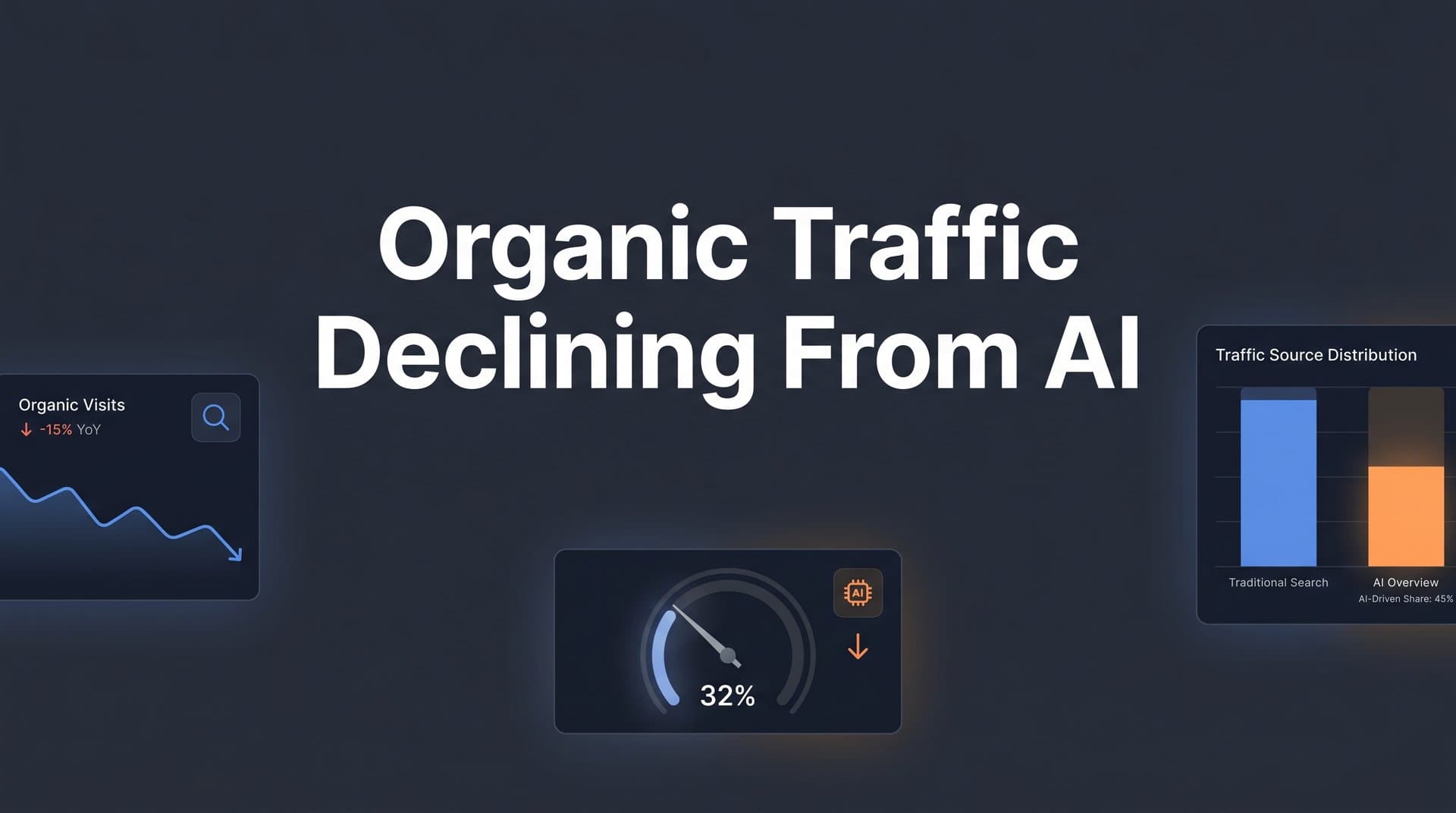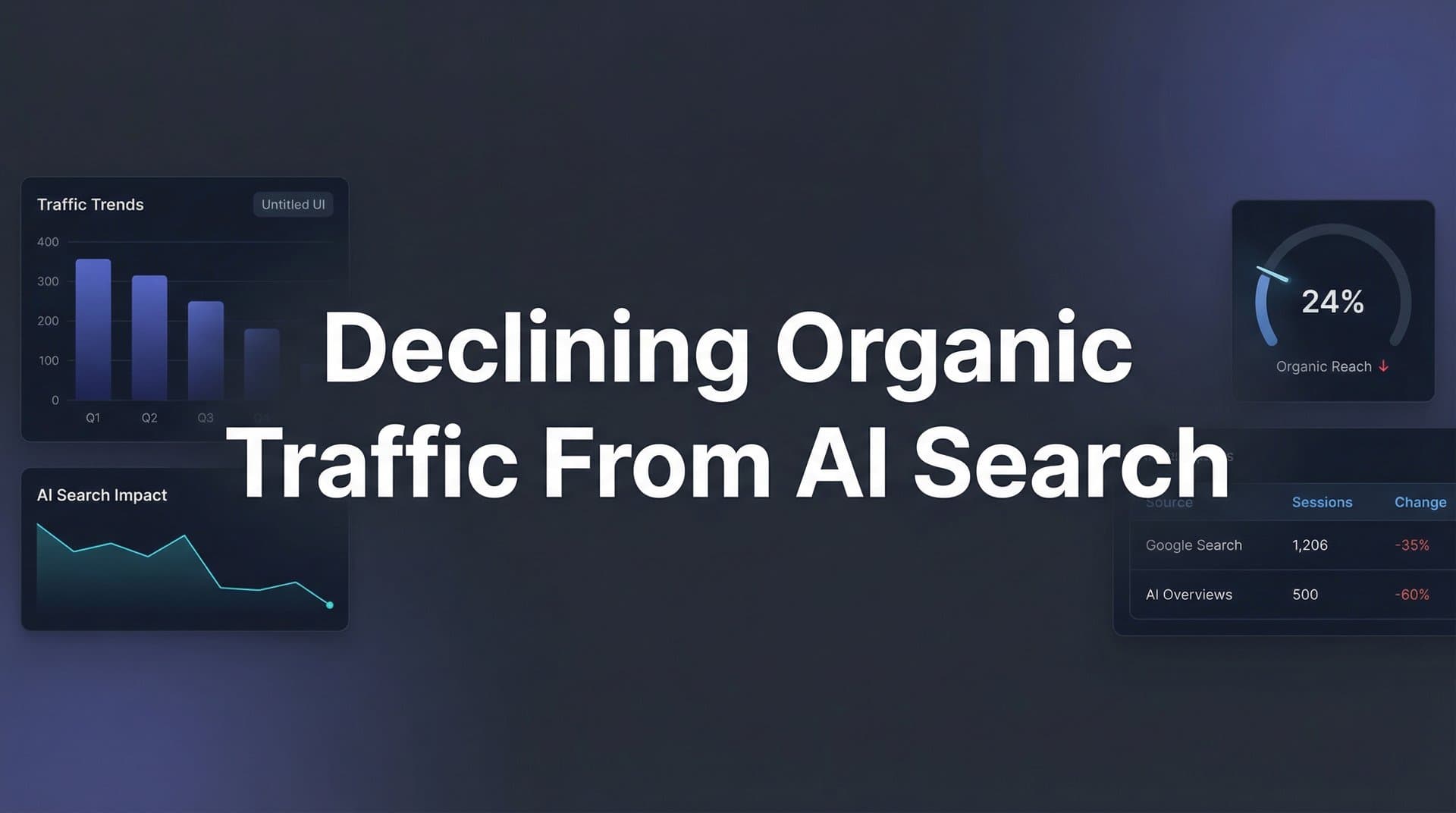
You've been doing everything right. Your keyword research is thorough, your content quality is high, and your technical SEO is solid. Yet when you pull up your analytics dashboard, the trend line keeps sliding downward. Month after month, your organic traffic numbers shrink despite your best efforts to maintain—and even improve—your traditional SEO practices.
Here's what's actually happening: the rules of organic discovery have fundamentally changed, and most marketers are still playing by the old playbook.
AI search engines like ChatGPT, Perplexity, and Claude have quietly revolutionized how users find information. Instead of clicking through ten blue links to compare answers, users now get comprehensive responses synthesized from multiple sources—all without ever visiting your website. Your content might still rank on Google's first page, but if AI models aren't mentioning your brand when users ask questions in your domain, you're becoming invisible to a rapidly growing segment of searchers.
The Fundamental Shift in How Users Discover Information
Think about the last time you needed a quick answer to a complex question. Did you open Google and click through multiple websites, or did you ask ChatGPT and get an immediate, synthesized response?
This behavioral shift is accelerating faster than most marketing teams realize. Users increasingly treat AI interfaces as their primary research tool, especially for informational queries that traditionally drove significant website traffic. They're not abandoning search entirely—they're just completing their journey without the clicking part.
The rise of zero-click searches has been building for years through Google's featured snippets and knowledge panels. AI search has amplified this trend exponentially. When someone asks Claude "What are the best project management strategies for remote teams?", they receive a detailed, multi-paragraph response drawing from dozens of sources. The user gets their answer. The conversation continues. No website visits occur.
Here's the critical insight most marketers miss: your traditional keyword rankings no longer guarantee traffic when AI becomes the intermediary between users and your content. You might rank #3 for "remote project management strategies" on Google, but if AI models consistently recommend your competitors when synthesizing answers about this topic, your traffic evaporates regardless of your SERP position.
This creates a peculiar situation where your SEO metrics look healthy while your actual traffic deteriorates. You're winning a game that fewer people are playing, while losing visibility in the arena where your audience has migrated.
The shift affects different content types unevenly. Educational and informational content—the backbone of most content marketing strategies—faces the steepest declines because AI excels at synthesizing this material into direct answers. Transactional queries and highly specific searches may maintain their click-through rates longer, but the overall trend is unmistakable.
Identifying Whether AI Search Is Your Real Problem
Not every traffic decline stems from AI disruption. Sometimes you're dealing with conventional SEO issues: algorithm updates, technical problems, or increased competition. The key is diagnosing the actual cause before prescribing solutions.
Start by examining which content categories are losing traffic. If your transactional pages (product comparisons, pricing guides, specific how-to tutorials) remain stable while your educational content (industry explainers, concept definitions, general guides) shows significant declines, AI search disruption is likely your culprit.
Look at your query patterns in Search Console. Are you maintaining impressions but losing clicks? This pattern suggests users are finding your content in traditional search but getting their answers elsewhere—often from AI interfaces that synthesize your information without sending traffic your way.
Here's a revealing metric to check: compare your traffic from informational keywords versus navigational and transactional keywords over the past 12-18 months. Many companies find their informational traffic has dropped 30-50% while other categories remain relatively stable. This disparity signals AI-driven traffic erosion rather than broad ranking problems.
The referral pattern analysis reveals another clue. Traditional SEO issues typically show correlated changes across multiple referral sources—if you're losing Google traffic, you're probably losing Bing traffic too. AI-driven declines often show Google traffic falling while direct traffic or branded search remains steady, indicating your brand awareness hasn't declined but discovery through informational queries has shifted to AI channels. Understanding direct traffic vs organic search patterns helps clarify these distinctions.
But here's the hidden problem that analytics dashboards can't easily show: your content may still rank perfectly well, but AI models simply aren't citing or recommending your brand when users ask relevant questions. You're invisible in the conversations happening inside ChatGPT, Claude, and Perplexity—conversations that increasingly replace traditional search sessions.
Without monitoring how AI models discuss your brand, you're essentially flying blind. You might attribute traffic declines to SEO factors and waste months optimizing for traditional ranking signals while your real problem—AI visibility—goes unaddressed.
The Authority Question AI Models Ask
Understanding why AI models skip your brand requires understanding how these systems evaluate and select sources. It's not the same process that determines traditional search rankings, and that's where most content strategies go wrong.
When an AI model generates a response, it's not simply returning the top-ranking pages for a keyword. It's synthesizing information from its training data and, in some cases, real-time web searches, then selecting which sources to cite or recommend based on perceived authority, relevance, and comprehensiveness.
Think of it this way: traditional SEO optimizes for ranking algorithms that evaluate hundreds of signals—backlinks, page speed, mobile-friendliness, keyword usage. These signals help search engines decide which pages to show. AI models, however, are answering a different question: which sources should I trust and reference when synthesizing an answer for this specific query?
This distinction matters enormously. You can have perfect technical SEO, strong backlinks, and excellent keyword optimization, yet AI models may rarely mention your brand because they don't perceive your content as authoritative for the topics users ask about.
AI models prioritize several authority signals that differ from traditional ranking factors. Content comprehensiveness matters more than keyword density—models favor sources that thoroughly cover a topic rather than targeting specific phrases. Clarity of explanation outweighs clever copywriting—AI models need to parse and understand your content to reference it accurately.
The structure of your expertise also influences AI recommendations. Content that clearly establishes domain authority through demonstrated knowledge, original insights, or unique data gets weighted more heavily than generic information that could come from anywhere. This is why two articles covering the same topic can have dramatically different AI visibility—one gets cited regularly while the other is ignored.
There's also a recency factor that operates differently than traditional search. AI models trained on data up to a certain cutoff date may not know about your brand if you've only recently established authority in a space. Even models with web search capabilities may overlook your content if it's not structured in ways that make your expertise immediately apparent.
Generative Engine Optimization: The Framework for AI Visibility
If traditional SEO optimized content for ranking algorithms, Generative Engine Optimization (GEO) optimizes content for AI models to understand, trust, and cite. It's not about replacing SEO—it's about adding a layer of optimization specifically for how AI systems discover and recommend information.
The fundamental principle of GEO is this: structure your content so AI models can easily parse your expertise, understand your unique perspective, and confidently reference your insights when answering relevant queries. This requires thinking about content architecture differently than you might for traditional search optimization.
Start with how you establish authority. AI models need clear signals about why your perspective matters. This means explicitly stating your expertise, experience, or unique data rather than assuming your domain authority will speak for itself. An article that opens with "Based on analyzing 50,000 customer support tickets across 200 companies" signals authority differently than one that simply discusses customer support best practices without establishing the foundation for those recommendations.
Content structure matters enormously for AI discoverability. Models excel at parsing well-organized information with clear hierarchies and logical flow. Use descriptive headings that function as standalone summaries of the content beneath them. Break complex topics into distinct, clearly labeled sections. Make your main points explicit rather than burying insights in narrative prose. Understanding AI search optimization vs traditional SEO helps you balance both approaches effectively.
The questions you answer should align with how users actually phrase queries to AI assistants. Conversational AI queries tend to be longer and more specific than traditional keyword searches. Instead of optimizing for "project management tips," think about the actual questions users ask: "What project management approach works best for remote teams with members across multiple time zones?" Your content should directly address these specific, contextual queries.
Comprehensiveness takes on new meaning in GEO. AI models favor sources that thoroughly cover a topic from multiple angles rather than focusing narrowly on a single keyword. This doesn't mean writing longer articles for the sake of length—it means ensuring your content addresses the full scope of questions someone might have about your topic, including related concepts, common misconceptions, and practical implementation details.
Original insights and unique data become differentiators. When AI models synthesize answers from multiple sources, they need to decide which sources to cite. Generic information that appears everywhere gets absorbed without attribution. Unique perspectives, original research, or proprietary data create citation-worthy content that models specifically reference.
Building Your AI Visibility Measurement System
You can't optimize what you don't measure. The challenge with AI visibility is that it's fundamentally different from traditional SEO metrics—you're not tracking rankings or impressions, you're monitoring how AI models discuss your brand across different platforms and contexts.
The core metric is mention frequency: how often do AI models reference your brand when users ask questions in your domain? This isn't a single number—it varies dramatically based on the specific query, the AI platform, and how the question is phrased. A comprehensive visibility measurement system tracks your brand mentions across multiple AI platforms (ChatGPT, Claude, Perplexity, and others) for a representative sample of queries relevant to your business.
But frequency alone doesn't tell the complete story. Sentiment analysis reveals whether AI models position your brand positively, neutrally, or negatively when they do mention you. Are you being recommended as a solution, mentioned as one option among many, or referenced as a cautionary example? The context and tone of mentions matter as much as the frequency.
Prompt coverage measures the breadth of queries where your brand appears. You might have strong visibility for certain topics but be completely absent from adjacent areas where you also offer expertise. Mapping your visibility across different query categories reveals gaps in your AI presence and highlights opportunities for content development. If you discover your brand is missing from AI searches, you've identified a critical gap to address.
Competitor comparison provides essential context. Your absolute mention frequency means little without understanding how you compare to competitors for the same queries. Are you being mentioned alongside major players in your space, or are AI models consistently recommending competitors while overlooking your brand? This competitive context guides prioritization of optimization efforts.
The real power comes from creating a feedback loop between visibility data and content strategy. When you identify queries where competitors get mentioned but you don't, you've found content gaps to address. When you publish new content and see your mention frequency increase for related queries, you've validated your GEO approach. When sentiment shifts after you update existing content, you understand which changes improve how AI models perceive your expertise.
This measurement system transforms AI visibility from an abstract concept into actionable intelligence. Instead of guessing whether your content resonates with AI models, you have concrete data showing exactly where you appear, how you're positioned, and where opportunities exist to increase your presence. Leveraging organic traffic growth tools designed for AI visibility can streamline this entire process.
Your Roadmap to Recovering AI-Driven Traffic
Recovery starts with an honest audit of your existing content through the lens of AI discoverability. Pull your top-performing pages from the past two years—the ones that historically drove significant organic traffic—and evaluate each one with a critical question: if an AI model wanted to cite authoritative information on this topic, would it choose this page?
Look for authority signals. Does the content clearly establish why your perspective matters? Have you included original insights, proprietary data, or unique experiences that differentiate your content from generic information available everywhere? If your content reads like a summary of what everyone else says, AI models have no reason to cite you specifically.
Assess your content structure. Can an AI model easily parse the key points and understand how different sections relate to each other? Are your headings descriptive enough to function as content summaries? Have you organized information logically with clear hierarchies? Content that's easy for humans to scan is also easy for AI models to understand and reference.
Examine how you answer questions. Are you addressing the specific, conversational queries users actually ask AI assistants, or are you optimizing for short keyword phrases? Expand your content to cover the full spectrum of related questions someone might have about your topic. Think in terms of complete answers rather than keyword targets. Solid keyword research for organic SEO remains foundational, but the application has evolved.
Certain content types consistently perform well in AI recommendations. Comprehensive guides that thoroughly cover a topic from multiple angles get cited more frequently than narrowly focused articles. Authoritative explainers that break down complex concepts with clear examples and analogies help AI models understand and communicate your expertise. Content with structured data—whether that's tables, step-by-step processes, or clearly formatted lists—makes it easier for models to extract and reference specific information.
But here's the crucial balance: recovering AI visibility doesn't mean abandoning traditional SEO fundamentals. The most sustainable organic traffic growth strategies layer GEO optimization on top of solid SEO practices. You still need technical excellence, quality backlinks, and keyword relevance—these factors influence both traditional search rankings and how AI models discover and evaluate your content.
The practical approach is to audit and optimize in phases. Start with your highest-traffic pages that have shown the steepest declines. Enhance these with stronger authority signals, better structure, and more comprehensive coverage. Monitor how these changes affect both traditional rankings and AI visibility. Use what you learn to guide optimization of additional content.
Create new content specifically designed for AI discoverability. Target the conversational queries you've identified through visibility tracking. Structure this content with clear expertise signals, comprehensive coverage, and logical organization. Publish consistently and monitor how your AI visibility metrics respond.
Thriving in the Dual-Search Reality
Declining organic traffic from AI search isn't a death sentence for your content strategy—it's a signal that the discovery landscape has evolved and your approach needs to evolve with it. The brands that recognize this shift early and adapt their content strategies accordingly will gain significant competitive advantages as AI search adoption accelerates.
The reality is that we're living in a dual-search world. Traditional search engines aren't disappearing, but they're being joined by AI-powered discovery that operates on different principles and rewards different optimization approaches. Your content needs to succeed in both environments, which means maintaining SEO fundamentals while adding GEO strategies specifically designed for AI visibility.
The good news is that many GEO best practices—comprehensive coverage, clear authority signals, logical structure, original insights—also improve traditional SEO performance. You're not choosing between optimization approaches; you're expanding your optimization framework to address how content gets discovered and recommended across all channels.
What separates winners from losers in this transition isn't technical sophistication or massive content budgets. It's awareness of how the game has changed and willingness to adapt strategies accordingly. Brands that continue optimizing solely for traditional search will watch their organic traffic erode as more users shift to AI-powered discovery. Brands that embrace both SEO and GEO will capture traffic from all discovery channels.
The competitive advantage goes to those who move first. While your competitors are still trying to understand why their traffic is declining, you can be systematically improving your AI visibility, capturing mentions across AI platforms, and positioning your brand as the authoritative source AI models reference when users ask questions in your domain.
Stop guessing how AI models like ChatGPT and Claude talk about your brand—get visibility into every mention, track content opportunities, and automate your path to organic traffic growth. Start tracking your AI visibility today and see exactly where your brand appears across top AI platforms.