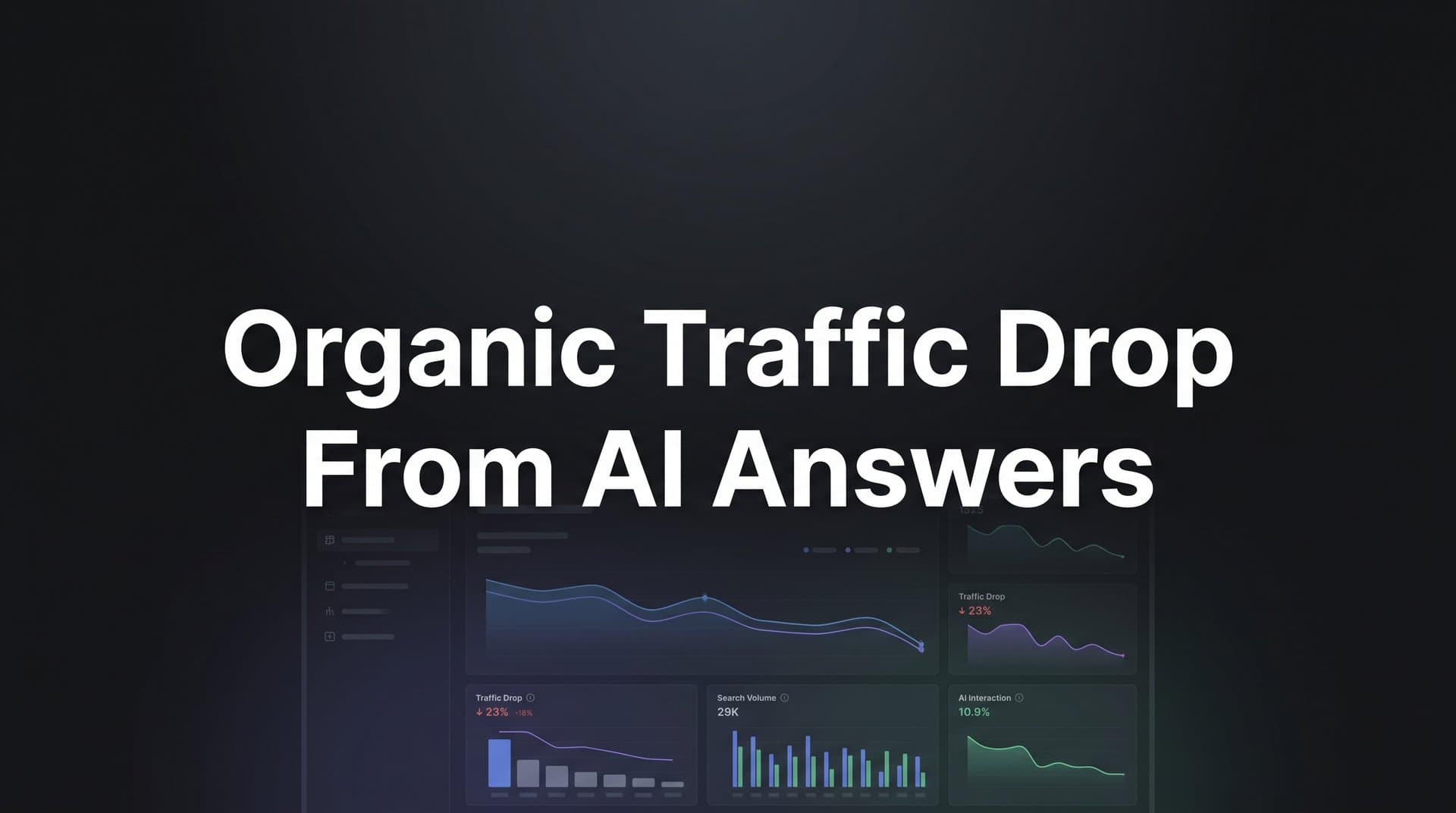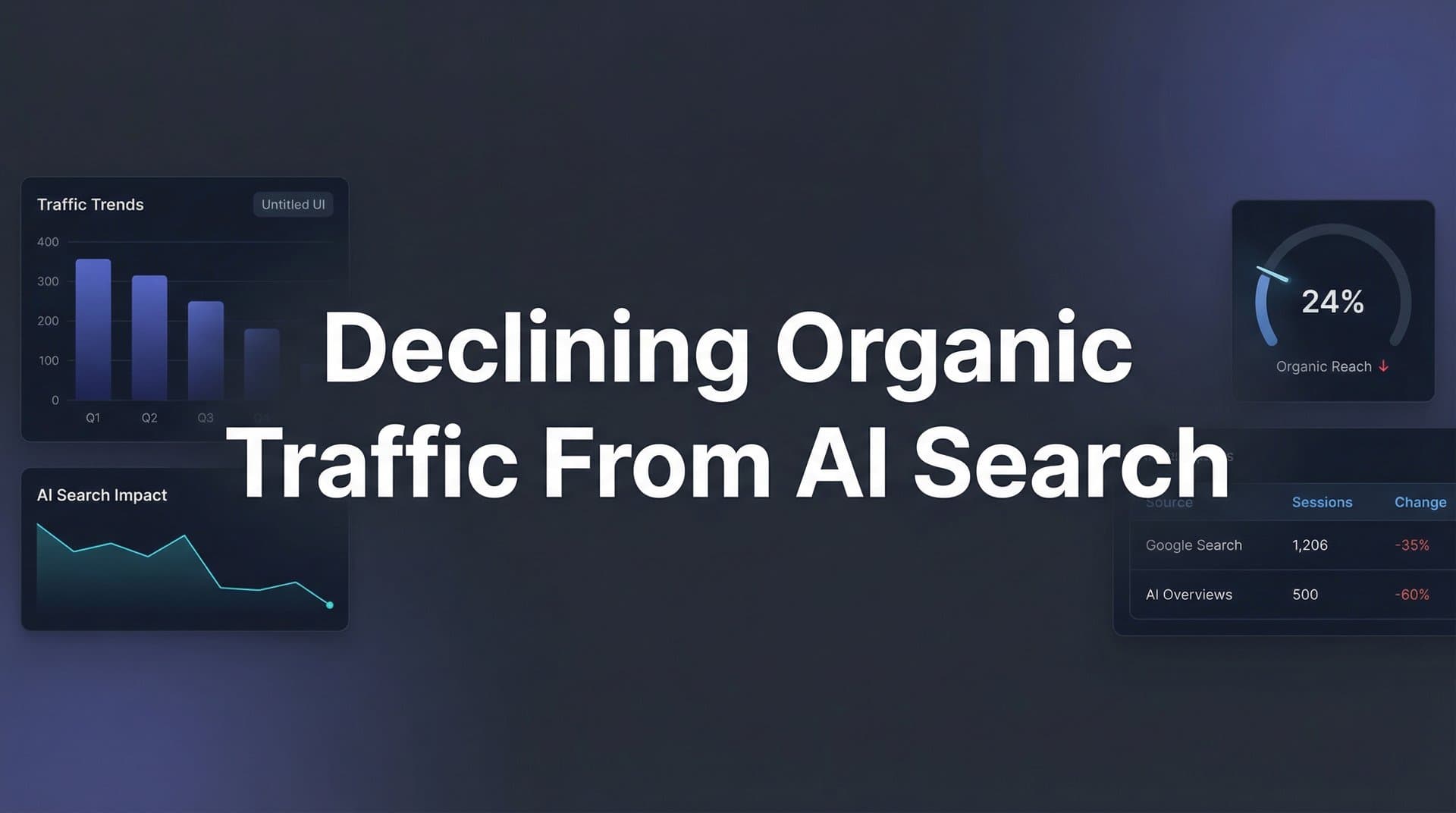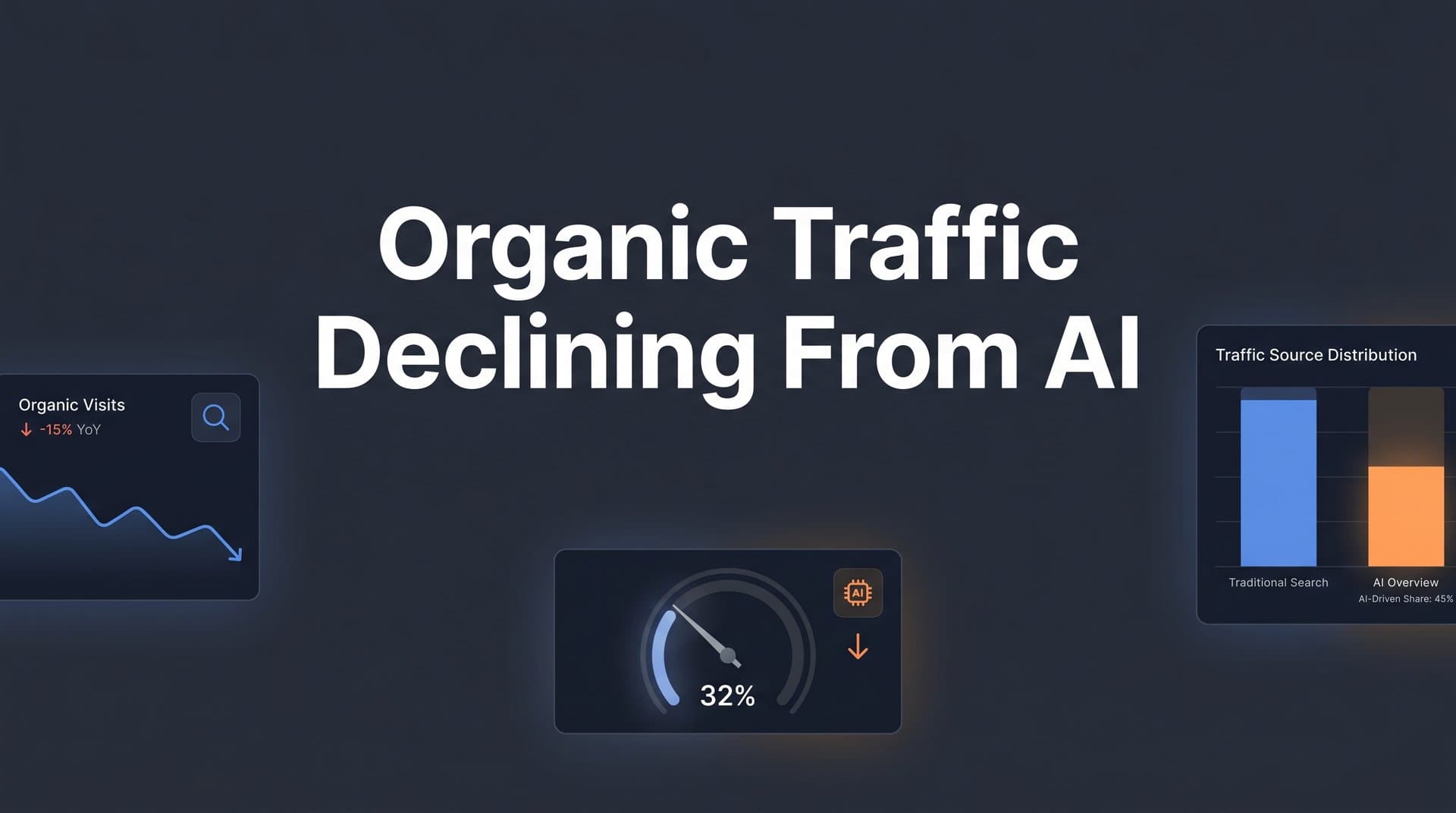
Check your Google Analytics dashboard right now. If you're seeing a slow, steady decline in organic traffic over the past year or two, you're not alone, and you're probably not doing anything wrong. The culprit isn't a Google penalty, a technical SEO issue, or a competitor outranking you on every keyword. It's something more fundamental: the way people find information is changing at a structural level, and the old playbook is losing its grip.
AI-powered search experiences, from Google's AI Overviews to ChatGPT's web search, Perplexity's answer engine, and Claude's expanded capabilities, are intercepting queries that used to send users clicking through to your pages. The user gets their answer. You get nothing. No session, no lead, no conversion opportunity. For businesses that built their growth engine on organic search traffic, this is more than an inconvenience. It's an existential question about where the next audience is going to come from.
The anxiety is real, but the panic isn't necessary. What this moment actually calls for is clarity: understanding exactly what's driving the decline, which parts of your traffic are truly at risk, and what the forward-thinking teams in your space are doing to not just survive but build new competitive advantages in the AI search era. That's exactly what this article covers.
The Mechanics Behind the Traffic Drop
To understand why organic traffic is declining from AI, you need to understand what's actually happening at the point of search. When a user types a question into Google today, they increasingly see an AI-generated summary at the top of the results page before they see any blue links. Google's AI Overviews synthesize information from multiple sources and present a coherent answer inline. The user reads it, gets what they need, and moves on. No click. No visit. No engagement with your carefully crafted article.
This isn't entirely new territory. Zero-click searches have existed for years. Featured snippets, knowledge panels, and People Also Ask boxes were already siphoning clicks before AI entered the picture. But there's a meaningful difference between the old zero-click world and the new AI-generated answer paradigm. A featured snippet pulled a direct quote from one page. AI Overviews synthesize responses from multiple sources into a fluid, conversational answer that feels complete. Users have even less reason to dig deeper.
Outside of Google, the shift is even more pronounced. When someone asks ChatGPT or Perplexity a question, they're not even in a traditional search environment. There's no results page to compete on. The AI model generates an answer, may cite a few sources, and the conversation moves forward. Your website might have the best content on the topic, but if the model doesn't surface it, you don't exist in that interaction. This pattern is a key reason businesses are losing organic traffic to AI answers at an accelerating rate.
The query types most affected follow a clear pattern. Informational queries, the "what is," "how does," and "explain to me" questions, are handled exceptionally well by AI models. How-to content, definition articles, comparison guides, and general explainers are precisely the formats that AI can synthesize and deliver inline. These are also, not coincidentally, the formats that content-heavy websites have built entire traffic strategies around.
Transactional queries tell a different story. When someone searches for a specific product, a local service provider, or a brand by name, AI models are less likely to fully satisfy the intent without sending the user somewhere. Highly niche, technical, or experience-based queries also retain stronger click-through rates because the AI either doesn't have confident answers or the user needs to verify specifics. Understanding this distinction is the first step toward knowing which parts of your traffic are genuinely at risk and which are more defensible.
Which Businesses Feel It First
Not every business is equally exposed to organic traffic declining from AI. The impact depends heavily on your content model, your industry, and the types of queries that historically drove your traffic. Some businesses are watching their traffic erode quickly. Others are barely affected. The difference comes down to how much of your audience was arriving via informational intent.
Content-heavy sites sit at the highest risk. Blogs, media publishers, affiliate content sites, and educational resource hubs built their audiences on the back of informational queries. These are exactly the query types AI handles best. If your traffic strategy was "publish comprehensive guides on topics your audience searches for," you're competing directly with what AI models now provide for free, inline, without a click.
SaaS companies and marketing agencies that invested heavily in top-of-funnel educational content are experiencing a specific version of this problem. The blog posts designed to capture awareness-stage traffic, the "what is X," "how to do Y," and "best practices for Z" articles, are losing volume. Meanwhile, bottom-of-funnel pages, pricing pages, comparison pages, case studies, and product-specific landing pages, tend to hold up better because users with high purchase intent are more likely to want to visit the source directly. If your numbers have dropped sharply, our guide on organic traffic declining fast breaks down the immediate steps to take.
E-commerce and local service businesses occupy a different position. Someone searching for a plumber in their city or a specific product to buy isn't going to be satisfied by an AI-generated paragraph. The intent requires a real-world action that AI can't fulfill on its own. These businesses face different challenges in the AI era, but the traffic cliff that content publishers are experiencing is less acute for them.
There's also a compounding dynamic worth taking seriously. When traffic declines, engagement signals weaken. Fewer clicks, less time on site, fewer backlinks from people discovering and sharing content, all of these can gradually erode the domain authority signals that support rankings. Lower rankings mean less traffic, which further weakens signals. For sites already on a downward trajectory, the negative feedback loop can accelerate the decline if no corrective action is taken. Catching this early matters more than waiting to see if the trend reverses on its own.
AI Visibility: The Metric Most Teams Are Ignoring
Here's the reframe that changes everything: traffic isn't disappearing. It's migrating. The people who used to find you through a Google search are still out there, still asking questions, still looking for solutions. They're just doing it increasingly through AI interfaces, and the brands that show up in those AI-generated responses are capturing the attention that used to flow through blue links.
This is what AI visibility means in practice. It's the measure of whether your brand, your products, or your content gets cited, recommended, or referenced when users ask AI models questions in your domain. When someone asks ChatGPT "what's the best tool for tracking SEO performance," which brands does it mention? When a founder asks Perplexity "how do I improve my content marketing strategy," which resources or companies does it point to? Understanding how AI search recommends your brand is now a critical competency.
For most businesses, the honest answer is: they have no idea. They're tracking keyword rankings with the same tools they've used for years, watching organic traffic numbers in Google Analytics, and completely blind to whether they exist in the AI search layer at all. This is a significant strategic gap, and it's widening every month as more search behavior migrates to AI platforms.
Tracking AI visibility requires a different approach than traditional SEO monitoring. You're not checking where you rank for a keyword on a results page. You're systematically prompting AI models with the questions your target audience is likely to ask and analyzing whether your brand appears in the responses, how it's described, and whether the sentiment is positive, neutral, or negative. Across ChatGPT, Claude, Perplexity, and other platforms, the responses can vary significantly, which means you need coverage across multiple models to get a complete picture.
Think of it this way: a decade ago, if you weren't tracking keyword rankings, you were flying blind on SEO. Today, if you're not tracking AI mentions, you're flying blind on a channel that's growing faster than traditional search. The good news is that tools now exist specifically for this purpose. Platforms like Sight AI are built to monitor brand mentions across AI models, track how those mentions change over time, analyze sentiment, and identify which prompts and topics are driving or missing brand citations. This kind of visibility is quickly becoming table stakes for any team serious about organic growth in the current environment.
The teams that start building this intelligence now will have a significant advantage. They'll know which AI platforms mention them, what context those mentions appear in, and where the gaps are. That information directly informs the content strategy decisions that determine whether your brand grows or shrinks in the AI search layer.
Adapting Your Content Strategy for GEO and AI Search
Generative Engine Optimization, or GEO, is the discipline of structuring and creating content so that AI models can easily parse, cite, and recommend it. It's an emerging practice that's gaining serious traction among SEO professionals and content strategists who've recognized that optimizing purely for Google's crawler is no longer sufficient. GEO doesn't replace traditional SEO. It extends it into the AI layer.
The core principles of GEO start with entity clarity. AI models build understanding through entities, specific named things like brands, people, products, concepts, and their relationships. Content that clearly establishes what your brand is, what it does, who it serves, and how it relates to adjacent concepts gives AI models the structured context they need to cite you accurately. Vague, keyword-stuffed content that was written to game a ranking algorithm is exactly the kind of content AI models struggle to attribute and recommend. Teams exploring AI optimization for organic traffic are finding that entity-first content outperforms traditional keyword-focused approaches.
Structured data remains important, but its purpose is evolving. Schema markup helps AI models understand the type of content on a page, the entities involved, and the relationships between them. Well-structured pages with clear hierarchies, concise answer formatting, and explicit sourcing are more likely to be parsed correctly and referenced in AI-generated responses.
Authoritative sourcing is another GEO priority. AI models are more likely to cite content that demonstrates expertise, references credible sources, and takes clear positions based on evidence. This aligns with Google's long-standing E-E-A-T framework, but the stakes are higher in the AI context because a model that cites you is effectively endorsing you to its user.
The practical content pivot that many teams need to make is a shift away from high-volume informational keywords toward content that AI models can't easily synthesize on their own. This means experience-driven content: first-person accounts, original research, proprietary data, and expert opinions that aren't available anywhere else. AI models are trained on existing web content, which means they can reproduce general knowledge fluently. What they can't reproduce is your original perspective, your unique data, or your lived experience with a specific problem.
This is a meaningful strategic shift. Instead of writing the hundredth article explaining what content marketing is, you publish original research about how content marketing performance has changed in your industry. Instead of a generic how-to guide, you share a detailed case study from your own experience. Instead of aggregating information that AI already has, you become the primary source that AI models need to cite because the information exists nowhere else. That's the content that survives and thrives in the GEO era.
Faster Discovery: Why Indexing Speed Now Matters More Than Ever
There's a dimension of the AI search landscape that gets less attention than content strategy but is equally important: how quickly your new content gets discovered and indexed. In the traditional SEO world, a delay of a few days or weeks between publishing and indexing was inconvenient but rarely catastrophic. In the AI search era, that lag has more significant consequences.
AI models draw from indexed web content when generating responses. The faster your content enters the indexed web, the faster it becomes part of the knowledge pool that models can reference. If you publish a timely piece of original research or a response to a breaking industry development, but it takes two weeks to get indexed, you've missed the window where that content could have been surfaced in AI responses while the topic was actively being queried. Teams focused on faster organic traffic results are prioritizing indexing speed as a core part of their workflow.
This is where protocols like IndexNow become strategically relevant. IndexNow is a real protocol supported by Microsoft Bing and adopted by other search engines that allows websites to notify search engines of content changes the moment they're published, rather than waiting for a crawler to discover the update on its own schedule. The result is dramatically faster indexing, which means your content enters the discovery pipeline sooner.
Automated sitemap management works alongside this. When your sitemap is automatically updated every time you publish, and that update triggers an IndexNow notification, you've created a publishing workflow where discoverability is nearly instantaneous. For teams publishing at high velocity, this isn't a minor optimization. It's a compounding advantage. Every piece of content gets into the pipeline faster, which means more content accumulates in the indexed web over time, which means more opportunities to appear in AI-generated responses.
Publishing velocity itself becomes a strategic variable in this context. Teams that can consistently produce high-quality, GEO-optimized content and get it indexed quickly are building a larger surface area for AI citation. Sight AI's platform connects content generation for organic traffic, indexing automation, and AI visibility tracking precisely because these three functions are now deeply interdependent. Publishing without tracking whether it's being cited is like running ads without checking conversion data.
Building a Traffic Recovery Playbook for the AI Era
Understanding the problem is one thing. Having a concrete framework for responding to it is another. If your organic traffic is declining from AI-driven search changes, here's how to approach the recovery systematically.
Start with a traffic audit by intent: Pull your top-performing pages from 12-24 months ago and compare them to current performance. For each page that's lost significant traffic, categorize the primary query intent. Informational pages that lost traffic to AI Overviews need a different response than pages that lost traffic due to algorithm updates or competitive shifts. Knowing the cause determines the fix.
Identify what's recoverable through traditional SEO: Some pages lost traffic because they were outranked, not because AI intercepted the query. These are candidates for traditional SEO improvement: better content depth, stronger internal linking, updated information, improved E-E-A-T signals. Don't abandon SEO. Sharpen it where it still applies. Our breakdown of how to improve organic search traffic covers the fundamentals that remain effective.
Identify what needs an AI visibility strategy: Pages that lost traffic on informational queries where AI Overviews now dominate need a different approach. Ask whether the content can be transformed into something more original, more experience-driven, or more data-rich, content that AI models would want to cite rather than synthesize away. If the answer is no, consider whether that content is worth maintaining or whether resources are better redirected.
Diversify your traffic sources actively: Organic Google traffic should no longer be your only channel. Build presence in AI answer engines by optimizing for GEO. Develop direct audience relationships through email and community. Invest in content that earns backlinks and brand mentions organically, since these signals still matter for both traditional rankings and AI model training data. A comprehensive set of organic traffic growth strategies using AI can help you map out this diversification.
Set new KPIs that reflect the AI search reality: If you're only measuring organic sessions and keyword rankings, you're measuring the old game. Add AI mention frequency, AI sentiment scores, and brand recommendation rates across major AI platforms to your reporting dashboard. These metrics tell you whether you're winning or losing in the channel where your audience is increasingly spending its attention. Tools built specifically for AI visibility tracking make this measurable and actionable rather than anecdotal.
Scale content production with AI-assisted tools: The volume of GEO-optimized content needed to build meaningful AI visibility is significant. AI content tools that understand both traditional SEO requirements and GEO principles can help teams publish at the velocity needed without sacrificing quality. The key is using these tools to produce genuinely useful, original content, not to flood the web with generic material that AI models will ignore.
The New Organic: What Comes Next
Organic traffic declining from AI is a real trend with real consequences for businesses that haven't adapted. But it's worth stepping back and seeing it for what it actually is: the beginning of a new distribution channel, not the end of organic growth.
The audience hasn't disappeared. They're asking more questions than ever. They're getting answers from AI models, and those models are citing sources, recommending brands, and shaping purchasing decisions in ways that are only going to become more influential. The teams that treat AI models as a distribution layer, something to optimize for and build presence in, will capture the audience that's migrating away from traditional search.
The path forward starts with knowing where you stand. You can't optimize for AI visibility you can't see. Understanding how ChatGPT, Claude, Perplexity, and other models talk about your brand right now, what they say, what they miss, and where competitors are being cited instead, is the intelligence that makes every other strategic decision sharper.
From there, the work is about building content that earns its place in the AI search layer: original, authoritative, well-structured, and published fast enough to stay relevant. The companies that start this work now, while many competitors are still in denial about what's happening, will have a compounding advantage as AI search continues to mature.
Start tracking your AI visibility today and see exactly where your brand appears across top AI platforms. Stop guessing how AI models like ChatGPT and Claude talk about your brand, and start building the intelligence that turns a declining traffic trend into a genuine competitive advantage.