Picture this: A potential customer opens ChatGPT and types, "What's the best marketing automation tool for small agencies?" The AI responds with three detailed recommendations—and your product isn't one of them. Meanwhile, your competitor gets mentioned twice, complete with specific use cases and glowing context. This scenario is playing out thousands of times daily across AI search platforms, and most brands have no idea it's happening.
AI search engines like ChatGPT, Claude, and Perplexity have fundamentally altered how users discover brands and make purchasing decisions. Unlike traditional search engines that present a list of ranked pages, these AI models synthesize information from across the web and directly recommend solutions. Users often never click through to a website at all—they trust the AI's summary and move forward based on that advice alone.
For marketers and founders, this creates both a challenge and an opportunity. Your content must now be structured and optimized not just for Google's algorithms, but for the large language models that increasingly influence purchasing decisions. The good news? Most brands haven't adapted yet, which means early movers can capture significant visibility.
This guide walks you through a practical, six-step framework to optimize your content for AI search engines. You'll learn how to audit your current visibility, structure content for AI comprehension, build the authority AI models recognize, and continuously improve your presence across these platforms. Let's get started.
Step 1: Audit Your Current AI Visibility Baseline
You can't improve what you don't measure. Before diving into optimization, you need to understand where you currently stand in the AI visibility landscape. AI models may already be mentioning your brand—or they might be completely ignoring you in favor of competitors.
Start with manual testing. Open ChatGPT, Claude, and Perplexity in separate tabs. Craft 10-15 prompts that mirror how your target audience would ask for recommendations in your space. If you're a project management software, try prompts like "What's the best project management tool for remote teams?" or "Compare project management software for marketing agencies." Document every response meticulously.
Pay attention to three critical metrics during this manual audit. First, mention frequency—how often does your brand appear compared to competitors? Second, sentiment and context—when you are mentioned, is it positive, neutral, or in a limited context? Third, accuracy—are the AI models describing your product correctly, or are they confusing your features with another company's?
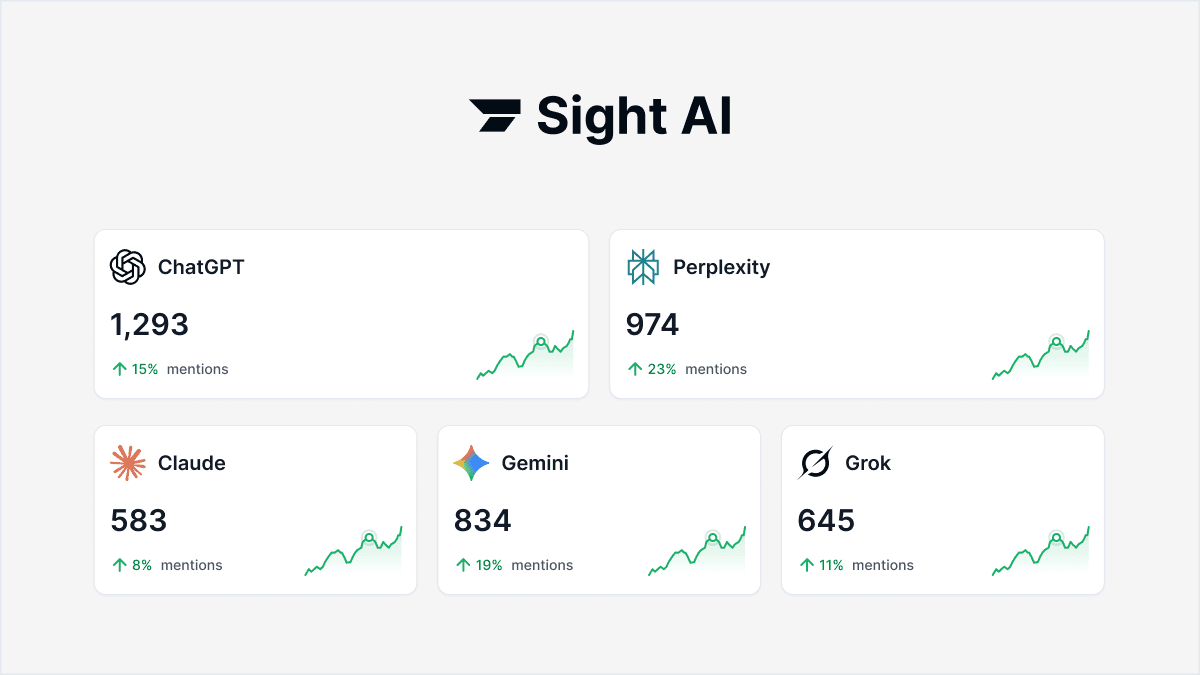
Manual testing gives you qualitative insights, but it's time-consuming and doesn't scale. For systematic monitoring, consider using AI visibility tracking tools that automatically test hundreds of prompts across multiple AI platforms. These tools can show you trends over time, alert you when your visibility changes, and provide competitive benchmarking that would take weeks to compile manually.
Create a simple baseline document. Record your current mention rate across each platform, note the prompts where you appear versus those where you don't, and identify which competitors consistently outrank you in AI recommendations. This baseline becomes your starting point for measuring improvement as you implement the optimization steps that follow.
The insight you gain here might surprise you. Many brands discover they're mentioned more than expected in certain contexts but completely absent in others. Understanding these patterns helps you prioritize which content gaps to fill first. If you're finding your content not ranking in AI search results, this audit will reveal exactly where the gaps exist.
Step 2: Structure Content for AI Comprehension
AI models don't read content the way humans do. They parse structure, identify entities, and map relationships between concepts. Content that works beautifully for human readers might be nearly invisible to an AI trying to understand what your company does and who it serves.
Start by implementing clear hierarchies in every piece of content. Use semantic HTML properly—H2 tags for main sections, H3 for subsections, and maintain a logical flow. AI models use these structural signals to understand which information is primary and which is supporting detail. A wall of text with no clear organization makes it difficult for AI to extract and cite your key points.
Write in a question-answer format whenever possible. This mirrors how users actually prompt AI assistants. Instead of writing "Our approach to customer onboarding," use "How does our customer onboarding process work?" as your heading. Then answer that question clearly and completely in the following paragraphs. This structure makes it easy for AI models to match user queries with your content.
Define entities explicitly. Don't assume the AI knows what your product is or does. Include clear statements like "Sight AI is an AI visibility tracking platform that monitors how brands are mentioned across ChatGPT, Claude, and Perplexity." These explicit definitions help AI models understand your category, function, and differentiators without having to infer from context.
Avoid jargon, unexplained acronyms, and industry shorthand unless you define them first. AI models struggle with ambiguity. If you use "GEO" in your content, explicitly state "GEO (Generative Engine Optimization)" the first time it appears. This clarity helps AI models confidently reference your content without second-guessing terminology. Understanding how AI search engines rank content will help you structure your pages more effectively.
Consider implementing schema markup where appropriate. While AI models don't rely on schema the same way traditional search engines do, structured data helps clarify relationships between entities—your company, your products, your team, and your content. Product schema, organization schema, and article schema all provide additional context that can improve AI comprehension.
The goal is to make your content so clear and well-structured that an AI model can quickly understand what you offer, who you serve, and why you're relevant to specific user queries. Remove ambiguity, add explicit definitions, and organize information logically.
Step 3: Build Topical Authority Through Comprehensive Coverage
AI models assess expertise differently than traditional search engines. Instead of primarily relying on backlinks and domain authority, they evaluate the depth and breadth of your content on a given topic. Comprehensive coverage signals genuine expertise.
Think of your content as a knowledge graph. If you want to be recognized as an authority on AI search optimization, you can't just publish one article about it. You need to cover the topic from multiple angles—introductory guides, advanced tactics, case studies, tool comparisons, industry trends, and common challenges. Each piece reinforces your expertise.
Create content clusters around your core topics. Start with a comprehensive pillar page that covers the fundamentals, then build supporting articles that dive deep into specific subtopics. For example, if your pillar page is "AI Search Optimization Guide," your cluster might include articles on AI visibility tracking, content structure for AI models, citation optimization, and distribution strategies.
Cover adjacent topics and anticipate follow-up questions. When users ask AI assistants about a topic, they rarely stop at one question. They ask follow-ups, explore related concepts, and seek deeper understanding. If your content only answers the initial question but ignores natural follow-ups, you miss opportunities for visibility in those subsequent queries. Learning to optimize content for LLM recommendations helps you capture these extended conversations.
Link related content pieces strategically. Internal linking helps AI models understand the relationships between your articles and reinforces that you've covered a topic comprehensively. When you mention a concept that you've written about elsewhere, link to that resource. This creates a web of topical authority that AI models can recognize and reference.
Update your content regularly to maintain accuracy and freshness. AI models increasingly favor current information, especially for topics that evolve quickly. Set a quarterly review schedule for your core content. Add new sections as the landscape changes, update statistics and examples, and remove outdated information. Fresh content signals ongoing expertise rather than stale knowledge from years past.
Comprehensive coverage doesn't mean publishing hundreds of shallow articles. It means thoroughly exploring your domain with depth and nuance. Quality beats quantity, but breadth matters when establishing authority in the eyes of AI models that synthesize information from multiple sources.
Step 4: Optimize for Citation and Attribution
AI models prefer to cite sources they can confidently attribute. Being citable isn't just about having good content—it's about making that content easy to reference with clear authorship, verifiable claims, and quotable insights.
Include original research, data, and unique perspectives in your content. AI models are more likely to cite sources that provide information they can't find elsewhere. If you're repeating the same advice available on dozens of other sites, there's little reason for an AI to specifically reference you. Conduct surveys, analyze industry trends, or share proprietary data that adds new information to the conversation.
Write clear, quotable statements that summarize key points concisely. Think of these as "pull quotes" that an AI could extract and attribute to you. Instead of burying insights in long paragraphs, create standalone sentences that capture important ideas. For example: "AI search optimization requires comprehensive topical coverage, not just keyword targeting." These crisp statements are easy for AI models to extract and cite.
Ensure your brand name appears naturally alongside your expertise claims. Don't just write about concepts in the abstract—connect them to your company's approach or methodology. This helps AI models associate your brand with specific strategies or insights. When appropriate, phrase things as "At Sight AI, we've found that..." or "Our approach to AI visibility tracking involves..." This attribution helps AI models understand who is making the claim.
Make your content easily verifiable with clear authorship and publication dates. Include author bios that establish credentials, display publication dates prominently, and update timestamps when you refresh content. AI models increasingly check the recency and authority of sources, and these signals help them assess whether your content is worth citing. For a deeper dive into this topic, explore strategies to optimize content for AI recommendations.
Avoid making claims you can't support. If you state a statistic or reference a trend, be prepared to back it up. AI models are becoming better at fact-checking, and unsupported claims can hurt your credibility. When you do cite external sources, link to them clearly—this transparency builds trust and makes your content more authoritative.
Step 5: Distribute Content Where AI Models Train and Retrieve
Your website isn't the only place AI models look for information about your brand. Modern AI systems use retrieval-augmented generation, pulling from diverse sources across the web to answer queries. Strategic distribution amplifies your visibility beyond your own domain.
Focus on getting mentioned on authoritative industry publications and review sites. When reputable third-party sources discuss your product or reference your expertise, AI models take notice. This external validation carries significant weight. Contribute guest articles to industry blogs, participate in expert roundups, and seek coverage from relevant media outlets.
Participate actively in forums, communities, and Q&A platforms where your target audience asks questions. Platforms like Reddit, Quora, and industry-specific forums are increasingly indexed and referenced by AI models. When you provide helpful, detailed answers on these platforms, you create additional touchpoints where AI can discover your expertise. Always add value first—self-promotion without substance backfires.
Ensure your content gets indexed quickly through automated tools. AI models that use real-time retrieval need to discover your content before they can reference it. Implement IndexNow integration to notify search engines immediately when you publish or update content. Understanding faster content discovery by search engines can dramatically improve how quickly your new articles appear in AI responses.
Consider creating an llms.txt file for your website. This emerging standard helps AI crawlers understand your site structure and prioritize which pages contain your most important information. While not yet universally adopted, early implementation positions you well as this practice becomes more common.
Think beyond traditional SEO distribution. AI models learn from podcasts, video transcripts, social media discussions, and collaborative documents. Diversify your content formats and platforms. A podcast interview where you discuss your expertise might be transcribed and referenced by AI models. A detailed Twitter thread might surface in AI-generated summaries. The more quality touchpoints you create across the web, the more opportunities AI models have to discover and reference your brand.
Distribution isn't about spamming your content everywhere—it's about being present in the authoritative sources and communities where your audience already seeks information. Focus on quality placements that genuinely serve users, and AI visibility will follow.
Step 6: Monitor, Measure, and Iterate Your AI Visibility
AI search optimization isn't a one-time project—it's an ongoing process of measurement and refinement. Set up systems to track your visibility over time and use that data to continuously improve your approach.
Establish ongoing tracking to measure changes in AI mentions across platforms. Manual spot-checks are useful for initial audits, but you need automated monitoring to understand trends. Track your mention frequency weekly or monthly, noting when visibility increases or decreases. Correlate these changes with your content publishing schedule to identify which types of content drive the most AI visibility.
Analyze which content topics and formats generate the most AI references. You might discover that comprehensive guides get cited more than brief blog posts, or that content addressing specific use cases appears more frequently than general overviews. These patterns should inform your content strategy going forward. Double down on what works and adjust what doesn't. Reviewing AI content optimization for search best practices can help refine your approach.
Test different optimization approaches and measure their impact. Try varying your content structure, experimenting with different question-answer formats, or adjusting how explicitly you define entities. Give each test enough time to show results—AI visibility can take weeks to shift as models update their knowledge. Document what you try and what happens so you build institutional knowledge about what drives results for your brand.
Pay attention to sentiment analysis, not just mention frequency. Being mentioned is good, but being mentioned positively is better. If AI models reference your brand in neutral or negative contexts, investigate why. You might need to address outdated information, clarify misconceptions, or improve aspects of your product that are generating criticism.
Create a monthly review cadence to assess your AI search performance. Block time each month to review your visibility metrics, analyze new patterns, identify emerging opportunities, and adjust your strategy accordingly. This regular rhythm ensures AI optimization remains a priority rather than something you check once and forget.
Share insights across your team. AI visibility impacts marketing, product, and customer success. When you notice AI models frequently mentioning a specific feature or use case, that's valuable market intelligence. When you see competitors gaining visibility in areas where you're absent, that reveals content gaps to fill. Make AI visibility data accessible to stakeholders who can act on it.
Putting It All Together
Optimizing content for AI search engines requires a systematic approach that differs fundamentally from traditional SEO. By auditing your baseline visibility, structuring content for AI comprehension, building topical authority, optimizing for citations, distributing strategically, and continuously monitoring results, you position your brand to be recommended when users ask AI assistants for solutions in your space.
The shift to AI search is happening now, not in some distant future. Every day, thousands of purchasing decisions are influenced by AI recommendations. Brands that adapt to this new reality early will capture visibility that becomes increasingly difficult to earn as competition grows and best practices mature.
Start with Step 1 this week. Test your current visibility across ChatGPT, Claude, and Perplexity using prompts relevant to your industry. Document what you find—where you appear, where you don't, and how you compare to competitors. That baseline data becomes your roadmap for improvement.
Then work through each subsequent step methodically. You don't need to implement everything at once. Focus on one step per month if that's what your resources allow. The key is consistent progress, not perfection. Each improvement compounds over time, gradually increasing your presence in AI-generated recommendations.
Remember that AI search optimization isn't about gaming the system—it's about making your genuine expertise more accessible to AI models that are trying to help users find the best solutions. When you create comprehensive, well-structured, authoritative content and distribute it strategically, you're making it easier for AI to do its job well. That's a win for users, for AI platforms, and for your brand.
Stop guessing how AI models like ChatGPT and Claude talk about your brand—get visibility into every mention, track content opportunities, and automate your path to organic traffic growth. Start tracking your AI visibility today and see exactly where your brand appears across top AI platforms.