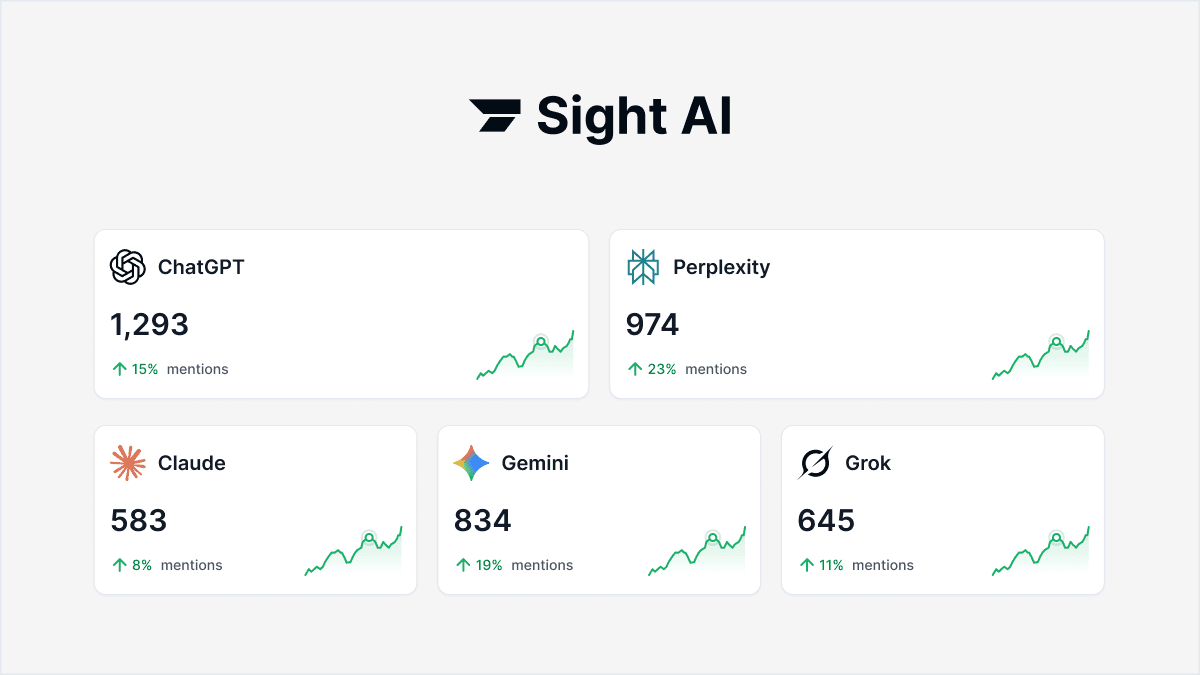
When a potential customer asks ChatGPT "What's the best marketing analytics platform?" your brand either gets recommended—or your competitor does. That single moment determines whether you gain a qualified lead or lose them to someone else. The stakes are higher than most marketers realize: LLMs like ChatGPT, Claude, Perplexity, and Gemini are becoming primary research tools, generating recommendations for millions of users daily. These AI systems don't just retrieve information—they synthesize it, evaluate credibility, and make judgment calls about which brands deserve mention.
Here's the challenge: optimizing for LLM recommendations requires a completely different playbook than traditional SEO. You're not gaming algorithms or stuffing keywords. You're teaching AI systems to understand your brand's unique value, recognize your expertise, and confidently recommend you when users ask relevant questions.
This guide provides a systematic framework for making your brand a consistent presence in AI-generated recommendations. Each step builds on the previous one, taking you from baseline assessment to ongoing optimization. By the end, you'll have a clear roadmap for positioning your content so that when users turn to AI for answers, your brand shows up.
Step 1: Audit How LLMs Currently Perceive Your Brand
Before you can optimize anything, you need to know where you stand. Most brands have zero visibility into how AI models currently talk about them—or whether they're mentioned at all.
Start by querying multiple LLMs with the exact prompts your target audience would use. Don't ask "Do you know about [Your Brand]?" That's useless. Instead, ask questions like "What are the best tools for [your category]?" or "Which [product type] should I use for [specific use case]?" Test variations across ChatGPT, Claude, Perplexity, and Gemini. Each model has different training data and recommendation patterns.
Document Everything: Create a spreadsheet tracking which competitors get mentioned, in what context, and with what level of detail. Pay attention to how LLMs describe these brands. Are they positioned as "industry leaders" or "affordable alternatives"? What specific features or benefits do the models highlight? This reveals the narrative framework LLMs use for your category.
Identify the Gaps: Compare how you position your brand versus how LLMs describe your category. If you claim to be "the most innovative solution" but LLMs describe your category in terms of "ease of use" and "affordability," you've found a disconnect. These gaps show where your messaging isn't penetrating AI training data.
Use AI visibility tracking tools to establish baseline metrics. Track mention frequency, sentiment, and context across different query types. This creates a benchmark for measuring improvement as you implement optimization strategies. Understanding how to track LLM recommendations for products is essential for establishing this baseline. Without this baseline, you're flying blind.
The audit typically reveals uncomfortable truths: competitors with weaker products but stronger content strategies dominate AI recommendations. That's actually good news—it means you can close the gap through systematic content optimization rather than product changes.
Step 2: Structure Content with Clear Entity Relationships
LLMs don't think in keywords—they think in entities and relationships. Your brand needs to exist in their knowledge graph as a distinct entity with clear, consistent attributes.
Define your brand using explicit relationship statements that LLMs can easily parse and remember. Instead of vague positioning like "We help businesses grow," use precise formulations: "Sight AI is an AI visibility tracking platform that monitors brand mentions across ChatGPT, Claude, Perplexity, and other AI models." This structure—[Brand] is a [category] that [specific function]—gives LLMs a clear framework for understanding what you do.
Consistency Is Everything: Use identical core descriptions across your website, About page, product pages, and blog content. LLMs learn from patterns. When they encounter the same entity description repeatedly across multiple sources, they encode it as authoritative information. Inconsistent descriptions create confusion and weaken your entity signal.
Create content that establishes explicit connections between your brand and relevant topics. Don't just write about "content marketing"—write about "how Sight AI helps marketers track AI visibility for content optimization." These relationship statements teach LLMs which topics should trigger mentions of your brand.
Schema Markup Matters: Implement Organization schema on your homepage with detailed properties: name, description, founding date, industry, products, and key differentiators. Add Product schema with specific attributes. While schema primarily serves search engines, it also provides structured data that AI crawlers can more easily process and incorporate into their knowledge bases.
Think of entity optimization as teaching LLMs your brand's identity. Every piece of content should reinforce who you are, what you do, and why you're relevant. Learning how to optimize content for AI models requires this repetition across contexts to build the strong entity signal that makes LLMs confident in recommending you.
Step 3: Write Definitive, Quotable Statements
LLMs generate recommendations by synthesizing information from sources they perceive as authoritative. Your content needs to give them clear, confident statements they can quote or paraphrase when answering user questions.
Craft concise statements that directly answer common questions in your category. Instead of "Our platform can help with various aspects of marketing," write "AI visibility tracking identifies exactly which AI platforms mention your brand and in what context." The second version is specific, quotable, and gives LLMs concrete information to work with.
Position as the Definitive Answer: Use authoritative language that signals expertise. Phrases like "The most effective approach to..." or "Industry leaders use this method to..." position your content as the authoritative source. LLMs are trained to recognize and value this confident, factual tone over hedged, uncertain language.
Include specific differentiators that help LLMs distinguish your offering from competitors. Generic descriptions like "powerful analytics" don't give AI systems anything unique to latch onto. Specific claims like "tracks brand mentions across 6+ AI platforms including ChatGPT, Claude, and Perplexity" provide concrete details LLMs can use when making recommendations.
Avoid hedging language. Phrases like "might help," "could potentially," or "in some cases" signal uncertainty. LLMs favor confident assertions backed by specifics. This doesn't mean making false claims—it means stating your actual capabilities with clarity and conviction.
Create pull-quote-worthy sentences throughout your content. These are statements so clear and valuable that an LLM would naturally select them when generating a response. Test this by asking yourself: "If an AI could only quote one sentence from this paragraph to answer a user's question, which sentence would be most useful?"
Step 4: Build Topical Authority Through Content Clusters
LLMs don't just evaluate individual pages—they assess your overall depth of knowledge on a topic. Comprehensive content ecosystems signal expertise in ways that isolated articles cannot.
Create content hubs around your core expertise areas. If you're a marketing analytics platform, build clusters covering AI visibility, content optimization, SEO strategy, and organic traffic growth. Each cluster should include a pillar page that provides comprehensive overview and multiple supporting articles that dive deep into specific aspects.
Interlink Strategically: Connect related articles using descriptive anchor text that reinforces topical relationships. When you link from an article about "AI content optimization" to one about "tracking brand mentions," you're teaching LLMs that these topics connect through your expertise. This internal linking structure helps AI systems understand the breadth and depth of your knowledge.
Cover adjacent topics that establish broader category authority. If your primary focus is AI visibility tracking, also create content about AI generated content for organic growth, SEO trends, and AI search optimization. This peripheral content reinforces your position as a comprehensive resource rather than a narrow specialist.
Freshness Signals Matter: LLMs are trained to value recent, updated information. Regularly refresh your content clusters with new insights, updated statistics, and current examples. Add publication dates and last-updated timestamps. This ongoing maintenance signals that your expertise remains current and relevant.
The goal is to become the go-to source for information in your domain. When LLMs encounter multiple high-quality pieces from your brand covering different aspects of a topic, they learn to recognize you as an authoritative voice worth recommending.
Step 5: Optimize for Conversational Query Patterns
Users ask AI assistants questions differently than they type into Google. Understanding these conversational patterns is critical for LLM optimization.
Research how people phrase questions to AI versus search engines. Traditional search queries are often fragmented: "best marketing analytics tool." Conversational AI queries are complete questions: "What's the best marketing analytics tool for tracking AI visibility?" Your content needs to address these fuller, more specific questions.
Structure for Common Question Formats: Build content around the question patterns LLMs encounter most frequently. "What is the best [category] for [use case]?" "How do I [accomplish goal] using [tool type]?" "Which [product] should I choose if I need [specific feature]?" Create dedicated sections or articles that directly answer these question formats.
Include comparison content that positions your brand against alternatives. Users frequently ask LLMs "What's the difference between [Brand A] and [Brand B]?" or "Should I use [Your Brand] or [Competitor]?" If you don't create this comparison content, LLMs will generate answers based solely on competitor information or third-party sources that may not accurately represent your advantages.
FAQ Sections Work: Add FAQ sections using natural, conversational language. Format them as actual questions users would ask: "How does AI visibility tracking help with SEO?" rather than "AI Visibility Tracking Benefits." These FAQ sections give LLMs ready-made question-answer pairs they can reference when generating responses.
Think about the full conversation flow. Users don't just ask one question—they ask follow-ups. Structure your content to address the logical progression of questions someone might ask about your category, your product, and your specific approach. Understanding how to optimize content for AI search ensures you're covering this comprehensive coverage that increases the likelihood that LLMs will find relevant information no matter how users phrase their queries.
Step 6: Amplify Credibility Signals Across the Web
LLMs are trained to value corroborated information. A claim on your website carries less weight than the same claim validated by multiple independent sources.
Secure mentions on authoritative industry publications and review sites. Guest posts, expert roundups, and contributed articles on respected platforms create third-party validation that LLMs recognize as credibility signals. When multiple sources mention your brand in similar contexts, AI systems encode that information as more reliable.
Reviews and Testimonials: Encourage authentic reviews on platforms that LLMs reference. G2, Capterra, Trustpilot, and industry-specific review sites all contribute to how AI models perceive your brand. Detailed reviews that mention specific features or benefits provide LLMs with concrete information they can synthesize into recommendations.
Build backlinks from trusted sources that reinforce your expertise claims. A backlink from an industry authority site doesn't just help with traditional SEO—it signals to LLMs that credible sources consider your content valuable enough to reference. Quality matters far more than quantity. A single mention from a highly authoritative source can outweigh dozens of low-quality backlinks.
Consistency Across Touchpoints: Maintain identical brand information across all digital properties. Your LinkedIn company page, Crunchbase profile, industry directories, and social media profiles should all use the same core description and positioning. Inconsistencies create noise that weakens the signal LLMs use to understand your brand.
Consider the cumulative effect of these credibility signals. Each individual mention might seem small, but collectively they create a pattern that LLMs interpret as authority and trustworthiness. The brands that dominate AI recommendations aren't necessarily the best products—they're the ones with the strongest, most consistent credibility signals across the digital ecosystem.
Step 7: Track, Measure, and Iterate Your LLM Visibility
LLM optimization isn't a one-time project. It requires ongoing monitoring and adjustment based on real performance data.
Set up systematic monitoring of brand mentions across major AI platforms. Track not just whether you're mentioned, but in what context, with what sentiment, and alongside which competitors. This ongoing visibility reveals patterns you can't see from occasional manual checks.
Sentiment and Context Matter: A brand mention isn't always positive. Monitor whether LLMs recommend you enthusiastically or mention you with caveats. Track the specific use cases or scenarios where you get recommended versus where competitors dominate. This context helps you identify content gaps and messaging opportunities.
A/B test content changes and measure their impact on LLM visibility. When you update your entity descriptions, add new content clusters, or refine your positioning, track whether these changes correlate with increased mentions or improved context in AI-generated responses. This experimental approach helps you identify which optimization tactics deliver the strongest results for your specific brand and category.
Adjust Based on Performance: Analyze which content types drive the most AI mentions. Are your comparison articles getting referenced more than your feature descriptions? Do your how-to guides generate more recommendations than your product pages? Leveraging an SEO content platform with analytics helps you double down on what works and refine what doesn't.
Create a regular review cycle—monthly or quarterly—where you systematically audit your LLM visibility, analyze changes, and adjust your content strategy accordingly. This disciplined approach ensures you're continuously improving rather than implementing changes blindly and hoping for results.
The brands winning in AI recommendations treat this as an ongoing discipline, not a campaign. They monitor constantly, experiment systematically, and iterate based on data. This sustained effort compounds over time, creating increasingly strong signals that make LLM recommendations more frequent and more favorable.
Putting It All Together
Optimizing content for LLM recommendations combines traditional content excellence with new AI-specific strategies. The framework is straightforward: understand your current position, establish clear entity relationships, create authoritative quotable content, build topical depth, optimize for conversational patterns, amplify credibility signals, and measure everything.
Start with your brand audit. Spend a week querying different LLMs with realistic user questions and documenting the results. This baseline shows you exactly where you stand and which competitors you need to outposition.
Then work systematically through entity optimization. Refine your core brand description, implement it consistently across all properties, and create content that reinforces these entity relationships. This foundation makes everything else more effective.
Build your content clusters methodically. Don't try to cover everything at once. Pick your three most important topic areas and create comprehensive hubs around them. Using long form content generation tools can help you scale this process while maintaining quality and depth that beats breadth every time.
The brands that master LLM optimization now will dominate AI-generated recommendations for years to come. While your competitors are still figuring out that this matters, you can establish the strong signals, comprehensive content, and credibility markers that make you the default recommendation in your category.
Use this checklist to track your progress: brand audit complete, entity descriptions defined and implemented, quotable authoritative statements created, content clusters built and interlinked, conversational query optimization applied, credibility signals amplified across the web, and monitoring systems active and producing regular insights.
The opportunity window won't stay open forever. As more brands recognize the importance of LLM visibility, competition for AI recommendations will intensify. The time to build your foundation is now, while the strategies outlined here can still deliver outsized results.
Start tracking your AI visibility today and see exactly where your brand appears across top AI platforms. Stop guessing how AI models like ChatGPT and Claude talk about your brand—get visibility into every mention, track content opportunities, and automate your path to organic traffic growth.