When someone opens ChatGPT and asks "What's the best project management tool for remote teams?" your brand either gets mentioned—or it doesn't. That single moment determines whether you've captured a potential customer or lost them to a competitor. The difference isn't luck. It's optimization.
AI assistants like ChatGPT, Claude, and Perplexity are fundamentally changing how people discover brands and make purchasing decisions. These platforms don't just return a list of blue links. They synthesize information, evaluate sources, and generate specific recommendations based on patterns they've learned and content they can retrieve.
Here's the challenge: AI models don't process content the way traditional search engines do. Google looks at backlinks and keyword density. AI looks for clear, authoritative information it can extract and cite with confidence. It evaluates whether your content directly answers questions, whether you're consistently associated with specific solutions, and whether your information is structured in a way that makes extraction effortless.
This creates an entirely new optimization challenge. You're not trying to rank number one on a search results page. You're trying to become the source AI trusts enough to mention when it matters most—when someone is actively seeking a solution you provide.
This guide walks you through six actionable steps to optimize your content specifically for AI recommendations. You'll learn how to structure information so AI can easily extract and cite it, build the authority signals that make AI trust your brand, and track whether your optimization efforts are actually working. By the end, you'll have a repeatable framework for increasing your brand's visibility across AI-powered search and recommendation systems.
Step 1: Audit Your Current AI Visibility Baseline
You can't improve what you don't measure. Before you change a single piece of content, you need to understand exactly how AI platforms currently talk about your brand—or whether they mention you at all.
Start by identifying the prompts your target audience actually uses. Think beyond vanity searches like "best [your product category]" and consider the full range of questions someone might ask. If you sell email marketing software, they might ask "How do I increase open rates for cold emails?" or "What tools do B2B companies use for lead nurturing?" Write down 10-15 realistic prompts that would naturally lead to your solution.
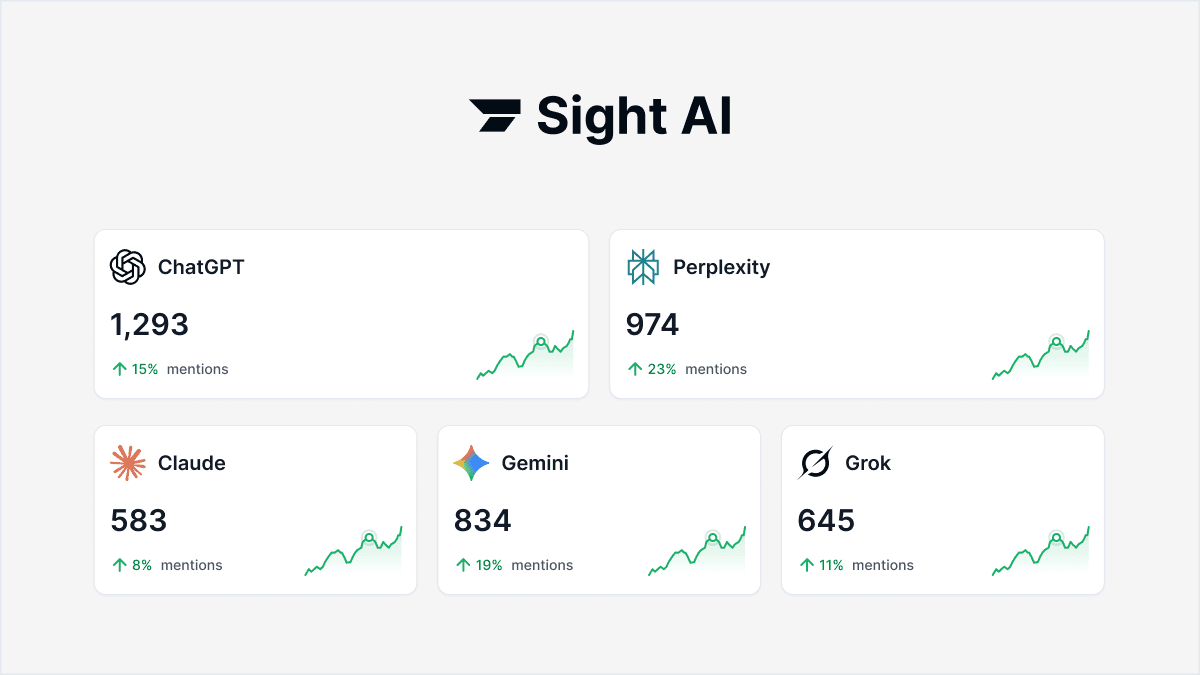
Now query each major AI platform with these prompts. Test ChatGPT, Claude, Perplexity, and Gemini at minimum. Don't just check if your brand appears. Document everything: Which competitors get mentioned? How are they described? What specific features or benefits does AI highlight? Where do you rank in the list of recommendations, if you appear at all?
Pay close attention to how AI describes brands when it does mention them. Does it cite specific use cases? Does it mention pricing, features, or ideal customer profiles? This tells you what information AI considers relevant and quotable for recommendations.
Create a simple tracking spreadsheet with columns for: prompt used, AI platform, brands mentioned, your brand's position (or "not mentioned"), and how your brand was described. Include a date column so you can track changes over time.
The gaps you discover here are your roadmap. If AI mentions competitors for specific use cases but not your brand, you know you need content that explicitly connects your solution to those scenarios. If AI describes your product inaccurately, you need clearer, more authoritative content defining what you actually do. Understanding how to optimize content for ChatGPT recommendations starts with knowing your current baseline.
This baseline audit typically reveals uncomfortable truths. Many brands discover they're completely absent from AI recommendations despite having strong traditional SEO. That's actually good news—it means there's significant opportunity for improvement.
Step 2: Structure Content for AI Extraction
AI doesn't read your content the way humans do. It scans for extractable facts, clear statements, and structured information it can confidently cite. Your job is to make that extraction effortless.
Start with your headings. Every H2 and H3 should be a complete, descriptive phrase that could stand alone as a question or statement. Instead of "Features" write "Key Features That Set [Your Product] Apart for Remote Teams." AI uses these headings to understand content structure and identify relevant sections to extract from.
Lead every paragraph with your main point stated directly and factually. Think of it as writing topic sentences that could be quoted verbatim. Instead of building up to your point, start with it. "Sight AI's content generation system uses 13 specialized AI agents to create SEO-optimized articles" is immediately extractable. "Our system is really interesting because we've developed something unique" is not.
Structure complex information using formats AI can easily parse. Comparison tables work exceptionally well—AI can extract structured data and present it clearly in responses. Numbered lists with clear labels help AI understand sequences and hierarchies. Definition blocks that explain "What is X" in self-contained sentences become prime citation material.
Here's the critical rule: every sentence should make complete sense when extracted out of context. AI might pull a single sentence from the middle of your article and present it as a fact. When you optimize content for LLM consumption, sentences that rely on context from previous paragraphs become misleading or confusing when isolated.
Test this yourself. Pick random sentences from your content and read them in isolation. Do they communicate a complete, accurate thought? If not, rewrite them to be self-contained while maintaining natural flow.
Avoid ambiguous pronouns and vague references. Instead of "This helps teams collaborate better," write "Sight AI's real-time collaboration features help marketing teams publish content faster." The second version is extractable because it includes the subject, action, and outcome in one complete statement.
Think of your content as a database of quotable facts rather than a narrative essay. You can still maintain engaging writing, but every key point should be structured for easy extraction and citation.
Step 3: Build Topical Authority Through Content Depth
AI trusts sources that demonstrate comprehensive expertise in specific domains. Scattered, shallow content signals you're a generalist. Deep, interconnected content clusters signal you're an authority worth citing.
Identify your core expertise areas—the topics where you genuinely have unique knowledge and experience. For each area, map out the full spectrum of questions someone might ask, from absolute beginner to advanced practitioner. This becomes your content cluster strategy.
Create pillar content that comprehensively covers each major topic. These aren't 800-word blog posts. They're definitive guides that answer every fundamental question about a subject. When AI looks for authoritative information about a topic, comprehensive coverage signals reliability. Using a long form AI content writer for SEO can help you create the depth needed to establish authority.
But depth isn't just about word count. It's about original value. Include proprietary data you've collected, case studies from your actual experience, or unique frameworks you've developed. AI particularly values information it can't find replicated across dozens of other sources.
Interlink your content strategically. When you write about related topics, link between them using descriptive anchor text. This helps both crawlers and AI systems understand the relationships between your content pieces and recognize you as a topical authority.
Answer questions at every level of sophistication. If you only create advanced content, AI won't cite you for beginner questions. If you only create introductory content, AI won't trust you for complex queries. Coverage across the knowledge spectrum establishes you as the go-to source regardless of the user's expertise level.
Consistency matters as much as depth. Publishing one comprehensive guide then going silent for six months doesn't build authority. Regular publication on your core topics signals you're an active, current source of expertise.
The goal is to become the definitive source for your niche. When AI needs to answer questions in your domain, it should find multiple high-quality pieces of content from your site, all demonstrating deep expertise and interconnected knowledge.
Step 4: Optimize for Entity Recognition and Brand Mentions
AI needs to understand what your brand is, what it does, and when it's relevant to recommend. This requires consistent, clear entity signals throughout your content.
Use your exact brand name consistently across all content. Variations and abbreviations confuse entity recognition systems. If your brand is "Sight AI," don't alternate between "Sight," "Sight.ai," and "the platform." Consistency helps AI understand these references point to the same entity.
Associate your brand with specific use cases and outcomes in explicit terms. Don't just describe features—connect them to scenarios. "Sight AI helps marketers track how ChatGPT and Claude mention their brands" creates a clear association between your brand, your audience (marketers), and specific outcomes (tracking AI mentions).
Create dedicated pages that clearly define your brand's purpose and ideal users. An "About" page isn't enough. You need content that explicitly states "Sight AI is a [category] for [audience] that helps [outcome]." These definition statements become anchor points for AI's understanding of your entity.
Appear in contexts where AI would naturally recommend solutions. If you sell project management software, create content answering "How do remote teams stay organized?" and "What tools prevent project delays?" Your brand should appear in content that directly addresses the problems you solve. Learning how to optimize for AI recommendations requires understanding these contextual triggers.
Build semantic associations between your brand and category terms. Mention your brand alongside the specific category you compete in: "Sight AI's AI visibility tracking platform" reinforces that you're in the AI visibility tracking category. This helps AI understand when to recommend you based on category queries.
The more consistently your brand appears connected to specific problems, solutions, and use cases, the more confidently AI can recommend you in relevant contexts. Entity recognition isn't about gaming a system—it's about making your brand's purpose and value unmistakably clear.
Step 5: Accelerate Content Discovery and Indexing
Even the best-optimized content can't influence AI recommendations if it hasn't been discovered and processed. Faster indexing means your content can impact AI responses sooner, particularly for systems that use real-time retrieval.
Implement IndexNow to notify search engines immediately when you publish or update content. This protocol allows you to ping search engines directly rather than waiting for them to crawl your site naturally. Major search engines including Bing and Yandex support IndexNow, and submitted URLs get processed significantly faster than those discovered through traditional crawling.
Maintain an accurate, up-to-date XML sitemap that includes all your important content. Use priority signals appropriately—your pillar content and most valuable pages should have higher priority values. Submit your sitemap to search engines and update it automatically whenever you publish new content.
Optimize your site's technical performance for crawler efficiency. Fast page load times mean crawlers can process more of your content in each crawl session. Mobile-friendly rendering ensures your content is accessible across all crawler types. Clean HTML structure without excessive JavaScript dependencies makes content extraction straightforward. These technical foundations support your broader content optimization for AI discovery efforts.
Publish consistently to signal you're an active, authoritative source. Sites that publish regularly get crawled more frequently. This creates a positive feedback loop—more frequent crawling means new content gets indexed faster, which reinforces your site's authority and crawl priority.
For time-sensitive content or major updates, consider using multiple indexing methods simultaneously. Submit through IndexNow, update your sitemap, and share new content on platforms where it might get picked up quickly. The goal is reducing the lag between publication and when AI systems can access your content.
Monitor your indexing status through search console tools. If important pages aren't getting indexed, investigate technical barriers like robots.txt blocks, noindex tags, or crawl errors that might be preventing discovery.
Step 6: Monitor, Measure, and Iterate on AI Mentions
Optimization without measurement is guesswork. You need systematic tracking to understand what's working and where to focus your efforts next.
Set up a regular AI visibility monitoring schedule—monthly at minimum, weekly if you're actively optimizing. Use the same prompts from your baseline audit, but expand the list as you identify new relevant queries. Test across multiple AI platforms because each may have different training data and retrieval capabilities.
Track not just whether you're mentioned, but how you're described. Is AI accurately representing your product? Is the sentiment positive? Are the features and use cases it highlights aligned with your positioning? Inaccurate descriptions signal you need clearer, more authoritative content defining your brand.
Identify patterns between your content and AI mentions. When you publish a comprehensive guide on a specific topic, do you start appearing in AI responses related to that topic? This correlation helps you understand which content types and topics drive visibility most effectively. Mastering how to optimize content for AI search requires this kind of iterative analysis.
Document prompt variations that do and don't trigger mentions. Sometimes a slight rewording reveals gaps in your optimization. If AI mentions you for "best AI visibility tools" but not "how to track ChatGPT brand mentions," you know you need content that explicitly addresses that second query.
Create a scoring system for tracking progress. Assign points for appearing in responses, bonus points for being mentioned first or described in detail, and track your total score over time. This quantifies improvement and helps you demonstrate ROI for optimization efforts.
Use these insights to refine your content strategy continuously. If certain content pieces correlate with increased mentions, create more content in that style or on related topics. If you're absent from specific query types despite having relevant offerings, that's your content gap to fill.
The brands seeing the most success with AI visibility treat it like a continuous optimization cycle: measure, create targeted content, measure again, refine based on results.
Putting It All Together
Optimizing content for AI recommendations isn't a one-time project—it's an ongoing process of creating clear, authoritative content and tracking how AI systems respond. The brands winning AI recommendations are those treating AI visibility as seriously as traditional SEO, with dedicated measurement systems and continuous optimization.
Start with your baseline audit. Spend an hour querying AI platforms with prompts your target audience would use. Document everything you find. This gives you both your starting point and your roadmap for improvement.
Next, restructure your highest-value content for AI extraction. Take your most important pillar pages and apply the formatting principles from Step 2. Clear headings, self-contained statements, structured data. You'll immediately see the difference in how quotable your content becomes.
Implement IndexNow for faster content discovery. This is a one-time technical setup that pays dividends on every piece of content you publish going forward. Your new content will influence AI responses weeks or months faster than it would through traditional crawling alone.
Set up monthly AI visibility tracking. Put it on your calendar. Use the same prompts each month so you can measure progress accurately. This regular measurement keeps you focused on what's actually working rather than what you assume is working.
Here's your quick-start checklist: Query AI platforms with your target prompts and document current visibility. Restructure one pillar page using AI-friendly formatting. Implement IndexNow for faster content discovery. Set up monthly AI visibility tracking.
The opportunity here is significant. Most brands haven't started optimizing for AI recommendations yet. They're still focused exclusively on traditional search while their potential customers increasingly turn to AI for research and recommendations. Starting now gives you a measurable advantage.
Stop guessing how AI models like ChatGPT and Claude talk about your brand—get visibility into every mention, track content opportunities, and automate your path to organic traffic growth. Start tracking your AI visibility today and see exactly where your brand appears across top AI platforms.