When someone asks ChatGPT to recommend a project management tool, does your brand come up? When Claude synthesizes information about your industry, does it mention your company as a credible source? If you don't know the answer, you're already behind.
AI search engines have fundamentally rewritten the rules of online visibility. Traditional search engines show you a list of links. AI models like ChatGPT, Claude, Perplexity, and Gemini synthesize information from across the web and generate direct answers—often naming specific brands, products, and companies in their responses.
This isn't just a different interface for the same old SEO playbook. It's a complete paradigm shift.
The optimization strategies that worked for Google's algorithm won't necessarily make AI models recommend your brand. Link building matters less. Keyword density is nearly irrelevant. What matters now is whether AI systems can comprehend your content, trust your authority, and confidently cite you as a reliable source.
The challenge? Most marketers and founders are flying blind. They have no idea how AI models currently talk about their brand, which competitors are dominating AI-generated recommendations, or what content gaps are costing them visibility.
This guide changes that. You're about to learn a six-step framework for optimizing your brand's presence across AI search algorithms. By the end, you'll know exactly how to structure content so AI models understand it, build the topical authority that makes AI systems trust you, and establish monitoring systems that reveal optimization opportunities before your competitors find them.
Whether you're a marketer trying to increase organic visibility, a founder wondering why competitors keep getting mentioned instead of you, or an agency managing visibility for multiple clients, these six steps will help you build a presence that AI algorithms can't ignore.
Step 1: Audit Your Current AI Visibility Baseline
You can't optimize what you haven't measured. Before you change a single piece of content, you need to understand your starting point: how AI models currently perceive and present your brand.
Start by querying your brand name directly across the major AI platforms. Open ChatGPT, Claude, Perplexity, and Gemini. Ask each one: "What do you know about [Your Brand Name]?" Then get more specific: "What are the best [your product category] tools?" and "How does [Your Brand] compare to [top competitor]?"
Document everything. Does the AI mention your brand at all? If it does, what does it say? Is the information accurate, outdated, or completely wrong? What's the sentiment—positive, neutral, or negative? What context surrounds your mention?
Here's what many companies discover during this audit: AI models either don't mention them at all, or they present outdated information from years-old sources. Meanwhile, competitors with stronger content strategies dominate the responses.
These gaps aren't failures. They're opportunities.
Next, identify the content gaps. When you ask about your product category and your brand doesn't appear, that's a signal. What topics are competitors covering that you're not? What questions do AI models answer using competitor content instead of yours?
Create a simple spreadsheet with three columns: Query, AI Platform, and Result. Test 10-15 relevant queries across all platforms. Track which competitors appear, in what context, and with what frequency. This becomes your competitive intelligence baseline.
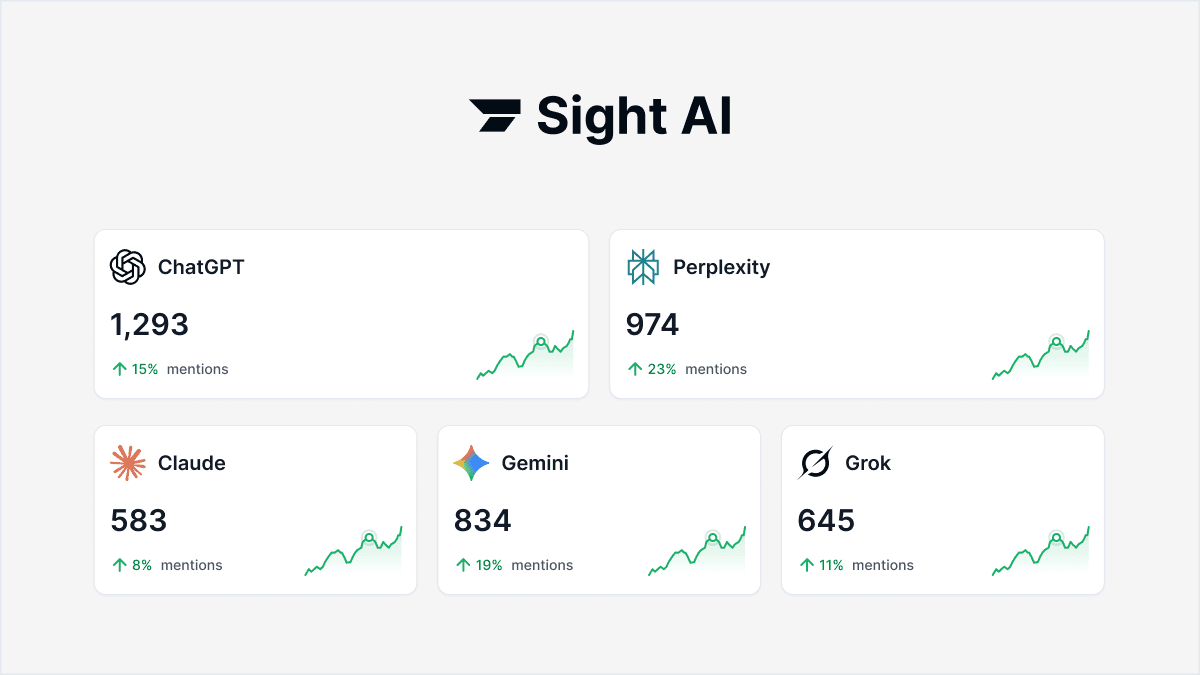
The most effective approach is using AI visibility tracking tools that automate this process. Manually querying multiple platforms weekly isn't scalable. Tools that monitor brand mentions across AI models give you quantifiable benchmarks: how often you're mentioned, sentiment trends over time, and which content drives the most citations.
Set your baseline metrics now. In 30 days, after implementing the remaining steps, you'll measure again. The difference will tell you exactly what's working.
Step 2: Structure Content for AI Comprehension
AI models don't read content the way humans do. They parse structure, extract entities, and synthesize information based on how clearly you've organized your ideas. If your content is a wall of text with vague headings, AI algorithms struggle to understand what you're actually saying.
Start with hierarchical content structure. Your H2 headings should clearly signal what each section covers. Not "Getting Started" but "How to Set Up Your First Campaign in Under 10 Minutes." Not "Features" but "Core Features That Differentiate Our Platform from Competitors."
AI models use these headings as signals for topic relationships. When your structure is clear, AI can confidently extract and cite specific information. When it's vague, AI moves on to clearer sources.
Write explicit definitions and explanations. Traditional SEO taught us to be clever and conversational. AI optimization requires directness. If you offer "workflow automation software," say that explicitly in the first paragraph. Don't make AI infer it from context clues.
Think about how AI models answer questions. Someone asks, "What is workflow automation?" The AI synthesizes definitions from multiple sources. If your content includes a clear, authoritative definition—"Workflow automation is the process of using software to execute recurring business tasks without manual intervention"—you become a citeable source.
Implement schema markup and structured data. This is technical, but it matters. Schema tells AI models exactly what entities exist on your page: products, services, people, organizations, reviews, FAQs. When you mark up a product with schema, you're explicitly telling AI crawlers: "This is a product. Here's its name, description, price, and availability."
Most content management systems have plugins that make schema implementation straightforward. If you're on WordPress, use a schema plugin. If you're on Webflow or custom code, implement JSON-LD structured data in your page headers.
Add FAQ sections that mirror natural language queries. When someone asks an AI model a question, the AI looks for content that directly answers that question format. An FAQ section with questions like "How does [your product] integrate with Salesforce?" or "What's the difference between [your product] and [competitor]?" gives AI models ready-made answers to cite.
Format these FAQs with schema markup for maximum impact. Each question-answer pair becomes a structured entity that AI models can extract and reference with confidence. Understanding how AI search engines rank content helps you prioritize these structural elements.
Step 3: Build Topical Authority Through Content Clusters
AI models favor sources that demonstrate comprehensive expertise. A single great article isn't enough. You need depth across an entire topic area—what content strategists call topical authority.
Map your expertise into interconnected content hubs. Identify your core topics—the areas where your brand has genuine expertise and value to offer. For each core topic, create a pillar page that serves as the definitive guide.
Let's say you offer marketing automation software. Your core topics might include email marketing, lead scoring, campaign analytics, and CRM integration. Each becomes a pillar page: comprehensive, authoritative content that covers the topic thoroughly.
Then develop supporting content around each pillar. Your email marketing pillar might have supporting articles on deliverability best practices, subject line optimization, segmentation strategies, and automation workflows. Each supporting article links back to the pillar and to related supporting content.
This structure helps AI models understand the depth of your expertise. When multiple pages on your site cover different angles of the same topic, all linking to each other with clear context, AI algorithms recognize you as an authoritative source worth citing.
Create content that answers every related question in your domain. Use tools like AnswerThePublic or browse Reddit and Quora to identify real questions people ask about your topics. Turn each question into a piece of content.
When someone asks an AI model a question about your domain, you want your content to be the clear, comprehensive answer the AI reaches for. That only happens when you've covered the topic more thoroughly than competitors. Implementing semantic search optimization techniques strengthens these topical connections.
Interlink strategically. Every piece of content should link to related content with descriptive anchor text. Not "click here" but "learn how email segmentation improves deliverability." These internal links help AI crawlers understand relationships between your content pieces and map your topical coverage.
The companies winning AI visibility right now aren't those with the most content. They're those with the most comprehensive, interconnected content on specific topics.
Step 4: Optimize for Entity Recognition and Brand Signals
AI models build knowledge graphs—interconnected databases of entities and their relationships. For your brand to be recognized as a credible entity, you need consistent signals across the web that validate your existence and authority.
Start with NAP consistency. Name, Address, Phone number should be identical everywhere your brand appears online. Your website, Google Business Profile, LinkedIn company page, industry directories, review sites—every instance should match exactly.
Why does this matter for AI? Because AI models cross-reference information from multiple sources. Inconsistent NAP data creates confusion about whether two mentions refer to the same entity. Consistency builds confidence.
Build citations on authoritative industry directories and knowledge bases. Identify the top 10-20 directories and review sites in your industry. Create or claim your profiles. Fill them out completely with consistent information.
These citations serve as validation signals. When AI models encounter your brand name, they look for corroborating information. Multiple authoritative sources saying the same thing about your brand strengthens entity recognition. Understanding AI search engine ranking factors helps you prioritize which signals matter most.
Create a comprehensive About page that establishes expertise and credibility. This isn't marketing fluff. This is entity documentation. Who founded the company? When? What problem does it solve? Who are the key team members? What credentials and experience do they bring?
AI models use About pages to understand what a company actually does and whether it's a legitimate, established entity. Include team pages with individual bios. Link to team members' LinkedIn profiles. Show that real, credentiable people stand behind your brand.
Maintain active presence on platforms AI models frequently reference. LinkedIn is particularly important—AI models often cite LinkedIn company pages and employee posts as authoritative sources. Industry publications, trade associations, and professional networks also carry weight.
Publish thought leadership content on these platforms. When AI models see your executives contributing insights on LinkedIn or quoted in industry publications, it reinforces your brand's authority and expertise.
Step 5: Accelerate Content Discovery and Indexing
The fastest content to get indexed is the content AI models see first. Traditional SEO relied on search engine crawlers eventually discovering new pages. AI optimization requires proactive notification.
Implement the IndexNow protocol. This is a simple API that lets you notify search engines and AI crawlers the instant you publish new content. Instead of waiting days or weeks for discovery, your content gets indexed within hours. Learn more about IndexNow vs Google Search Console to understand which approach fits your workflow.
IndexNow is supported by Microsoft Bing, Yandex, and other search engines. While Google doesn't officially participate, faster indexing across other platforms still improves overall AI visibility. Implementation is straightforward—most modern CMS platforms have plugins or integrations that automate IndexNow submissions.
Maintain updated XML sitemaps and submit them to all major search engines. Your sitemap is a roadmap of your content. When it's current and properly submitted, crawlers know exactly what exists on your site and when it was last updated.
Update your sitemap automatically whenever you publish new content. Submit it to Google Search Console, Bing Webmaster Tools, and other search platforms. This ensures AI crawlers have a complete, current map of your content.
Publish consistently to signal freshness. AI models prioritize recently updated sources. A site that publishes weekly signals active maintenance and current information. A site that hasn't been updated in months signals potential staleness.
You don't need to publish daily, but establish a consistent cadence. Weekly is ideal. Bi-weekly works. Monthly is the minimum to maintain freshness signals.
Monitor crawl rates and fix technical issues. Use Google Search Console and Bing Webmaster Tools to track how often AI crawlers access your site. If crawl rates drop, investigate. Are there server errors? Slow page speeds? Robots.txt blocks preventing access? Our guide on how to get indexed by search engines faster covers these technical optimizations in detail.
Technical issues that block crawlers also block AI visibility. A page AI crawlers can't access is a page AI models can't cite.
Step 6: Monitor, Measure, and Iterate Your AI Optimization
AI search optimization isn't a one-time implementation. It's an ongoing discipline that requires consistent monitoring and strategic refinement based on what you learn.
Track brand mentions across AI platforms weekly. Return to the queries you tested in Step 1. Run them again. Are you appearing more frequently? Has sentiment improved? Are you being mentioned in new contexts? Tools designed to monitor AI search engine results can automate this tracking.
Consistent tracking reveals trends. Maybe your brand starts appearing in responses about a specific use case you've been creating content around. That's validation—double down on that content cluster. Maybe a competitor suddenly dominates a category you used to own. That's a signal to investigate what changed.
Analyze which content types generate the most AI citations. Not all content performs equally. You might discover that your how-to guides get cited frequently while your product announcements don't. Or that comprehensive comparison articles drive more mentions than brief blog posts.
When you identify high-performing content types, create more of them. AI visibility optimization is about pattern recognition—find what works and scale it.
Monitor competitor mentions to identify new optimization opportunities. When competitors are ranking better in AI search and you're not appearing, investigate the content they've created. What topics are they covering that you haven't? What questions are they answering? What format are they using?
You're not copying competitors. You're identifying content gaps in your own strategy and filling them with your unique expertise and perspective.
Adjust your content strategy based on how AI responses evolve over time. AI models update regularly. The sources they reference shift. The way they synthesize information changes. Your optimization strategy needs to evolve with them.
Set a monthly review where you analyze visibility trends, content performance, and competitive landscape. Use these insights to refine your content calendar, update existing content, and identify new optimization opportunities.
Putting It All Together
AI search algorithm optimization isn't a one-time project. It's an ongoing discipline that requires consistent monitoring and refinement. But you don't need to implement everything at once.
Here's your quick-start checklist: First, audit your current AI visibility across major platforms. Document where you appear, where competitors dominate, and what content gaps exist. Second, restructure your highest-traffic existing content for AI comprehension—add clear headings, explicit definitions, and FAQ sections. Third, map your content into topical clusters and identify the pillar pages you need to establish authority.
Fourth, audit your NAP consistency and build citations on authoritative industry directories. Fifth, implement IndexNow and update your XML sitemaps to accelerate content discovery. Sixth, establish weekly monitoring routines to track brand mentions and identify optimization opportunities.
Start with Step 1 today. You can't optimize what you haven't measured. Run those initial queries across ChatGPT, Claude, Perplexity, and Gemini. Document what you find. That baseline becomes your starting point.
The brands winning AI visibility right now are those treating it as seriously as they once treated traditional SEO. They're not waiting for AI models to discover them by accident. They're proactively structuring content, building authority, and monitoring visibility with the same rigor they applied to ranking on Google. Understanding the key differences between AI search optimization vs traditional SEO is essential for this transition.
The opportunity window is still open. AI search optimization is new enough that many companies haven't started yet. The brands that establish authority now, while competition is relatively low, will have a significant advantage as AI search becomes the dominant discovery method.
Stop guessing how AI models like ChatGPT and Claude talk about your brand—get visibility into every mention, track content opportunities, and automate your path to organic traffic growth. Start tracking your AI visibility today and see exactly where your brand appears across top AI platforms.