Search has fundamentally changed, and most marketers haven't caught up yet. Your potential customers aren't just typing queries into Google anymore—they're asking ChatGPT for recommendations, getting instant answers from Claude, and discovering solutions through Perplexity. These AI assistants are becoming the new front door to information, and if your content isn't optimized for them, you're invisible to a rapidly growing segment of searchers.
Here's the challenge: traditional SEO strategies that got you to page one of Google don't automatically make AI models cite your brand. These language models read the web differently, extract information differently, and decide what's worth mentioning based on entirely different signals than search engine algorithms. You might rank #1 for your target keyword but never get mentioned when someone asks ChatGPT for the best solution in your category.
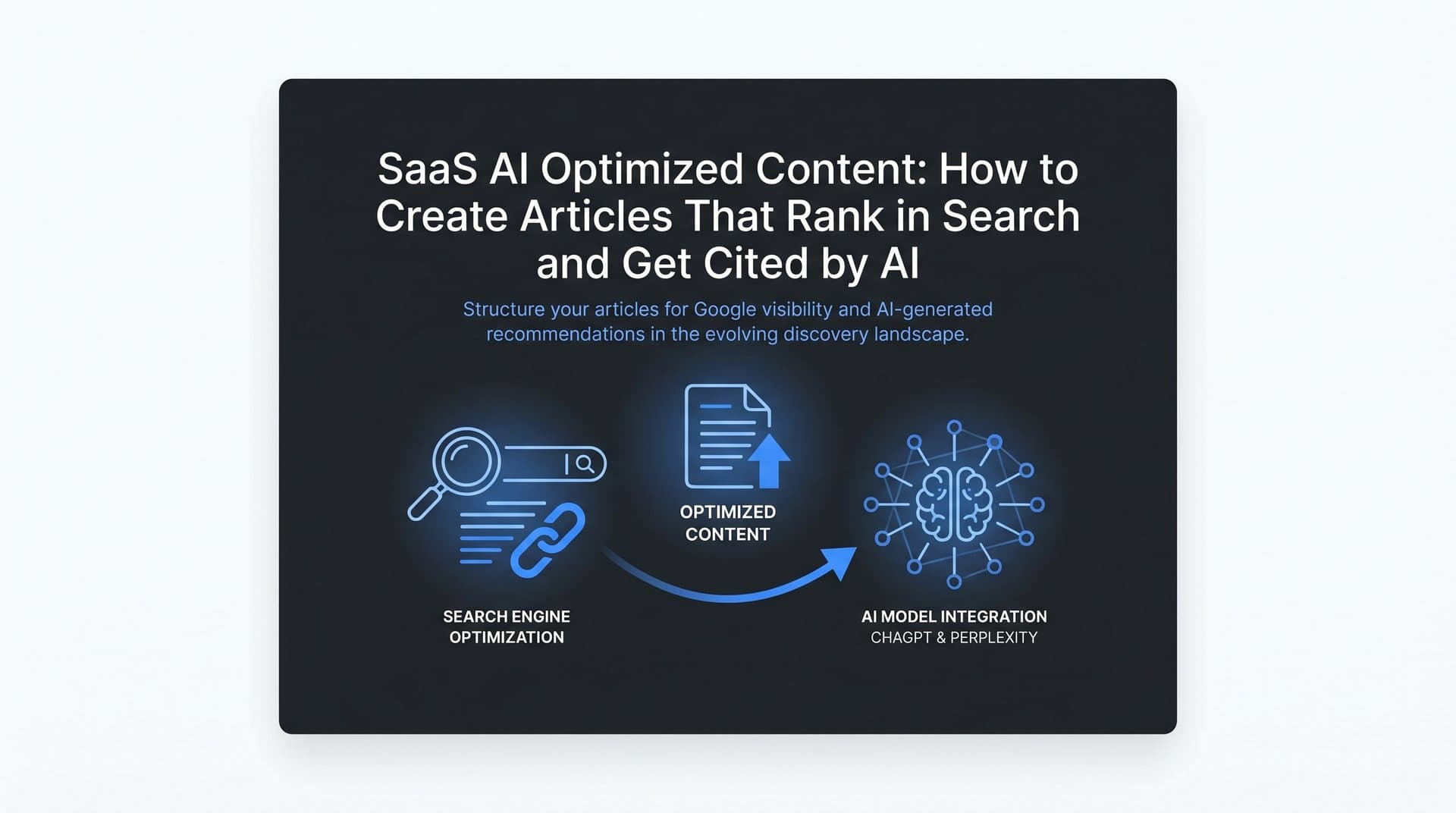
AI content optimization bridges this gap. It's not about abandoning SEO—it's about expanding your optimization strategy to work across both traditional search engines and the AI platforms that are reshaping how people find information. This article will show you exactly how to create content that performs in both worlds, giving you a competitive advantage while your competitors are still optimizing for yesterday's search landscape.
Understanding How AI Models Discover and Use Your Content
Google's crawlers and AI language models approach your content with fundamentally different objectives. When Googlebot crawls your site, it's indexing pages, analyzing link structures, and trying to match queries with relevant results. The goal is to point users toward helpful pages. AI models, on the other hand, are building knowledge representations—they're reading your content to understand concepts, extract facts, and synthesize information they can later recall and cite when answering questions.
This difference matters more than most marketers realize. Google cares about your page's authority signals, backlink profile, and user engagement metrics. AI models care about the clarity of your information, the factual density of your statements, and how easily they can extract and attribute specific claims. A page stuffed with keywords and optimized for click-through rates might rank well but provide little value to an AI trying to understand your expertise.
Think of it like this: Google is building a directory of the best places to find information. AI models are building a knowledge base of the information itself. When someone asks Claude "What's the best approach to email segmentation?" the model isn't searching an index of web pages—it's synthesizing knowledge it has already processed from thousands of sources, determining which approaches are most commonly recommended, and deciding which sources are authoritative enough to cite.
This is where GEO (Generative Engine Optimization) comes into play. While SEO focuses on ranking in search results, GEO focuses on being cited in AI-generated responses. The two disciplines overlap significantly—both reward high-quality, authoritative content—but they diverge in crucial ways. GEO places premium value on factual precision, clear attribution-friendly statements, and content structures that AI can easily parse and quote.
The practical implication? Content that ranks well on Google might never get mentioned by AI assistants if it's not written in a way that language models can confidently extract and cite. Your competitor with slightly lower Google rankings but clearer, more citation-worthy content structure might dominate AI visibility. As more users shift to AI-first search behaviors, that visibility gap becomes a business problem.
Writing Content That AI Models Can Extract and Cite
AI models excel at processing clear, declarative statements. When you write "Email segmentation improves campaign performance," that's a statement an AI can extract, understand, and potentially cite. When you write "It's no secret that savvy marketers have long known the power of dividing their lists," you've said essentially the same thing but in a way that's much harder for AI to parse and attribute.
The difference comes down to semantic clarity. Language models are trained to identify factual claims, definitions, and explicit relationships between concepts. Stylistic flourishes, rhetorical questions, and indirect statements create ambiguity that makes AI less confident about extracting and citing your content. This doesn't mean your writing should be robotic—it means your key points should be stated explicitly alongside your engaging prose.
Structure your content around frameworks that AI can easily recognize and reproduce. Definitions work exceptionally well: "Conversion rate optimization (CRO) is the systematic process of increasing the percentage of website visitors who complete a desired action." Comparisons are equally valuable: "Unlike A/B testing, which compares two variants, multivariate testing examines multiple variables simultaneously." Step-by-step processes give AI clear, sequential information to extract.
Make your expertise explicit: Instead of assuming readers understand context, state it clearly. "Based on analysis of successful SaaS onboarding flows, the most effective approach includes three core elements..." gives AI both the claim and the context needed for confident citation.
Use attribution-friendly phrasing: When you make claims, structure them in ways that naturally lend themselves to citation. "Research indicates that..." or "Industry analysis shows that..." signals to AI that this is factual information worth extracting, even when you're speaking from general industry knowledge rather than citing specific studies.
Front-load key information: AI models often extract information from the beginning of sections. If your main point appears in the third paragraph after extensive setup, it's less likely to be captured. Lead with your core insight, then elaborate.
Create conceptual density: AI values content that efficiently conveys substantive information. A paragraph that clearly explains three related concepts is more citation-worthy than three paragraphs that each meander toward a single point. Pack genuine insight into every section without sacrificing readability.
The goal isn't to write for robots—it's to write for humans in a way that robots can also understand and extract. Think of it as adding a layer of clarity that benefits both audiences. Your human readers get more actionable, clearly stated insights. AI models get content they can confidently process and cite. Understanding the nuances of AI content vs human content for SEO helps you strike this balance effectively.
Technical Infrastructure for AI Discoverability
Creating citation-worthy content is only half the equation—AI models also need to find and process that content efficiently. The technical foundation of your site plays a crucial role in AI visibility, and some of these technical considerations differ significantly from traditional SEO best practices.
Structured data and schema markup have always mattered for SEO, but they're increasingly important for AI comprehension. When you mark up your content with schema.org vocabulary, you're essentially translating your page into a format that machines can understand with high confidence. An article marked up with Article schema, including clear author information, publication date, and topic tags, gives AI models explicit context about your content's authority and relevance.
Speed of indexing has taken on new urgency in the AI era. Traditional SEO operated on timelines where getting indexed within days or weeks was acceptable. With AI models, there's a critical window for getting your content into training datasets and retrieval systems. If your competitor's content gets indexed and processed before yours, they establish first-mover advantage in AI knowledge bases.
This is where protocols like IndexNow become strategically important. IndexNow allows you to notify search engines and AI platforms immediately when you publish or update content, dramatically accelerating the discovery process. Instead of waiting for crawlers to eventually find your new article, you're pushing that update directly to the systems that matter.
Implement machine-readable formats: Beyond basic HTML, consider how your content appears in formats AI can easily parse. Clean semantic HTML, proper heading hierarchies, and well-structured lists all improve machine readability. Avoid burying important information in images or complex JavaScript that AI crawlers might struggle to process.
Optimize for llms.txt: Similar to how robots.txt tells search crawlers which pages to access, llms.txt is an emerging protocol for communicating with AI crawlers. While still evolving, implementing this file allows you to guide AI models toward your most authoritative content and away from pages that might confuse or mislead language models.
Maintain content freshness signals: AI models pay attention to publication and update dates when determining content relevance. Regularly updating cornerstone content and clearly marking those updates helps AI understand that your information remains current and authoritative. Understanding content freshness signals for search is essential for maintaining visibility across both traditional and AI search platforms.
The technical side of AI optimization isn't about gaming algorithms—it's about removing friction from the discovery and comprehension process. Every technical improvement that helps AI models find, understand, and trust your content compounds over time as those models continue to learn and evolve.
Measuring Your Visibility Across AI Platforms
Traditional rank tracking tells you where your pages appear in Google search results. That's valuable data, but it's only part of the picture when AI assistants are answering millions of queries daily. The question isn't just "Do we rank for this keyword?" but "When people ask AI about this topic, does our brand get mentioned?"
AI visibility measurement requires a fundamentally different approach. You need to track how often your brand, products, or content appear in responses from ChatGPT, Claude, Perplexity, and other AI platforms. More importantly, you need to understand the context of those mentions—are you being recommended as a solution, cited as an authority, or mentioned alongside competitors? Platforms designed for content optimization for Perplexity and similar AI search engines can provide these insights.
Sentiment analysis becomes crucial in this context. A mention isn't inherently positive. If an AI model cites your brand but describes a limitation or problem, that's valuable intelligence that traditional SEO metrics would miss entirely. Understanding not just if you're mentioned but how you're described gives you actionable insight into your AI reputation.
Track prompt patterns: Different queries trigger different responses from AI models. By monitoring which prompts and questions lead to mentions of your brand, you can identify content gaps and opportunities. If AI mentions you for "email marketing automation" but not "marketing automation platforms," that signals a specific content opportunity to address.
Monitor competitive visibility: AI citation isn't zero-sum, but it is competitive. When AI recommends solutions in your category, which brands get mentioned? Are you consistently included, occasionally mentioned, or notably absent? This competitive intelligence helps you understand your share of AI visibility relative to market position.
Measure across platforms: Different AI models have different knowledge bases and citation patterns. You might have strong visibility in ChatGPT but weak presence in Claude or Perplexity. Platform-specific tracking reveals where your optimization efforts are working and where you need to adjust strategy. Leveraging the best tools for AI search optimization makes this cross-platform measurement manageable.
Establish baseline metrics: AI visibility fluctuates as models update and training data evolves. Establishing baseline measurements for your brand mentions, sentiment scores, and citation frequency allows you to track trends over time and measure the impact of your optimization efforts.
The goal of measurement isn't just data collection—it's creating feedback loops that inform content strategy. When you see which topics, formats, and approaches generate AI citations, you can double down on what works and refine what doesn't. This iterative approach turns AI visibility from a mystery into a manageable, optimizable channel.
Integrating AI Optimization Into Your Content Workflow
AI content optimization works best when it's woven into your existing processes rather than treated as a separate initiative. The most effective approach combines the rigor of traditional SEO with new considerations for AI visibility, creating a unified workflow that addresses both search surfaces simultaneously.
Start with topic selection and keyword research that considers both traditional search volume and AI citation potential. Some topics naturally lend themselves to AI citations—definitive guides, comparison content, and how-to frameworks tend to perform well across both Google and AI platforms. Other content types might rank well in traditional search but rarely get cited by AI assistants. Understanding AI search optimization vs traditional SEO helps you make smarter topic decisions.
During content creation, build in checkpoints that ensure AI optimization. After drafting, review your content specifically for citation-worthiness: Are your key points stated explicitly? Do you have clear definitions for important concepts? Are your frameworks and processes described in ways AI can easily extract and reproduce? This review doesn't require rewriting everything—often it's about adding clarity to a few key sections.
Balance automation with expertise: AI-assisted content generation tools can accelerate production, but the most citation-worthy content typically combines AI efficiency with human expertise. Use AI to draft outlines, generate initial content, and suggest structure—then layer in your unique insights, specific examples, and authoritative perspective that only human expertise can provide. Exploring AI content creation with SEO optimization can help you find this balance.
Create content in clusters: AI models recognize topical authority through comprehensive coverage. Rather than publishing isolated articles, build content clusters around core topics. When you've published multiple high-quality pieces on related subjects, AI models are more likely to recognize your authority and cite your content when those topics arise.
Implement rapid publishing and indexing: Once content is finalized, get it indexed quickly. The faster your content enters AI knowledge bases, the sooner it can start generating visibility. Automated indexing through protocols like IndexNow should be built into your publishing workflow, not treated as an afterthought.
Monitor and iterate: After publication, track how your content performs across both traditional search and AI platforms. Which pieces generate citations? What patterns emerge in how AI models use your content? Use this intelligence to refine your approach for future content, creating a continuous improvement cycle. A dedicated AI search optimization platform can streamline this monitoring process.
The workflow doesn't end at publication. Regular content audits should now include AI visibility as a key metric alongside traditional SEO performance. Content that ranks well but generates no AI citations might need restructuring for better extraction. Content that AI frequently cites but doesn't rank well might need traditional SEO improvements. The goal is optimization across both dimensions.
Moving Forward in the Convergent Search Landscape
AI content optimization isn't replacing SEO—it's expanding what search optimization means in an era where answers come from multiple sources. The marketers who recognize this shift early and adapt their strategies accordingly will build sustainable competitive advantages while others are still optimizing exclusively for yesterday's search paradigm.
The convergence is already happening. Google is integrating AI-generated answers into search results. AI platforms are becoming more sophisticated about sourcing and attributing information. The line between "traditional search" and "AI search" will continue to blur until the distinction becomes largely meaningless. What matters is being visible and authoritative wherever your audience looks for information.
Early adoption compounds over time. Every piece of content you publish with AI optimization in mind becomes an asset that can generate visibility across multiple platforms. As AI models continue to evolve and their training data expands, well-optimized content from today becomes the foundation for citations tomorrow. The brands building this foundation now will dominate AI visibility in their categories for years to come.
The competitive landscape is still forming. Most companies haven't yet developed systematic approaches to AI content optimization. They're either ignoring AI search entirely or making scattered, inconsistent efforts without clear measurement. This creates an opportunity window for organizations that take a strategic, data-driven approach to optimization across both traditional and AI search surfaces.
Success in this new landscape requires visibility into how AI models actually talk about your brand. You can't optimize what you can't measure, and traditional SEO tools weren't built to track AI citations, sentiment, or competitive positioning across AI platforms. Start tracking your AI visibility today and see exactly where your brand appears across top AI platforms, what prompts trigger mentions, and how your content performs compared to competitors. Stop guessing about your AI presence and start building a systematic advantage in the search landscape that's emerging right now.