Tracking a handful of keywords manually is manageable. Tracking hundreds across multiple locations, devices, and search engines is a different challenge entirely. A multiple keyword rank checker lets you monitor your entire keyword portfolio in one place, surfacing ranking shifts before they become traffic problems.
This list covers the best tools for bulk keyword rank tracking in 2026, evaluated on tracking accuracy, scale, reporting depth, and value for money. Whether you're a solo founder monitoring a niche site or an agency managing dozens of client campaigns, there's a fit here for you.
One thing worth noting upfront: traditional rank tracking tools show Google positions, but AI search is creating a parallel discovery channel. Teams that only track Google rankings may be missing visibility shifts happening in AI-generated responses from platforms like ChatGPT, Perplexity, and Claude. We've factored that evolving reality into this list.
How to Use Ahrefs to Find Competitor Keywords
Ahrefs is one of the most capable tools available for uncovering the keywords your competitors rank for, and the workflow is more straightforward than many SEOs expect. The core idea is simple: instead of guessing which keywords to target, you let your competitors' existing rankings show you where organic traffic opportunity already exists.
The starting point is Site Explorer. Enter any competitor's domain into the Site Explorer search bar and navigate to the Organic Keywords report. This view shows every keyword the domain currently ranks for in Google's top 100 results, along with position, estimated traffic, and keyword difficulty. For large competitor sites, this list can run into the tens of thousands of keywords. Use the built-in filters to narrow it down: filter by position (for example, keywords ranking in positions 1 through 10 to find their strongest content), by keyword difficulty to find more attainable targets, or by traffic value to prioritize commercially significant terms.
The Top Pages report inside Site Explorer is worth visiting alongside the keyword view. Rather than looking at keywords in isolation, Top Pages shows which individual pages on a competitor's site drive the most organic traffic, along with the keywords each page ranks for. This is useful because it reveals the content formats and topics that are already proven to attract search traffic in your space. If a competitor has a page pulling significant organic visits from a cluster of related keywords, that's a signal worth taking seriously when planning your own content.
For a more targeted approach, Ahrefs' Content Gap tool is where competitive keyword research gets especially actionable. Navigate to Content Gap inside Site Explorer, enter your own domain as the target, and add two or three competitors as comparison domains. Ahrefs will return a list of keywords that your competitors rank for but your site does not. You can filter this list by the number of competitors ranking for each keyword: terms where multiple competitors rank simultaneously are often more reliable indicators of genuine search demand than one-off anomalies.
The Competing Domains report is a useful step to take before diving into keyword lists, particularly if you're new to a niche or working on a client site. It shows which domains share the most keyword overlap with your site, helping you identify your true organic competitors. These may not always be the brands you think of as business competitors. A media publication or an industry blog might share more keyword territory with your site than a direct product competitor, and those overlapping domains are worth investigating through Site Explorer as well.
When working through competitor keyword data in Ahrefs, a practical approach is to sort findings into three categories: keywords where a competitor ranks in the top three and you don't appear at all (indicating a significant gap), keywords where you rank on page two or three while a competitor holds page one (indicating an optimization opportunity rather than a creation opportunity), and keywords where neither of you rank strongly but search volume exists (indicating an open field worth entering). This sorting helps you prioritize effort based on the type of work required, whether that's publishing new content, strengthening existing pages, or building authority in an underserved topic area.
One practical limitation worth keeping in mind: Ahrefs' organic keyword data is based on its own crawl index and ranking estimates, not directly from Google. Position data may differ slightly from what you see in Google Search Console, particularly for lower-volume keywords. Using Ahrefs for competitive discovery and directional prioritization, then cross-referencing your own site's performance in Search Console, gives you a more complete and accurate picture than relying on either tool alone.
Quick methodology note: tools were assessed on their ability to handle large keyword sets, frequency of rank updates, SERP feature tracking, and ease of use for teams. Pricing reflects publicly available plans as of mid-2026.
1. Sight AI
Best for: Marketers and founders who need keyword tracking plus AI search visibility in one platform.
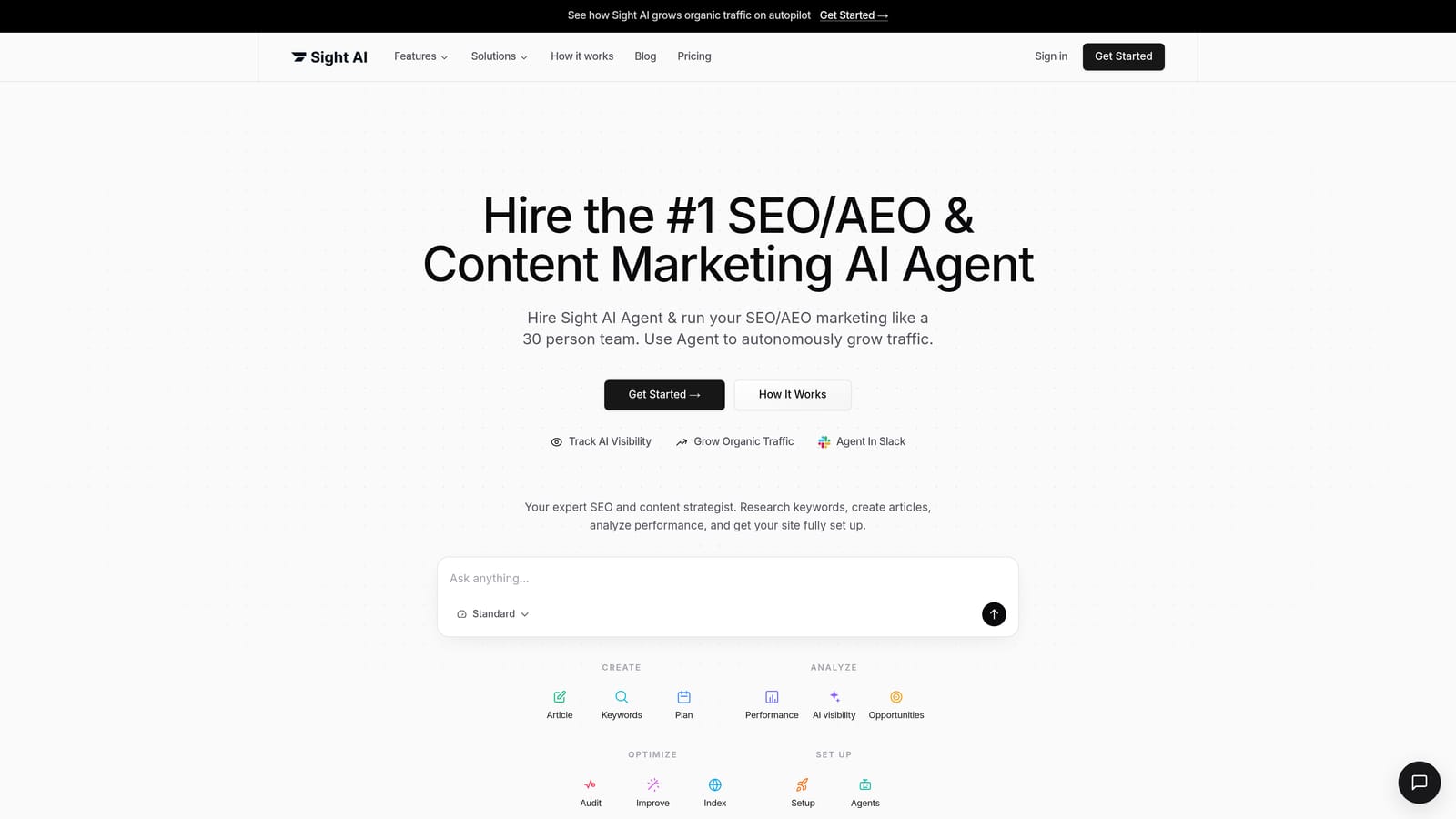
Sight AI is an all-in-one SEO and AI visibility platform that combines keyword rank tracking with brand mention monitoring across AI models like ChatGPT, Claude, and Perplexity, plus automated content generation and indexing tools.
Where This Tool Shines
Most rank trackers answer one question: where does my site rank on Google? Sight AI answers a broader one: where does my brand show up when people search, whether that's in traditional SERPs or AI-generated responses? That dual focus makes it genuinely different from every other tool on this list.
The platform is built for teams that recognize organic growth in 2026 means more than blue-link rankings. If your audience is increasingly discovering brands through AI assistants, having keyword rank data and AI visibility data in the same dashboard removes a significant blind spot from your reporting workflow.
Key Features
AI Visibility Score: Tracks how your brand appears across 6+ AI platforms including ChatGPT, Claude, and Perplexity, with sentiment analysis and prompt tracking built in.
Keyword Rank Tracking: Monitor your keyword portfolio alongside AI visibility data, giving you a complete picture of your organic search presence.
13+ Specialized AI Content Agents: Generate SEO and GEO-optimized content at scale using purpose-built agents for listicles, guides, explainers, and more.
IndexNow Integration: Automatically pushes new content to search engines for faster discovery, reducing the lag between publishing and indexing.
CMS Auto-Publishing: Connects content generation directly to your CMS, enabling a near-automated publishing workflow from brief to live article.
Best For
Marketers, founders, and agencies who are actively thinking about AI search visibility alongside traditional SEO. If you're running content programs at scale and want a single platform that handles tracking, content creation, and indexing, Sight AI is built for that workflow specifically.
Pricing
Visit trysight.ai for current pricing and plan options. Multiple tiers are available depending on keyword volume and feature needs.
2. Semrush
Best for: SEO teams that need daily rank tracking integrated with a full competitive intelligence suite.
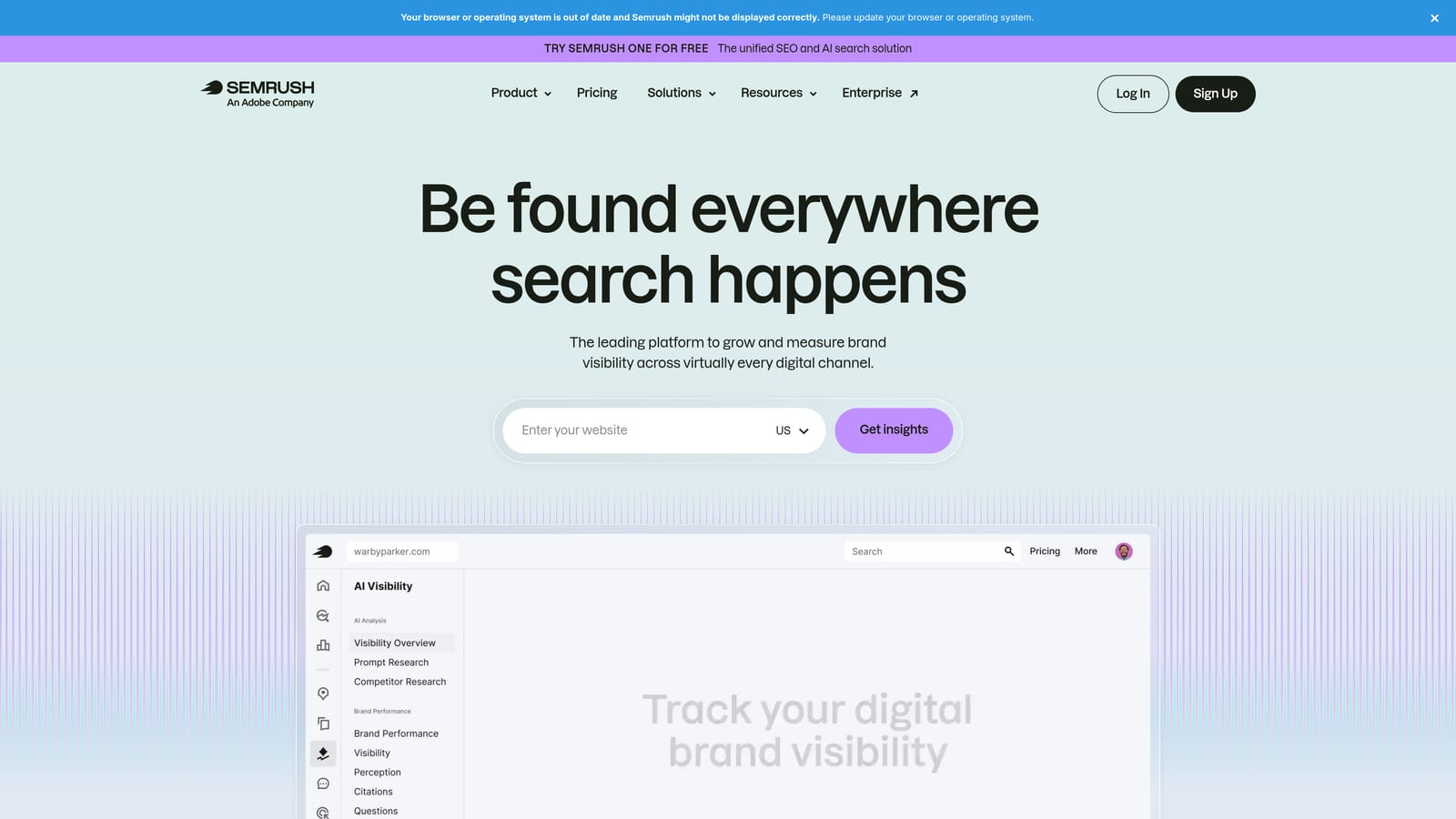
Semrush is one of the most widely used SEO platforms globally, with a dedicated Position Tracking tool that monitors large keyword sets daily across Google and Bing.
Where This Tool Shines
Semrush's Position Tracking is genuinely powerful for teams that need to monitor large keyword sets with daily granularity. The SERP feature tracking is particularly strong: you can see not just where you rank, but whether you're appearing in featured snippets, local packs, or People Also Ask boxes, which matters a lot for understanding actual traffic potential.
The bigger advantage is integration. Because Position Tracking lives inside the broader Semrush ecosystem, you can move fluidly between rank data, backlink analysis, site audits, and content tools without switching platforms. For teams that have standardized on Semrush, that workflow continuity is a real productivity advantage.
Key Features
Daily Rank Updates: Monitors thousands of keywords with daily refresh cycles, giving teams timely data for fast-moving competitive landscapes.
SERP Feature Tracking: Tracks presence in featured snippets, local packs, image packs, and other SERP features beyond standard organic positions.
Competitor Rank Comparison: Side-by-side visibility into how competitors rank for the same keyword set, within the same project view.
Device and Location Tracking: Separate rank data for mobile and desktop, plus location-specific tracking for local SEO campaigns.
Full Suite Integration: Rank data connects directly to Semrush's site audit, backlink analysis, and content marketing tools.
Best For
In-house SEO teams and agencies that want a single platform covering rank tracking, competitive research, backlinks, and content. Semrush works especially well when rank data needs to inform broader strategic decisions, not just reporting.
Pricing
Multiple subscription tiers available. Check semrush.com for current pricing, as plans and limits are updated regularly.
3. Ahrefs
Best for: SEO teams that want rank tracking tightly connected to backlink and content gap analysis.
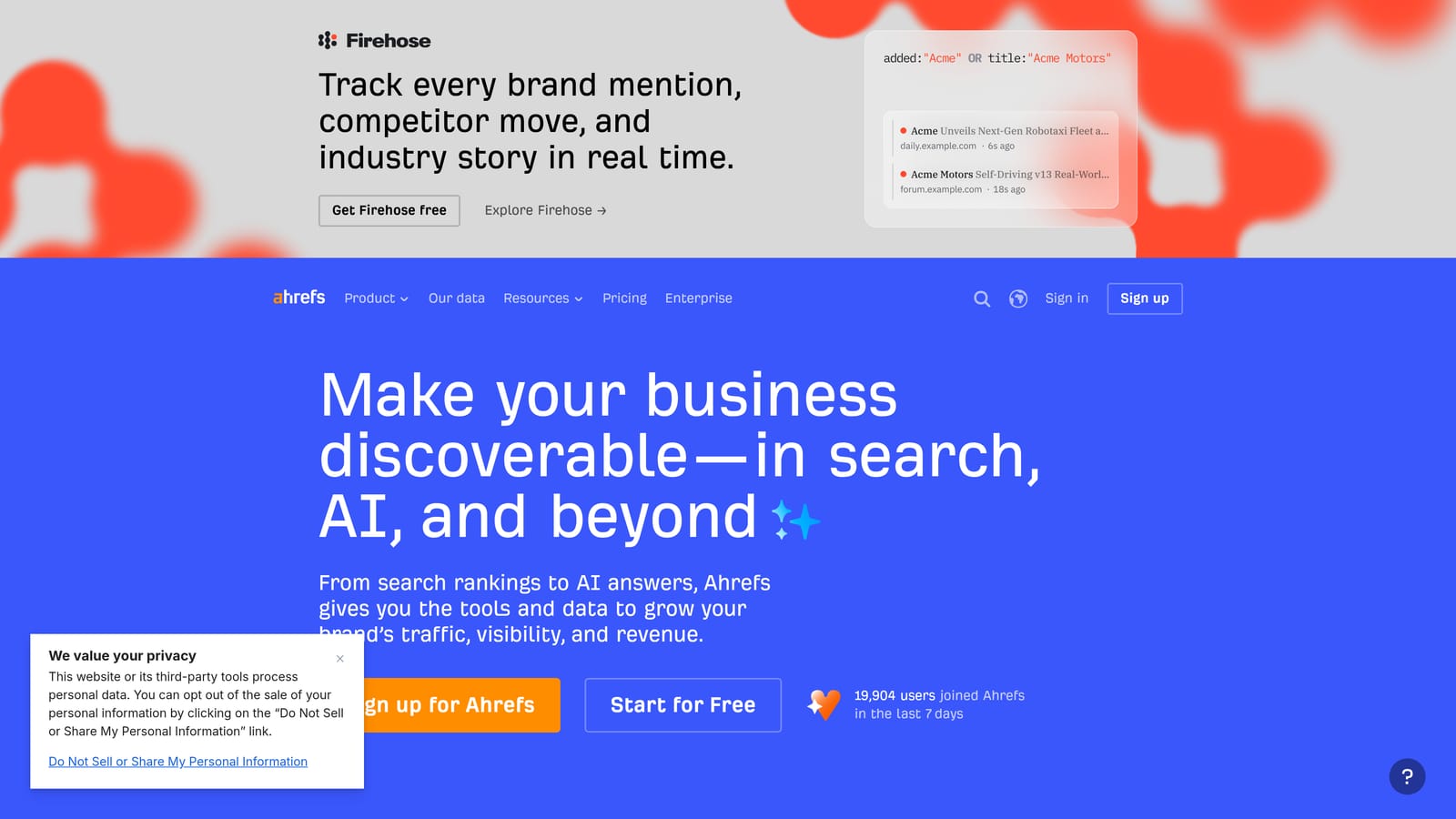
Ahrefs is a leading SEO toolset with a Rank Tracker that integrates directly with its site explorer and content tools, enabling a connected keyword-to-content workflow.
Where This Tool Shines
Ahrefs built its reputation on backlink data, but its Rank Tracker is a genuinely strong product in its own right. The real value comes from how rank data connects to the rest of the platform: you can identify keywords where you're losing ground, then immediately investigate whether the cause is a backlink drop, a content gap, or a competitor gaining authority.
Historical ranking trend visualization is particularly useful for reporting. Rather than just showing current positions, Ahrefs makes it easy to see how rankings have evolved over time, which is valuable context for both internal stakeholders and client presentations.
Key Features
Multi-Country and Multi-Engine Tracking: Tracks keyword rankings across multiple countries and search engines beyond just Google US.
Historical Ranking Trends: Visualizes ranking trajectory over time, making it easier to identify patterns and diagnose ranking changes.
Content Gap Integration: Connects rank data with Ahrefs' content gap tool to surface keyword opportunities competitors are winning that you're not.
SERP Feature Visibility: Tracks whether you're capturing SERP features for tracked keywords, not just organic position.
Competitor Rank Comparison: Monitors how competitors rank for the same keyword set within the same project dashboard.
Best For
SEO professionals who want rank tracking as part of a holistic content and link-building strategy. Ahrefs is particularly strong for teams that use rank shifts as signals to trigger deeper content or backlink investigations.
Pricing
Subscription-based with multiple tiers. Visit ahrefs.com for current pricing and keyword limits per plan.
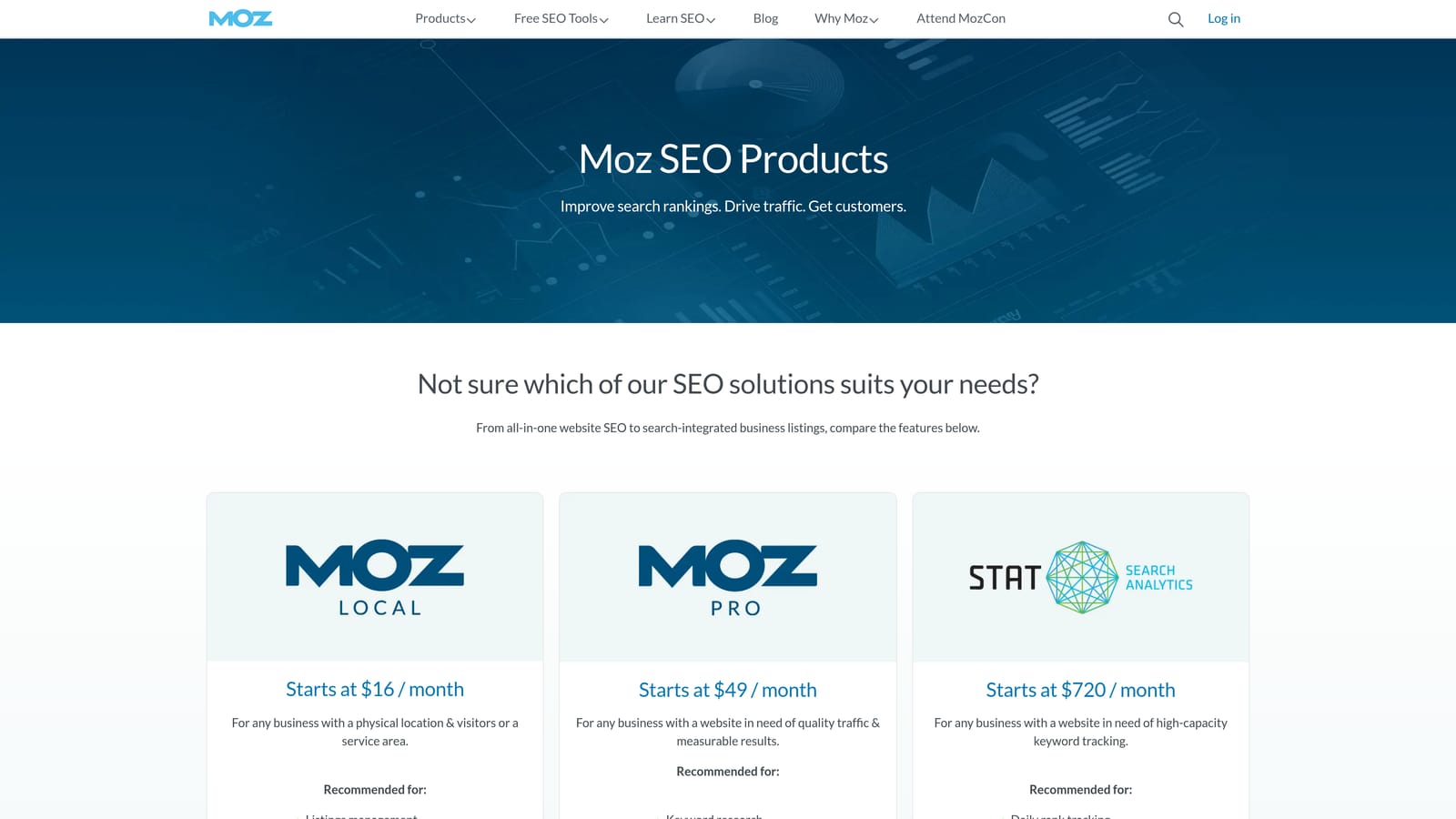
4. Moz Pro
Best for: SEO teams that want rank tracking paired with Domain Authority context for performance reporting.
Moz Pro is an established SEO platform with a Rank Tracker that ties keyword positions to Moz's proprietary Domain Authority and Page Authority metrics for context-rich reporting.
Where This Tool Shines
Moz has long been known for accessibility: its interface is clean, its documentation is thorough, and the learning curve is gentler than some competing platforms. For teams newer to SEO or those managing stakeholders who aren't deep in the weeds, Moz Pro's reporting dashboards communicate ranking performance clearly without overwhelming detail.
The integration of DA and PA metrics alongside rank data is a practical differentiator. Seeing that a keyword ranking dropped while a competitor's DA increased gives you more diagnostic context than raw position data alone, which helps prioritize where to focus link-building efforts.
Key Features
DA/PA Context: Pairs keyword rank data with Domain Authority and Page Authority metrics for richer performance interpretation.
SERP Feature Tracking: Monitors your presence in featured snippets and other SERP features alongside standard organic positions.
Local Rank Tracking: Supports location-specific rank tracking for businesses with local SEO requirements.
Accessible Reporting Dashboards: Clean, stakeholder-friendly reports that communicate ranking performance without requiring deep SEO expertise to interpret.
Link Research Integration: Rank data connects to Moz's link explorer and site crawl tools for a more complete SEO workflow.
Best For
In-house teams and smaller agencies that prioritize ease of use and clear reporting over raw feature depth. Moz Pro is a particularly good fit when rank tracking reports need to be shared with non-technical stakeholders regularly.
Pricing
Tiered subscription plans available. Check moz.com for current pricing and keyword limits per tier.
5. AccuRanker
Best for: Agencies that need fast, on-demand rank refreshes and white-label client reporting at scale.
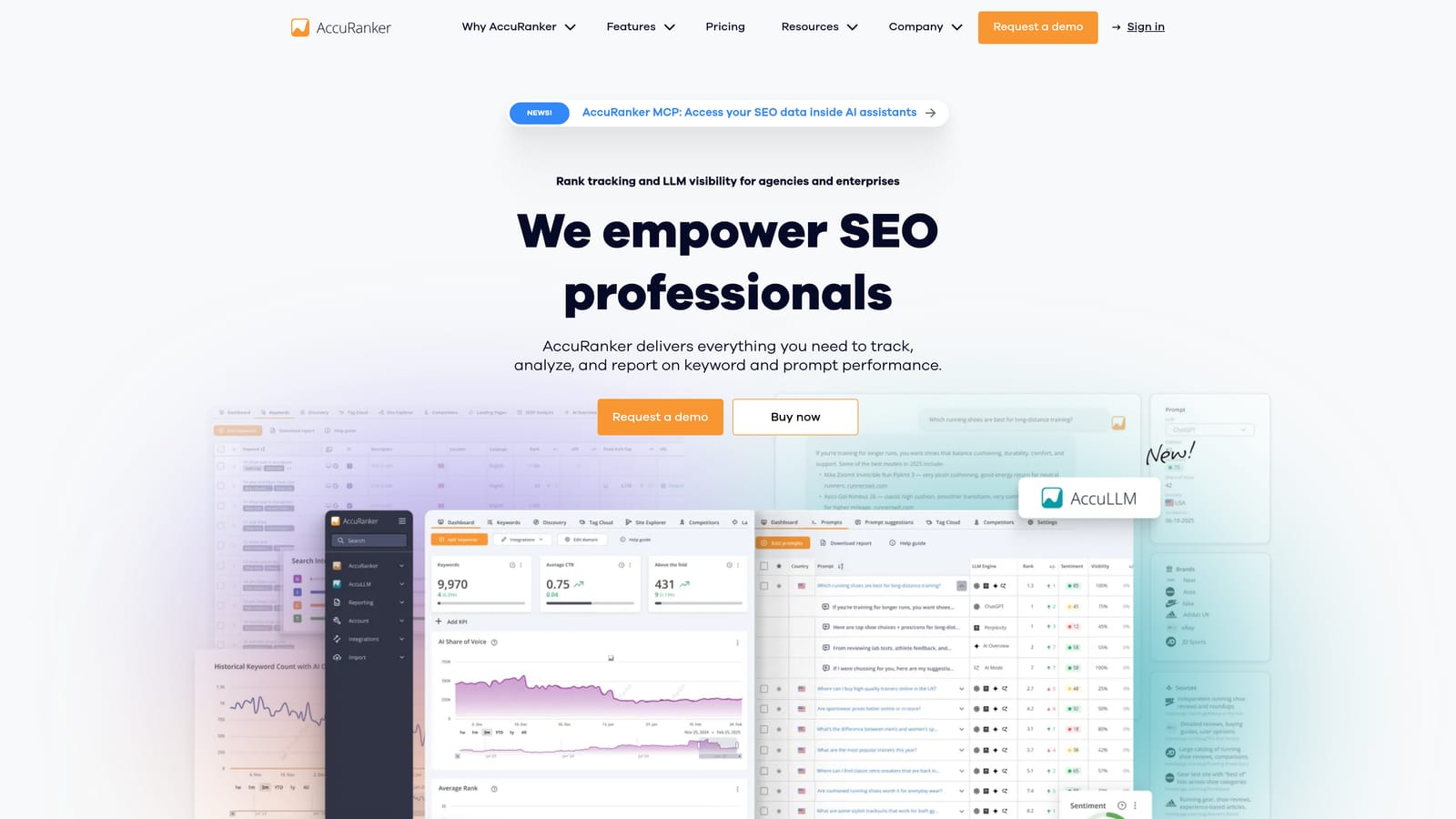
AccuRanker is a dedicated rank tracking platform built specifically for agencies, offering on-demand rank refreshes, white-label reporting, and support for tracking large keyword volumes at speed.
Where This Tool Shines
AccuRanker does one thing and focuses on doing it exceptionally well: rank tracking. Unlike all-in-one platforms where rank tracking is one feature among many, AccuRanker's entire product is optimized for speed and accuracy at volume. The on-demand rank refresh feature is the clearest example: you can trigger a fresh rank check at any time rather than waiting for the next scheduled update cycle.
For agencies delivering client reports, the white-label capabilities are polished. Custom branding, shareable dashboards, and clean export formats make it straightforward to deliver professional rank tracking reports without additional design work.
Key Features
On-Demand Rank Refresh: Trigger rank updates instantly rather than waiting for scheduled daily checks, critical when monitoring volatile keywords or new content launches.
White-Label Reporting: Fully branded client reports with custom logos and domain options for agency use.
Multi-Search-Engine Support: Tracks rankings across Google, Bing, Yandex, and Baidu for international campaigns.
SERP Feature and Local Tracking: Monitors SERP feature presence and location-specific rankings alongside standard organic positions.
API Access: Enables custom integrations with internal dashboards, reporting tools, or data pipelines.
Best For
Digital agencies managing multiple client accounts with large keyword sets and regular reporting cycles. AccuRanker is especially valuable when clients expect real-time or near-real-time ranking visibility, not just weekly snapshots.
Pricing
Keyword-volume-based pricing tiers. Visit accuranker.com for current plan options and limits.
6. SE Ranking
Best for: Growing agencies and in-house teams that want full SEO platform features at competitive pricing.
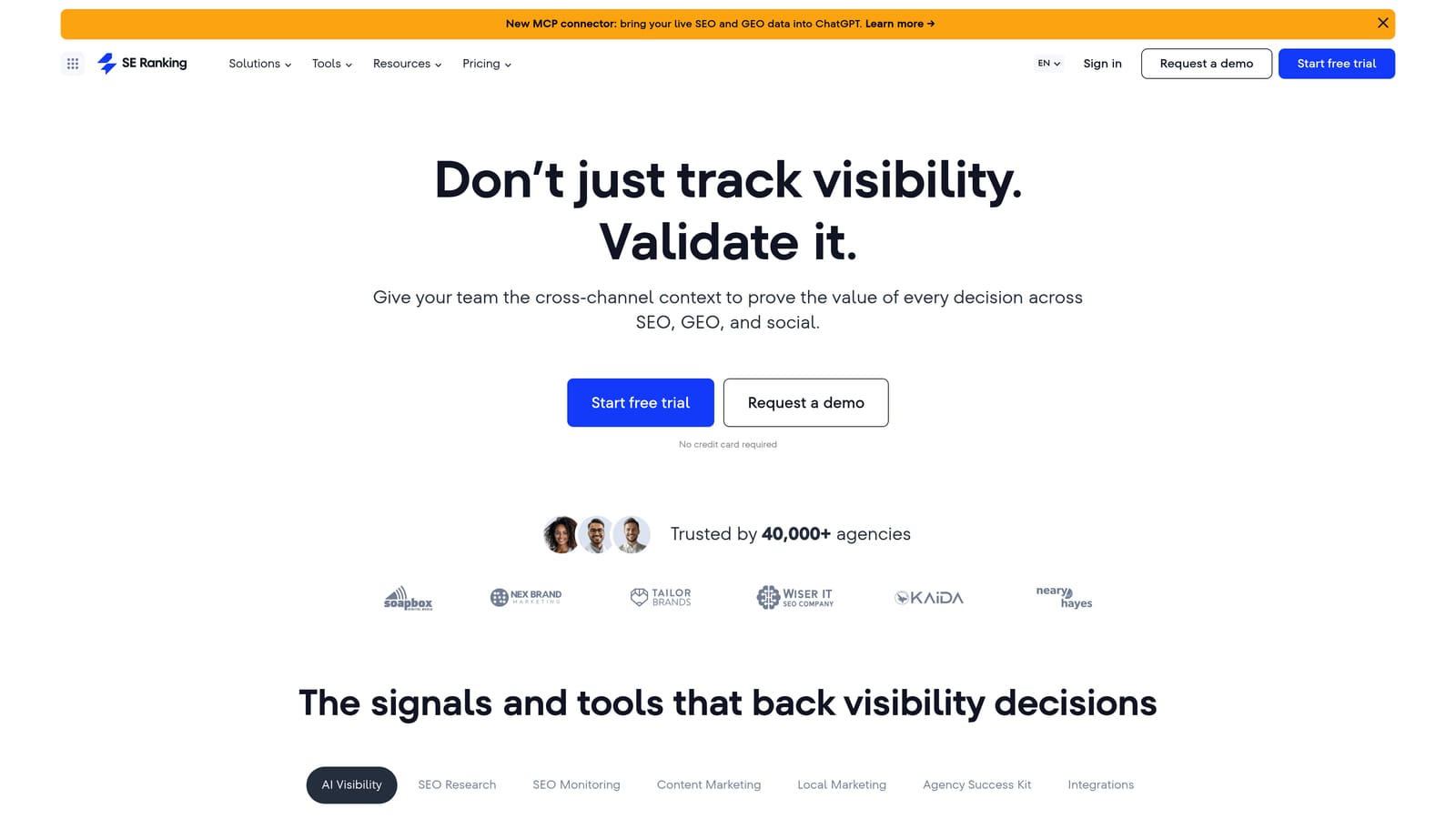
SE Ranking is a full-featured SEO platform with flexible rank tracking check frequencies, white-label reporting, and pricing that suits teams scaling their SEO operations without enterprise budgets.
Where This Tool Shines
SE Ranking's standout characteristic is its flexibility-to-cost ratio. You get white-label reporting, multi-location tracking, competitor monitoring, and a full SEO suite at price points that are generally more accessible than Semrush or Ahrefs at equivalent feature depth. For agencies that are growing but haven't yet hit enterprise scale, that balance matters.
The flexible check frequency setting is genuinely useful for managing costs intelligently. Not every keyword in your portfolio needs daily updates: tracking high-priority terms daily while monitoring informational content weekly lets you allocate your keyword credits more efficiently.
Key Features
Flexible Check Frequency: Set rank checks to run daily, every three days, or weekly per keyword, giving you control over update frequency and credit usage.
White-Label Reporting: Custom-branded reports and dashboards for client-facing agency workflows.
Multi-Location and Multi-Device Tracking: Separate rank data for different geographic locations and device types within the same project.
Competitor Rank Monitoring: Track how competitors rank for your target keywords alongside your own positions.
Full SEO Suite Integration: Rank tracking connects to SE Ranking's site audit, backlink checker, keyword research, and content tools.
Best For
Mid-sized agencies and in-house SEO teams that need a comprehensive platform with white-label capabilities but want more competitive pricing than the top-tier enterprise tools. SE Ranking is a strong choice for teams scaling from small to mid-size.
Pricing
Tiered plans with keyword limits. Check seranking.com for current pricing and plan comparisons.
7. SerpWatch
Best for: Lean teams that want clean, focused rank monitoring with smart alerts and collaboration features.
SerpWatch is a streamlined rank tracking tool designed for teams who want clear rank monitoring with smart alerts, without the overhead of a full SEO suite.
Where This Tool Shines
SerpWatch is intentionally focused. It doesn't try to be an all-in-one platform, and that restraint shows in the quality of the core experience: the interface is clean, the alerting system is well-designed, and the team collaboration features work without friction. For smaller teams or content-focused operations that don't need enterprise-scale competitive intelligence, that simplicity is a feature, not a limitation.
The Slack and email alert integrations are particularly practical. Rather than logging into a dashboard to check for changes, ranking shifts surface directly in your existing communication workflow, which keeps the team informed without adding another tool to the daily routine.
Key Features
Smart Alerts: Slack and email notifications for significant ranking changes, keeping teams informed without requiring daily manual dashboard checks.
Team Collaboration: User management and shared project access for small to mid-sized teams working on the same keyword sets.
Historical Trend Views: Daily rank updates with trend visualization to track ranking trajectory over time.
Multi-Location and Device Tracking: Location-specific and device-specific rank data for campaigns with geographic or mobile targeting requirements.
Clean Interface: Streamlined UI designed for fast navigation and clear data presentation without unnecessary complexity.
Best For
Small to mid-sized teams, content marketers, and niche site operators who want reliable rank monitoring with minimal setup and a clean day-to-day experience. SerpWatch suits teams where simplicity and alerting matter more than deep competitive analytics.
Pricing
Subscription-based plans available. Visit serpwatch.io for current pricing options.
8. Rank Tracker by Link-Assistant
Best for: SEOs who need to track large keyword sets without per-keyword subscription costs scaling against them.
Rank Tracker by Link-Assistant is a desktop-based rank tracking application that removes per-keyword subscription limits, making it cost-effective for tracking large keyword portfolios.
Where This Tool Shines
The core value proposition here is straightforward: if you're tracking thousands of keywords, cloud-based tools with per-keyword pricing can get expensive fast. Rank Tracker's desktop model breaks that relationship. You pay for the software, not for the size of your keyword set, which makes it economically attractive for SEOs managing large sites or multiple projects on a constrained budget.
The breadth of search engine support is also notable. Beyond Google and Bing, Rank Tracker covers a wide range of international and niche search engines, which matters for campaigns targeting markets where Google isn't the dominant engine.
Key Features
No Keyword Volume Limits: Track as many keywords as you need without hitting subscription-tier caps or paying per-keyword fees.
Desktop Software: Available for both Windows and Mac, with data stored locally rather than in the cloud.
Wide Search Engine Coverage: Supports tracking across a broad range of search engines beyond Google, including international platforms.
Scheduled Automated Checks: Set up automated rank check schedules to run without manual intervention.
Free Version Available: Core rank tracking functionality accessible without a paid subscription, useful for testing or lightweight use cases.
Best For
Independent SEOs, technical SEO consultants, and in-house teams managing large keyword sets who prefer desktop software over cloud-based SaaS. Also well-suited for users in markets where tracking across non-Google search engines is a priority.
Pricing
Free version available with core features; paid plans unlock advanced capabilities. Check link-assistant.com for current plan options.
9. Google Search Console
Best for: Any site owner who needs first-party Google ranking data as a free baseline for their SEO workflow.
Google Search Console is Google's free, first-party webmaster tool that provides direct ranking and performance data for your site's keywords, making it the essential starting point for any rank tracking workflow.
Where This Tool Shines
No third-party tool can replicate what Search Console provides: ranking data sourced directly from Google. There's no estimation, no crawling delay, and no algorithmic approximation. When Search Console shows an average position of 4.2 for a keyword, that's Google telling you directly. For validating data from other rank tracking tools, it's indispensable.
The query-level performance data is also genuinely useful for discovery. You'll often find keywords driving impressions and clicks that you didn't explicitly target, which can surface content optimization opportunities that wouldn't appear in a pre-defined keyword tracking list.
Key Features
First-Party Google Data: Ranking and performance data sourced directly from Google, not estimated by third-party crawlers.
Performance Metrics Per Query: Average position, impressions, clicks, and click-through rate for every query your site appears for.
Historical Data: Up to approximately 16 months of performance history for trend analysis and year-over-year comparisons.
URL Inspection Tool: Check individual page indexing status, last crawl date, and any indexing issues directly within the platform.
No Keyword or Query Limits: Covers every query your site appears for, not just a pre-defined tracked keyword set.
Best For
Every website owner, regardless of budget or scale. Search Console is the non-negotiable baseline layer in any rank tracking setup. It works best as a validation and discovery tool used alongside a dedicated rank tracker for competitive benchmarking and historical depth.
Pricing
Completely free with no keyword limits or subscription tiers.
Which Tool Is Right for Your Workflow
The right multiple keyword rank checker depends on your actual workflow, not just feature count. Here's a quick framework for narrowing it down.
If you're an agency handling multiple clients with large keyword sets, AccuRanker and SE Ranking offer the best combination of speed, scale, and white-label reporting. AccuRanker wins on raw tracking performance and on-demand refresh; SE Ranking wins on overall platform depth at a more accessible price point.
If you need deep competitive intelligence alongside rank tracking, Semrush and Ahrefs are the established leaders. Both justify their price through the breadth of what they connect rank data to: backlinks, content gaps, site health, and more.
For budget-conscious teams or those building their first rank tracking setup, Google Search Console is the non-negotiable free foundation. Pair it with Rank Tracker by Link-Assistant if you need to track large keyword sets without scaling costs, or SerpWatch if you want a clean cloud-based experience with smart alerting.
But here's the consideration that separates 2026 SEO strategy from 2022 SEO strategy: search is no longer just Google. AI models like ChatGPT, Claude, and Perplexity are increasingly where audiences discover brands, compare products, and make decisions. A team that only tracks Google rankings is watching one screen while another screen quietly influences their audience.
That's where Sight AI stands apart from every other tool on this list. It's the only platform here that tracks both traditional keyword rankings and AI search visibility in a single workflow, with content generation and indexing tools built in to act on what you find.
Start with your actual workflow: how many keywords you're tracking, how often you need updates, whether white-label reporting matters, and whether AI search visibility is part of your growth roadmap. The best rank checker is the one that surfaces the signals that matter most to your strategy.
Stop guessing how AI models like ChatGPT and Claude talk about your brand. Start tracking your AI visibility today and see exactly where your brand appears across top AI platforms, alongside your traditional keyword rankings, in one place.