AI-powered search has fundamentally changed how brands get discovered. When users ask ChatGPT, Claude, or Perplexity a question, the answers they receive are shaped by how well brands have optimized for large language model search, not just traditional Google rankings. This has created an entirely new category of tooling built specifically for this challenge.
LLM search optimization platforms help marketers track brand mentions across AI models, generate GEO-optimized content, and ensure their sites are indexed and visible to AI crawlers. Whether you're a founder trying to get your brand cited by AI assistants, a marketer building organic authority, or an agency managing AI visibility for clients, the right platform can be the difference between being mentioned and being invisible.
Here are the best LLM search optimization platforms available in 2026, evaluated on AI visibility tracking, content generation capabilities, indexing automation, and overall value.
1. Sight AI
Best for: Teams that need end-to-end LLM search optimization in a single platform
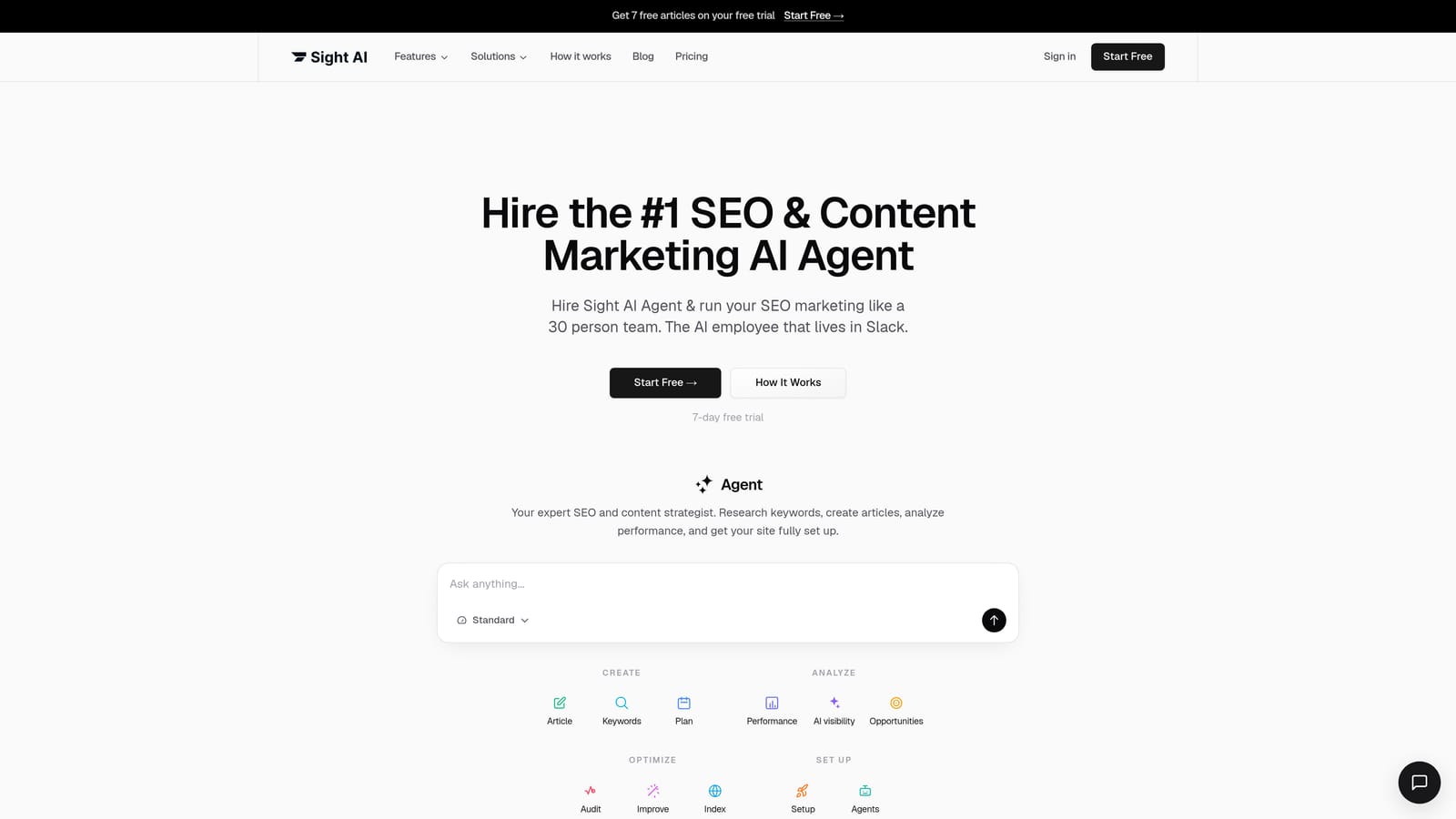
Sight AI is an all-in-one LLM search optimization platform combining AI visibility tracking across 6+ AI models, GEO-optimized content generation via 13+ specialized AI agents, and automated website indexing with IndexNow integration.
Where This Tool Shines
Most teams trying to optimize for LLM search end up stitching together three or four separate tools: one for monitoring AI mentions, another for content creation, and something else for indexing. Sight AI collapses that stack into a single workflow, which matters when you're trying to move quickly and maintain consistency across all three layers of the optimization process.
The AI Visibility Score is the standout feature for many users. Rather than manually querying ChatGPT or Claude to see if your brand shows up, Sight AI does this systematically across multiple platforms and surfaces sentiment data alongside mention frequency. You get a clear picture of not just whether you're being mentioned, but how AI models are describing your brand.
Key Features
AI Visibility Score: Tracks brand mentions across ChatGPT, Claude, Perplexity, and 3+ additional AI platforms in one unified dashboard.
Sentiment Analysis and Prompt Tracking: Reveals how AI models characterize your brand and which specific prompts surface your content in responses.
13+ Specialized AI Agents: Generates SEO/GEO-optimized articles, listicles, guides, and explainers tailored for AI citation and organic search performance.
Autopilot Mode: Automates content generation and publishing so your team can scale output without adding headcount.
IndexNow Integration: Submits new and updated content to search engines automatically, with sitemap updates handled in the background for faster discovery.
CMS Auto-Publishing: Connects content generation directly to your live site, removing manual steps from the content-to-published workflow.
Best For
Marketers, founders, and agencies who want to track AI visibility, generate optimized content, and automate indexing without managing multiple vendors. Particularly well-suited for teams where speed and workflow efficiency are priorities alongside visibility performance.
Pricing
Visit trysight.ai for current plan details. Pricing is structured around team size and usage volume.
2. Promptwatch
Best for: Brands that need granular, prompt-level insight into AI model behavior
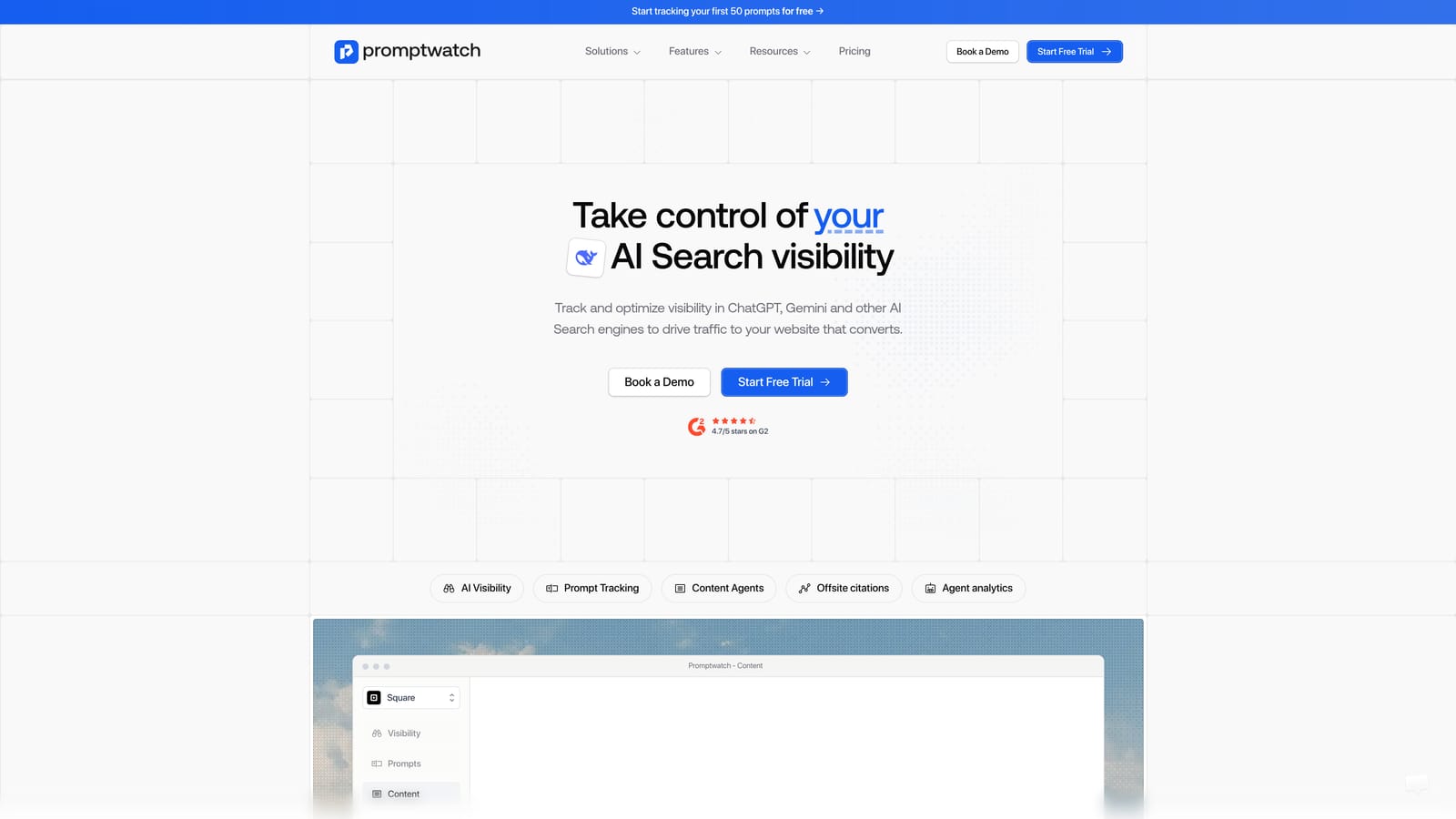
Promptwatch is a focused AI prompt monitoring tool that tracks how large language models respond to specific branded and category queries, giving marketers visibility into their AI search presence at the prompt level.
Where This Tool Shines
Promptwatch takes a deliberately narrow approach, and that's its strength. Rather than trying to be an all-in-one platform, it focuses on answering a specific question: when users ask AI models about your brand or category, what exactly are those models saying? That granularity is useful when you're diagnosing why your brand isn't surfacing for certain queries.
The alerting system is particularly valuable for brands managing reputation or competitive positioning in AI-generated responses. When AI models shift how they describe your brand or competitors, you'll know about it quickly rather than discovering the change weeks later.
Key Features
Prompt-Level Brand Tracking: Monitors specific prompts to see exactly when and how your brand appears in AI model outputs.
Change Detection Alerts: Notifies you when AI responses shift around key branded or category queries.
Query Gap Analysis: Surfaces which prompts are and aren't surfacing your brand, giving you a clear content opportunity map.
Brand Description Monitoring: Tracks how AI models characterize your brand over time, not just whether you're mentioned.
Best For
Brands and marketers who want focused, prompt-level intelligence on their AI search presence. Works well as a monitoring layer alongside a content generation tool, since Promptwatch itself doesn't produce or publish content.
Pricing
Verify current pricing directly at promptwatch.io, as plans may have changed.
3. Profound
Best for: Enterprise marketing teams and agencies needing deep AI search analytics
Profound is an enterprise-grade AI search analytics platform focused on measuring brand presence and share of voice in AI-generated answers, with reporting capabilities built for large marketing teams and multi-brand agencies.
Where This Tool Shines
Profound is built for organizations where reporting is as important as the data itself. The dashboards are designed for teams that need to present AI visibility metrics to stakeholders, track performance across multiple brands simultaneously, and benchmark share of voice in LLM-generated responses over time.
For enterprise teams where a single analyst or agency is managing AI visibility across several client accounts, the multi-brand management capability is a meaningful differentiator. You're not building separate tracking setups for each brand from scratch.
Key Features
Brand Presence Analytics: Measures how often and how prominently your brand appears in AI-generated answer surfaces across major platforms.
Share of Voice Tracking: Quantifies your brand's relative presence in LLM responses compared to the broader category.
Enterprise Reporting Dashboards: Structured reporting views designed for marketing leadership and client-facing presentations.
Multi-Brand Management: Supports agencies and enterprise teams managing AI visibility across multiple brands or client accounts from a single interface.
Best For
Enterprise marketing teams and agencies that need robust analytics and reporting infrastructure around AI search visibility. Less suited for teams looking for content generation or indexing automation as part of the same platform.
Pricing
Verify current pricing and plan options at profound.com. Enterprise pricing is typically quote-based.
4. Peec
Best for: Competitive intelligence teams tracking share of AI voice against named rivals
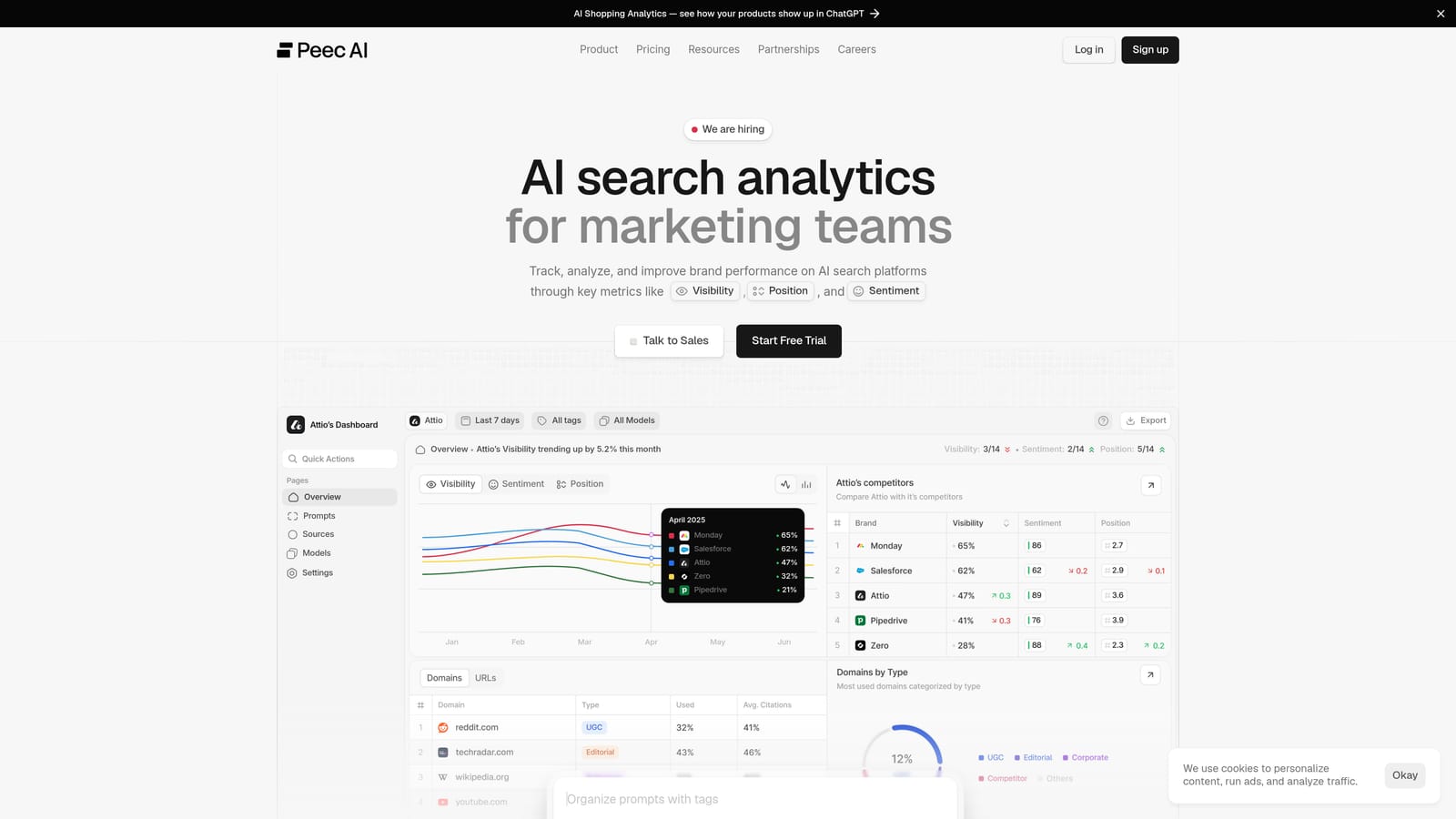
Peec is a competitive AI visibility benchmarking tool that tracks how your brand stacks up against competitors in LLM-generated responses, providing share of AI voice metrics for growth and competitive intelligence teams.
Where This Tool Shines
The core value proposition of Peec is competitive context. Most AI visibility tools tell you how your brand is performing in isolation. Peec tells you how you're performing relative to the competitors that matter to your business, which is often the more actionable framing for growth teams.
If your category is competitive and you need to understand whether your LLM optimization efforts are actually moving the needle against specific rivals, Peec's benchmarking dashboards give you that comparative view over time. It's a focused tool that does this specific job well.
Key Features
Brand vs. Competitor Tracking: Monitors your brand and named competitors simultaneously in AI model outputs for direct comparison.
Share of AI Voice Metrics: Quantifies your brand's relative presence in LLM-generated responses as a percentage of total category mentions.
Competitive Positioning Dashboards: Visualizes how your AI visibility compares to rivals across tracked prompts and platforms.
Trend Tracking: Benchmarks relative AI visibility over time so you can see whether your optimization efforts are gaining or losing ground.
Best For
Competitive intelligence teams, growth marketers, and category leaders who need to understand their AI search positioning relative to specific named competitors. Not a content creation platform, so pairs best with a generation tool in your stack.
Pricing
Verify current pricing at peec.ai for the most accurate plan information.
5. AirOps
Best for: Content teams and agencies scaling structured AI content production workflows
AirOps is an AI content workflow automation platform that enables teams to build structured, repeatable pipelines for AI-assisted content creation and publishing, well-suited for agencies and content teams operating at scale.
Where This Tool Shines
AirOps is built around the idea that content production at scale requires process, not just generation. The visual workflow builder lets teams design multi-step pipelines where AI generation, review, formatting, and publishing happen in a structured sequence rather than as ad-hoc tasks. For agencies running content programs across multiple clients, that repeatability has real operational value.
The template system means you can standardize your content formats across a team, so output quality doesn't vary depending on who's running the workflow that day. This is less about AI visibility tracking and more about building a reliable content production engine.
Key Features
Visual Workflow Builder: Drag-and-drop interface for designing multi-step AI content generation pipelines without requiring technical setup.
Content Templates: Reusable templates for repeatable, structured content production across formats and clients.
Publishing Integrations: Connects to CMS and publishing tools so content moves from generation to live without manual handoff steps.
Scalable Automation: Designed for high-volume content teams that need consistent output across large content programs.
Best For
Content teams and agencies that need structured, repeatable AI content pipelines rather than one-off generation. AI visibility tracking and indexing automation are not core features, so AirOps works best as the content production layer in a broader stack.
Pricing
Verify current plan pricing at airops.com for the most up-to-date information.
6. Writesonic
Best for: Marketing teams and freelancers scaling SEO content volume quickly
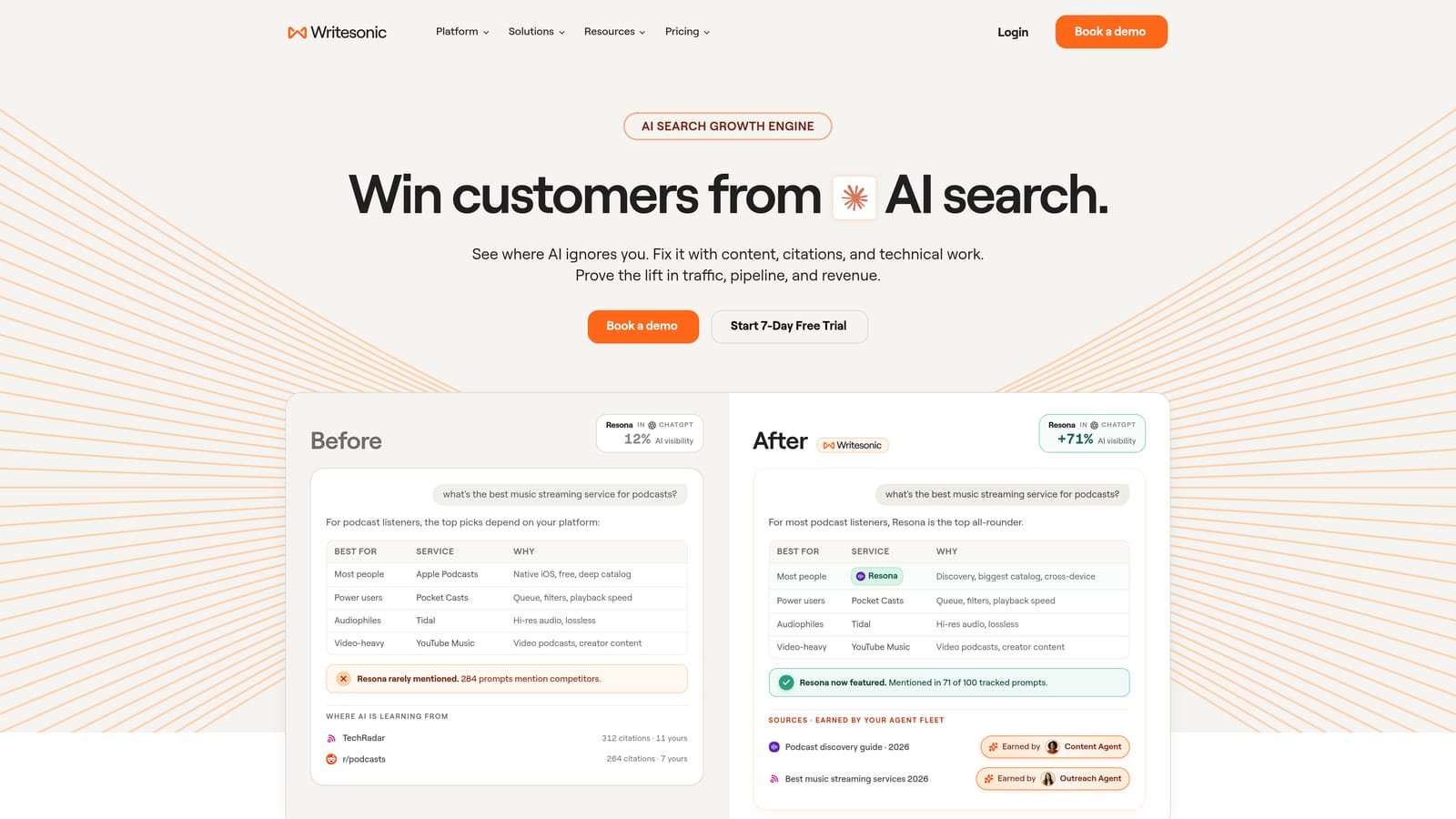
Writesonic is a broad AI writing platform with built-in SEO optimization features, offering content generation for articles, blogs, and long-form pieces with a lower barrier to entry than more specialized platforms.
Where This Tool Shines
Writesonic has built a large user base by being accessible. The platform covers a wide range of content types, from long-form articles and blog posts to ads and product descriptions, making it useful for teams that need content variety alongside volume. The built-in SEO guidance during content creation is a practical feature for teams that don't want to run separate SEO tools alongside their writing workflow.
The free plan makes it a reasonable starting point for smaller teams or freelancers who want to experiment with AI content generation before committing to a paid tier. It's a general-purpose AI writing tool rather than an LLM-specific optimization platform, so expectations should be set accordingly.
Key Features
AI Article and Long-Form Generation: Produces full-length articles and blog posts with SEO optimization built into the generation process.
Broad Content Type Support: Covers blogs, ads, product descriptions, social content, and more from a single platform.
Built-In SEO Guidance: Surfaces keyword and optimization recommendations during content creation to improve search performance.
Publishing Integrations: Connects to popular CMS and marketing tools to reduce manual steps in the publishing workflow.
Free Plan Available: Accessible entry point for teams getting started with AI content generation before scaling to paid tiers.
Best For
Marketing teams, freelancers, and content creators producing high volumes of SEO content who need a broad, accessible AI writing tool. LLM-specific visibility tracking and indexing automation are outside Writesonic's core scope.
Pricing
Free plan available. Paid plans start at accessible price points. Verify current pricing at writesonic.com.
Which Platform Is Right for Your Team?
The right LLM search optimization platform depends heavily on what gap you're actually trying to fill. Here's how to think through the decision based on your primary need.
If you need an end-to-end solution covering AI visibility tracking, GEO content creation, and automated indexing without managing multiple vendors, Sight AI is the natural starting point. It's the only platform in this list that handles all three layers of LLM search optimization in a single workflow, which matters for teams that can't afford to stitch together separate tools.
For enterprise teams where analytics depth and stakeholder reporting are the priority, Profound offers the dashboard infrastructure and multi-brand management capabilities that larger organizations typically need. For competitive intelligence, Peec fills a specific gap that other platforms don't address as directly: understanding your AI visibility relative to named competitors over time.
If your primary need is prompt-level monitoring rather than broad visibility tracking, Promptwatch delivers focused insight into exactly how AI models respond to specific queries around your brand. For teams scaling content production through structured workflows, AirOps provides the pipeline automation layer. And for teams new to AI content generation who want an accessible, broad-purpose writing tool, Writesonic offers a low-friction entry point with a free plan to get started.
The broader trend is clear: LLM search optimization is no longer optional for brands that depend on organic discovery. AI assistants are increasingly the first touchpoint between a user and a recommendation, and the brands that get cited are the ones that have invested in being visible to those models.
Stop guessing how AI models like ChatGPT and Claude talk about your brand. Start tracking your AI visibility today and see exactly where your brand appears across top AI platforms, what content opportunities you're missing, and how to automate your path to consistent organic traffic growth.