If you are wiring keyword positions into a dashboard, a client report, or your own SEO product, the API you pick shapes your costs and your data quality for years. This list is for developers, agencies, and SEO leads who need programmatic rank data. The tools were chosen on four criteria: data coverage (locations, devices, SERP features), pricing model, rate limits, and documentation quality. They fall into three groups: raw SERP scraping APIs, rank-tracking platform APIs, and suite APIs. One entry, Sight AI, covers a different layer: visibility inside AI answers.
Quick Comparison of the Rank Checker APIs
- Sight AI: teams measuring AI search visibility alongside classic rankings; pricing on its website; tracks brand mentions and sentiment inside AI model answers.
- DataForSEO: developers building custom rank tracking at scale; pay-as-you-go, see website; queued versus live modes let you tune cost per check.
- SerpApi: developers integrating many search engines quickly; monthly quota plans with a free tier, see website; the widest range of search verticals with polished client libraries.
- Serper.dev: budget-conscious builders and AI agent developers; credit bundles, see website; speed and simple credit pricing suited to agent workflows.
- Semrush API: existing Semrush teams automating reporting; API units, see website; rank data alongside the broadest competitive research dataset.
- Ahrefs API: Ahrefs customers combining links and rankings; plan-gated, see website; industry-leading backlink data next to rank data.
- SE Ranking API: agencies and SMB tools managing many projects; see website; project management endpoints for client-facing tracking.
- AccuRanker API: enterprise and agency teams with large keyword sets; quote or keyword-tier based, see website; fast on-demand refreshes at high volume.
- Zenserp: startups and solo developers prototyping; free tier, see website; a low-friction entry point for small projects.
1. Sight AI
Sight AI is the odd one out on this list, and it is worth being direct about why. It does not return Google keyword positions. It tracks how AI models such as ChatGPT, Claude, and Perplexity talk about your brand, then pairs that measurement with content generation and indexing. Think of it as a complement to a rank checker API, not a replacement. Classic position data cannot tell you whether an AI answer names your brand, and that gap is what Sight AI fills.
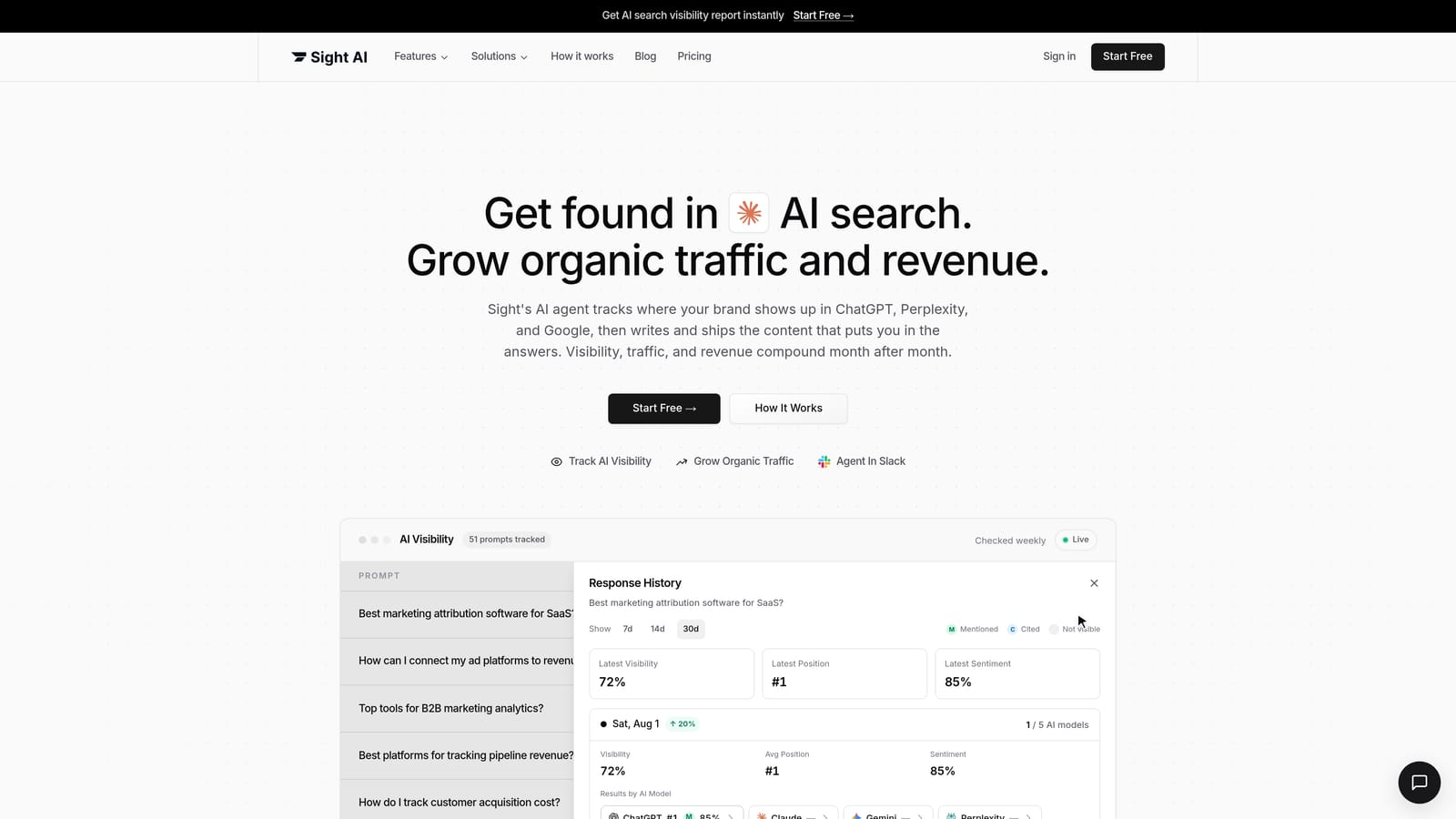
It is built for marketers, founders, and agencies who already watch organic rankings and want the same discipline applied to GEO, meaning visibility in generative answers. Where the other tools here answer "where do I rank for this keyword?", Sight AI answers "what do AI models say when someone asks about my category, and am I in the answer?"
- AI Visibility Score with sentiment analysis shows how often your brand appears in AI answers and whether the framing is positive, neutral, or negative.
- Prompt tracking across ChatGPT, Claude, Perplexity, and other platforms lets you watch the specific questions your buyers ask.
- AI Content Writer uses 13+ specialized agents to produce SEO and GEO-optimized articles such as listicles, guides, and explainers, so gaps you find can be filled.
- IndexNow indexing and automated sitemap updates push new pages to participating search engines faster instead of waiting for a crawl.
- CMS auto-publishing moves approved articles to your site without manual copy and paste.
Setup is mainly connecting your site, defining the prompts and brand terms to track, and linking your CMS for publishing. A marketer can run it day to day; no engineering is required for the core workflow.
The limitations are clear. You will not get SERP positions, SERP feature parsing, or device and location rank checks from it, so you still need one of the other eight tools for classic rankings. If you plan to pull data programmatically, confirm API availability with Sight AI before building around it. Pricing details are on its website, so check current plans there.
Best for: Teams that need to measure and improve visibility in AI search alongside classic rankings.
2. DataForSEO
DataForSEO is a pay-as-you-go SERP API covering multiple search engines, aimed at developers who want raw data and are willing to build everything around it. You send a keyword, location, language, and device, and you get back parsed results, including SERP features.
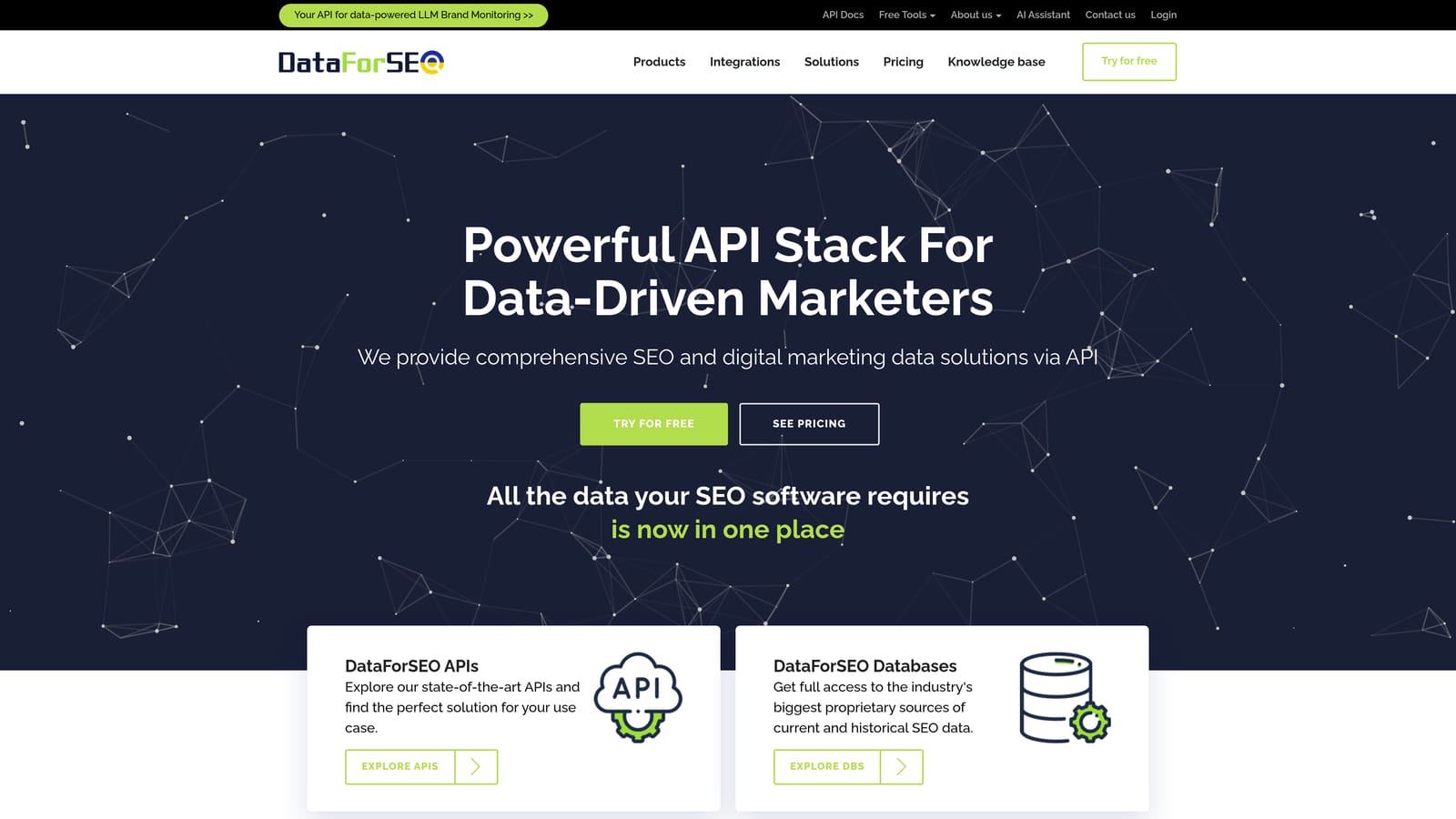
Its defining advantage is the choice of request mode. Standard (queued) requests are cheaper and return results after a short wait, while Live requests return immediately at a higher price. For a nightly rank-tracking job, queued mode keeps your cost per check low. For a user clicking "check now" in your app, live mode gives an instant answer. Few competitors let you tune cost and latency this directly.
- Standard and Live SERP modes let you trade price for speed on a per-request basis.
- Multi-engine coverage means one integration can serve Google, Bing, and other engines.
- Location and language targeting gives you results for specific markets rather than a generic national view.
- SERP feature parsing exposes elements like featured snippets and local packs, not just blue-link positions.
It is a REST API, and queued tasks can notify you through webhook or postback instead of polling. Expect real engineering effort: you store the results, schedule the checks, and build the interface. That is the main limitation. If you want a finished dashboard, this is the wrong layer. Cost also scales with keywords times frequency times locations, so model your volume before committing. Pricing is pay-as-you-go, and the current rates are on the DataForSEO site.
Best for: Developers building custom rank tracking products at scale.
3. SerpApi
SerpApi is a real-time search scraping API that returns structured JSON, and its calling card is breadth. Beyond Google web results it covers Bing, YouTube, Maps, Shopping, and other verticals, which matters if your product reaches past plain web rankings.
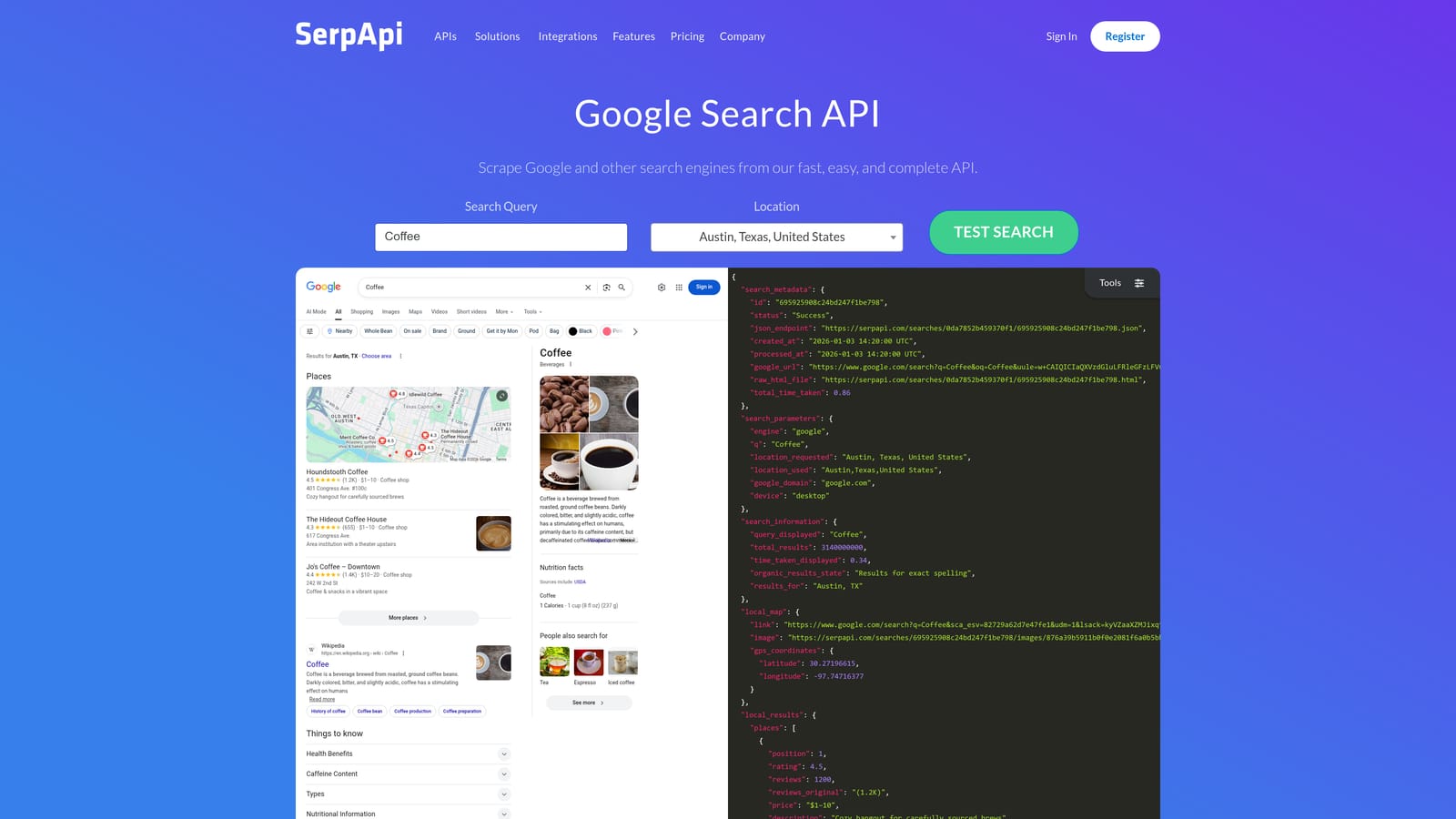
The experience is polished. Official client libraries exist for Python, Node.js, Ruby, Java, and PHP, and there is a Google Sheets option for non-developers. A developer can often get a first working call running in minutes, and a free tier lets you test before paying.
- Many engines and verticals let you track web, video, maps, and shopping visibility through one vendor.
- Official client libraries cut integration time and reduce the glue code you maintain.
- Location targeting returns results as seen from a chosen place.
- Free tier allows a proof of concept without a purchase order.
Pricing is by monthly plan with a search quota. That is predictable for modest usage but can get expensive when you track large keyword lists daily, since every check consumes a search from the quota. For a 20,000-keyword set checked daily, run the numbers against DataForSEO or Serper.dev first. Plan sizes and prices change, so confirm them on the SerpApi site.
Like other raw SERP APIs, it gives you data, not a tracking product: you handle scheduling, history, and reporting yourself.
Best for: Developers who want fast integration across many search engines.
4. Serper.dev
Serper.dev is a fast, low-cost Google SERP API sold in credit bundles. It has become a common choice for AI agent builders because it returns Google results quickly, and a simple credit model makes cost easy to reason about.
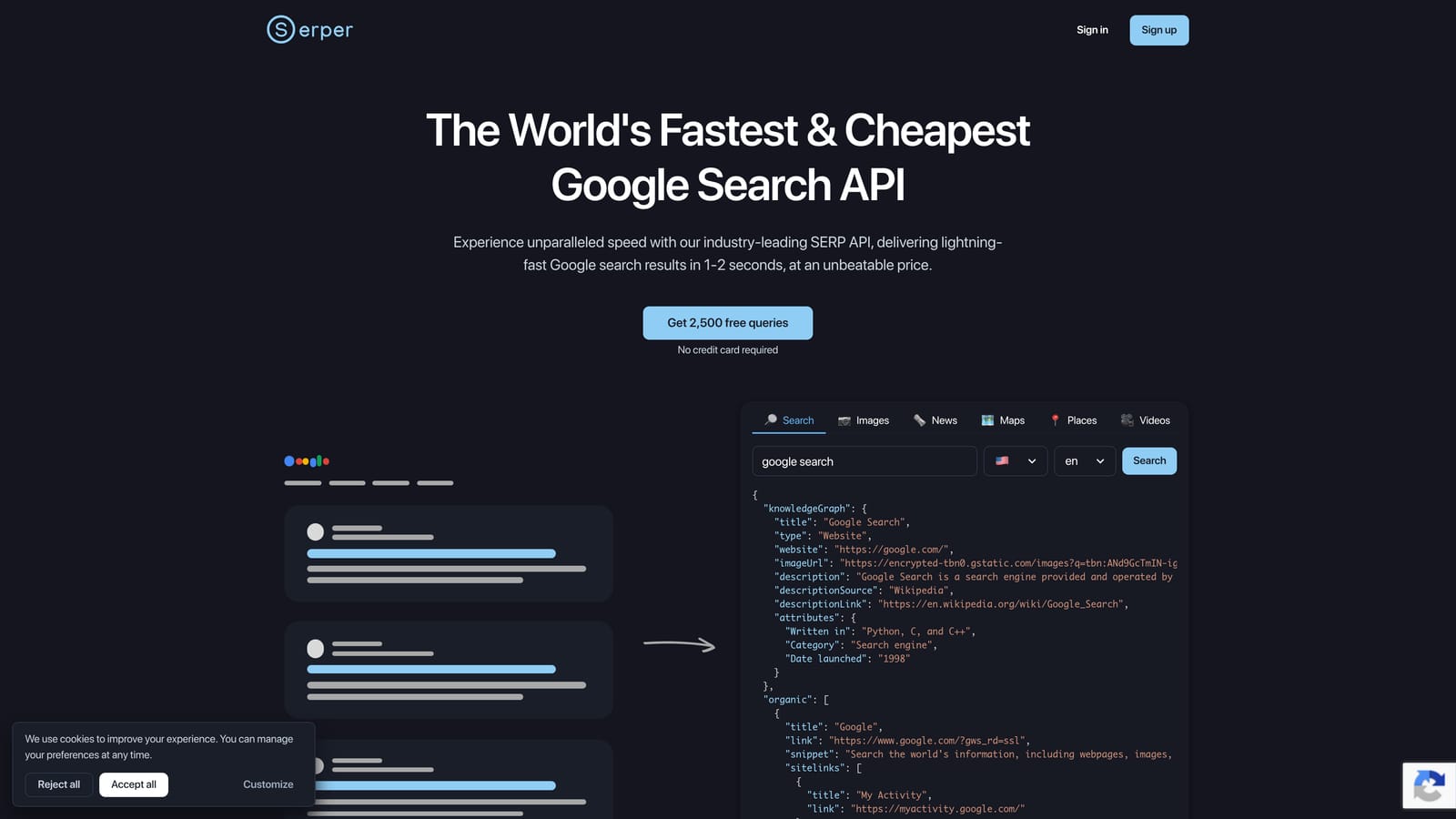
It focuses on Google: web, news, images, and places. That narrow scope is both the appeal and the limit. You will not find the engine variety of SerpApi or DataForSEO, nor deep SERP feature coverage, but you get low latency and a short path from signup to a working request, with free starter credits to try it.
- Google web, news, images, and places results cover the common query types without extra configuration.
- Fast responses keep agent loops and interactive tools feeling responsive.
- Credit-based pricing means you buy a bundle and spend it as needed, with no monthly seat commitment.
- Free starter credits let you validate output before spending.
Integration is a plain REST call, and it fits neatly into LLM agent frameworks such as LangChain, where a search tool is a common building block. That same simplicity means you build your own rank-tracking logic: find your domain in the results, record the position, store history.
It is not the right pick if you need multi-engine coverage, rich SERP feature parsing, or enterprise support commitments. Check the current bundle sizes and per-credit costs on the Serper.dev site, as these change.
Best for: Budget-conscious builders and AI agent developers.
5. Semrush API
The Semrush API gives programmatic access to Semrush data, including Position Tracking, keyword metrics, and domain analytics, billed through API units. Its value is the dataset behind the rankings: competitor research, keyword data, and domain analytics in the same ecosystem.
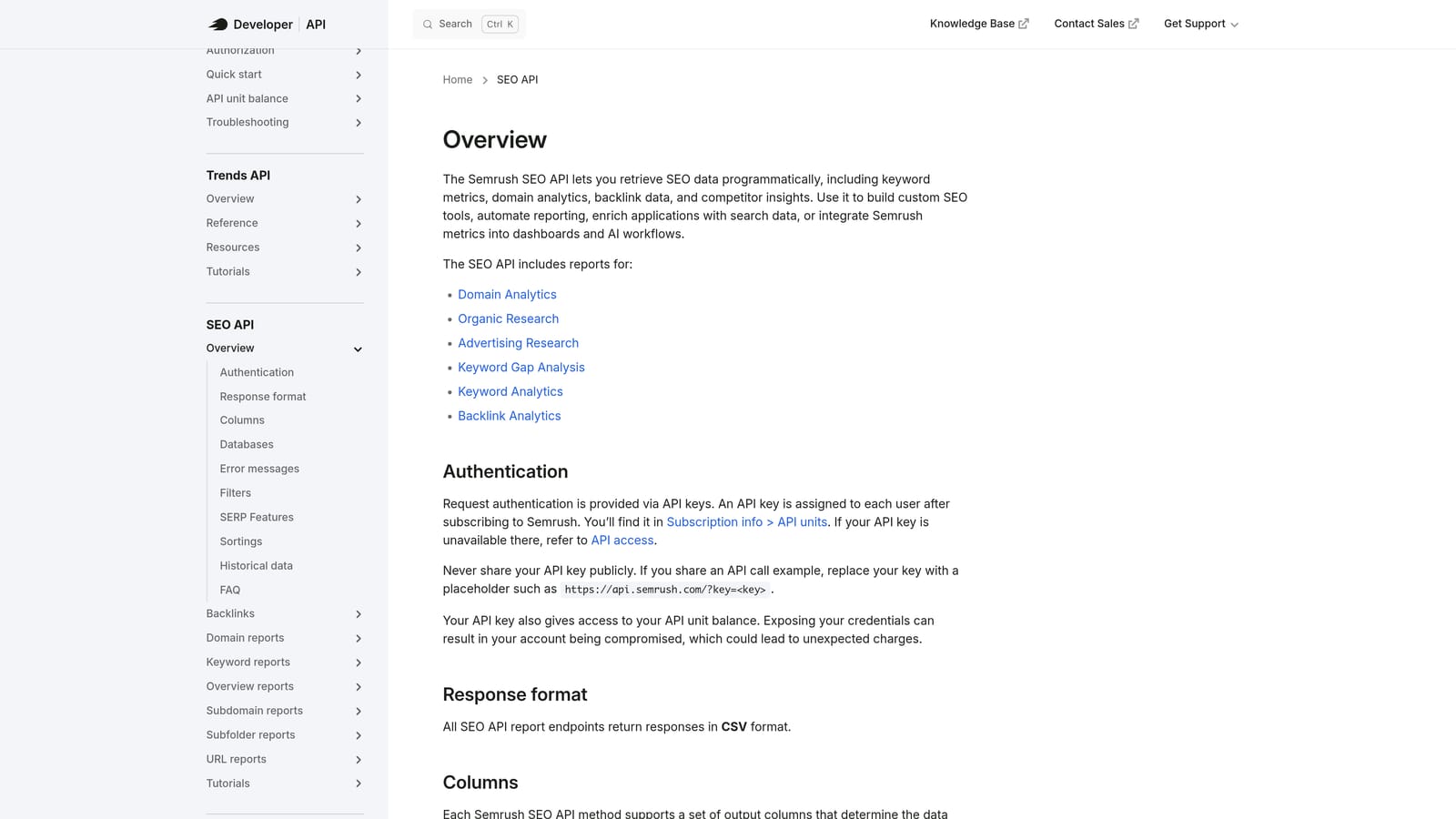
That makes it a reporting tool more than a scraping tool. If your team already lives in Semrush, the API lets you push position data and competitive metrics into Looker Studio, Google Sheets, or an internal dashboard without manual exports.
- Position Tracking data brings your tracked-keyword rankings into your own reports.
- Keyword and domain analytics add volume, difficulty, and traffic estimates next to positions.
- Competitor research lets you automate comparisons against rivals without opening the interface.
- Report automation through Looker Studio and Sheets connections reduces the monthly reporting grind.
The catch is cost. API units are sold separately from a standard subscription, and as of October 2026 you should verify current access rules and unit pricing on the Semrush site. Using it purely to check ranks is usually poor value next to a dedicated SERP API, because you are paying for a research dataset you may not use.
It also assumes an existing Semrush setup, with projects and tracked keywords already configured. Without that, you are buying into a platform to get an API.
Best for: Existing Semrush teams automating reporting.
6. Ahrefs API
The Ahrefs API exposes data from Rank Tracker, Site Explorer, and Keywords Explorer, now on API v3. What sets it apart is link data: Ahrefs is widely regarded for its backlink index, so you can pull rankings and the link profile behind them through one integration.
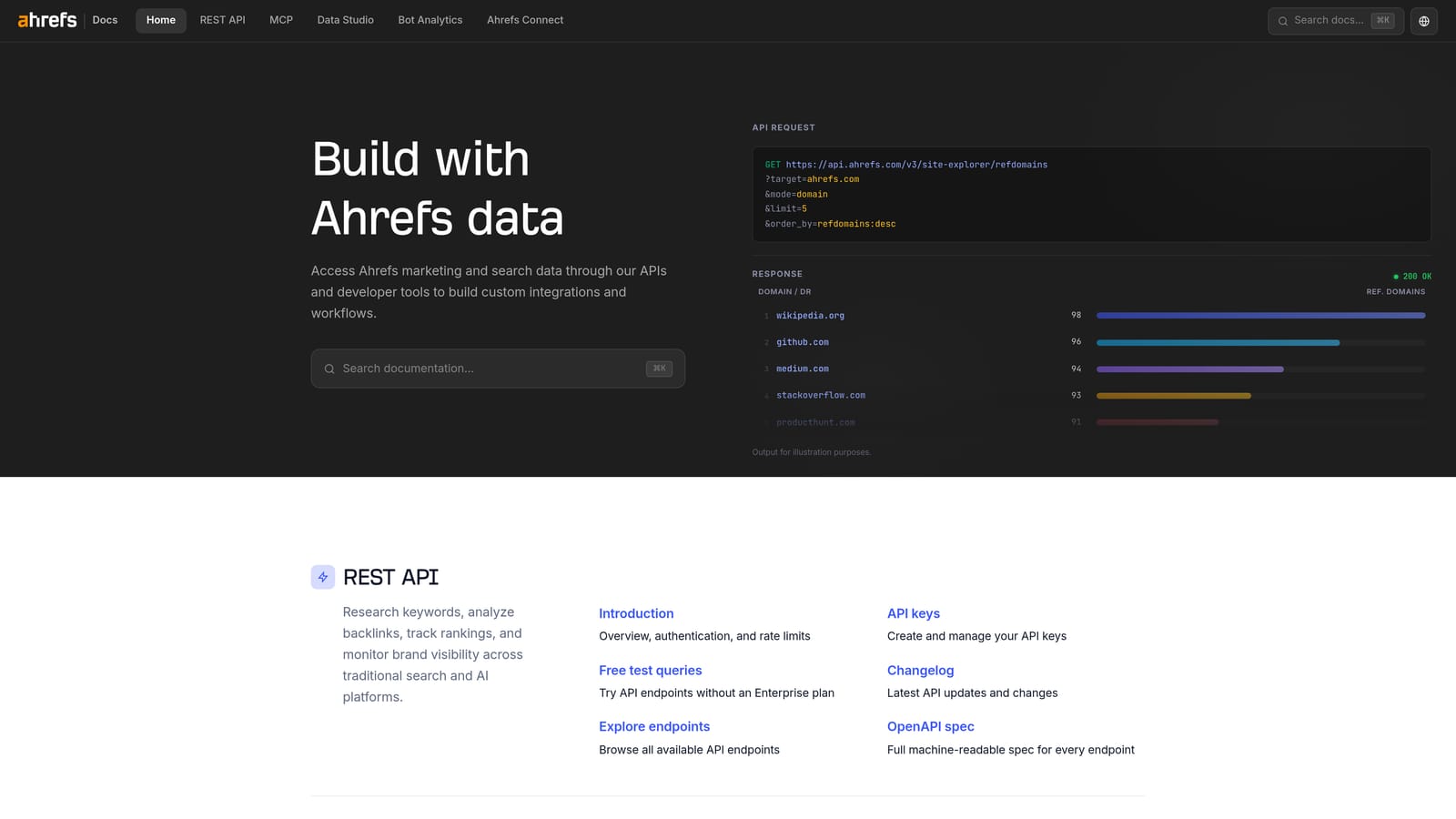
That suits analysis-heavy workflows. A typical use is a BI dashboard that joins a site's tracked positions with referring domains and organic traffic data, so a ranking drop can be examined alongside link changes.
- Rank Tracker data brings your tracked keyword positions into external reports.
- Backlink and organic data lets you explain movement in rankings, not just record it.
- Keywords Explorer metrics add volume and difficulty to your keyword sets.
- API v3 provides the current interface; check the documentation for endpoint specifics.
Access is gated by plan, so eligibility and usage limits depend on your subscription, and you should confirm current terms on the Ahrefs site before designing around it. It is not built for cheap, high-volume SERP scraping. Checking arbitrary keywords for arbitrary locations at scale is better served by DataForSEO, SerpApi, or Serper.dev.
Setup is light if you already use Ahrefs: generate credentials, then connect through your BI tool or scripts. The work is in modeling the data, not wiring the connection.
Best for: Ahrefs customers combining links and rank data.
7. SE Ranking API
The SE Ranking API is project-based. Instead of firing off ad-hoc queries, you create projects, add keywords, and read back tracked positions, volumes, and competitor data. That structure mirrors how agencies actually work, with one project per client.
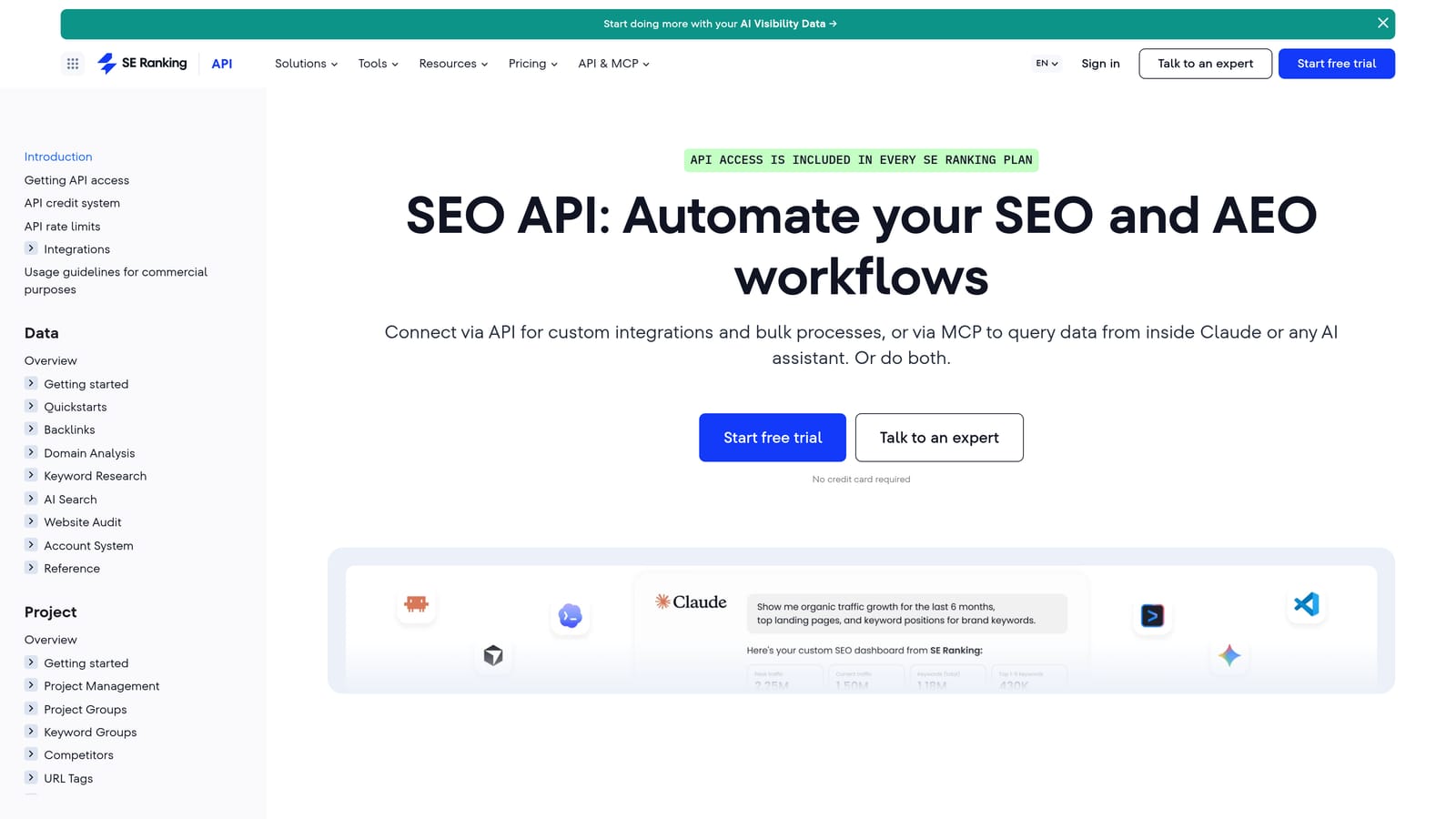
The project management endpoints are what differentiate it here. If you are building a client-facing portal, you can create and manage tracked projects programmatically instead of building that layer yourself on top of a raw SERP feed.
- Daily rank updates give you a steady history without scheduling your own scrapers.
- Multi-engine, device, and location tracking covers the variation that makes one-number rankings misleading.
- Competitor data lets you chart your client against named rivals.
- Data and project APIs separate reading results from managing the tracked set.
Integrations include Looker Studio and Google Sheets, and white-label reports help agencies present data under their own brand. Setup is moderate: define projects and keywords first, then connect your reporting layer.
The trade-off is that it is less suited to ad-hoc live SERP queries. If your product needs "check this keyword right now for any location", a SERP scraping API fits better. Pricing and API access depend on plan, so check the SE Ranking site for current details.
Best for: Agencies and SMB tools managing many tracked projects.
8. AccuRanker API
AccuRanker is a rank-tracking specialist known for fast on-demand refreshes. Its API provides keyword and ranking data for dashboards, and it is built for large keyword sets where waiting for a daily update is not acceptable.
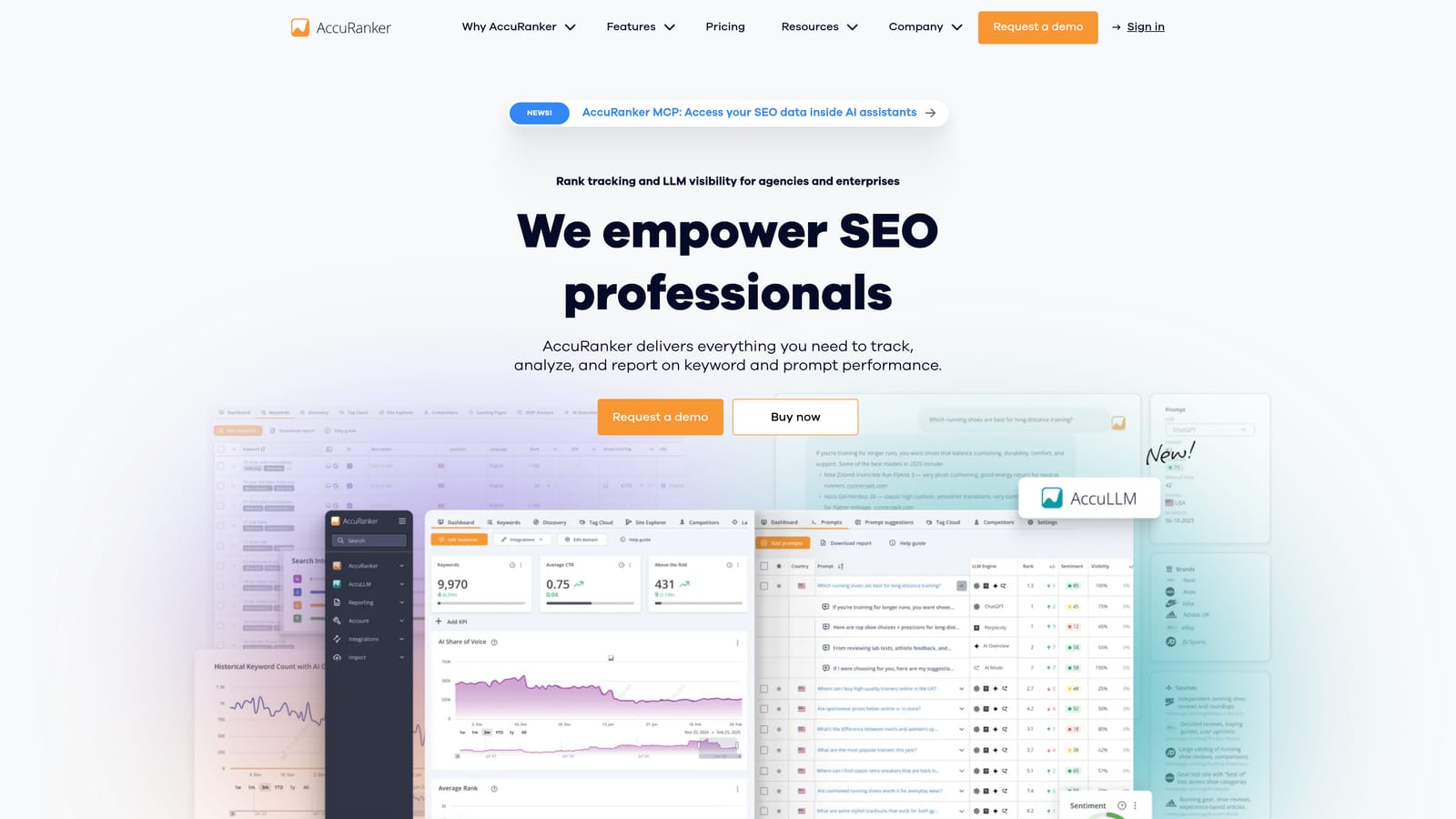
The standout is refresh speed at volume. When a client asks whether a fix worked, you can refresh a large keyword group and see the answer quickly rather than tomorrow. That responsiveness matters in agency and enterprise settings where the reporting cadence is tight.
- On-demand rank refresh lets you re-check positions after a change instead of waiting for the next scheduled run.
- Large keyword volumes support enterprise portfolios without stitching together multiple accounts.
- API for keyword and ranking data feeds your own dashboards and warehouses.
- Agency reporting features help produce client-ready outputs.
It connects to Looker Studio, BI tools, and Google Search Console, so the data can sit beside traffic and impression figures. A technical marketer or analyst can run it day to day; engineering involvement is mostly for the warehouse or dashboard side.
The limitation is focus. AccuRanker does rank tracking and little else, so there is no broader keyword research or backlink data. Pricing is typically tied to keyword tiers or arranged by quote, so confirm current terms on its site. It is poor value if you only need a few hundred ad-hoc checks.
Best for: Enterprise and agency teams with large keyword sets.
9. Zenserp
Zenserp is a straightforward SERP API for Google and other engines that returns structured JSON. It is the lowest-friction option here: sign up, grab a key, and make a request.
It covers Google web, image, news, maps, and shopping endpoints with location targeting, and there is a free tier for testing. That is enough for a prototype that checks where a domain ranks for a handful of keywords, or for a side project where setup time matters more than scale.
- Multiple Google endpoints cover web, image, news, maps, and shopping in one service.
- Location targeting returns results from a specified market.
- Free tier lets you build and test before paying.
- JSON output is easy to parse in any language.
Integration is a REST call, and the documentation includes examples for common programming languages, so there is little to learn. A single developer can run it without ceremony.
The limitations show as you grow. Its ecosystem is smaller than SerpApi's or DataForSEO's, and enterprise support and deep SERP feature coverage are not its strengths. If you expect millions of checks or strict service guarantees, evaluate larger vendors early. Plan sizes and prices are on the Zenserp site and may change.
Best for: Startups and solo developers prototyping rank checks.
Matching an API to Your Build
Positions differ by location, device, and personalization, and scraping cost scales with keywords times frequency times locations. Settle those variables before comparing prices. Beyond that, the choice comes down to what you are building.
- Custom build: DataForSEO or SerpApi. DataForSEO gives the most control over cost per check; SerpApi gets you running fastest across many engines.
- AI agents on a budget: Serper.dev, for speed and simple credit pricing.
- Existing subscribers: Semrush or Ahrefs, if you already pay for the platform and want reporting automation or link context.
- Agency reporting: SE Ranking for project-based client portals, AccuRanker for large keyword sets and fast refreshes.
- Prototypes: Zenserp, until volume justifies a heavier vendor.
Whichever you choose, none of them will show whether ChatGPT, Claude, or Perplexity mention your brand. That is where Sight AI fits, running alongside any of these APIs to track AI visibility, surface content opportunities, and publish optimized articles.
Stop guessing how AI models like ChatGPT and Claude talk about your brand. Get visibility into every mention, track content opportunities, and automate your path to organic traffic growth. Start tracking your AI visibility today and see exactly where your brand appears across top AI platforms.