When someone asks ChatGPT "What's the best marketing automation tool?" or queries Claude about "Which companies lead in customer analytics?", your brand either shows up in the answer—or it doesn't. This isn't hypothetical. AI assistants have become primary research tools for millions of professionals making purchasing decisions, and the brands that appear in those AI-generated recommendations gain enormous competitive advantages.
Think about how this changes the game. Traditional SEO gets you ranked on page one of Google. AI visibility gets you directly recommended in conversational responses where users trust the AI to filter through options and present the best choices. When an AI model confidently mentions your brand alongside industry leaders, you've essentially earned a referral from a trusted advisor.
The challenge? AI models don't work like search engines. You can't simply optimize meta tags or build backlinks and expect results. AI visibility requires understanding how these models synthesize information from across the web, what signals they interpret as authority, and how to position your brand so it naturally surfaces in relevant contexts.
The opportunity is significant. Most companies haven't started optimizing for AI visibility yet, which means early movers can establish authority signals that will influence AI responses for years to come. This guide breaks down six concrete steps to systematically improve your brand's presence in AI outputs, from establishing your baseline to scaling a sustainable visibility strategy.
Step 1: Audit Your Current AI Visibility Baseline
You can't improve what you don't measure. Before implementing any strategy, you need to understand exactly how AI models currently talk about your brand—or whether they mention you at all.
Start by creating a list of 10-15 prompts your target audience would actually use. Think specific scenarios: "What are the best project management tools for remote teams?" or "Which companies offer enterprise-level customer data platforms?" These should reflect real questions potential customers ask when researching solutions in your category.
Query each major AI platform with these prompts. Test ChatGPT, Claude, Perplexity, and Google's Gemini at minimum. Copy the full responses into a spreadsheet. Document which brands get mentioned, in what order, and with what context. Pay attention to how competitors are described—what specific features or benefits does the AI highlight?
This is where it gets interesting. You'll likely notice patterns. Certain competitors appear consistently across multiple AI models. Others get mentioned for specific use cases. Some brands receive glowing descriptions while others get neutral mentions. Track all of this.
Sentiment matters enormously. An AI mentioning your brand with caveats like "though some users report issues with..." is very different from "known for exceptional customer support and reliability." Document the tone and framing of every mention.
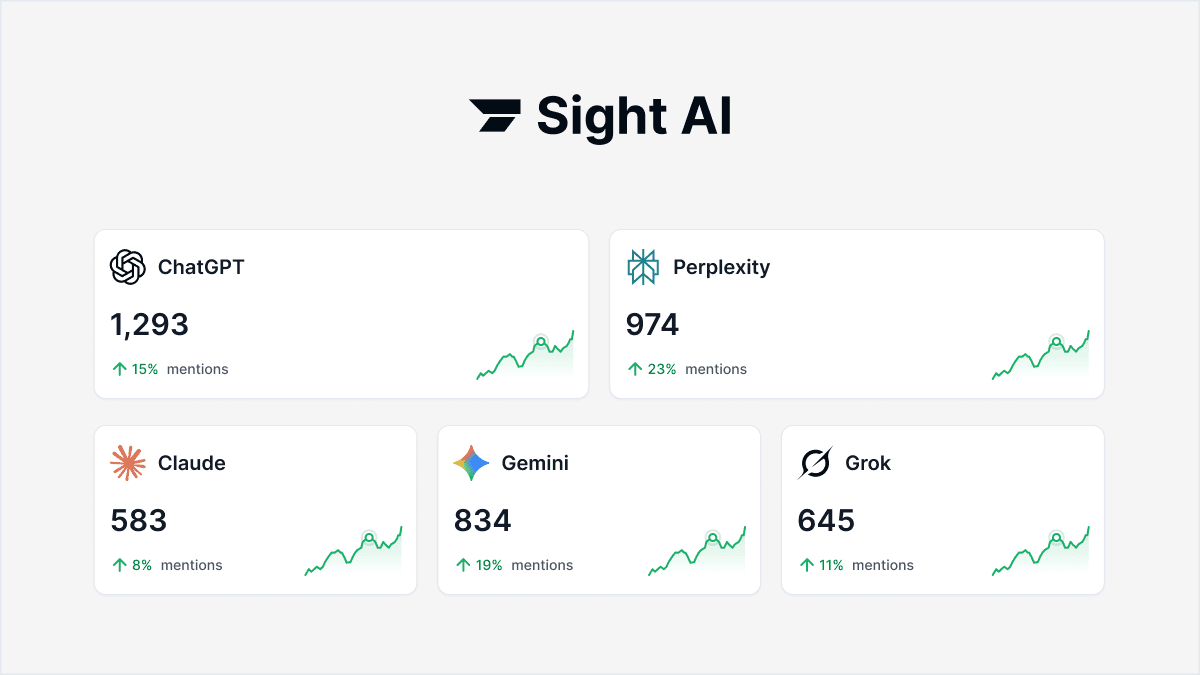
For brands serious about AI visibility, manual querying quickly becomes unsustainable. AI visibility tracking tools automate this process, running your target prompts across multiple models daily and alerting you to changes. This gives you the feedback loop needed to connect content changes with visibility improvements.
Your success indicator: You have a clear spreadsheet showing your mention rate compared to competitors, the contexts where you appear (or don't), and baseline sentiment scores. This becomes your benchmark for measuring progress.
Step 2: Build Authoritative, Citable Content Assets
AI models favor content they can confidently cite as factual and authoritative. Generic marketing copy doesn't cut it. You need content assets that provide unique value—the kind of resources industry professionals bookmark and reference.
Original research stands out. When you publish data nobody else has—whether it's a survey of your customer base, an analysis of industry trends, or benchmark reports—AI models gain a reason to cite you specifically. They can't get that information elsewhere. A well-executed industry report can generate AI mentions for years as models reference your findings.
Structure matters as much as substance. AI models parse content looking for clear definitions, specific statistics, and expert insights they can extract. Use headers that directly answer questions: "What is X?", "How does Y work?", "When should you use Z?" This makes your content easier for AI to understand and cite accurately.
Comprehensive guides that thoroughly address a topic signal authority. Instead of writing five 800-word blog posts on related topics, consider creating one 3,000-word definitive guide. AI models recognize depth and completeness. They're more likely to cite a single authoritative source than piece together information from multiple shallow articles.
Schema markup helps AI understand your content's context. Implement Article, HowTo, and FAQ schema where appropriate. When you define key terms, use proper semantic HTML. These technical signals help AI models correctly interpret what you're saying and how it relates to user queries.
Case studies with specific outcomes provide the concrete examples AI models look for when explaining concepts. Instead of claiming "our platform improves efficiency," document how named companies achieved measurable results. Understanding how to get cited by AI models requires this level of specificity and documentation.
Your success indicator: You've published at least three substantial content assets that provide unique value—whether original data, comprehensive guides, or detailed case studies—that would be worth citing in an AI response about your industry.
Step 3: Strengthen Your Brand's Web Presence and Authority Signals
AI models synthesize information from across the web. A single mention on your own site means little. Consistent mentions across multiple authoritative sources signal that your brand matters in your industry.
Industry publications and authoritative sites carry disproportionate weight. A mention in TechCrunch, Forbes, or a respected industry trade publication does more for your AI visibility than dozens of low-quality directory listings. Focus your PR efforts on earning coverage from sources AI models would consider credible.
Expert roundups and "best of" lists frequently appear in AI training data. When industry blogs compile lists of top tools or leading companies, getting included matters. Reach out to editors running these roundups. Explain what makes your solution unique and why readers would benefit from knowing about it.
Podcast appearances and interviews create additional reference points. When you discuss your expertise on established industry podcasts, those conversations often get transcribed and published, creating text content AI models can access. The conversational format also tends to produce the kind of clear explanations AI models favor.
Directory listings and review sites contribute to consistent brand presence. Ensure your company appears accurately on platforms like G2, Capterra, Product Hunt, and industry-specific directories. Keep your NAP (Name, Address, Phone) and core brand information consistent across all platforms. AI models look for this consistency as a trust signal.
Wikipedia and similar neutral reference sources carry enormous authority with AI models. If your company qualifies for Wikipedia inclusion (based on their notability guidelines), the effort to create and maintain an accurate page pays dividends. If you're wondering why your brand is not showing in AI responses, weak third-party presence is often the culprit.
Your success indicator: When you Google your brand name plus "review" or "alternative," you find your company accurately represented across at least 5-10 authoritative third-party sources with consistent information.
Step 4: Optimize for AI-Specific Discovery Mechanisms
Beyond traditional content, specific technical implementations help AI models discover and understand your brand more effectively.
The llms.txt file is an emerging standard that provides AI-readable information about your site. Similar to robots.txt for search engines, llms.txt tells AI models what they should know about your brand. Create a file at yoursite.com/llms.txt that includes your company description, key products or services, target audience, and any important context. Use clear, factual language without marketing hyperbole.
FAQ content directly addresses the questions AI models receive. Create a comprehensive FAQ section that answers common queries about your product category, your specific solution, and related topics. Structure each answer to stand alone—AI models often extract individual answers without surrounding context. Use the question as a header and provide a complete, self-contained answer.
Language clarity matters more for AI than humans. While creative marketing copy engages readers, AI models prefer straightforward, factual statements they can cite with confidence. In your core informational content, prioritize clarity over cleverness. Save the creative writing for blog posts and campaigns.
Fast indexing ensures new content reaches AI training pipelines quickly. Implement IndexNow to notify search engines immediately when you publish new content. Learning how to get faster Google indexing directly impacts how quickly your content can influence AI responses. Some AI models pull from recent web data, making speed particularly valuable.
Structured data beyond basic schema can help. If you publish regular reports, use Dataset schema. For events, implement Event schema. The more context you provide through structured data, the better AI models can understand and appropriately cite your content.
Your success indicator: You've implemented llms.txt, ensured fast indexing through IndexNow or similar tools, and structured your core content with clear questions and answers that AI models can easily extract and cite.
Step 5: Monitor and Respond to AI Mention Patterns
AI visibility isn't static. Models update, training data changes, and your competitors publish new content. Ongoing monitoring turns AI visibility from a one-time project into a sustainable competitive advantage.
Establish a regular tracking cadence. Weekly or bi-weekly, run your core set of target prompts across the major AI platforms. Track changes in mention frequency, positioning, and sentiment. Create a simple dashboard that shows trends over time. Are your mentions increasing? Is sentiment improving? Are you appearing for new types of queries?
Identify gap prompts—queries where competitors get mentioned but you don't. These represent your biggest opportunities. When you notice a pattern of being excluded from responses about a particular topic or use case, that's a signal to create authoritative content addressing that specific angle.
Analyze what triggers competitor mentions. When a competitor consistently appears in AI responses, look for patterns in how they're described. Do AI models cite specific features? Reference particular case studies? Mention awards or recognition? Understanding what makes competitors "citation-worthy" reveals what you need to develop.
Address inaccurate or negative mentions promptly. If AI models consistently misrepresent your product or include outdated information, you need to update your web presence. Publish clear, current information on your site. Update third-party profiles. Reach out to sites with outdated information and request corrections. Knowing how to monitor brand mentions in AI responses helps you catch these issues early.
Connect content updates to visibility changes. When you publish new content or make significant updates, track whether AI mentions change in the following weeks. This feedback loop helps you understand what content investments actually move the needle on AI visibility versus what doesn't impact mentions.
Your success indicator: You have a tracking system showing month-over-month changes in AI mentions, and you can point to specific content or authority-building efforts that correlated with visibility improvements.
Step 6: Scale Your AI Visibility with Consistent Content Production
One-off content efforts create temporary visibility bumps. Sustained improvement requires consistent content production that builds topical authority over time.
Develop a content calendar specifically targeting AI-relevant topics. These aren't necessarily high-traffic SEO keywords. Instead, focus on topics where professionals ask AI for recommendations or explanations. Industry comparison content, how-to guides, and definitional articles all serve AI visibility well.
Content clusters establish topical authority more effectively than scattered articles. Choose a core topic central to your business and create 8-10 pieces of related content that thoroughly cover different angles. Link these pieces together. AI models recognize when a site demonstrates deep expertise in a specific area, making them more likely to cite you as an authority.
Publishing velocity matters. Brands that consistently publish quality content build authority signals faster than those with sporadic output. Aim for at least weekly publication of substantial content. This doesn't mean churning out thin articles—focus on comprehensive pieces that add genuine value.
AI content tools can help maintain consistency without sacrificing quality. Modern AI writing assistants can help you scale content production while maintaining your brand voice and ensuring thorough coverage of topics. The key is using AI as a force multiplier for your expertise, not a replacement for it.
Test and iterate based on data. Not every content piece will impact AI visibility equally. Some topics and formats drive mentions while others don't. Use your monitoring data to identify what's working. Double down on content types and topics that correlate with increased AI mentions. Adjust or eliminate approaches that don't move the needle.
Refresh and update existing content regularly. AI models favor current information. Revisit your highest-value content quarterly. Add new data, update statistics, and expand sections that could be more comprehensive. Understanding how blogging grows organic traffic applies equally to building AI visibility through consistent publishing.
Your success indicator: You have a documented content calendar, publish consistently, and can show a clear upward trend in AI mentions over a 90-day period that correlates with your content production efforts.
Putting It All Together
Getting mentioned in AI responses represents a fundamental shift in how brands get discovered. Unlike traditional SEO where you optimize for rankings, AI visibility requires building genuine authority through quality content, consistent presence across trusted sources, and technical optimization that helps AI models understand and cite your brand accurately.
The six steps in this guide create a complete system: audit your baseline, create citable content assets, strengthen your web presence, optimize for AI discovery, monitor your visibility, and scale with consistent production. Each step builds on the previous one, creating compound effects over time.
Start with Step 1 today. Open ChatGPT, Claude, and Perplexity. Query them with the questions your customers ask. Document where you stand compared to competitors. This baseline takes an hour but provides the clarity needed to prioritize everything else.
Quick Action Checklist for the next 30 days:
□ Audit current AI mentions across ChatGPT, Claude, Perplexity for 10-15 target prompts
□ Identify 3-5 authoritative content pieces to create or significantly improve
□ Review your brand presence on third-party sites and update outdated information
□ Implement technical optimizations: create llms.txt file and ensure fast indexing
□ Set up a system for ongoing AI visibility monitoring (manual or automated)
□ Create a 90-day content calendar targeting AI-relevant topics in your niche
The brands that establish strong AI visibility now will benefit for years as these models become even more central to how professionals discover solutions. Every piece of authoritative content you publish, every trusted source that mentions you, and every technical optimization you implement compounds over time.
This isn't about gaming the system. It's about ensuring that when AI models synthesize information about your industry, they have access to accurate, comprehensive information about your brand. The companies that invest in genuine authority and valuable content will naturally surface in AI responses.
Stop guessing how AI models like ChatGPT and Claude talk about your brand—get visibility into every mention, track content opportunities, and automate your path to organic traffic growth. Start tracking your AI visibility today and see exactly where your brand appears across top AI platforms.