Every piece of content that drives organic traffic starts with the same foundation: the right keywords. Whether you're a founder trying to grow your SaaS brand, a marketer building out a content calendar, or an agency managing multiple client sites, keyword research is the skill that separates content that ranks from content that collects dust.
But keyword research in 2026 isn't what it was a few years ago. You're not just optimizing for Google's search results anymore. You need to think about how AI models like ChatGPT, Claude, and Perplexity surface and recommend brands in response to user prompts. That means the keywords you target need to serve double duty: ranking in traditional search engines AND positioning your brand for mentions across AI-powered search experiences.
This shift matters more than most marketers realize. When someone asks an AI chatbot "what's the best tool for X" or "how do I solve Y problem," the AI's response is shaped by the content it has indexed and learned from. If your content doesn't speak the right language, you're invisible in both worlds.
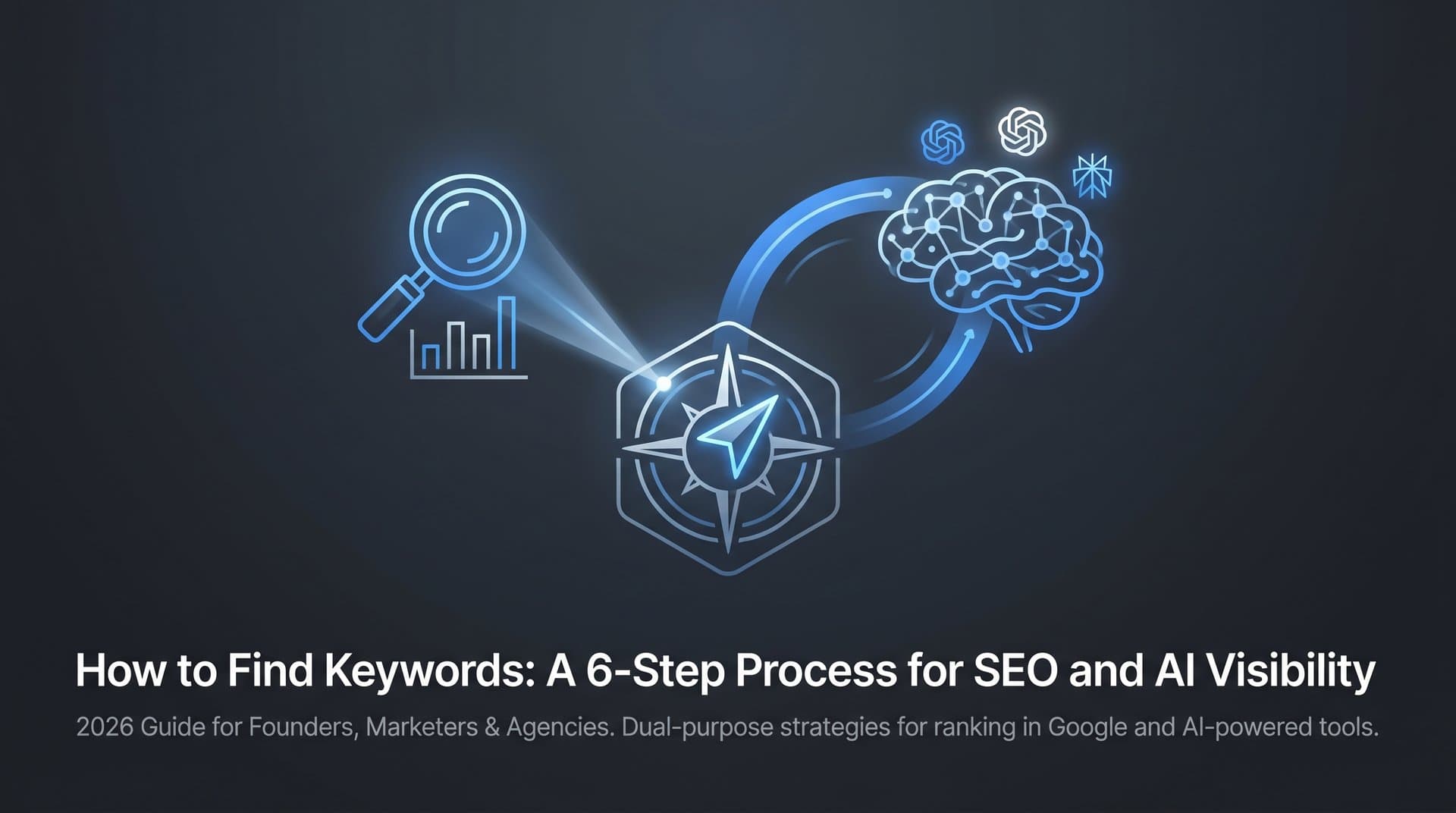
This guide walks you through a practical, six-step process for finding keywords that fuel both SEO and AI visibility. You'll learn how to generate seed ideas, evaluate search intent, assess competition, prioritize opportunities, and organize your findings into a content plan you can actually execute. No fluff, no theory-only advice. Just a repeatable workflow you can start using today.
Step 1: Build Your Seed Keyword List From Real-World Sources
Before you open a single keyword tool, you need raw material to work with. The best seed keywords don't come from algorithms — they come from the language your actual customers use when they describe their problems, goals, and frustrations.
Start with the most underrated source in keyword research: your own customer conversations. Pull language from support tickets, sales call transcripts, onboarding questions, and community forums like Reddit or Slack groups where your audience hangs out. When a customer says "I can't figure out why my site isn't showing up in Google," that's a keyword signal. When they ask "how do I know if my content is working," that's another one. This real-world language is gold because it reflects how people actually search, not how marketers assume they search.
Next, open Google Search Console and look at your existing query data. Filter for keywords where you're ranking in positions 5 through 30. These are terms you already have some authority for, but haven't fully capitalized on. A page sitting at position 12 for a relevant query is a content improvement opportunity, not a failure. Add these to your seed list.
Here's a tactic that most guides skip entirely: mine AI chatbot responses. Open ChatGPT, Claude, and Perplexity and ask the questions your target audience would ask. Pay attention to the terminology and phrasing these models use in their answers. The language AI models use to explain your topic reflects how they've been trained to frame it, which gives you insight into the vocabulary that performs well in AI-powered search contexts. This is early-stage GEO (Generative Engine Optimization) research built right into your keyword process.
Round out your seed list by brainstorming competitor brand names, product categories, and the broader problem space your solution addresses. Think about the job your product does, not just what it's called.
Your goal at this stage is quantity over quality. Aim for 30 to 50 raw seed keywords before you move on. Don't filter yet. You want a wide net to cast into the research tools in the next step.
Step 2: Expand Your List With Keyword Research Tools
Now it's time to take your seed keywords and multiply them. This is where research tools come in, and you don't need to spend a fortune to get meaningful data.
Start with the free options. Google Keyword Planner gives you estimated search volume ranges and related keyword suggestions. Google Autocomplete shows you what real users are typing in the search bar right now. The "People Also Ask" boxes on search results pages are a direct window into the questions your audience is asking. These three sources alone can generate dozens of high-quality keyword variations at zero cost.
If you have access to paid tools like Ahrefs, Semrush, or Ubersuggest, use them to layer in competitive intelligence. These platforms give you keyword difficulty scores, click-through rate estimates, and the ability to see which keywords your competitors rank for that you don't. That last feature is particularly valuable for gap analysis, which we'll cover in Step 4.
When you're inside these tools, use the "Questions" filter wherever it's available. Informational queries phrased as questions tend to perform well in both traditional search and AI-generated answers. AI models frequently pull from content that directly answers a specific question, so building a list of question-format keywords gives you a head start on AI discoverability.
As you expand your list, think in clusters rather than individual terms. A keyword like "keyword research" doesn't exist in isolation. It belongs to a cluster that includes "how to find keywords," "keyword research tools," "long-tail keywords," "search intent," and dozens of related terms. Developing a clear SEO keywords strategy around these clusters will serve you well when you build your content architecture in Step 6.
Export everything into a spreadsheet with consistent columns: keyword, estimated monthly search volume, keyword difficulty score, and a placeholder for search intent (which you'll fill in during Step 3). Keep your spreadsheet clean and structured from the start. It will save you significant time later.
One common pitfall to avoid: don't chase only high-volume terms. Knowing how to find low competition keywords is critical, especially for newer sites or brands entering competitive spaces. A keyword that gets 200 searches per month from people who are ready to buy or sign up is worth more than one that gets 20,000 searches from people who are just browsing.
Step 3: Classify Search Intent Behind Every Keyword
Volume and difficulty numbers only tell part of the story. Before you can decide whether a keyword belongs in your content plan, you need to understand what the person searching for it actually wants. That's search intent, and getting it right is one of the most important steps in the entire process.
There are four main intent categories. Informational queries are searches for knowledge: "how to find keywords," "what is search intent," "why is my site not ranking." Navigational queries are searches for a specific brand or destination: "Ahrefs login," "Semrush pricing page." Commercial investigation queries signal someone comparing options before making a decision: "best keyword research tools," "Ahrefs vs Semrush," "top SEO platforms for agencies." Transactional queries signal purchase or sign-up intent: "buy Semrush subscription," "start free trial keyword tool."
Go through your keyword list and assign an intent category to each term. Then do something that many marketers skip: check the actual search results page for each keyword. The type of content Google ranks at the top tells you exactly what intent it has assigned to that query. Learning how to find SERP features opportunities during this review can reveal high-value placements you might otherwise miss. If the top results are all blog posts and how-to guides, Google has classified the keyword as informational. If product pages and comparison sites dominate, it's commercial or transactional. Matching your content format to the dominant intent is non-negotiable if you want to rank.
For AI visibility specifically, informational and commercial investigation keywords are where you should focus the most attention. These are the query types that AI models most frequently answer with cited content. When someone asks ChatGPT or Perplexity for a recommendation or an explanation, the AI draws from authoritative content that addresses those exact question types. Building strong content around these intent categories increases the likelihood that AI models will surface your brand in their responses.
While you're reviewing SERPs, flag any keyword where Google is showing an AI Overview or a featured snippet at the top of the page. These placements are high-priority targets for GEO. Structured, direct content that clearly answers the query is more likely to be pulled into these formats, giving you visibility above the traditional organic results.
Remove or deprioritize any keyword where the dominant intent doesn't match what your site can realistically deliver. If a keyword is clearly transactional but you don't have a relevant product page, it belongs in a future planning column, not your current content cycle.
Step 4: Evaluate Competition and Identify Gaps
Keyword difficulty scores are useful as a starting signal, but treat them as a rough guide rather than a final verdict. A keyword with a difficulty score of 65 might still be winnable if the current top results are thin, outdated, or poorly structured. Manual review of the top five results is always worth the time.
When you look at the top-ranking pages for a keyword, ask yourself a few specific questions. How comprehensive is the content? Does it actually answer the query thoroughly, or does it skim the surface? When was it last updated? A post from several years ago that hasn't been refreshed is a vulnerability you can exploit with a more current, complete piece. Understanding competition level for keywords requires this kind of hands-on analysis beyond just looking at a number in a tool.
Content gaps are your most valuable opportunities. These are keywords where existing top results fail to fully answer the query, miss key angles, or haven't been updated to reflect current developments. In fast-moving fields like AI, SEO, and technology, content gaps appear constantly because the landscape shifts faster than most publishers can keep up with.
Competitor analysis adds another layer. Use your keyword research tools to look at which terms your direct competitors rank for that you haven't targeted yet. Understanding why you want to run competitive analyses of keywords helps frame this step as essential rather than optional. These represent proven demand in your market.
Here's a dimension of competitive analysis that's increasingly important: check whether AI models currently mention your competitors when answering questions related to those keywords. If you ask ChatGPT or Perplexity "what are the best tools for X" and your competitors appear but your brand doesn't, that's an AI visibility gap. It means your content isn't being parsed and referenced by these models the way your competitors' content is. Closing that gap requires both the right keyword targeting and the right content structure, which we'll address in Step 6.
Use your competition analysis to sort keywords into three tiers. Quick wins are low-competition terms where you can realistically rank within a few months with quality content. Medium-term targets require more effort and content depth but are achievable with consistent output. Long-term aspirational keywords are high-difficulty terms worth building toward as your domain authority grows. This tiering system becomes the backbone of your prioritization in the next step.
Step 5: Score and Prioritize Your Final Keyword List
You've built a large, well-researched list of keywords with intent classifications and competition tiers. Now comes the discipline of narrowing it down. Not every keyword deserves your attention in the next content cycle, and trying to target everything at once is a reliable way to make slow progress on everything.
A simple scoring framework makes prioritization objective rather than gut-driven. Rate each keyword on four dimensions, each on a scale of one to five.
Business relevance: How closely does this keyword connect to what your product or service actually does? A keyword that attracts your ideal customer profile scores a five. A keyword that brings in curious visitors with no purchase intent scores a one or two.
Search volume potential: Higher estimated monthly searches score higher, but weight this dimension carefully. Volume is a proxy for opportunity, not a guarantee of results.
Competition feasibility: Based on your manual review and difficulty scores, how realistic is it that you can rank for this keyword given your current domain authority and content resources? Your quick-win tier keywords score highest here.
AI visibility opportunity: Does this keyword trigger AI-generated answers in tools like ChatGPT, Perplexity, or Google's AI Overviews? Keywords that appear in AI model responses represent dual-channel visibility: you're not just competing for a blue link, you're competing to be the source an AI cites. Learning how to integrate AI in your SEO workflow helps you evaluate this dimension more effectively. These keywords should score higher because they serve both SEO and GEO goals simultaneously.
Business relevance should carry the most weight in your scoring. A keyword with modest search volume but high purchase intent and strong AI visibility potential is often worth more than a high-volume vanity term that attracts the wrong audience. The goal is qualified traffic and brand mentions in the right contexts, not raw numbers.
Add up the scores for each keyword and sort your list from highest to lowest. Then narrow down to your top 20 to 30 priority keywords for the upcoming content cycle. Deciding how many keywords to use for SEO per page is a separate but related decision you'll make as you move into content planning. Your final list should include a healthy mix: some quick-win long-tail terms you can publish and rank for quickly, and some higher-difficulty cornerstone topics worth investing in for the long term. That balance keeps momentum going while building toward bigger opportunities.
Step 6: Organize Keywords Into a Content Plan You Can Execute
A prioritized keyword list is only valuable if it leads to published content. This final step is where strategy becomes execution, and where most keyword research projects either succeed or stall out.
Start by grouping your priority keywords into topic clusters. A topic cluster is a group of related keywords that can be addressed through a pillar page and a set of supporting articles that link back to it. For example, if "keyword research" is your pillar topic, supporting articles might cover "how to find long-tail keywords," "search intent explained," "keyword difficulty guide," and "how to use Google Search Console for keyword research." Each supporting article targets a more specific keyword while reinforcing the authority of the pillar page through internal links.
This architecture works well for both traditional SEO and AI visibility. Search engines reward sites with deep, interconnected content on a topic. AI models are more likely to reference content from sources that demonstrate comprehensive coverage of a subject area rather than isolated, standalone posts.
Next, map each keyword to a specific content format based on the intent classification you did in Step 3. Informational keywords get step-by-step guides, explainers, or how-to posts. Knowing how to write a blog post for SEO ensures each piece is structured for maximum ranking potential. Commercial investigation keywords get comparison posts, listicles, or review-style articles. Transactional keywords get landing pages or product-focused content with clear calls to action. Matching format to intent isn't optional — it's what gets you ranked.
Assign publication priority based on your scores from Step 5. Quick-win keywords go first. Publishing content that ranks relatively fast builds domain authority, generates early traffic, and gives you data on what's working before you invest in more competitive topics. Momentum compounds, and early wins make the harder targets more achievable over time.
Plan for AI discoverability from the start, not as an afterthought. Structure your content with clear H2 and H3 headings that directly answer the questions behind each keyword. Include concise, direct answers near the top of each article. Use authoritative citations where relevant. AI models parse structured content more effectively than dense, unformatted prose. Writing for clarity and structure serves both human readers and AI crawlers simultaneously.
Set up a production workflow that your team can maintain consistently. Content automation tools and AI writing assistants can help you scale output without burning out your team. Platforms that combine content generation with auto-publishing to your CMS reduce the friction between "keyword identified" and "content live."
Finally, make sure every piece of new content gets indexed quickly. Using the IndexNow protocol or automated sitemap updates notifies search engines and AI crawlers the moment new content is published. Understanding search engine indexing optimization ensures your keyword research starts paying off sooner rather than waiting for crawlers to discover your content on their own schedule.
Your Six-Step Keyword Research Checklist
Finding keywords isn't a one-time task. It's an ongoing discipline that compounds over time. The brands that win in both traditional search and AI-powered discovery are the ones that treat keyword research as the strategic foundation it is, and then execute consistently against it.
Here's your quick-reference checklist to keep the process on track:
1. Build seed keywords from customer language, Search Console data, AI chatbot responses, and competitor analysis. Aim for 30 to 50 raw terms.
2. Expand with research tools using Google Keyword Planner, Autocomplete, People Also Ask, and paid platforms like Ahrefs or Semrush. Export everything into a structured spreadsheet.
3. Classify search intent for every keyword. Check the actual SERP to confirm what Google thinks the intent is. Flag AI Overviews and featured snippets as GEO priorities.
4. Evaluate competition manually. Look for content gaps, outdated results, and keywords where competitors appear in AI model responses but your brand doesn't.
5. Score and prioritize using business relevance, volume potential, competition feasibility, and AI visibility opportunity. Narrow to 20 to 30 priority keywords per content cycle.
6. Organize into topic clusters with assigned content formats, a publication sequence, and a production workflow that includes fast indexing through IndexNow or automated sitemap updates.
Start with your first batch of priority keywords this week. Publish content optimized for both search engines and generative AI. And don't just track rankings in Google — track how your brand is being mentioned across AI platforms too.
Stop guessing how AI models like ChatGPT and Claude talk about your brand. Start tracking your AI visibility today and see exactly where your brand appears across top AI platforms, so you can close the gaps your keyword research uncovers and turn every published article into a real visibility opportunity.