Finding SERP feature opportunities is all about being strategic. It means identifying the keywords that trigger things like Featured Snippets or "People Also Ask" boxes, and then actually structuring your content to win those spots. This is a move beyond just traditional rankings; it's about capturing the most prominent real estate on Google's results page.
And it's a critical shift. These features often answer a user's question directly on the SERP, grabbing clicks before anyone even has a chance to scroll down to the standard blue links.
Why SERP Features Are the New SEO Battleground
Let's be honest, the days of a simple list of ten blue links are long gone. Google's SERP is now a dynamic, interactive space built to give people answers instantly. Winning at SEO today isn't just about hitting that number one spot—it's about owning the most valuable and eye-catching features on the entire page.
Think about it: capturing a Featured Snippet can actually drive more clicks than the top organic position it sits above.
This whole trend reflects a massive change in how Google works and how we all search. Google wants to satisfy user intent as fast as possible, often without needing a click-through at all. This is the heart of Answer Engine Optimization, a strategy all about providing direct answers. For any business, this means you have to adapt. Your goal isn't just ranking for keywords anymore; it's directly answering the questions your audience is asking.
To really get why this is happening, it helps to understand the fundamental 4 Pillars of SEO that underpin any solid online presence. SERP features are the next layer you build on top of that foundation to gain a real competitive edge.
The Shrinking Organic Landscape
The rise of all these SERP features has a very real consequence: it pushes the traditional organic results further and further down the page, especially on mobile. The competition for visibility is fiercer than ever. If you're ignoring SERP features, you're essentially fighting for a smaller and smaller piece of the pie.
Recent data really puts this into perspective. One analysis found that SERP features captured a massive 65% of total SERP visibility across hundreds of thousands of pages. That left traditional organic results with just a 35% share. It’s a stark reminder that targeting these features is no longer optional if you want to maintain, let alone grow, your traffic.
The Strategic Value of Different Features
Not all SERP features are created equal, and they don't all serve the same purpose. Figuring out their strategic value is key to prioritizing where you spend your time and energy.
To help you get started, here's a quick breakdown of the most common features and what they're best for.
Key SERP Features and Their Strategic Value
This table gives a quick overview of common SERP features and the primary strategic benefit each offers.
| SERP Feature | Primary Goal | Best For |
|---|---|---|
| Featured Snippets | Establish Authority | Answering high-intent, question-based queries directly. |
| People Also Ask | Build Awareness | Addressing related user questions and guiding them deeper into your content. |
| Local Pack | Drive Foot Traffic | Businesses with physical locations needing to attract local customers. |
| Image & Video Packs | Enhance Engagement | Visual-first industries where multimedia content is more appealing. |
| Knowledge Panel | Brand Dominance | Building brand credibility and providing an at-a-glance company overview. |
As you can see, each feature offers a unique opportunity to connect with your audience.
Here's a more detailed look at how to think about them:
- Featured Snippets: These are perfect for establishing your brand as an authority and capturing high-intent traffic from question-based searches.
- People Also Ask (PAA): This is your playground for top-of-funnel awareness. By answering these related questions, you can guide users deeper into your content ecosystem. We dive deeper into this in our guide on what is Answer Engine Optimization.
- Local Pack: For any business with a physical storefront, this is non-negotiable. It's the engine that drives direct foot traffic and local phone calls.
- Image & Video Packs: Absolutely critical for visual-first industries. These features enhance brand appeal and engage users who'd much rather watch a video or see a picture than read text.
By focusing your efforts on finding these SERP feature opportunities, you're not just chasing rankings—you're investing in a more resilient and future-proof SEO strategy.
Building Your SERP Feature Discovery Workflow
Alright, let's move from theory to action. Snagging SERP feature opportunities isn't about luck or random checks; it's about building a repeatable, systematic process. You need a workflow that consistently flags high-value targets. This means going beyond your traditional keyword research playbook and learning to see the SERP landscape through a new lens.
The first move is to completely reframe how you think about keyword research. Stop fixating only on those high-volume head terms. Instead, you need to actively hunt for the kinds of queries that make SERP features pop up in the first place.
Start with Question-Based Keyword Research
So many of the most valuable SERP features, like Featured Snippets and People Also Ask boxes, are triggered by simple questions. Your audience is literally asking Google for direct answers, and your job is to be the one providing them.
Start by brainstorming the core questions your customers have at every single stage of their journey. Think about all the "how to," "what is," "why," and "best" queries that relate to your products or services. These are absolute goldmines for feature ownership.
Of course, tools can speed this up dramatically. You can jump into your favorite keyword research tool and filter specifically for keywords phrased as questions. This instantly generates a hit list of potential targets that are far more likely to display a SERP feature.
Let's imagine you're a B2B software company. Instead of just targeting a broad term like "project management software," you'll find better opportunities around questions like:
- How to improve team collaboration remotely?
- What is the best software for agile workflows?
- Asana vs Trello comparison for small teams.
These long-tail, question-based queries are often less competitive and are the exact kind of searches that trigger the features you want to own.
Scan the SERPs—Manually and with Automation
Once you've got a target list of keywords, it's time to see what’s actually happening on the results page. This is a two-pronged attack: a little bit of manual inspection mixed with a whole lot of automated scanning to map out the current landscape.
A manual check is invaluable for getting the context right. For a handful of your most critical keywords, pop open an incognito window and do a Google search. Take note of every single feature that appears—Featured Snippet, PAA, Image Pack, Video Carousel—and see who currently owns that spot. This hands-on approach gives you a real, qualitative feel for the competitive environment.
But let's be real, manual checks don't scale. When you're dealing with hundreds or thousands of keywords, you need automation. This is where specialized tools become your best friend.
A robust SERP analysis tool can churn through your entire keyword list and automatically tell you which features are present for every single query. This saves an insane amount of time and gives you a comprehensive dataset to build your strategy on. It's the true backbone of your SERP landscape analysis.
The visual below nails this fundamental shift—moving away from an outdated SEO focus to a modern strategy all about winning these high-visibility SERP features.
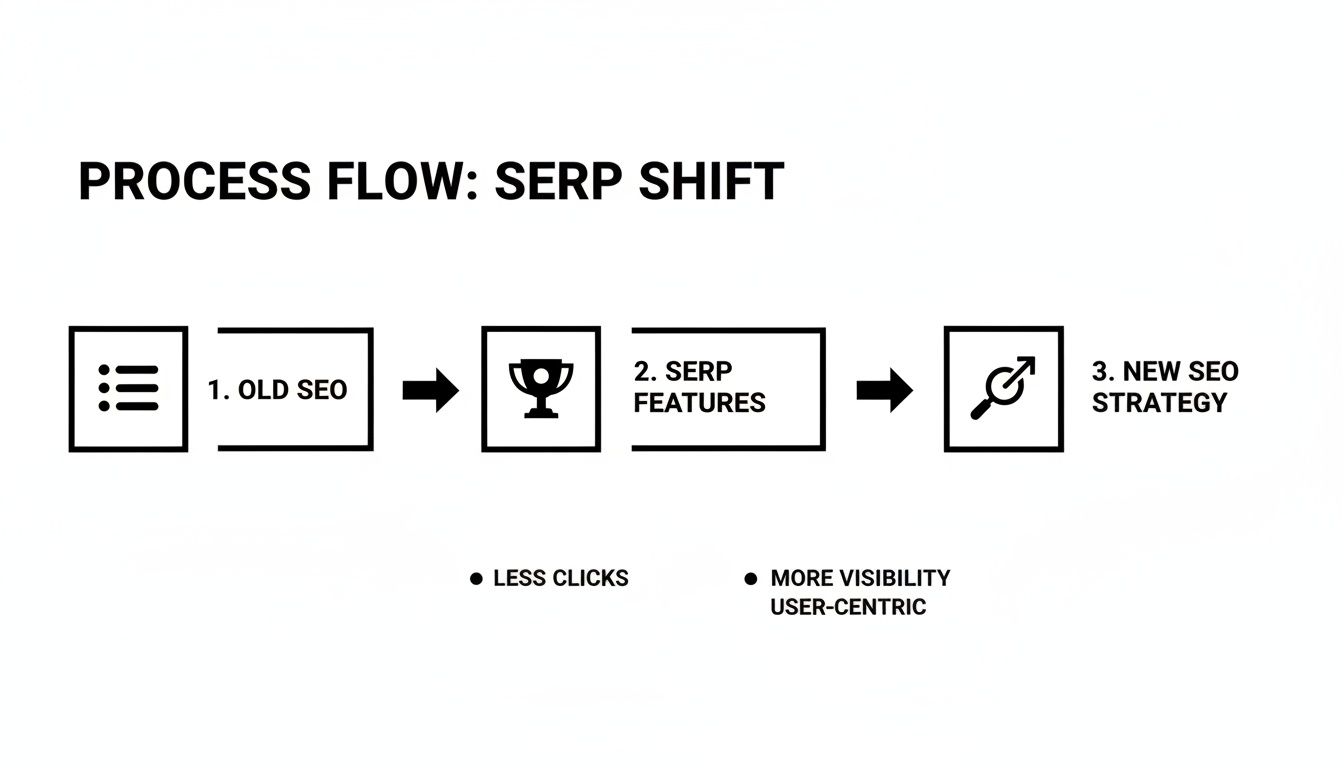
This flow makes it clear: success isn't just about a list of blue links anymore. It's about capturing the most prominent real estate on the page.
Create Your SERP Landscape Analysis
With all your data in hand, the final step is to organize it into a "SERP Landscape Analysis." Think of it as a spreadsheet or database that maps out every single one of your opportunities. This becomes your strategic blueprint for deciding where to invest your content efforts.
Your analysis should track a few key data points for each target keyword:
- The Keyword Itself: The query you're going after.
- Monthly Search Volume: To gauge the potential audience size.
- SERP Features Present: A list of all features you found (e.g., Snippet, PAA, Local Pack).
- Current Owner(s): The domain(s) currently sitting in those feature spots.
- Your Current Rank: Where your site stands today for that query.
This document becomes your single source of truth. At a glance, you can see where your competitors are dominating and, more importantly, where they're dropping the ball. Maybe a competitor owns the Featured Snippet, but no one is properly answering the questions in the PAA box. That’s your opening.
To keep tabs on these positions over time, you need a reliable tracking method. For those ready to get serious about automation, our guide on the best SERP tracking tools is a great place to start. It covers platforms that can help you monitor progress and spot new opportunities as they pop up. Remember, this analysis isn't a one-and-done task; it's a living process of discovery and refinement.
You've uncovered a goldmine of potential SERP feature opportunities. That's the exciting part. Now comes the hard part: where do you even begin?
Chasing every single opportunity is a classic rookie mistake. It’s a surefire way to stretch your team too thin and end up with a lot of half-finished work and zero real wins. Some features dangle the promise of massive traffic but are locked down by heavyweight competitors. Others are low-hanging fruit, easy to grab but might only bring in a trickle of visitors.
The real game-changer is moving from a raw, overwhelming list to a prioritized, strategic action plan. This means you need a system to score each opportunity, so you can focus your energy where it'll actually move the needle.
Building a Simple Scoring Framework
Forget gut feelings. A practical scoring framework is what separates strategic SEOs from those just throwing things at the wall. When you evaluate every opportunity against the same set of criteria, you can objectively weigh a tough-to-win Featured Snippet against an easier People Also Ask box and know which one makes more sense for your business right now.
We can boil this down to three core pillars:
- Traffic Potential: How many clicks could this feature realistically drive?
- Intent Alignment: How well does this feature match our audience's needs and our business goals?
- Competitive Difficulty: How hard will it be to win and hold this position?
By giving each pillar a simple score (say, 1-5), you can calculate a total priority score that brings instant clarity to your roadmap. This is how you turn a messy spreadsheet into a focused to-do list.
Opportunity Scoring Matrix
To put this into practice, you can build a simple scoring matrix. This framework helps you quantify your analysis, making it easy to stack-rank opportunities and decide what to tackle first, second, and third. It’s a straightforward way to visualize your priorities.
| Opportunity | Traffic Potential (1-5) | Intent Alignment (1-5) | Competitive Difficulty (1-5) | Priority Score |
|---|---|---|---|---|
| Example 1: Featured Snippet "best project management software" | 5 | 5 | 5 (Very Hard) | Calculated |
| Example 2: PAA "how to delegate tasks" | 3 | 4 | 2 (Easy) | Calculated |
| Example 3: Local Pack "project management consultant near me" | 2 | 5 | 3 (Medium) | Calculated |
A simple formula like (Traffic + Intent) - Difficulty can work well. The goal isn't perfect math; it's about creating a consistent system to guide your decisions and justify your strategy to stakeholders.
Evaluating Traffic and Intent
Let’s be honest, estimating traffic from a SERP feature isn't an exact science. But you can make some pretty solid educated guesses. A Featured Snippet for a query with 10,000 monthly searches is almost always going to be more valuable than a PAA result for a term with just 100 monthly searches. Look at the keyword volume, but also consider the feature's prominence. If it’s right at the top, its click-through potential is naturally higher.
Next up is intent. Is the user just browsing for information, or are they ready to pull out their wallet? Nabbing a Featured Snippet for "how to clean suede shoes" is fantastic for brand awareness. But winning one for "best waterproof suede protector" is far more likely to ring the cash register.
The real magic happens when you align the SERP feature with a specific stage in the customer journey. A PAA box might be perfect for attracting top-of-funnel users, while a Local Pack is critical for converting bottom-of-funnel searchers ready to visit a store.
Aligning your efforts with user intent is a core part of identifying what your audience is missing. This process is very similar to what you would do when conducting an SEO content gap analysis, where you look for topics your competitors cover that you don’t. Here, you're looking for feature gaps.
Assessing the Competitive Landscape
Finally, you need a reality check on the competition. Time to put on your detective hat. Who currently holds the SERP feature you’re eyeing?
Dig into the current owner by asking a few key questions:
- Is it a monster domain like Wikipedia or a major news outlet?
- Is their content perfectly structured and optimized for that specific feature?
- How fresh is their content? When was it last updated?
If the top spot is held by a site with massive authority and their content is flawless, trying to unseat them will be a long, painful uphill battle. That’s a low score for "ease of winning" (or a high score for "competitive difficulty").
On the flip side, if the current owner is a smaller site, their content is thin, or the answer is just plain bad, you've struck gold. That’s a high-priority target because the barrier to entry is so much lower. This analysis saves you from wasting months fighting an unwinnable war and instead points you toward quick, attainable wins that build momentum.
Crafting Content That Captures Specific SERP Features
Alright, you've pinpointed your SERP feature opportunities. Now for the fun part: creating or tweaking content that actually wins those coveted spots.
Just hitting "publish" on a standard blog post and crossing your fingers isn't going to get you there. Every SERP feature plays by its own set of unwritten rules. To win, you need to structure your content in a way that screams to Google, "Hey, I have the best, most direct answer right here!"
This isn't about spammy, old-school SEO tactics. It’s about building your content to be "feature-ready" from the get-go. Mastering top content optimization strategies is key to structuring your information in a way that Google can't ignore for these high-visibility placements.

Optimizing for Featured Snippets
Featured Snippets, or "position zero," are the holy grail for informational searches. They sit right at the top, above the #1 organic result, and can seriously boost your click-through rate. The secret to capturing one? Give a direct, concise, and authoritative answer.
Google generally pulls from three main formats for these snippets:
- Paragraph Snippets: Think short, direct answers (40-60 words) to "what is," "who is," or "why is" questions.
- List Snippets: Perfect for "how-to" steps, "best of" lists, or rankings. Both numbered and bulleted lists work well here.
- Table Snippets: Your best bet for comparing data, pricing, or product features in a clean, structured format.
To set yourself up for success, put the target question in a subheading (an H2 or H3). Right below it—and I mean immediately below it—provide the answer in the right format. For a paragraph snippet, that’s a tight, clean definition. For a list, make sure you're using proper <ol> or <ul> HTML tags.
Pro Tip: Don't bury the lead. The single biggest mistake I see is people writing a long, meandering intro before getting to the point. Put the snippet-worthy answer right at the top, then you can expand on it further down the page. It’s a win-win for both Google and your readers.
Winning People Also Ask Boxes
The People Also Ask (PAA) section is an absolute goldmine. It's where you can intercept mid-funnel searchers and build some serious topical authority. Since PAA questions are directly related to the main query, answering them on your page tells Google your content is the real deal—a comprehensive resource.
The strategy here is surprisingly simple: treat each PAA question like a mini-section within your article.
- Find the Questions: Use your SERP tools or just look at the live results to see what questions pop up for your main keyword.
- Build an FAQ: You can either create a dedicated FAQ section at the bottom of your post or weave the questions and answers into the flow of your article using H3s.
- Keep Answers Punchy: Just like with snippets, aim for direct answers around 50-70 words each. This makes it incredibly easy for Google to grab your text and slot it into the PAA dropdown.
A single article with a solid Q&A structure can start ranking for dozens of related long-tail queries, massively expanding its footprint. Plus, it's great for the user experience, as you're already answering their next question before they even have to ask it.
Capturing Local Pack Visibility
If you're a local business, the Local Pack is your bread and butter. It’s that map with three business listings that shows up for searches like "pizza near me" or "best roofer in Austin." Getting into this exclusive club is less about the content on your page and more about your Google Business Profile (GBP) and local signals.
Your GBP listing needs to be your top priority. Make sure it's 100% complete and obsessively accurate.
- NAP Consistency: Your Name, Address, and Phone number must be identical everywhere—on your website, in your GBP, and across all local directories.
- Pick the Right Categories: Be precise with your primary and secondary business categories.
- Get More Reviews: Actively ask your happy customers to leave reviews. A steady flow of 4- and 5-star reviews is a massive trust signal to Google and a huge ranking factor.
Beyond your GBP, creating location-specific service pages on your website is a game-changer. A page for "Emergency HVAC Repair in Austin" has a much better shot at ranking in the Austin Local Pack than a generic "Services" page. These pages are also the perfect place to nail your on-page SEO. For a great refresher, check out our guide on how to write meta descriptions for SEO that get those local clicks.
Dominating with Image and Video Content
Search is becoming more visual every day. Image Packs and Video Carousels are massive opportunities to stand out, especially if you have a visually appealing product or service. If you're not optimizing for these, you're just leaving traffic on the table.
For images, there's more to it than just uploading a file.
- Use Descriptive File Names: Ditch
IMG_1234.jpg. Usemodern-farmhouse-kitchen-remodel.jpginstead. - Write Helpful Alt Text: Describe the image clearly. This helps search engines understand it and makes your site accessible.
- Compress Your Images: Use a tool to reduce the file size. Fast-loading pages are crucial, and heavy images are a common culprit for slow sites.
When it comes to video, platforms like YouTube and Vimeo are the standard. To boost your odds of showing up in a video carousel, focus on these areas:
- Keyword-Rich Titles & Descriptions: Your video title and description are just as important as a blog post's title and meta description. Optimize them!
- Use Video Schema Markup: Add video schema to the page where your video is embedded. It gives Google extra context about what your video is about.
- Create a Killer Thumbnail: Your thumbnail needs to be eye-catching and accurately represent the video. A high click-through rate on your thumbnail signals to Google that your video is relevant and engaging.
Tracking Performance and Scaling Your Wins
Nailing your first SERP feature is a huge win, but let's be honest, the real growth comes from knowing why it worked and doing it again. And again. Finding these opportunities isn't a one-and-done project; it’s a constant cycle. To really get ahead, you have to look past simple what is rank tracking and start measuring the things that actually show the value of owning these SERP positions.
What you're building is a feedback loop. Performance data should directly fuel your next strategic move. Without this, you’re just throwing content at the wall and hoping something sticks. A solid tracking system is what turns a few lucky wins into a repeatable, scalable engine for organic growth.

Setting Up Your Tracking Dashboard
Your best friend here is Google Search Console (GSC). It's an absolute goldmine of performance data, but you need to know where to dig. The trick is to filter your reports to isolate the specific pages winning SERP features and watch how their metrics evolve.
Jump into the Performance report in GSC. Start by comparing date ranges to see what changed before and after you started targeting a feature.
Keep a close eye on these KPIs:
- Impressions: When you see a massive spike in impressions for a page, it’s a huge clue you've likely grabbed a high-visibility feature like a Featured Snippet or an Image Pack.
- Click-Through Rate (CTR): Watch how this number moves. Winning "position zero" can send your CTR through the roof, but other features might give you a ton of impressions without the same lift in clicks. Both outcomes are valuable, just in different ways.
- Average Position: This one can be tricky. Don't freak out if your average position gets worse after winning a Featured Snippet. GSC can count it in weird ways. The real story is always in your clicks and impressions.
Set up a dedicated dashboard, either right in GSC or by piping the data into a tool like Looker Studio. It’s the single best way to keep these metrics in front of you. Track your target pages and their queries to get a clear, constant picture of what you own on the SERP.
Identifying What Truly Matters
Old-school SEO is obsessed with that #1 spot. But with SERP features, the KPIs that matter are far more nuanced. You're trying to understand the quality of the visibility you’re earning, not just its rank.
Think about it this way: say you capture a "People Also Ask" dropdown. Your clicks probably won't skyrocket immediately. But your impressions for that page will climb, and you're now building authority and brand visibility around a whole new cluster of related questions. That's a long-term win that a simple rank report would totally miss.
Even features you don't directly own can be incredibly valuable. One recent Moz study found that related searches popped up in a staggering 99% of the SERPs they analyzed. While people often use these to refine their search instead of clicking, they give you a direct roadmap to user intent. You can literally see what topics to cover next to pull in more targeted traffic.
Scaling Your Success and Compounding Wins
Once your tracking is humming along, patterns will start to emerge. You’ll see which content formats, page structures, and optimization tactics consistently win specific features for your site. This is where you pour fuel on the fire.
- Find Your "Winning Formula." Did that page with a tight Q&A section and a numbered list snag a Featured Snippet? Great, that’s your new template.
- Audit Your Existing Content. Go find other relevant pages on your site that could be retrofitted with this same winning structure.
- Inform New Content Creation. Make sure every new content brief includes clear instructions for targeting SERP features based on your own data.
This creates a powerful cycle: you track performance, figure out what works, apply those learnings to more content, and track it all over again. Every feature you capture builds on the last, compounding your visibility over time. This data-first approach takes SERP feature hunting from a hopeful tactic to a core part of your entire SEO strategy.
Answering Your Burning Questions About SERP Features
As you start digging into SERP feature opportunities, a few common questions always seem to surface. Getting these sorted out early on helps sharpen your strategy and sets the right expectations for your team. This is where we move from theory to what actually works.
Let's break down some of the most common questions that pop up when SEOs and marketers get serious about a SERP feature-driven content plan.
How Long Does It Take to Win a SERP Feature?
This is the classic "it depends" answer, but for good reason. I've seen results pop in a few days, and I've seen others take several months. The timeline really hinges on the keyword competition, your site's overall authority, and just how perfectly your content nails the format for the feature you're after.
For a low-competition, long-tail query, a perfectly structured answer can sometimes snatch a Featured Snippet in under a week. On the other hand, a high-value, competitive feature like a brand's Knowledge Panel might take months of consistent effort and building signals all over the web. The real work is in the consistent monitoring and tweaking.
Don't get discouraged if results aren't immediate. The name of the game is incremental improvement. Winning your first feature, even a small one, gives you an invaluable playbook you can use to replicate that success at a much larger scale.
Can One Page Target Multiple SERP Features?
Absolutely. In fact, you should be doing this. It's one of the most efficient ways to maximize your content's real estate on the results page. A single, powerhouse piece of content is the perfect vehicle for capturing several features at once. It’s a massive signal to Google that your page is the authority on that topic.
Think about a comprehensive guide you’ve published. That one page could realistically:
- Grab the main Featured Snippet for the broad, head-term topic.
- Have different H2s or H3s show up in People Also Ask boxes for more specific, related questions.
- Feature well-optimized images that get pulled into the Image Pack.
By structuring your content with sharp headings, clean lists, and direct answers, you're not just optimizing for one feature—you're setting a trap for several.
What Is the Most Valuable SERP Feature to Target?
The "most valuable" feature is the one that actually helps your business. There's no universal trophy here; what's valuable is completely tied to your specific goals. You have to align your SERP feature targets with what you're trying to accomplish.
Think about what a "win" looks like for your campaign:
- Driving high-intent traffic and leads? A Featured Snippet or a top position in the Local Pack is probably your best bet for getting clicks that convert.
- Building brand authority and trust? Nothing beats a Knowledge Panel for owning your branded search results and establishing instant credibility.
- Capturing top-of-funnel interest? Showing up in multiple People Also Ask dropdowns is a fantastic way to introduce your brand to people who are just starting their research.
Your strategy for finding SERP feature opportunities has to be led by your marketing objectives. The "best" feature is simply the one that gets you closer to hitting your goals.
Ready to turn AI and search visibility into measurable growth? With Sight AI, you can monitor how top AI models see your brand, uncover high-value content gaps, and generate SEO-optimized articles effortlessly. Learn more about how Sight AI can transform your content strategy.