AI models like ChatGPT, Claude, and Perplexity are quickly becoming the first stop for buyers researching products, comparing vendors, and evaluating solutions. When someone asks an AI model "what's the best platform for X?" or "which companies are leaders in Y?", the brands that appear in those responses get the consideration. The brands that don't are effectively invisible to that buyer at that moment.
LLM brand analytics platforms exist to close that visibility gap. They systematically query AI models with prompts relevant to your category, analyze how your brand appears in the responses, and give you the intelligence to act on what AI is saying about you. But the market is still maturing rapidly, and platforms vary widely in which AI models they cover, how they measure sentiment, what reporting they surface, and what actions they enable downstream.
Choosing the wrong tool creates real problems: blind spots in your AI visibility data, wasted budget on a platform that doesn't cover the AI channels your audience actually uses, and missed opportunities to influence how AI models represent your brand to potential buyers.
This guide walks you through a structured seven-step evaluation process, from clarifying your core requirements to running a side-by-side vendor comparison and setting up ongoing measurement. By the end, you will know exactly what to look for, what questions to ask vendors, and which capabilities separate entry-level tools from enterprise-grade solutions.
Step 1: Define Your LLM Brand Analytics Goals Before You Shop
Before you look at a single platform demo, get clear on what you actually need the data to do. This sounds obvious, but it is the step most teams skip, and it is the primary reason they end up with a tool that is optimized for the wrong use case.
Start by identifying your primary objective. There are four common use cases, and each one points toward different platform capabilities:
Brand monitoring: You want to know whether and how your brand appears across AI-generated responses. The focus is on presence, sentiment, and the specific language AI models use to describe you.
Competitive benchmarking: You want to compare your AI share of voice against named competitors across the same prompts. The focus is on relative positioning, not just absolute visibility.
Content strategy and GEO optimization: You want to identify the prompts where competitors appear but you don't, then create or optimize content to close those gaps. The focus is on actionable content opportunities.
Client reporting: You are an agency that needs to show clients how their AI visibility is trending over time. The focus is on clean, exportable reporting and multi-client workflow support.
Next, determine which AI platforms matter most to your audience. A brand targeting enterprise buyers may find that Perplexity and ChatGPT are the primary discovery channels. A consumer brand might prioritize different models. The platforms you need covered should drive which analytics tool you select.
Clarify who will use the data day-to-day. If it is your SEO lead, they need integration with keyword and content workflows. If it is agency clients or C-suite stakeholders, they need clean dashboards and exportable summaries. If it is your content team, they need prompt-level insights they can act on directly.
Finally, document your must-have outcomes before you open a single browser tab to research vendors. Write down the specific things you need the platform to deliver: sentiment classification, competitor share of voice, prompt coverage reports, trend tracking, or something else. This list becomes your evaluation scorecard in Step 5.
The common pitfall here is assuming that any LLM analytics platform will cover your needs. They won't. Being specific about your goals now saves you from a painful platform switch six months later.
Step 2: Map Out the Core Features That Actually Matter
Once you know what you need the platform to accomplish, translate that into a concrete feature checklist. This checklist is what you bring into every vendor demo so you are evaluating each platform against the same criteria rather than getting swept up by whichever UI looks most polished.
Here are the capabilities that separate useful platforms from limited ones:
Multi-platform AI coverage: This is the single most important feature to evaluate. Different AI models draw on different training data, retrieval mechanisms, and citation behaviors. A brand might appear prominently in Perplexity responses, which use real-time web retrieval, but not in ChatGPT responses, which rely more heavily on training data. A platform that only queries one or two AI models gives you an incomplete picture of your actual AI visibility. Look for platforms that cover ChatGPT, Claude, Perplexity, Gemini, and others, and ask vendors directly which models they query and how frequently they add new ones.
Prompt library breadth and customization: The value of an LLM analytics platform is directly tied to the quality and relevance of the prompts it tests. Generic category prompts are a starting point, but your audience asks specific questions. Look for platforms that allow you to add custom prompts so you can test the exact queries your buyers are likely to use when researching your category.
Sentiment analysis with context: Presence in an AI response is not inherently positive. A brand can be mentioned as a cautionary example, compared unfavorably to a competitor, or described with outdated information. Platforms that classify mentions as positive, neutral, or negative, and surface the actual response text alongside that classification, give you significantly more actionable data than those that only report mention counts.
AI Visibility Score or equivalent normalized metric: A single, normalized score that aggregates your brand's performance across prompts and platforms makes it far easier to track progress over time and communicate results to stakeholders. Without it, you are comparing raw numbers across changing variables.
Competitor tracking: Can you benchmark your brand against named competitors across the same prompt set? This is essential for understanding your relative share of voice in AI-generated responses.
Data refresh frequency: Real-time or daily queries give you the speed to respond to changes quickly. Weekly or monthly refreshes may be adequate for long-term monitoring but will slow your ability to react to shifts in how AI models describe your brand.
Build this checklist before your first demo. Score each vendor against it consistently.
Step 3: Evaluate Reporting Depth and Actionability
A platform can have impressive coverage and still be nearly useless if its reporting doesn't give you anything to act on. This is one of the most overlooked dimensions of platform evaluation, and it is where many entry-level tools fall short.
The first thing to check is whether the platform surfaces the actual AI-generated response text. Aggregate scores and mention counts tell you that something changed, but they don't tell you why or what to do about it. When you can read the actual response an AI model generated in response to a specific prompt, you can diagnose the problem: Is your brand being described with outdated information? Is a competitor being positioned more favorably? Is the sentiment neutral when you expected it to be positive? That context is what makes analytics actionable.
Next, look for trend reporting. Can you see how your AI visibility changes week-over-week or month-over-month? A snapshot of your current visibility is useful. A trend line that shows whether you are gaining or losing ground over time is far more useful for making strategic decisions and justifying investment in GEO optimization efforts.
Assess export and sharing capabilities. If you are presenting results to clients or leadership, you need clean PDF reports or shareable dashboards. If you are integrating AI visibility data into a broader reporting stack, you need API access or CSV exports. For agencies, white-label reporting options are often essential for maintaining a professional client experience.
Finally, check whether the platform connects AI visibility insights to content recommendations or SEO actions. The most effective use of LLM analytics data is identifying content gaps: the prompts where competitors appear but you don't. Platforms that surface those gaps and link them to content opportunities compress the time between insight and action significantly.
The pitfall to avoid: platforms that only show aggregate scores without exposing the underlying AI responses make it very difficult to diagnose problems or develop a response strategy. If you can't see what the AI actually said, you are flying partially blind.
Step 4: Assess Integration With Your Existing SEO and Content Workflow
LLM brand analytics data is most valuable when it connects directly to the workflows where you can act on it. A platform that lives in isolation from your content and SEO tools adds friction between insight and action, which means insights often don't get acted on at all.
Start by checking for CMS integrations. Can the platform publish or sync content directly to your website? If you identify a content gap through your AI visibility data, the faster you can create and publish content to address it, the faster you can influence how AI models respond to the relevant prompts. Platforms that include content generation capabilities, or integrate with your existing CMS, significantly accelerate this loop.
Look for indexing tools as part of the platform's ecosystem. IndexNow integration and automated sitemap updates help search engines and AI models discover your new content faster. The time between publishing content and having it indexed and potentially surfaced in AI responses is a meaningful variable in your GEO strategy.
Evaluate whether the platform connects AI visibility insights to keyword tracking and organic performance data. Your AI visibility and your traditional SEO performance are increasingly related: content that ranks well in search tends to be more likely to be cited by AI models, and vice versa. Platforms that help you see both dimensions together give you a more complete picture of your content's performance.
For agencies, workflow considerations are especially important. Look for multi-client dashboards that let you manage multiple brand accounts without switching between separate logins. Role-based access controls matter if different team members or clients need different levels of access. White-label reporting, as noted in Step 3, is often a requirement for maintaining a professional client relationship.
Ask about API access if you plan to pipe AI visibility data into your own business intelligence or reporting stack. Some teams want to combine AI visibility data with revenue data, ad spend, or other marketing metrics in a centralized dashboard, and that requires clean API access.
The practical tip here: a platform that combines AI visibility tracking, content generation, and indexing tools in one place reduces tool sprawl and speeds up the feedback loop from insight to action. Every additional tool in the chain is another place for data to get siloed and insights to get lost.
Step 5: Run a Structured Vendor Comparison
At this point, you have your goals documented, your feature checklist built, your reporting requirements clear, and your integration needs mapped. Now it is time to put vendors to the test under controlled conditions.
Request a trial or demo from each platform you are seriously considering, and come prepared with your own test scenario. Use your actual brand name and two to three competitor names. Bring three to five prompts that your target audience would realistically ask an AI model when researching your category. This is not the time for generic test queries: use the real questions your buyers ask.
During the trial, evaluate how each platform handles brand mentions. Does it capture nuanced context, including the surrounding language and framing of the mention, or does it only report binary presence or absence? A platform that tells you "your brand was mentioned in 12 out of 20 prompts" is useful. A platform that shows you exactly how your brand was described in each of those 12 responses, with sentiment classification, is far more useful.
Score each vendor against your Step 2 feature checklist during or immediately after the trial. Do this consistently for every platform so you are comparing apples to apples. It is easy to let a polished UI or an enthusiastic sales rep override gaps in actual functionality. The checklist keeps you grounded.
Evaluate the vendor team as well. How responsive are they during the trial process? How thorough is their documentation? Onboarding support quality is often a strong signal of what ongoing support will look like once you are a paying customer.
Ask vendors directly about their roadmap: which AI platforms do they plan to add coverage for, and on what timeline? The LLM analytics market is evolving quickly. A platform that covers three AI models today but has no roadmap for expansion may leave you with significant coverage gaps within six to twelve months.
The pitfall to avoid at this stage: evaluating primarily on price. A cheaper platform with limited AI model coverage may leave you blind to your most important discovery channels. The cost of missing that visibility is typically far higher than the savings on the subscription fee.
Step 6: Validate Pricing Models Against Your ROI Expectations
Once you have a clear sense of which platforms meet your functional requirements, it is time to evaluate whether the pricing model makes sense for your situation and your expected return.
Understand the pricing structure before you get attached to any platform. Common models include per-seat pricing, per-brand pricing, per-prompt query volume, and flat monthly fees. Each has different implications depending on how you plan to use the platform.
Calculate the cost per insight at each tier. How many brands can you track? How many competitors? How many custom prompts are included? How frequently does the platform query AI models at each price point? A platform that looks affordable at the base tier may become expensive quickly once you add the brands, prompts, and refresh frequency you actually need.
For agencies, pricing model structure is especially important. Per-client fees that scale linearly with the number of clients you manage can erode margin significantly at scale. Flat-fee or brand-tiered pricing models are typically more favorable for agencies, because your cost doesn't grow proportionally with your client count.
Ask about overage charges. If your prompt query volume grows, or if you need to add brands mid-cycle, what does that cost? Unexpected overages can turn an affordable platform into an expensive one quickly.
Finally, think about the opportunity cost of not having this data. When AI models describe your brand to potential buyers, they are influencing purchase decisions. Knowing what those models say, and being able to improve it through targeted content and GEO optimization, has direct commercial value. Tie your ROI expectations to specific outcomes: increased AI-driven referral traffic, improved sentiment scores, faster content indexing, or more frequent brand mentions in high-intent AI responses. These are the metrics that justify the investment to leadership.
Step 7: Make Your Decision and Set Up for Ongoing Measurement
With your evaluation complete, finalize your selection based on the full picture: feature fit against your checklist, integration depth with your existing workflows, reporting quality and actionability, vendor responsiveness, and total cost relative to expected value.
Once you have selected a platform, the first priority is setting up your initial prompt library. Include three categories of prompts: branded queries that directly mention your company or product, category queries that represent how buyers research your space without using your brand name, and competitor comparison queries that ask AI models to compare options in your category. This three-category structure gives you a complete view of where you appear, where you are absent, and how you are positioned relative to alternatives.
Establish a baseline AI Visibility Score on day one. This is non-negotiable. Without a baseline, you cannot attribute future changes to specific actions. You won't know whether a content update improved your visibility, whether a competitor's new content reduced your share of voice, or whether changes in AI model behavior shifted your mentions. The baseline is what makes everything else measurable.
Schedule a recurring review cadence that matches your use case. Weekly reviews work well for active campaigns where you are publishing new content and want to measure its impact quickly. Monthly reviews are appropriate for ongoing monitoring where you are tracking longer-term trends.
Assign clear ownership. Someone on your team needs to be responsible for reviewing AI visibility data each cycle, identifying the most important insights, and translating those insights into content or strategy actions. Without assigned ownership, the data sits in a dashboard and nothing changes.
Connect your AI visibility data to your broader SEO and content strategy. The brands that will win in AI-driven discovery are the ones that treat GEO optimization as a continuous process: monitor what AI says, identify gaps, create targeted content, index it quickly, and measure the impact. When that loop runs consistently, improvements compound over time.
Your 30-day success indicator: you have a baseline established, you have identified at least one content gap where a competitor appears but you don't, and you have published or updated content to address it.
Your Platform Selection Checklist and Next Steps
Choosing the right LLM brand analytics platform is a structured decision, not a gut-feel purchase. Here is a quick-reference checklist to confirm you have covered every step:
Goals defined: Primary use case documented, target AI platforms identified, internal stakeholders and their needs mapped.
Core features mapped: Feature checklist built covering multi-platform coverage, prompt library customization, sentiment analysis, normalized visibility scoring, competitor tracking, and data refresh frequency.
Reporting depth evaluated: Confirmed the platform surfaces actual AI response text, trend reporting over time, and export or sharing options suited to your workflow.
Workflow integrations assessed: CMS publishing, IndexNow or sitemap indexing tools, keyword and organic data connections, and agency workflow features reviewed.
Structured vendor comparison completed: Tested each platform with your real brand name, real competitor names, and realistic audience prompts. Scored each vendor against your feature checklist.
Pricing validated: Pricing structure understood, cost per insight calculated at your required scale, ROI tied to specific measurable outcomes.
Baseline measurement established: Initial prompt library live, day-one AI Visibility Score recorded, review cadence and ownership assigned.
One important note: revisit your platform choice every six months. The LLM analytics market is evolving quickly, and a platform that meets your needs today may fall behind as new AI models emerge and competitor tools expand their capabilities. Regular re-evaluation keeps you ahead of the curve.
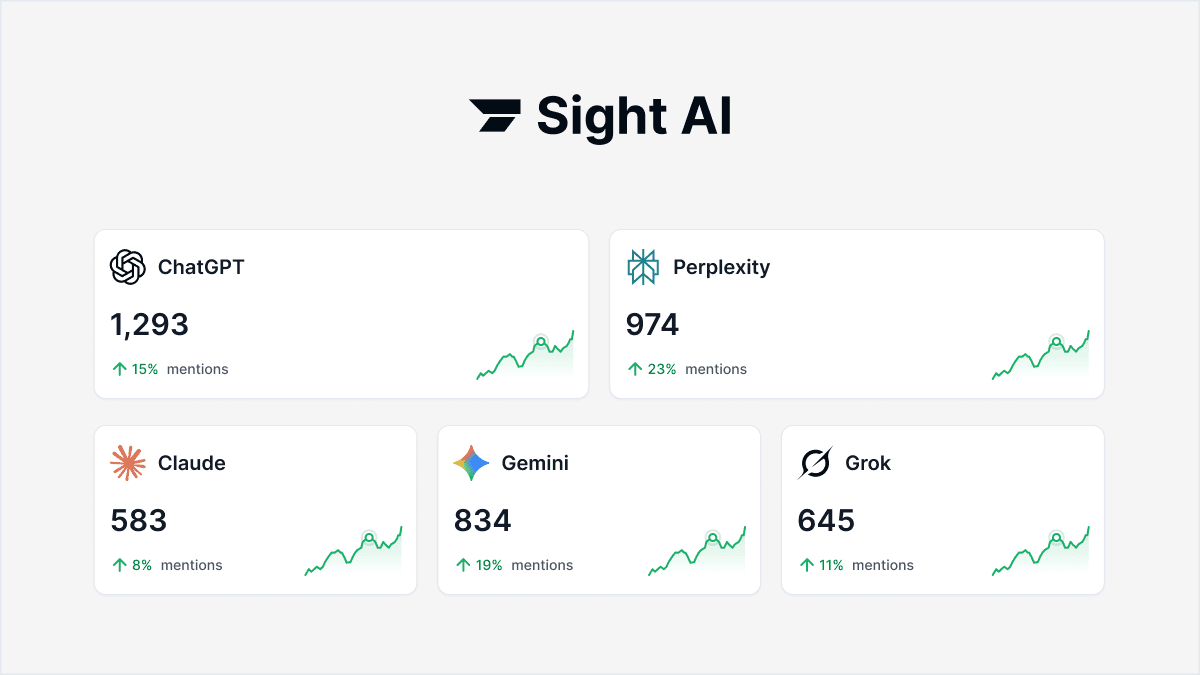
If you are ready to stop guessing how AI models like ChatGPT and Claude talk about your brand, Start tracking your AI visibility today with Sight AI. Track every mention across top AI platforms, uncover content opportunities your competitors are missing, and automate your path to faster organic traffic growth, all in one place.