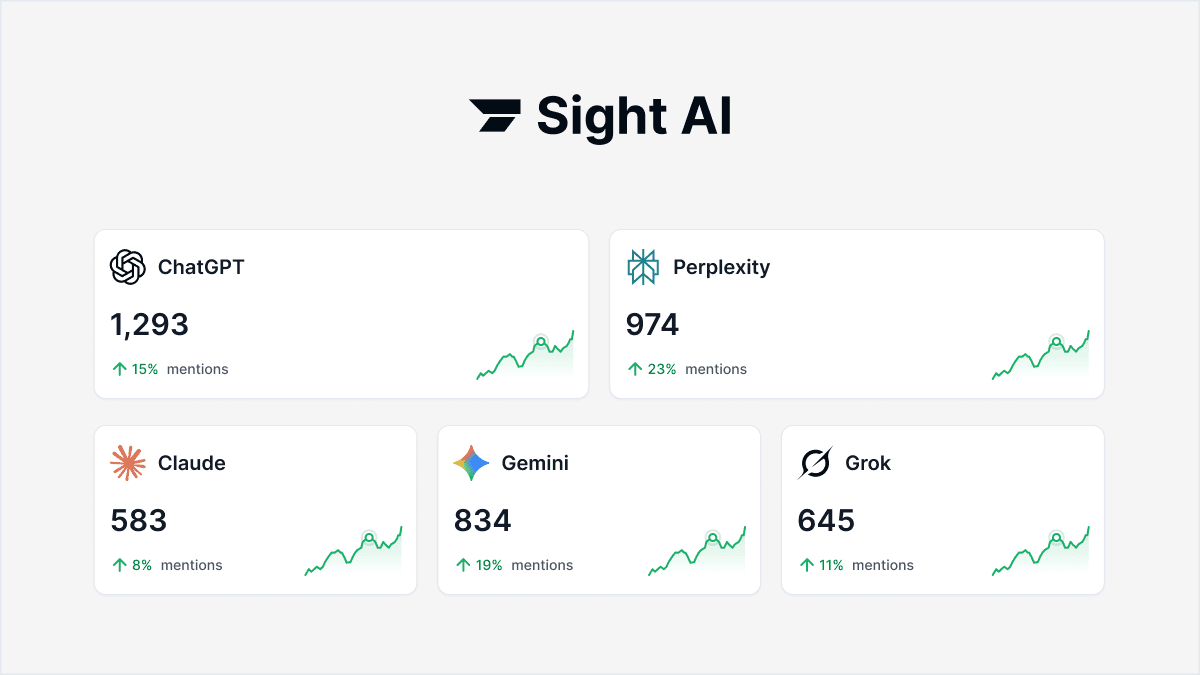
When a potential customer asks ChatGPT for software recommendations in your category, does your brand appear in the response? When someone queries Claude about industry best practices, is your company mentioned as a thought leader? For most brands, the answer is unknown—and that invisibility represents a massive missed opportunity.
AI assistants have fundamentally changed how people discover solutions. Rather than scrolling through ten blue links, users now receive curated recommendations from LLMs that synthesize information and make authoritative-sounding suggestions. If your brand isn't part of those conversations, you're invisible to a rapidly growing segment of your target audience.
An LLM response monitoring platform solves this visibility problem by systematically tracking how AI models discuss your brand, competitors, and industry topics. Think of it as brand monitoring for the AI era—instead of tracking social media mentions or press coverage, you're monitoring the responses generated by ChatGPT, Claude, Perplexity, and other AI assistants that millions of people consult daily.
This guide walks you through the complete setup process, from defining what you need to track through building dashboards that surface actionable insights. Whether you're concerned about brand perception, tracking competitive positioning, or identifying content gaps that prevent AI recommendations, you'll learn exactly how to implement monitoring that drives real business outcomes.
The stakes are higher than many realize. AI-generated responses shape perception at scale, and unlike traditional search results, users rarely question or verify what an AI assistant tells them. Getting this right means capturing visibility in the channel that's rapidly becoming the primary way people find and evaluate solutions.
Step 1: Define Your Monitoring Objectives and Key Metrics
Before configuring any platform or tracking any prompts, you need clarity on what success looks like. LLM monitoring can serve multiple strategic purposes, and trying to accomplish everything at once typically results in data overload without actionable insights.
Start by identifying your primary monitoring goal. Are you focused on brand mention tracking—simply understanding whether and how often your company appears in AI responses? Perhaps competitive intelligence is the priority, where you need to know how your positioning compares to rivals when users ask for recommendations. Maybe sentiment monitoring matters most because you've heard concerning feedback about how AI assistants describe your brand. Or possibly accuracy verification is critical—ensuring that when LLMs do mention your company, they're providing correct information about your products and services.
Most organizations benefit from tracking all these dimensions eventually, but establishing a primary objective focuses your initial setup and prevents analysis paralysis. A SaaS company launching a new product category might prioritize competitive positioning, while an established brand with reputation concerns would emphasize brand sentiment in AI responses.
Next, establish baseline metrics that let you measure progress. These might include current mention frequency across key prompts, sentiment distribution when your brand appears, share of voice compared to top competitors, and accuracy rates for product information. Without these baselines, you can't determine whether your optimization efforts are working.
Model selection requires strategic thinking about your audience. If your target customers are technical users who favor Claude for coding assistance, that model deserves priority attention. Consumer-focused brands might emphasize ChatGPT given its mainstream adoption. B2B companies should monitor Perplexity, which has gained traction among research-oriented professionals. Most comprehensive monitoring tracks all major models because different user segments have different preferences.
Create a comprehensive list of tracking terms. This includes obvious brand names and product names, but also common misspellings, abbreviations, and related terms. If you're known by different names in different markets, include those variations. Add competitor names—you need visibility into their AI presence to understand your relative positioning.
Document everything in a monitoring brief that serves as your implementation roadmap. This brief should specify your primary objective, list all tracking terms, identify priority AI models, define success metrics, and establish reporting cadences. This document keeps your team aligned and provides a reference point when monitoring reveals unexpected patterns.
Success at this stage means having a clear, written plan that anyone on your team could use to understand what you're tracking and why. If you can't articulate your monitoring objectives in specific, measurable terms, you're not ready to configure a platform—you'll end up with data but no direction.
Step 2: Choose and Configure Your Monitoring Platform
The platform you select determines what's possible with your monitoring program, so evaluation criteria matter. Multi-model support is non-negotiable if you're serious about comprehensive visibility—platforms that only track ChatGPT leave massive blind spots. Real-time brand monitoring across LLMs lets you catch sudden shifts in how AI models discuss your brand, while historical data access reveals trends over weeks and months.
Sentiment analysis functionality should go beyond simple positive/negative classification. Quality platforms identify nuanced sentiment like "positive but with caveats" or "neutral with competitive comparison." Look for platforms that can detect when your brand is mentioned but not recommended, or when information provided is outdated or incorrect.
Automated prompt scheduling saves countless hours compared to manual monitoring. The ability to run the same prompts weekly or daily across multiple models provides consistent data for trend analysis. API access matters if you want to integrate monitoring data with other business intelligence systems.
Alert configuration capabilities determine how quickly you can respond to issues. Platforms should let you set thresholds for significant changes—like a sudden spike in negative sentiment or a competitor displacing you in recommendation prompts. Customizable alert routing ensures the right team members get notified about issues within their domain.
During initial setup, you'll configure your account with the brand entities and keywords documented in your monitoring brief. Most platforms use a hierarchical structure where you define your primary brand, then add products, competitors, and related terms beneath it. This organization makes it easier to analyze data at different levels—overall brand health versus specific product mentions.
Establish your tracking parameters carefully. This includes specifying which AI models to monitor, how frequently to run prompts, and what response elements to capture. Some platforms let you track not just whether your brand appears, but where it appears in responses—being mentioned first in a list of recommendations carries different weight than appearing fifth.
Configure alert thresholds based on your baseline data. If your brand typically appears in 30% of relevant prompts, an alert threshold of 20% would catch significant drops. Sentiment alerts might trigger when negative mentions exceed 15% of total mentions, or when any individual response contains strongly negative language.
Connect necessary integrations at this stage. If you're using Slack for team communication, integrate alerts there. If you're reporting metrics in a business intelligence platform, set up those data connections. The goal is making monitoring data accessible where your team already works rather than requiring constant platform logins.
Test your configuration thoroughly before considering this step complete. Run a sample of your prompt library manually and verify that the platform captures responses correctly, categorizes sentiment appropriately, and triggers alerts as expected. This testing phase often reveals configuration issues that are easier to fix now than after you've accumulated weeks of potentially flawed data.
Success indicator: your platform is actively tracking all defined terms across target AI models, capturing responses consistently, and you've verified through testing that the data collection is accurate and complete.
Step 3: Build Your Prompt Library for Systematic Tracking
The prompts you monitor determine what insights you'll uncover, making prompt library development one of the most strategic aspects of LLM monitoring. Random or poorly constructed prompts produce inconsistent data that's difficult to interpret, while a well-designed library reveals actionable patterns.
Organize your prompts into strategic categories that align with how your target audience actually uses AI assistants. Informational queries are broad questions where users seek to understand a topic: "What is project management software?" or "How does marketing automation work?" These prompts reveal whether your brand appears in educational contexts and how AI models explain your category.
Comparison prompts directly pit you against competitors: "Compare Asana vs Monday vs Trello" or "Best CRM for small businesses." These are high-intent queries where users are actively evaluating options, making your presence or absence particularly consequential. Track prompts that include your brand alongside competitors, but also prompts that mention competitors without you—these gaps represent opportunities.
Recommendation requests ask AI assistants to suggest solutions: "Recommend a tool for team collaboration" or "What's the best email marketing platform for e-commerce?" These prompts have the highest commercial intent and often generate the most valuable monitoring data. Users asking for recommendations are typically ready to evaluate and purchase.
Use case prompts describe specific scenarios: "I need software to manage remote team projects across time zones" or "Looking for a CRM that integrates with Shopify." These longer, more specific prompts often surface different results than generic queries and help you understand whether AI models grasp your product's specific capabilities and use cases.
Mirror actual user language rather than using marketing speak. If your customers call your product category "invoicing software" but you prefer "accounts receivable automation," use their terminology. Review support tickets, sales calls, and search query data to identify authentic language patterns.
Include prompt variations that test consistency. Ask the same question in different ways to see if responses remain stable: "Best project management tools" versus "Top software for managing projects" versus "What project management platform should I use?" Significant variation in responses across similar prompts indicates opportunities to optimize for specific phrasings.
Develop competitor-focused prompts that reveal relative positioning. These might ask directly about competitors, or they might describe ideal customer profiles where you compete: "Software for marketing teams at Series B startups" or "Tools used by enterprise sales organizations." Understanding where competitors appear when you don't helps prioritize content and optimization efforts.
Establish a rotation schedule that balances comprehensive coverage with data manageability. Running every prompt daily across all models generates overwhelming data volume. Instead, categorize prompts by priority: critical prompts run daily, important prompts run weekly, exploratory prompts run monthly. This approach ensures you catch important changes quickly while still maintaining broad visibility.
Document each prompt with metadata explaining its purpose and expected insights. When monitoring reveals a sudden change, this context helps you interpret whether it matters. A prompt designed to track brand awareness requires different analysis than one focused on competitive positioning.
Success indicator: an organized prompt library covering key use cases, categorized by intent type, scheduled for appropriate tracking frequency, and documented with clear rationale for what each prompt measures.
Step 4: Establish Baseline Data and Competitive Benchmarks
Your first monitoring cycle produces the baseline data that makes all future analysis meaningful. Without understanding current performance, you can't identify improvements, catch deterioration, or prioritize optimization efforts effectively.
Run your complete prompt library across all configured AI models to generate initial data. This first sweep should be comprehensive—even if you'll eventually monitor some prompts less frequently, you need complete baseline coverage to understand the full landscape. Depending on your prompt library size and model count, this might take several hours or even days to complete.
Document current mention rates with precision. For each category of prompts, calculate what percentage of responses include your brand. You might discover that you appear in 40% of informational queries but only 15% of recommendation requests—a pattern that suggests AI models know about you but don't actively suggest you to users seeking solutions.
Track sentiment distribution across all mentions. Calculate the percentage of mentions that are positive, neutral, negative, or mixed. This baseline lets you detect sentiment shifts over time. Many brands are surprised to find that while mention rates are acceptable, sentiment skews more negative or neutral than expected.
Measure response accuracy wherever your brand appears. When AI models mention your products, are they describing features correctly? Are pricing tiers accurate? Is company information current? Implementing AI response quality analysis helps create a simple accuracy score for baseline purposes—perhaps the percentage of mentions that contain no factual errors. This metric often reveals significant problems that demand immediate attention.
Map competitor presence systematically. For every prompt where a competitor appears, note whether you appear as well, your relative positioning if both brands are mentioned, and the context of competitor mentions. Calculate share of voice—the percentage of total brand mentions in your category that belong to you versus competitors.
Identify gap prompts where your brand should logically appear but doesn't. These represent your highest-priority optimization opportunities. A project management platform that never appears when users ask for "software for agile teams" has a clear content gap to address, especially if competitors consistently appear for that prompt.
Create a baseline report that synthesizes these findings into a clear picture of your current AI visibility. This report should quantify mention rates, sentiment distribution, accuracy scores, competitive positioning, and priority gaps. Use visualizations where helpful—charts showing mention rates by prompt category or competitor share of voice make patterns immediately obvious.
Share this baseline report with stakeholders who need to understand AI visibility. Marketing teams, content creators, product marketers, and executives should all see the current state. This shared understanding builds alignment around why monitoring matters and helps justify optimization efforts.
Success indicator: a documented baseline report with quantified metrics across all key dimensions, providing clear benchmarks for measuring future progress and identifying immediate priorities for optimization.
Step 5: Configure Sentiment Analysis and Alert Systems
Automated sentiment tracking and intelligent alerts transform monitoring from a passive reporting exercise into an active intelligence system that catches issues before they escalate and surfaces opportunities as they emerge.
Configure sentiment categorization with enough granularity to be useful but not so much complexity that analysis becomes overwhelming. A five-tier system works well for most organizations: strongly positive, positive, neutral, negative, and strongly negative. Some platforms add a "mixed" category for responses that contain both positive and negative elements about your brand.
Establish what constitutes each sentiment category in your context. "Positive" might mean your brand is recommended without caveats, while "neutral" indicates mention without endorsement. "Negative" could mean your brand is mentioned but not recommended, or mentioned with explicit criticisms. Document these definitions so sentiment analysis remains consistent as your team grows or changes.
Set up alerts for negative sentiment spikes that could indicate reputation issues. A threshold might be "alert when negative mentions exceed 20% of total mentions in a 24-hour period" or "alert when any response contains strongly negative language about our brand." These alerts let you investigate and respond quickly rather than discovering problems weeks later in a monthly report.
Configure misinformation detection alerts that trigger when AI models provide factually incorrect information about your brand. This might include wrong pricing, discontinued products being described as current, or outdated company information. These alerts are critical because misinformation spreads quickly in AI contexts—one model's training data can influence others.
Establish notification workflows that route alerts to appropriate team members based on issue type. Sentiment alerts might go to brand managers and PR teams, while accuracy issues route to product marketing. Competitive displacement alerts—when a competitor suddenly appears in prompts where you previously dominated—might notify both marketing and executive leadership.
Create escalation procedures for reputation-threatening responses. Define what constitutes a critical issue: perhaps any strongly negative response that mentions your brand multiple times, or any response that makes false claims about your products. Critical alerts should have defined response protocols including who investigates, who approves public responses, and what remediation steps are available. Understanding how to handle negative AI chatbot responses is essential for protecting your brand.
Configure positive opportunity alerts that surface favorable changes. When your mention rate increases significantly, when sentiment improves, or when you start appearing in prompts where you were previously absent, these wins deserve attention. Positive alerts help you understand what's working so you can do more of it.
Set up competitor tracking alerts that notify you when rivals make significant gains. If a competitor's mention rate jumps 30% in recommendation prompts, you need to understand why and how to respond. These alerts prevent you from being blindsided by competitive shifts in AI visibility.
Test your alert system thoroughly before relying on it. Manually trigger conditions that should generate alerts and verify they route correctly and contain useful information. An alert that says "sentiment change detected" without context is useless—effective alerts include the specific prompt, the response content, the sentiment score, and comparison to baseline metrics.
Success indicator: automated alerts triggering appropriately when significant changes occur, routing to the right team members, and providing enough context for immediate assessment and response. Your team should be able to act on alerts without needing to log into the monitoring platform for additional information.
Step 6: Create Reporting Dashboards and Analysis Workflows
Data without interpretation is just noise. Effective dashboards and analysis workflows transform monitoring data into insights that drive decisions and actions.
Build primary dashboards that visualize your most important metrics at a glance. A mention trend chart showing how often your brand appears over time reveals whether visibility is growing, declining, or stable. Sentiment over time charts catch shifts in how AI models discuss your brand. Model-by-model breakdowns show whether you have strong presence in some AI assistants but weak presence in others.
Create competitive comparison dashboards that place your metrics alongside competitor data. Share of voice charts show what percentage of category mentions belong to you versus rivals. Positioning analysis reveals which prompts competitors dominate and where you have advantages. These competitive views often surface strategic priorities that single-brand dashboards miss.
Design prompt performance dashboards that show which queries consistently generate brand mentions and which never do. This view helps prioritize content optimization—prompts where you never appear despite clear relevance represent high-value opportunities. Prompts where you appear inconsistently might indicate that small content improvements could drive significant visibility gains.
Establish weekly reporting cadences for tactical monitoring. Weekly reports should highlight significant changes from the previous week: mention rate shifts, new prompts where you appeared or disappeared, sentiment changes, and competitor movements. Keep weekly reports focused on actionable items that demand immediate attention rather than comprehensive data dumps.
Set up monthly reporting for strategic analysis. Monthly reports provide enough time horizon to identify genuine trends rather than random fluctuations. These reports should include month-over-month comparisons, progress toward goals established in your monitoring objectives, deep dives into specific prompt categories, and strategic recommendations based on patterns observed.
Create analysis workflows that standardize how your team interprets changes. When mention rates drop, the workflow might specify: first check if the prompts changed, then verify the monitoring platform is functioning correctly, then analyze whether competitors gained share, then review recent content changes that might have affected relevance. Standardized workflows prevent knee-jerk reactions to data that might have simple explanations.
Connect monitoring insights directly to content strategy and optimization efforts. Dashboards should feed into content planning processes—gaps identified in monitoring become content briefs, competitor advantages become topics to address, and successful patterns inform future content approaches. Without this connection, monitoring remains interesting but not actionable.
Build role-specific dashboard views for different stakeholders. Executives might want high-level trends and competitive positioning, while content teams need prompt-level detail about where gaps exist. Product marketers might focus on accuracy metrics and feature mention rates. Customized views ensure everyone gets relevant insights without information overload.
Success indicator: recurring reports that stakeholders actually read and act on, delivering insights that directly influence content priorities, optimization efforts, and strategic decisions about AI visibility investment.
Step 7: Act on Insights to Improve AI Visibility
Monitoring without optimization is just expensive observation. The ultimate value comes from translating insights into actions that improve how AI models discuss and recommend your brand.
Translate monitoring data into prioritized content optimization opportunities. Prompts where competitors consistently appear but you don't become top-priority content targets. Create authoritative content that addresses those queries directly, using language patterns that mirror how users ask questions. If monitoring shows competitors dominate "best CRM for real estate agents" prompts, develop comprehensive content specifically addressing that use case.
Address misinformation through strategic content creation. When monitoring reveals AI models providing incorrect information about your products, create and publish authoritative content that corrects those errors. Make this content highly accessible and well-structured so AI models can easily incorporate accurate information in future responses. Press releases, official product pages, and detailed documentation all help establish correct information in AI training data.
Optimize for topics where competitors dominate but you have genuine expertise. Monitoring often reveals areas where rivals get mentioned not because they're actually better positioned, but because they've created more comprehensive content on specific topics. If you have equal or superior capabilities but lower AI visibility, targeted content creation can shift that dynamic.
Develop content specifically designed for AI consumption and recommendation. This means clear structure with descriptive headings, direct answers to common questions, comprehensive coverage of topics, and authoritative tone that AI models interpret as trustworthy. Content optimized for traditional SEO doesn't always perform well in AI contexts—you need content that AI assistants can easily parse and confidently reference. Leveraging LLM visibility optimization software can help streamline this process.
Create case studies and use case documentation that helps AI models understand when to recommend you. If monitoring shows you never appear for specific scenarios despite being well-suited, detailed use case content can change that. AI models recommend solutions they understand, and comprehensive use case documentation builds that understanding.
Track the impact of optimization efforts through continued monitoring. After publishing content targeting a specific gap, monitor whether your mention rates improve for related prompts. This feedback loop helps you understand what optimization approaches work and which need refinement. Effective optimization typically shows measurable impact within weeks as AI models incorporate new content into their knowledge base.
Iterate based on results. Content that successfully improves mention rates in one area provides a template for addressing other gaps. Approaches that don't move metrics need adjustment—perhaps the content wasn't authoritative enough, wasn't comprehensive enough, or didn't use language patterns that AI models recognize as relevant to user queries.
Build systematic optimization workflows where monitoring insights automatically feed into content planning. When weekly reports identify new gaps or competitive threats, those items should flow directly into content team backlogs with clear priorities. This systematic approach ensures monitoring drives continuous improvement rather than occasional reactive efforts.
Success indicator: documented improvement in mention rates, sentiment scores, and competitive positioning over time, with clear attribution to specific optimization efforts. Your monitoring data should show upward trends in priority metrics, demonstrating that your actions are working.
Your Path to AI Visibility Mastery
You now have a complete framework for monitoring and optimizing how AI assistants discuss your brand. The technology may be new, but the principle is timeless: you can't improve what you don't measure, and visibility requires active management rather than hopeful waiting.
Your monitoring platform is only as valuable as the consistency with which you use it. Set calendar reminders for weekly dashboard reviews, monthly deep dives, and quarterly strategy adjustments based on accumulated insights. Make monitoring data a standard part of content planning meetings and marketing strategy discussions.
Use this quick-start checklist to verify your setup is complete: monitoring objectives documented with specific success metrics, platform configured with all brand terms and competitor names, prompt library built covering key use cases and scheduled appropriately, baseline metrics established providing benchmarks for progress, alerts and sentiment tracking active and routing correctly, reporting dashboards live and accessible to stakeholders, and action workflows defined connecting insights to optimization efforts.
The competitive advantage in AI visibility goes to brands that move early and systematically. While others wonder whether AI-powered search matters, you'll be capturing the visibility that drives discovery and shapes perception. Every week you delay implementing monitoring is a week competitors might be gaining ground you can't see.
Remember that AI models update frequently, and their training data continuously evolves. What works today might need adjustment tomorrow, making multi-model AI presence monitoring essential rather than optional. Brands that treat AI visibility as a one-time project will fall behind those that build continuous monitoring and optimization into their standard operating procedures.
The insights you uncover will likely surprise you. Most brands discover they have less AI visibility than assumed, appear for unexpected queries, or face competitive dynamics in AI contexts that differ from traditional search. These surprises are valuable—they reveal opportunities and threats that remain invisible without systematic monitoring.
Start tracking your AI visibility today and see exactly where your brand appears across top AI platforms. Stop guessing how AI models like ChatGPT and Claude talk about your brand—get visibility into every mention, track content opportunities, and automate your path to organic traffic growth. The brands winning in AI-powered search aren't the ones with the biggest budgets or the most advanced technology. They're the ones who monitor systematically, optimize continuously, and act decisively on the insights they uncover. Your monitoring platform is ready. Now it's time to use it.