If you've ever tried to manually check where your website ranks for dozens of keywords across different locations and devices, you already know the problem. It's slow, inconsistent, and the moment you finish checking, the data is already stale. For agencies managing multiple clients or founders tracking competitive markets, manual rank checking isn't just inefficient—it's practically impossible at scale.
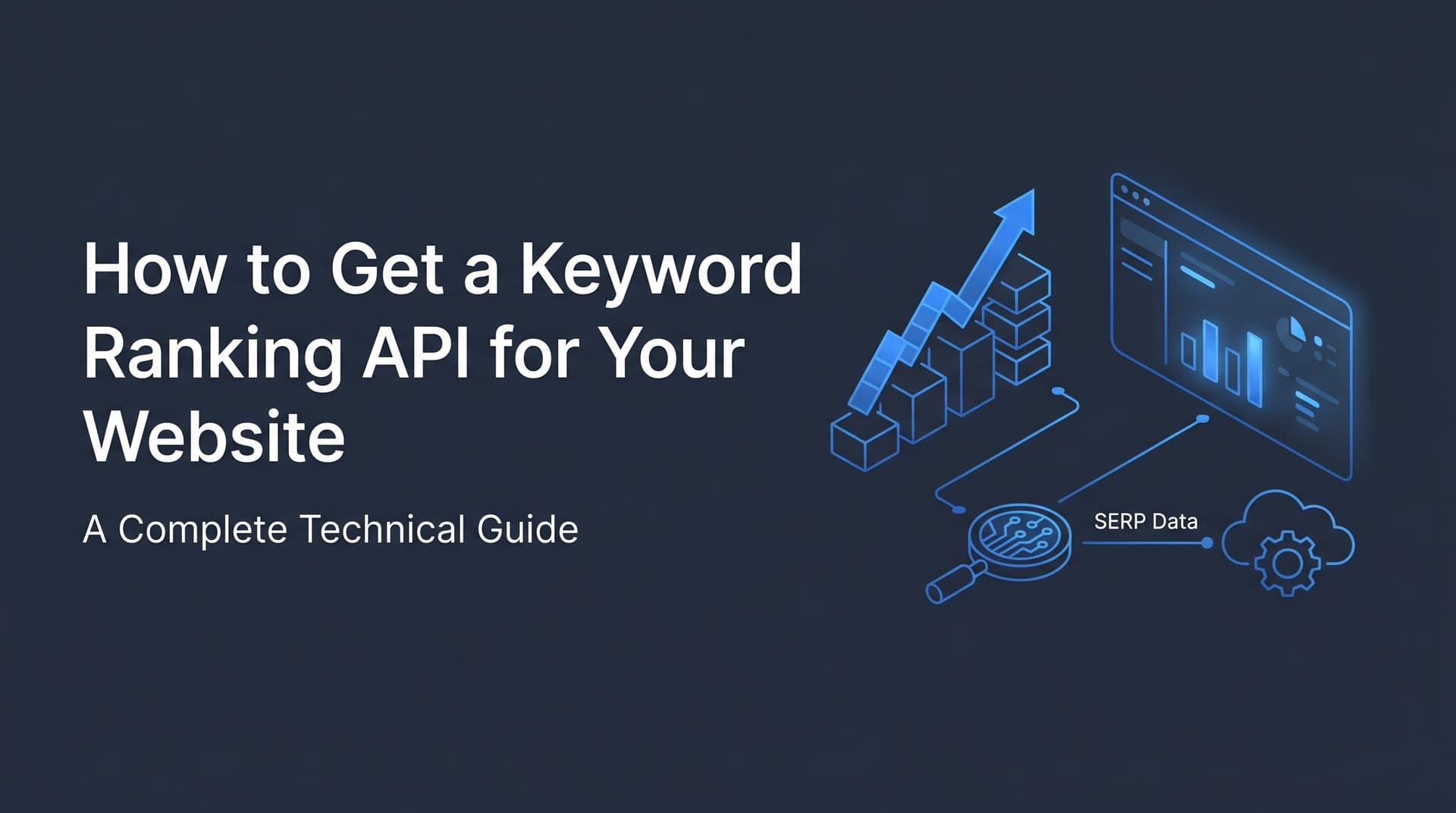
This is exactly the problem a keyword ranking API solves. Instead of logging into a tool and clicking through reports, you get a programmatic interface that delivers structured ranking data directly into your dashboards, databases, or automated workflows. You define the keyword, the domain, the location, the device—and the API returns the position, the ranking URL, and a wealth of contextual data about what's showing up on that search results page.
But here's the thing: the landscape is shifting beneath our feet. Traditional SERP rankings are no longer the only metric that matters. AI-powered answer engines like ChatGPT, Perplexity, and Google AI Overviews are intercepting queries that used to drive clicks to websites. A complete tracking strategy today means combining keyword ranking API data with AI visibility monitoring to understand your full organic footprint.
This guide is for marketers, founders, and agencies who want to move beyond manual rank checking and build a scalable, automated approach to tracking search visibility—across both traditional search engines and the AI platforms increasingly shaping how people discover brands.
Why Programmatic Rank Tracking Beats Manual Methods
Manual rank checking has a few fundamental problems that compound as your SEO operation grows. The first is time. Checking rankings for even fifty keywords across two or three locations takes meaningful effort every week. Scale that to five hundred keywords across ten client sites, and you've consumed hours that could go toward actual optimization work.
The second problem is inconsistency. When you search Google manually, you're getting results shaped by your browsing history, location, device, and logged-in account. Two people searching the same keyword from different offices will often see different results. Manual checks introduce this noise into your data, making it difficult to identify genuine ranking movements versus search personalization artifacts.
The third problem is coverage. Manual methods simply cannot track the volume of keywords that modern SEO strategies require. Long-tail keyword portfolios, competitive monitoring across dozens of competitors, and tracking rankings across mobile versus desktop—these require automation to be viable at all.
A keyword ranking API eliminates these constraints. You send structured requests with consistent parameters, and you receive structured responses with depersonalized ranking data. The same call made from any server returns comparable results, removing the personalization noise that plagues manual checks. If you're new to this process, our guide on how to track keyword rankings covers the foundational concepts in more detail. You can schedule pulls to run on whatever cadence your strategy requires—daily for high-priority terms, weekly for longer-tail keywords—and store everything in a database for trend analysis over time.
Beyond efficiency, there's a strategic dimension worth noting. The search landscape now includes AI-generated answers that appear before organic results, featured snippets that answer queries without requiring a click, and local packs that dominate mobile results for location-based searches. Tracking your position as a simple number misses much of this complexity. Modern keyword ranking APIs return SERP feature data alongside position data, giving you a richer picture of what's actually happening on the results page.
And then there's the AI search layer entirely. Traditional keyword ranking APIs don't capture whether your brand is being cited in a ChatGPT response or appearing in a Perplexity answer. That's a genuine gap—one that forward-thinking teams are addressing by pairing rank tracking with AI visibility monitoring. We'll come back to this, but it's worth keeping in mind as you architect your tracking strategy from the start.
Anatomy of a Keyword Ranking API: How It Works Under the Hood
Understanding how these APIs work mechanically helps you build more reliable integrations and debug problems when they arise. Most keyword ranking APIs follow REST architecture, meaning you interact with them through standard HTTP requests—typically GET or POST—sent to specific endpoints.
Authentication almost always involves an API key passed in the request header or as a query parameter. Some enterprise providers use OAuth for more granular access control, but for most use cases, a single API key per account is standard. Guard this key carefully: it's tied to your billing and usage limits.
The request parameters are where you define exactly what ranking data you want. Common parameters include:
Target keyword: The search query you want to check rankings for. Some APIs accept batches of keywords in a single request, which is more efficient than making individual calls for each term.
Target domain or URL: You can often specify either a root domain (to find which URL ranks) or a specific URL (to check if that particular page is ranking).
Search engine: Google is the default for most providers, but many also support Bing, Yahoo, and increasingly, specialized search engines. Some are beginning to add support for AI search platforms.
Device type: Mobile and desktop rankings can differ significantly, especially for queries with local intent. Tracking both gives you a complete picture.
Geographic location: This can be specified at the country, state, city, or even zip code level depending on the provider. Critical for local SEO and for understanding how rankings vary across markets.
Language: Affects the language of the results returned, important for international SEO strategies.
The JSON response typically includes the ranking position (or a null/not-found value if the domain doesn't appear in the top results), the specific URL that's ranking, SERP features detected on that results page (featured snippets, People Also Ask boxes, knowledge panels, local packs, AI overviews), and sometimes search volume estimates for that keyword. For developers building custom integrations, our article on indexing API for developers covers complementary API patterns worth understanding.
Rate limits and credit systems are practical constraints that shape how you architect your integration. Most providers use a credit model where each API call consumes credits based on the type of request—a basic position check might cost one credit, while a full SERP analysis with feature detection costs more. Monthly subscription tiers typically include a credit allowance, with overage charges or hard limits beyond that.
Understanding your credit consumption before you build is essential. An agency tracking five thousand keywords daily across ten clients will burn through credits very quickly. Model your expected usage against provider pricing before committing to an architecture, and build rate limit handling into your code from day one. Exponential backoff for rate limit errors—where your code waits progressively longer before retrying—is a standard pattern worth implementing early.
Evaluating and Choosing the Right Keyword Ranking API
The keyword ranking API market has several established players, including SEMrush, Ahrefs, Moz, DataForSEO, and SERPapi, among others. Each has a different approach to pricing, data freshness, and feature coverage. Choosing the right one depends on your specific use case, technical requirements, and budget.
Here are the criteria that matter most when evaluating providers:
Data accuracy and freshness: How recently was the ranking data collected? Some providers offer near-real-time data pulled fresh on each request; others serve cached results that may be hours or days old. For fast-moving competitive markets, freshness matters. Ask providers how they collect data and how often their cache refreshes.
Geographic and language coverage: If you're tracking rankings across multiple countries or languages, verify that the provider has genuine coverage in those markets. Coverage quality varies significantly outside major English-speaking markets.
SERP feature detection: This is increasingly non-negotiable. A ranking position of three means something very different if there's a featured snippet above it versus a clean results page. Providers that return rich SEO ranking data give you a much more actionable picture of actual visibility.
Mobile versus desktop splits: These can diverge substantially for many keywords. If your audience is predominantly mobile, you need mobile ranking data specifically.
Supported search engines and platforms: Most providers cover Google and Bing well. Some are beginning to add support for tracking visibility in AI-powered search experiences. This is an area where the market is evolving quickly.
Pricing model alignment: Per-query pricing is more flexible for variable workloads; subscription models with credit allowances work better for predictable, high-volume use cases. Calculate your expected monthly query volume and compare total cost across models, not just headline prices.
Documentation quality and SDK availability: Poor documentation is a significant time cost during integration. Look for providers with clear reference documentation, code examples in your language of choice, and responsive developer support.
One consideration worth raising explicitly: traditional keyword ranking APIs, regardless of provider, don't capture AI search visibility. When someone asks ChatGPT which tools to use for SEO, or asks Perplexity to recommend marketing platforms, your keyword rankings have no bearing on whether your brand appears in those answers. This is a meaningful and growing gap. Teams that recognize this early are building parallel tracking strategies that combine traditional rank data with competitors ranking in AI search monitoring—understanding not just where they rank on Google, but how AI models reference their brand across multiple platforms.
Step-by-Step: Integrating a Keyword Ranking API Into Your Workflow
Once you've chosen a provider, the integration process follows a predictable pattern. Let's walk through it from first API call to automated pipeline.
Setting up your first API call: Start with the provider's authentication documentation. Most will have you pass your API key as a header like Authorization: Bearer YOUR_API_KEY or as a query parameter. Make a single test call with a known keyword and your domain before building anything more complex. Verify that the response structure matches the documentation and that you understand how the provider signals "not ranked" versus "ranked outside top 100."
Constructing requests systematically: Build a function or class that accepts keyword, domain, location, and device as parameters and returns the parsed JSON response. Centralizing request construction makes it easy to add logging, error handling, and retry logic in one place rather than scattered across your codebase.
Handling errors gracefully: Four error types will appear regularly in production. Rate limit errors (HTTP 429) mean you've exceeded your allowed request frequency—implement exponential backoff. Timeout errors mean the provider took too long to respond—retry with a reasonable limit. Invalid parameter errors (HTTP 400) mean something in your request is malformed—log the full request for debugging. Authentication errors (HTTP 401 or 403) mean your API key is wrong, expired, or lacks permission for the endpoint you're calling.
Building an automated pipeline: The simplest architecture involves a scheduled job (a cron task, a workflow automation tool, or a cloud function) that runs your rank-checking function on a defined schedule. Daily pulls for priority keywords, weekly for longer-tail terms. Each run stores results in a database table with columns for keyword, domain, position, ranking URL, SERP features, device, location, and timestamp.
This time-series data is what makes rank tracking genuinely useful. A single data point tells you where you rank today. A table of data points tells you whether you're trending up, holding steady, or declining—and when changes happened, which helps you correlate ranking movements with site changes, algorithm updates, or competitor actions. Before your pages can rank at all, they need to be properly indexed—our guide on how to index a website in Google covers that critical prerequisite.
Triggering alerts: Once you have a database of ranking history, you can build alert logic on top of it. Common triggers include: a keyword drops more than five positions in a single day, a keyword falls off page one, a keyword that was outside the top fifty suddenly appears on page two (a quick-win opportunity), or a competitor gains a featured snippet on a term you were tracking.
Connecting to dashboards and reporting: Raw database tables aren't what stakeholders want to see. Connect your ranking data to a visualization tool—Google Looker Studio, Tableau, or a custom dashboard—so that clients and team members can see trends, filter by keyword group or location, and export reports without touching the underlying data. This is where the investment in clean data architecture pays off.
From Rankings to Revenue: Turning API Data Into SEO Action
Rank tracking data is only as valuable as the decisions it informs. The teams that extract the most value from keyword ranking APIs aren't just collecting data—they're building workflows that translate ranking signals into specific optimization actions.
The most immediate use case is identifying pages in decline before they fall off page one entirely. A page that has dropped from position four to position eight over three weeks is signaling something: a competitor has improved their content, you've earned a technical issue, or the query intent has shifted. Catching this early gives you time to investigate and respond—our article on content not ranking in search dives deeper into diagnosing these issues. Without automated tracking, these gradual declines often go unnoticed until traffic drops become visible in analytics—by which point recovery takes longer.
The second high-value use case is finding quick wins. Keywords where your domain ranks between positions eleven and twenty—just off page one—are often the highest-leverage optimization opportunities. The content exists, Google already considers it relevant, and a targeted improvement to that page (better title tag, stronger internal linking, expanded content depth) can move it onto page one without starting from scratch. Automated rank tracking makes it easy to filter your entire keyword portfolio for this "page two" opportunity set.
Content gap analysis: When you track rankings for a broad keyword set and see consistent non-ranking across a thematic cluster, that's a signal that you lack content covering that topic. API data aggregated by topic cluster helps you identify these gaps systematically rather than relying on intuition.
Combining rank data with content performance: Position data becomes significantly more actionable when combined with click-through rate data from Google Search Console and engagement metrics from your analytics platform. A keyword ranking at position two with a below-average click-through rate might need a stronger title and meta description. A page ranking at position six with high engagement metrics for visitors who do click might just need better internal linking to push it higher. Rank data tells you where you stand; performance data tells you why and what to fix. For a comprehensive approach to moving the needle, explore strategies to boost keyword rankings once you've identified your opportunities.
Here's where AI-optimized content creation enters the picture. Ranking insights tell you which topics are underperforming, which competitors are outranking you, and which query patterns your content doesn't currently address. Using those insights to brief and generate content—structured for both traditional search and AI search discovery—closes the loop between tracking and action. Rather than writing content based on intuition, you're writing based on specific ranking gaps and opportunities surfaced by your API data.
Beyond Traditional SERPs: Tracking Your Brand Across AI Search
Here's a reality that keyword ranking APIs, regardless of how sophisticated, cannot address on their own: a growing share of search behavior is now happening inside AI-powered answer engines that don't return traditional ranked lists of URLs at all.
When someone asks ChatGPT to recommend the best project management tools, or asks Perplexity to explain which SEO platforms are worth considering, or asks Claude to compare marketing automation options—your keyword rankings have no bearing on whether your brand appears in those answers. The AI model is drawing on its training data and, in some cases, live web retrieval to construct a response. Whether your brand is mentioned, how it's described, and what context surrounds it are entirely separate questions from where you rank on Google.
This isn't a hypothetical future concern. AI-powered search experiences are already handling a meaningful portion of informational and commercial queries. For brands in competitive categories, being absent from AI-generated answers while competitors are cited is a real visibility gap with real traffic and revenue implications. Understanding the AI search engine ranking factors that influence these citations is becoming essential for any serious SEO strategy.
AI visibility tracking addresses this gap by monitoring how AI models reference your brand across multiple platforms. This means tracking which prompts trigger mentions of your brand, what sentiment surrounds those mentions, how your brand is described relative to competitors, and how these patterns change over time as AI models are updated or as your content strategy evolves.
Building a unified tracking strategy: The most complete picture of organic discoverability combines both layers. Your keyword ranking API handles traditional SERP visibility: where you rank, which SERP features you appear in, how you're trending over time. Your AI visibility monitoring handles the AI search layer: whether your brand is being cited, in what context, and with what sentiment across ChatGPT, Claude, Perplexity, and other platforms. For a deeper dive into one of these platforms specifically, see our guide on how to optimize for Perplexity AI.
These two data streams inform each other. Content that ranks well in traditional search often performs better in AI-generated answers, because AI models frequently draw on well-ranking, authoritative pages. Conversely, understanding which topics AI models associate with your brand can reveal content opportunities that your traditional rank tracking might not surface. Building both capabilities into your tracking infrastructure positions you to compete across the full spectrum of how people discover brands today.
Putting It All Together
A keyword ranking API is foundational infrastructure for any SEO operation that needs to scale. It removes the bottlenecks of manual rank checking, delivers consistent and structured data, and enables the kind of automated workflows that turn ranking signals into optimization actions. Whether you're building a custom dashboard for internal stakeholders, automating client reporting for an agency, or monitoring competitive movements in a fast-moving market, programmatic rank tracking is the right approach.
The practical path forward is straightforward: start with a clear use case, choose a provider whose data quality and pricing model fit your volume, build a clean integration with proper error handling, and invest in the data storage and visualization layer that makes the data actionable for your team.
But keep the bigger picture in mind. Traditional keyword rankings are one dimension of organic visibility in an environment where AI search is rapidly expanding its footprint. The teams building durable competitive advantages right now are those combining programmatic rank tracking with AI visibility monitoring—understanding not just where they rank on Google, but how AI models across multiple platforms reference, describe, and recommend their brand.
That's the complete picture of discoverability in 2026. And it's the picture you need to be tracking.
Start tracking your AI visibility today and see exactly where your brand appears across top AI platforms. Stop guessing how ChatGPT, Claude, and Perplexity talk about your brand—get the data, uncover the content opportunities, and build the organic presence that compounds over time.