AI-powered search is no longer a future trend. ChatGPT, Perplexity, and Claude are actively replacing traditional search for millions of queries every day, and brands that only optimize for Google are already losing ground in AI-generated answers. Generative Engine Optimization (GEO) has become essential: creating content that AI models will cite, reference, and recommend alongside traditional search rankings.
The challenge is that most AI writing tools weren't built with GEO in mind. They produce content, but they don't track whether AI models are actually citing your brand, and they don't close the loop between monitoring and publishing. The tools below are different. Each one has genuine GEO relevance, whether through content generation, AI visibility monitoring, or workflow automation that supports a real GEO strategy.
Here are the best GEO SEO content generators and AI visibility platforms available in 2026, evaluated on content quality, GEO capabilities, automation depth, and monitoring features.
1. Sight AI
Best for: Marketers and agencies who want an all-in-one GEO + SEO platform with closed-loop visibility and content publishing.
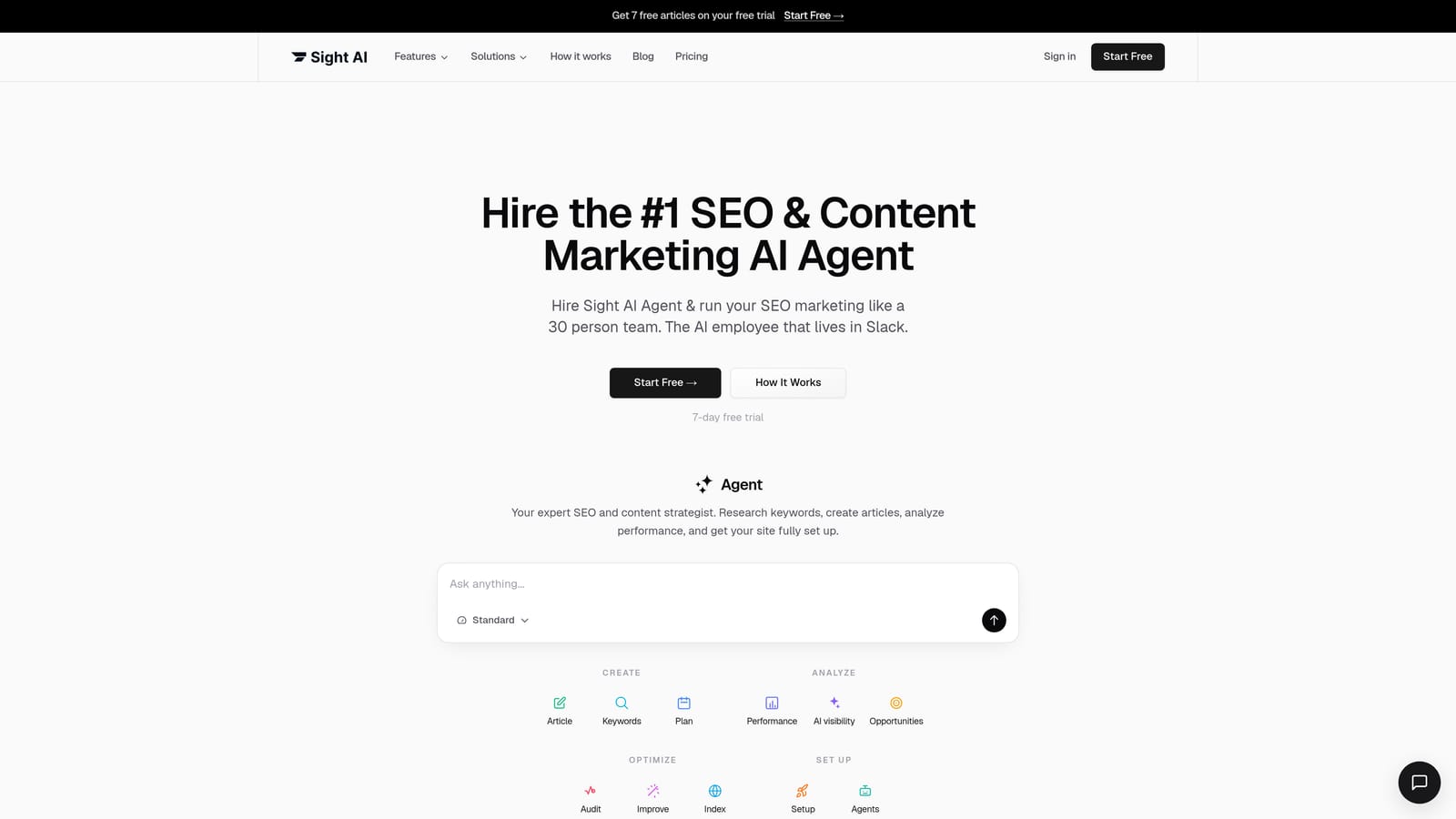
Sight AI is a full-stack GEO and SEO platform that tracks how AI models talk about your brand, generates optimized content to improve those mentions, and automatically indexes new content for faster discovery.
Where This Tool Shines
Most tools in this space do one thing: either they monitor AI visibility or they generate content. Sight AI does both, and more importantly, it connects the two. You can see exactly which prompts surface your competitors instead of you, then use the built-in AI content agents to publish content that addresses those gaps directly.
The Autopilot Mode takes this further by running continuous content publishing without manual intervention. For founders or small teams who need to build organic reach without a dedicated content operation, this kind of automation is genuinely useful rather than just a marketing feature.
Key Features
AI Visibility Score: Tracks brand mentions across ChatGPT, Claude, Perplexity, and 3+ additional AI platforms, with sentiment analysis and prompt-level reporting.
13+ Specialized AI Agents: Purpose-built agents for generating listicles, how-to guides, explainers, and other GEO/SEO-optimized content formats.
Autopilot Mode: Hands-off content publishing that continuously produces and schedules new content based on your brand's GEO strategy.
IndexNow Integration: Automatically submits new content to search engines via IndexNow, reducing the time between publishing and discovery.
CMS Auto-Publishing: Publishes content directly to your CMS with automated sitemap updates, removing manual steps from the workflow.
Best For
Sight AI is the strongest fit for marketers, founders, and agencies who want a single platform that handles both sides of GEO: understanding what AI models say about their brand today and publishing content to improve those mentions over time. It's particularly well-suited for teams that can't afford to run separate monitoring and content tools.
Pricing
Visit trysight.ai for current pricing and plan details. Multiple tiers are available to accommodate solo users through agency-scale operations.
2. Writesonic
Best for: Content teams producing high volumes of SEO-optimized articles, ads, and landing pages at scale.
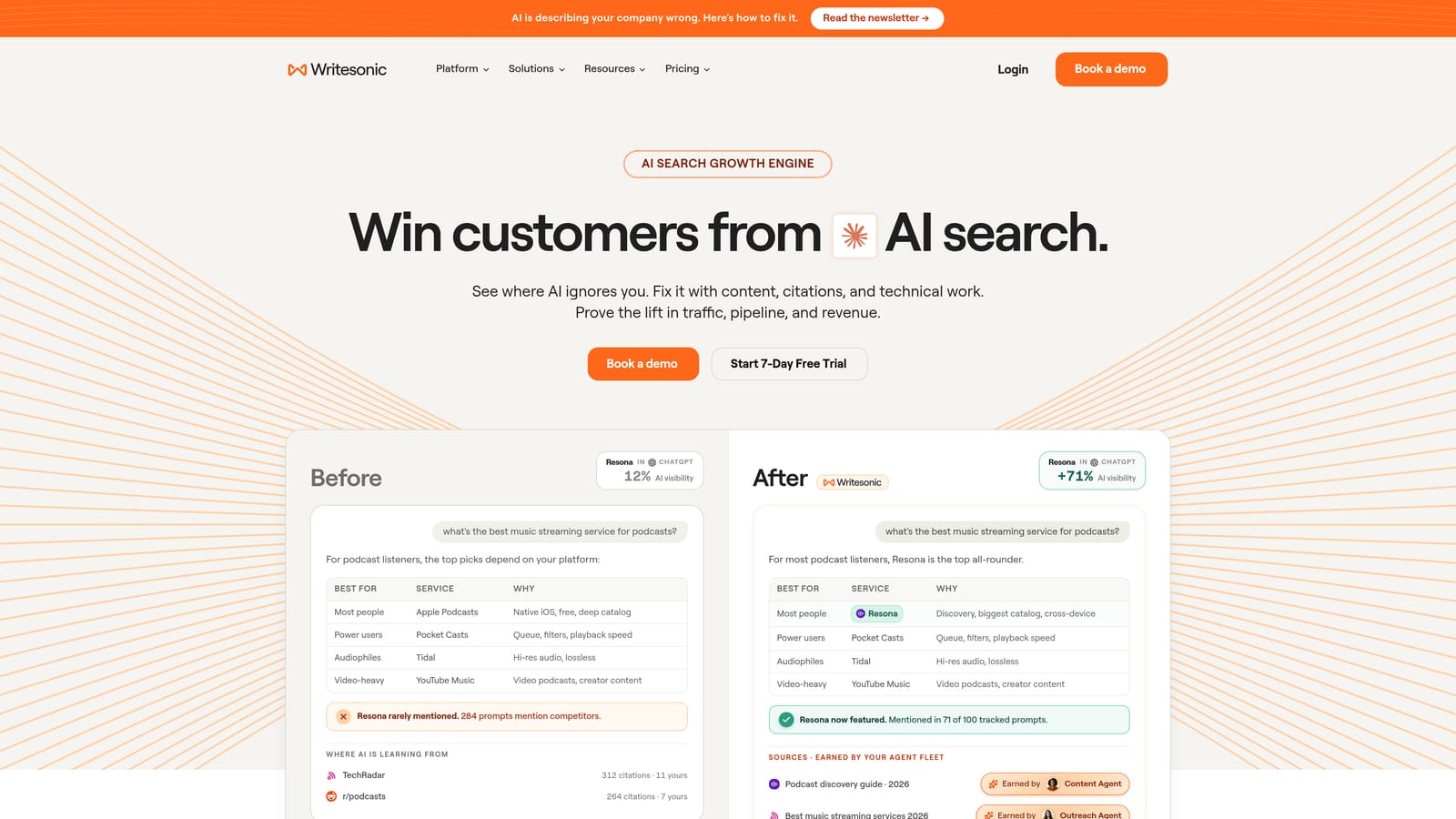
Writesonic is a well-established AI content platform offering a broad library of content formats, on-page SEO optimization features, and team collaboration tools built for production-scale publishing.
Where This Tool Shines
Writesonic's strength is throughput. If you need to produce a large volume of structured, readable content across multiple formats, the platform handles long-form articles, product descriptions, ad copy, and landing pages within a single workspace. The SEO optimization mode helps structure content with proper headings, keyword placement, and on-page signals that can support GEO performance when combined with a deliberate content strategy.
The Chatsonic assistant adds a research and ideation layer that's useful for identifying angles before drafting, which can help content teams think through GEO-relevant framing before committing to a piece.
Key Features
Long-Form Article Generation: Produces full-length blog posts and guides with structured formatting suitable for both search and AI model ingestion.
SEO Optimization Mode: Guides on-page content structure with keyword targeting and heading hierarchy for search performance.
Chatsonic AI Assistant: Conversational AI for research, ideation, and content planning before and during drafting.
Wide Format Library: Covers ads, landing pages, product descriptions, email sequences, and more from a single platform.
Team Collaboration Features: Shared workspaces and workflow tools for content teams managing multiple projects simultaneously.
Best For
Writesonic works best for content teams and agencies that need high-volume content production across multiple formats. It's a strong fit when the primary goal is publishing at scale with SEO fundamentals baked in. Note that Writesonic does not natively monitor AI visibility or track brand mentions in AI-generated answers, so it works best alongside a dedicated GEO monitoring tool.
Pricing
A free tier is available for getting started. Paid plans scale with usage and team size. Verify current pricing at writesonic.com.
3. AirOps
Best for: Agencies and content operations teams building custom, repeatable AI-powered content pipelines at scale.
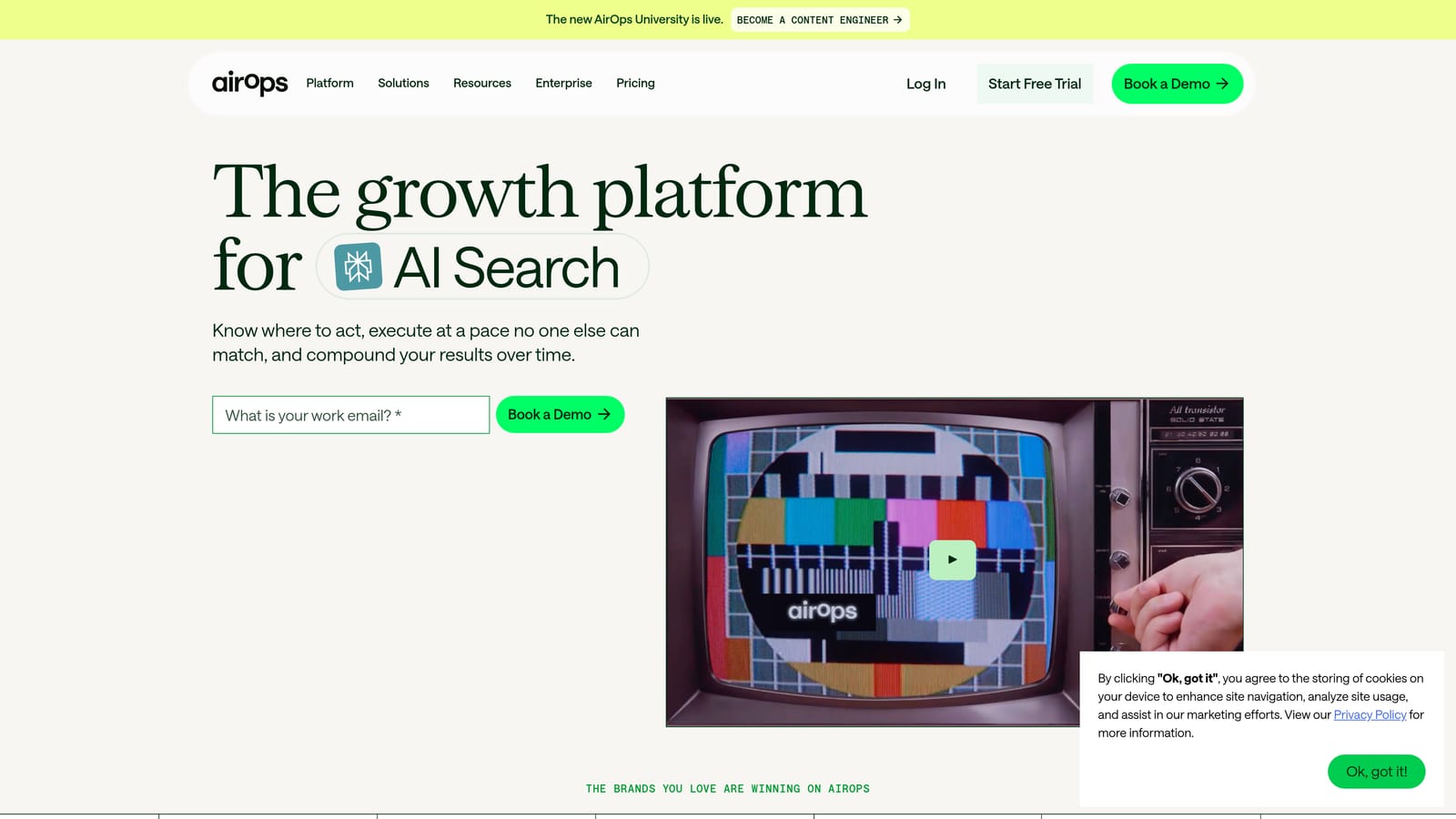
AirOps is an AI workflow automation platform that lets content teams design and run custom pipelines for GEO content production using multiple large language models.
Where This Tool Shines
AirOps is built for teams that have outgrown off-the-shelf content tools and need to engineer their own workflows. Instead of using a fixed content template, you build the pipeline: define the inputs, choose the LLMs, add data enrichment steps, and connect the output to wherever it needs to go. This flexibility makes it particularly powerful for agencies managing multiple clients with different content requirements.
The multi-LLM support is a meaningful differentiator. Teams can route different content types to different models based on performance, cost, or output style, rather than being locked into a single provider's capabilities.
Key Features
Custom AI Workflow Builder: Design and run repeatable content operations pipelines tailored to your specific GEO content strategy.
Multi-LLM Support: Integrate multiple language models into a single pipeline for flexible, optimized content production.
Data Enrichment Capabilities: Enrich content inputs with external data sources to improve depth and authority in AI-generated outputs.
Agency-Scale Architecture: Designed to support teams managing multiple clients or content streams simultaneously without workflow bottlenecks.
Tool Integrations: Connects with existing content, data, and publishing tools to fit into established team workflows.
Best For
AirOps is best suited for technically capable content operations teams and agencies that need custom-built pipelines rather than pre-packaged content tools. It requires workflow configuration to get started, so it's not the right choice for teams looking for a plug-and-play solution. There is no built-in AI visibility monitoring, so it pairs well with a dedicated GEO tracking tool.
Pricing
Verify current pricing and plan options at airops.com.
4. Profound
Best for: Enterprise teams that need deep analytics on brand visibility across AI answer engines to guide GEO strategy.
Profound is an AI answer engine monitoring platform that tracks how and where brands appear in AI-generated responses, delivering the intelligence needed to prioritize GEO content investment.

Where This Tool Shines
Profound goes beyond simple mention tracking. The platform provides query-level reporting, showing you exactly which prompts are surfacing your brand and which are sending users to competitors instead. This kind of granular visibility is what separates reactive GEO strategy from a proactive one: you're not guessing what content to create, you're responding to data.
The competitive share-of-voice analysis is particularly useful for enterprise teams benchmarking their AI presence against industry peers. Understanding where you're losing ground in AI-generated answers is the first step to closing those gaps with targeted content.
Key Features
Brand Visibility Tracking: Monitors how your brand appears across major AI answer engines, including frequency and context of mentions.
Sentiment Analysis: Evaluates the tone and framing of AI-generated brand mentions to identify positive, neutral, or negative positioning.
Query-Level Reporting: Shows which specific prompts surface your brand in AI responses, enabling precise content gap identification.
Competitive Share-of-Voice Analysis: Benchmarks your AI visibility against competitors to reveal where rivals are capturing citations you're missing.
GEO Strategy Dashboard: Consolidates analytics into a planning interface for content strategy prioritization.
Best For
Profound is best for enterprise marketing teams and agencies with dedicated GEO strategy functions. It's primarily a monitoring and analytics tool rather than a content generator, so it works best when paired with a content production platform. Teams looking for a combined monitoring and publishing solution may find Sight AI a more efficient single-platform alternative.
Pricing
Verify current pricing at profound.co.
5. Peec
Best for: Brands and agencies focused on competitive benchmarking and share-of-voice tracking in AI-generated search results.
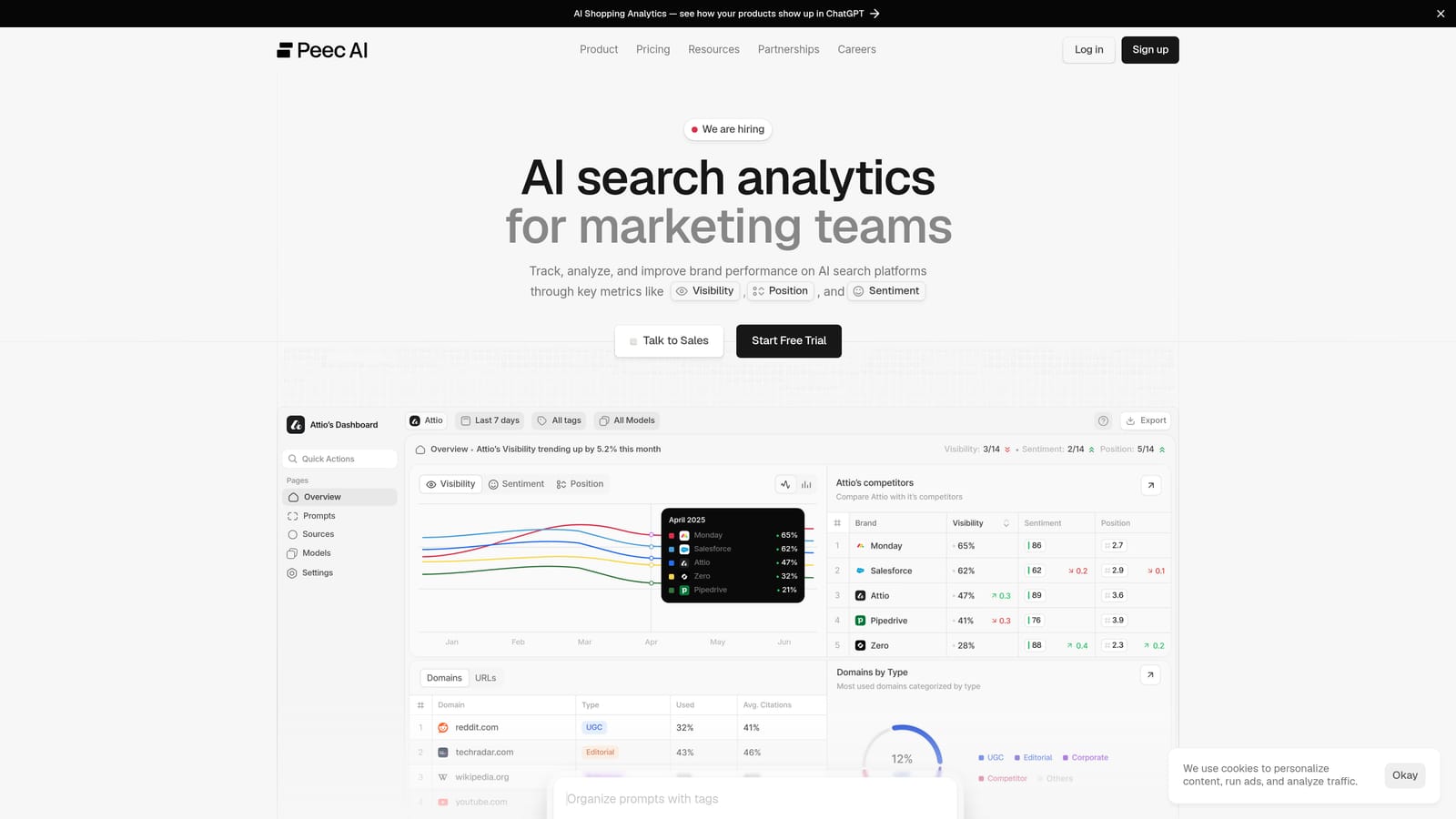
Peec is an AI search visibility tool that tracks brand and competitor mentions within AI-generated search responses, with a focused interface designed specifically for GEO competitive analysis.
Where This Tool Shines
Peec's value proposition is clarity. Rather than offering a sprawling analytics suite, it focuses on the specific question that matters most for GEO strategy: who is getting cited by AI models in your category, and how is that changing over time? The trend reporting makes it easier to see whether your content efforts are moving the needle on AI visibility or whether a competitor is gaining ground.
The streamlined interface is a genuine advantage for teams that don't need enterprise-level complexity. If your primary need is monitoring AI search share of voice and identifying content opportunities from competitive gaps, Peec delivers that without requiring extensive configuration or onboarding.
Key Features
Brand Mention Tracking: Monitors how often and in what context your brand appears in AI-generated search results across platforms.
Competitor Benchmarking: Compares your AI search share of voice against competitors to surface where you're over- or under-indexed.
Visibility Trend Reporting: Tracks changes in AI mention frequency over time to measure GEO content impact.
Query Monitoring: Identifies which search queries are generating AI responses that include or exclude your brand.
Focused Interface: Streamlined dashboard designed for AI visibility analysis without unnecessary feature bloat.
Best For
Peec is well-suited for marketing teams and agencies that need straightforward, competitive AI visibility data to inform their content strategy. Like Profound, it's a monitoring tool rather than a content generator, so teams will need a separate solution for content production and publishing.
Pricing
Verify current pricing at peec.ai.
6. Promptwatch
Best for: Teams that need granular, prompt-level tracking of how AI models respond to brand-related queries over time.
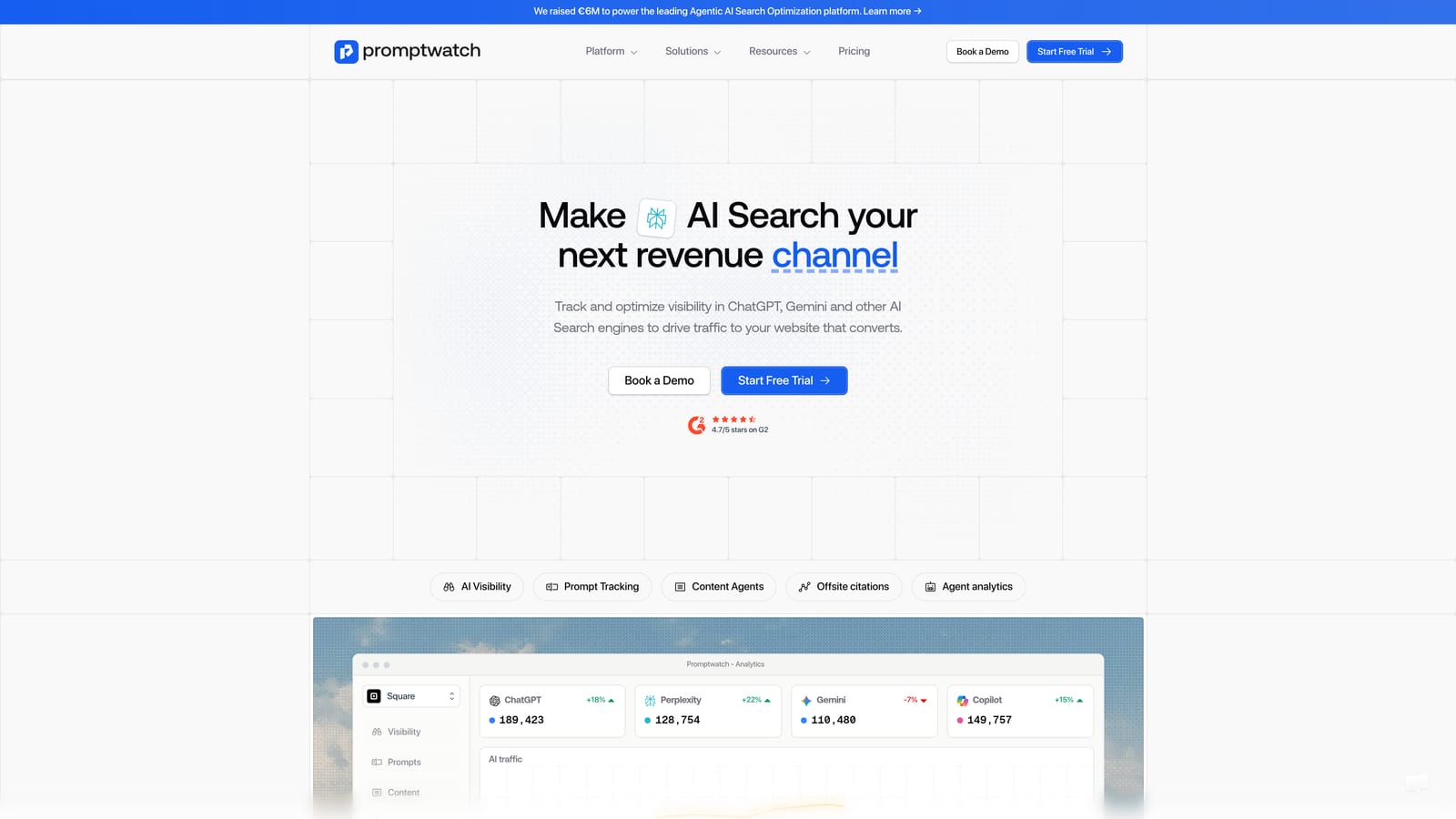
Promptwatch is an AI monitoring tool that tracks how specific prompts are answered by AI models, helping teams identify exactly which content gaps are costing them citations in AI-generated responses.
Where This Tool Shines
Where most monitoring tools show you aggregate visibility data, Promptwatch goes deeper. It tracks individual prompts over time, letting you see how AI model responses to specific brand-related queries shift as you publish new content or as competitors update their own. This historical tracking is valuable for understanding whether your GEO content efforts are actually changing what AI models say about you.
The content gap identification feature is particularly actionable. By showing you which competitor citations are appearing in response to prompts where your brand should logically appear, Promptwatch gives content teams a clear, prioritized list of what to create next rather than a general sense of where visibility is low.
Key Features
Prompt-Level Tracking: Monitors how AI models respond to specific brand-related queries with granular, query-by-query reporting.
Historical Response Monitoring: Tracks changes in AI model responses over time to detect shifts in citation patterns as content evolves.
Content Gap Identification: Surfaces competitor citation patterns to show exactly which topics need new or improved content to capture AI mentions.
Multi-Platform Coverage: Monitors responses across multiple AI platforms for broad visibility into where your brand is and isn't appearing.
GEO Content Prioritization Insights: Translates monitoring data into actionable content recommendations for GEO strategy teams.
Best For
Promptwatch is best for SEO and GEO strategists who want the most granular level of AI response tracking available. It's a strong complement to a content generation platform, providing the intelligence layer that tells you what to create while your content tools handle the actual production.
Pricing
Verify current pricing at promptwatch.io.
Matching the Right Tool to Your GEO Strategy
The right choice here depends less on which tool has the most features and more on where your biggest gap actually is. Here's a quick map based on buyer profile.
Full-stack GEO + SEO platform: Sight AI is the only tool on this list that combines AI visibility monitoring, content generation, and automated indexing in a single workflow. If you want to track what AI models say about your brand and publish content to improve those mentions without managing multiple separate tools, it's the most direct path to a closed-loop GEO operation.
High-volume content production: Writesonic handles scale well across multiple content formats. It's a strong fit when your primary need is publishing volume with SEO fundamentals built in, and you already have a monitoring solution in place.
Custom workflow automation: AirOps is the right choice for technically capable agencies that need to engineer their own content pipelines using multiple LLMs. It requires configuration but offers the most flexibility for complex, multi-client operations.
Enterprise AI monitoring and analytics: Profound delivers deep query-level reporting and competitive share-of-voice analysis for teams that need comprehensive GEO intelligence to guide strategy at scale.
Competitive GEO benchmarking: Peec offers focused, streamlined AI search visibility tracking with clear competitive comparison, well-suited for teams that need straightforward share-of-voice data without enterprise complexity.
Prompt-level tracking: Promptwatch provides the most granular view of how AI models respond to specific brand queries over time, making it the strongest tool for teams who want to understand exactly which content is driving or missing AI citations.
For most marketers, founders, and agencies who are just getting started with GEO or want to consolidate their stack, the most efficient starting point is a platform that handles both monitoring and content in one place. Start tracking your AI visibility today and see exactly where your brand appears across top AI platforms, then use that data to drive a content strategy that actually moves the needle in AI-generated search.