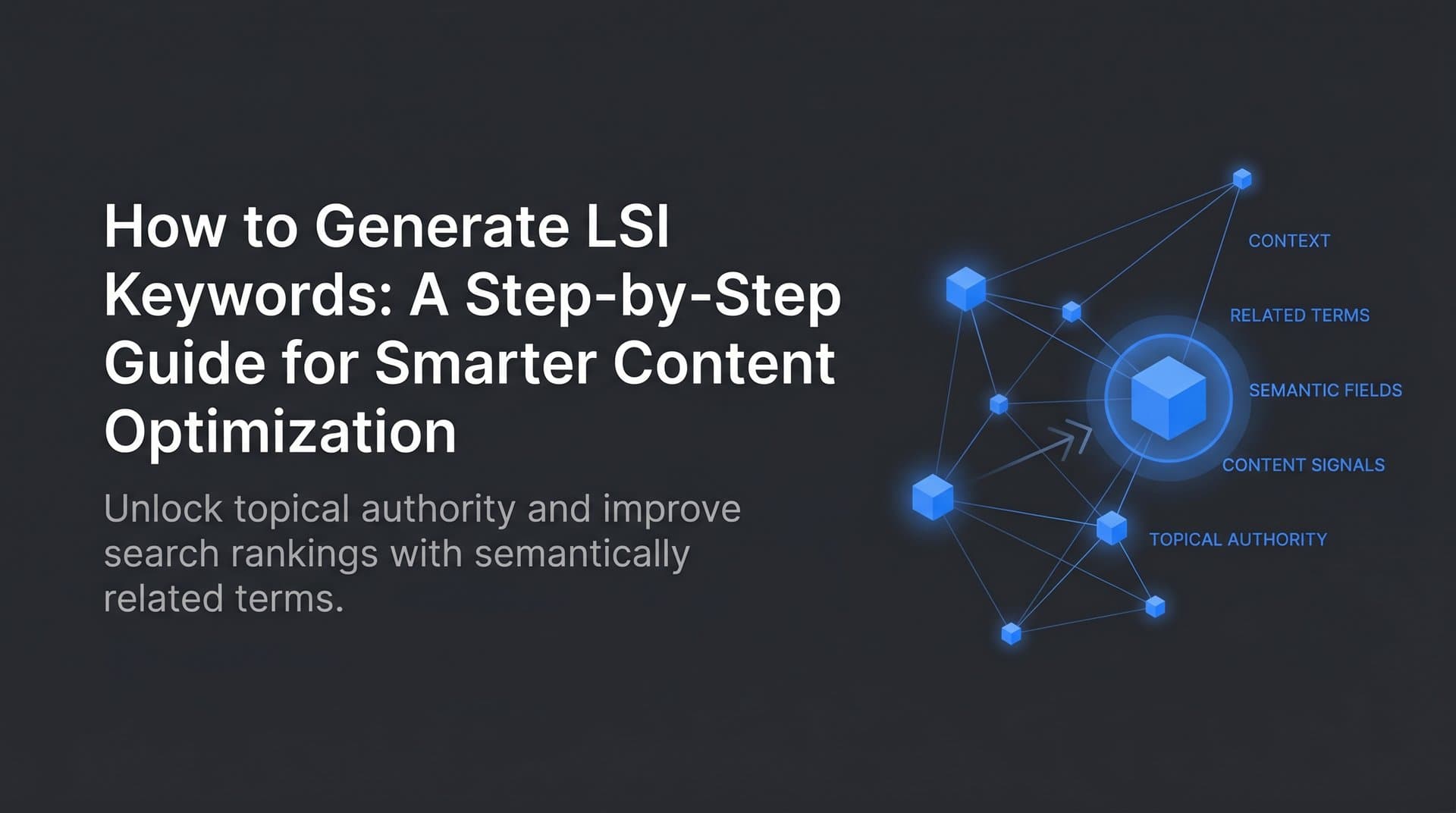
When you write content around a single keyword, you miss the broader semantic landscape that search engines and AI models use to understand your topic. Think of it this way: if you publish an article about "generate LSI keywords" but never mention related concepts like semantic search, topical authority, or content optimization, search engines have very little context to work with. You're handing them a puzzle with most of the pieces missing.
LSI (Latent Semantic Indexing) keywords are contextually related terms and phrases that help search engines grasp the full meaning behind your content, not just the exact words on the page. Since Google's Hummingbird update in 2013, and further refined through BERT and MUM, search algorithms have leaned heavily on semantic understanding rather than exact-match keyword matching. The implication for content creators is significant: topical depth now matters as much as keyword frequency.
For marketers, founders, and agencies focused on organic traffic growth and AI visibility, generating LSI keywords is a foundational skill. It strengthens your topical authority, helps your pages rank for a wider range of queries, and in 2026, makes your content more likely to be surfaced and cited by AI models like ChatGPT, Claude, and Perplexity. These models synthesize information from semantically rich, authoritative sources. If your content is thin on context, it gets passed over.
In this guide, you'll walk through a clear, repeatable process to generate LSI keywords for any topic. You'll learn how to extract them from search engine results, leverage dedicated tools, validate them against real search intent, and weave them into content that performs across both traditional search and AI-driven discovery. Whether you're optimizing a single blog post or scaling content across an entire site, these steps will give you a systematic approach to semantic keyword research that compounds over time.
Step 1: Define Your Seed Keyword and Map Its Search Intent
Before you can generate LSI keywords, you need a clear anchor point. Your seed keyword is the primary term your content targets, and everything else you build should orbit around it. The first task is not just naming that keyword but understanding precisely what it represents and what someone searching for it actually wants.
Start by analyzing the dominant search intent behind your seed keyword. Search intent generally falls into four categories: informational (the user wants to learn something), commercial (the user is evaluating options), navigational (the user is looking for a specific site or tool), and transactional (the user wants to take an action). To identify which applies, search your seed keyword in Google and study the SERP layout before clicking a single result. Understanding search intent in SEO is essential to this entire process.
Look at what Google serves up. If the top results are how-to guides and explainer articles, the intent is informational. If comparison pages and tool roundups dominate, the intent leans commercial. The SERP layout itself is Google's interpretation of what searchers want, and it's the most reliable signal you have.
Here's why this matters for LSI keyword generation: semantically related terms must align with the same intent cluster, not just be topically adjacent. Take the keyword "generate LSI keywords." It could carry informational intent (a user wants a step-by-step process) or tool-oriented intent (a user is hunting for a free LSI keyword generator). The LSI keywords you select will differ depending on which interpretation you're optimizing for. If you're writing a how-to guide, your semantic terms should include phrases like "semantic keyword research," "topical authority," and "content optimization process." If you're building a tool landing page, terms like "free LSI generator," "keyword suggestions tool," and "related keywords finder" become more relevant.
Document two or three intent variations before moving forward. This prevents you from accidentally mixing signals and ending up with content that satisfies no one fully.
Quick tip: Use Google's "People Also Ask" boxes and autocomplete suggestions as early intent signals. Type your seed keyword into the search bar and note the autocomplete options that appear. These are real queries from real users, and they reveal how people extend and contextualize your topic. Record these in a working document. You'll return to them in the next step.
At the end of Step 1, you should have your seed keyword clearly defined, its primary intent identified, and a short list of intent variations documented. This foundation shapes every LSI keyword decision you make from here.
Step 2: Mine Search Engine Results for Contextual Term Patterns
The most reliable source of LSI keywords is hiding in plain sight: the search results that are already ranking for your seed keyword. These pages have earned their position partly because they cover the topic with the right semantic depth. Mining them manually gives you contextually accurate LSI candidates because they come directly from content Google has already validated.
Search your seed keyword in Google and open the top ten organic results. Work through each one methodically. Pay attention to the page titles, meta descriptions, H2 and H3 headings, and the body content itself. You're looking for recurring terms and phrases that appear across multiple results. When the same concept shows up in three, five, or seven of the top pages, that's a strong signal that Google associates it with your topic. This kind of competitor SEO research is one of the most effective ways to uncover semantic patterns.
Create a simple spreadsheet as you go. Column one lists the term or phrase. Column two tracks how many of the top ten results include it. This frequency count becomes one of your primary prioritization signals later.
Next, scroll to the bottom of the SERP and examine the "Related Searches" section. Google generates these based on aggregate search behavior, meaning they reflect what real users search for before or after your seed keyword. These are some of the strongest LSI candidates you'll find for free. Copy all of them into your spreadsheet.
If your seed keyword triggers a featured snippet or knowledge panel, pay close attention to the bolded terms within those elements. Google bolds terms it considers semantically relevant to the query, not just exact matches. These bolded phrases are direct signals of the semantic associations Google has built around your topic.
What to record: Capture every unique term that appears across the titles, headings, and body content of the top ten results. Don't filter at this stage. Your goal is breadth. You'll validate and prioritize in Step 4.
Also revisit the "People Also Ask" questions you noted in Step 1. Each question contains embedded LSI terms. The question "What is the difference between LSI keywords and long-tail keywords?" tells you that "long-tail keywords" is a semantically associated concept worth including in your content.
By the end of this step, your spreadsheet should contain a raw list of 40 to 60 candidate terms pulled directly from what's already ranking. This manual SERP analysis is time-consuming, but it produces the most contextually accurate LSI keywords available because the source is Google's own ranking behavior.
Step 3: Use Dedicated LSI and Semantic Keyword Tools
Manual SERP analysis gives you accuracy. Dedicated tools give you scale. The combination of both is where your LSI keyword research becomes genuinely powerful. At this stage, you're expanding and cross-referencing your existing list rather than starting from scratch.
Several tools are commonly used for this purpose. LSIGraph is purpose-built for semantic keyword discovery. Enter your seed keyword and it returns a list of contextually related terms drawn from multiple data sources. AlsoAsked maps out "People Also Ask" question trees, revealing how subtopics branch from your main keyword. Google Keyword Planner surfaces related terms alongside search volume data, which helps you prioritize by demand. AnswerThePublic visualizes question-based queries around your topic, useful for identifying informational subtopics. For more advanced content optimization, platforms like Surfer SEO and Clearscope analyze top-ranking pages and recommend semantically relevant terms with frequency targets. You can explore a broader roundup of AI-powered SEO tools to find the right fit for your workflow.
The workflow for each tool is similar: enter your seed keyword, extract the generated term list, and add new terms to your spreadsheet with a notation indicating which tool surfaced them.
Here's where AI-powered content tools add a distinct advantage. Sight AI's content writer uses 13+ specialized AI agents that surface semantically related terms during article generation, embedding LSI keywords naturally throughout the content rather than treating them as an afterthought. Instead of manually inserting terms after the fact, the content is built with semantic richness from the ground up. This is particularly valuable when you're scaling content production across multiple topics simultaneously.
Once you've run your seed keyword through two or three tools, cross-reference the tool outputs with your manual SERP analysis from Step 2. Terms that appear in both your manual research and tool outputs are your highest-confidence LSI keywords. They've been validated by both human content patterns and algorithmic data, which means they carry stronger topical association signals.
Tip: Don't just collect keywords as a flat list. Group them by subtopic cluster as you go. For example, if your seed keyword is "generate LSI keywords," you might cluster terms into groups like: tools and methods, search intent and semantics, content optimization tactics, and AI visibility. This grouping makes content planning significantly easier and helps you identify which subtopics deserve their own dedicated sections or articles.
By the end of Step 3, your spreadsheet should contain a robust expanded list with source annotations and preliminary subtopic groupings. You're ready to filter.
Step 4: Validate and Prioritize Your LSI Keyword List
A long list of candidate terms is not the same as a useful list. At this stage, your job is to cut, organize, and prioritize so that you end up with a focused set of validated LSI keywords that will genuinely strengthen your content.
Start by removing terms that drift into unrelated subtopics or serve a different intent than your seed keyword. If your content is an informational how-to guide on generating LSI keywords, terms like "LSI keyword generator free download" or "buy SEO tools" belong to a different intent cluster. Including them dilutes your topical focus rather than strengthening it.
Next, apply a frequency filter. Prioritize terms that appeared in both your manual SERP analysis (Step 2) and your tool outputs (Step 3). These high-overlap terms have been validated from two independent sources, which makes them your most reliable LSI candidates. Mark them clearly in your spreadsheet.
Then check for content gaps. Scan your list for terms that represent subtopics your competitors cover but your current content does not. These are opportunities. Some gaps can be addressed by adding a section to your current article. Others are large enough to warrant a dedicated piece of content, feeding directly into your broader SEO keywords strategy. Flag these separately so they feed into your content calendar.
Here's a practical validation method for any term you're uncertain about: search it individually in Google and check whether the results overlap significantly with your seed keyword's SERP. If searching "semantic keyword research" returns results that are largely about content optimization and SEO, it's a strong LSI candidate for a page about generating LSI keywords. If the results pull in an entirely different direction, the term may be tangentially related rather than semantically core to your topic.
Target range: Many SEO practitioners recommend working with 15 to 30 semantically related terms per piece of content, though the right number varies by topic complexity and content length. For a standard long-form article, aim for a final working list of 15 to 25 validated LSI keywords. This is enough to demonstrate topical depth without overwhelming your content with forced insertions. If you're unsure about the right density, our guide on how many keywords to use for SEO provides a useful framework.
Organize your final list by priority tier. Tier one includes high-frequency, high-overlap terms that must appear in your content. Tier two includes supporting terms that add depth but aren't essential. This tiering guides your integration strategy in the next step.
Step 5: Integrate LSI Keywords Naturally Into Your Content
Having a validated list of LSI keywords means nothing if they're awkwardly stuffed into your content. The goal is seamless integration: your LSI terms should read as natural language that a knowledgeable writer would use anyway, not as calculated insertions that interrupt the reader's flow.
Place your highest-priority LSI keywords in the locations that carry the most semantic weight. H2 and H3 headings are particularly powerful because search engines use heading structure to understand content organization. If "semantic search optimization" is a tier-one LSI term, build a subheading around it rather than burying it in a paragraph. Opening paragraphs also carry strong signals. Getting a key LSI term into the first 100 words of a section helps establish the semantic context early. Other high-value placements include meta descriptions, image alt text, and the conclusion.
To illustrate the difference integration makes, consider these two versions of the same paragraph:
Before (thin, keyword-sparse): "LSI keywords help your content rank better. You should use them in your articles to get more traffic and improve your SEO."
After (enriched with LSI terms): "LSI keywords strengthen topical authority by giving search engines the semantic context they need to understand your content's full scope. When you incorporate related terms like 'semantic search,' 'content relevance,' and 'keyword co-occurrence,' you signal to both search algorithms and AI models that your page covers the topic comprehensively, not just superficially."
The second version communicates the same core idea but does so with the semantic richness that modern search algorithms reward. It also reads more naturally because the LSI terms are concepts a knowledgeable writer would genuinely use. Mastering this balance is a core part of effective SEO content optimization.
Practical integration rule: Read your content aloud after adding each LSI term. If it sounds forced or unnatural, rephrase the sentence around the concept rather than the exact phrase. Search engines understand semantic meaning well enough that a slight variation of a term carries similar signal value.
Use LSI keywords to create comprehensive subheadings that cover the full breadth of your topic. Each subheading is an opportunity to introduce a semantically related concept, answer a "People Also Ask" question, and demonstrate topical depth all at once. When your content covers a topic from multiple semantic angles, it becomes more likely to rank for a wider range of related queries, not just your primary seed keyword.
This approach also directly increases your likelihood of being cited in AI-generated answers. AI models like ChatGPT and Claude are more likely to surface content that demonstrates clear, comprehensive coverage of a topic through semantically rich, well-structured text.
Step 6: Optimize for AI Visibility and GEO Alongside Traditional SEO
In 2026, optimizing content for search engines and optimizing it for AI models are increasingly the same discipline, but with a few important distinctions worth understanding.
Generative Engine Optimization (GEO) refers to the practice of structuring content so that AI models can easily parse, understand, and cite it when generating answers. AI systems like ChatGPT, Claude, and Perplexity synthesize responses from multiple sources, and they favor content that is semantically rich, clearly structured, and demonstrably authoritative on a topic. This is where your LSI keyword strategy becomes a GEO strategy simultaneously: the more semantically complete your content, the more likely AI models will treat it as a trusted source. For a deeper dive into this discipline, explore our guide on AI SEO optimization for getting recommended by ChatGPT and Claude.
Structure your content with clear, well-labeled sections. AI models parse heading hierarchies to understand what each section covers. A page with vague or generic headings is harder for an AI to reference precisely. Specific, descriptive H2 and H3 headings that incorporate LSI terms make it easier for AI systems to extract and attribute the right answer to the right source.
Monitoring whether your optimization efforts are actually working requires visibility into how AI platforms are responding to your content. Sight AI's AI Visibility tracking lets you monitor brand mentions and citations across AI platforms including ChatGPT, Claude, and Perplexity. This gives you a feedback loop that traditional SEO tools don't provide: you can see whether your semantically enriched content is being surfaced in AI-generated answers, not just in traditional search results.
Once your LSI-optimized content is published, getting it indexed quickly matters. Sight AI's IndexNow integration and automated sitemap updates ensure your updated content is discovered by search engines faster, reducing the lag between publication and ranking movement. Learn more about how search engine indexing optimization can accelerate your rankings.
The connection between LSI keyword strategy and AI visibility is direct: semantic completeness signals authority, and authority is what both search algorithms and AI models use to determine which sources to surface.
Step 7: Measure Results and Refine Your LSI Strategy Over Time
Publishing LSI-enriched content is not the finish line. The real value of semantic keyword research compounds when you measure its impact and use those insights to improve your next piece.
After publishing, track ranking changes for both your seed keyword and the related long-tail queries that your LSI terms represent. A strong indicator that your semantic strategy is working is when you begin ranking for queries you never explicitly targeted. If your article about generating LSI keywords starts appearing for searches like "how to find semantically related keywords" or "semantic content optimization techniques," that's the signal you're looking for. It means search engines have recognized your content as topically authoritative across the broader subject cluster.
Monitor organic impressions alongside clicks. Impressions for related queries often increase before rankings fully consolidate, giving you an early signal that your semantic coverage is being recognized. Use Google Search Console to track this at the query level, and consider how your efforts contribute to your broader goal to improve organic search ranking across your site.
For AI visibility specifically, use Sight AI's AI Visibility Score to track whether your brand mentions increase across AI platforms after publishing optimized content. If you update an article with stronger semantic depth and begin appearing in more AI-generated answers on that topic, you've validated the connection between LSI keyword integration and GEO performance.
Revisit and update your LSI keyword list on a quarterly basis. Semantic associations evolve as search behavior shifts and as AI models are retrained on new data. A term that wasn't strongly associated with your topic six months ago may now be a core signal. Staying current with these shifts keeps your content competitive without requiring a complete rewrite.
Success indicator to watch for: When you rank for queries you never explicitly targeted, your LSI strategy is working. That's topical authority in action, and it's the most reliable long-term signal that your semantic keyword research is paying off.
Putting It All Together: Your LSI Keyword Checklist
Generating LSI keywords is not a one-time task. It's a repeatable process that strengthens every piece of content you publish, and it gets faster and more intuitive with practice.
Here's your quick-reference checklist to take into your next content project:
1. Define your seed keyword and map its search intent before touching any tools. Know what your content is for and who it's for.
2. Mine SERPs manually for recurring contextual terms across the top ten organic results, related searches, and People Also Ask boxes.
3. Use dedicated LSI and semantic keyword tools to expand your list and cross-reference with your manual research for high-confidence terms.
4. Validate and prioritize your list down to a focused set of 15 to 25 terms, organized by subtopic cluster and priority tier.
5. Integrate LSI keywords naturally across headings, opening paragraphs, body copy, meta descriptions, and image alt text.
6. Optimize for AI visibility alongside traditional SEO by structuring content clearly and monitoring citations across AI platforms.
7. Measure results and refine quarterly, tracking both traditional ranking signals and AI visibility metrics.
When you combine semantic depth with AI-optimized content structure, you don't just rank for more queries. You become the source that AI models cite when users ask questions in your topic area. That's the compounding advantage of getting this process right.
Start tracking your AI visibility today and see exactly where your brand appears across top AI platforms. Stop guessing how AI models like ChatGPT and Claude talk about your brand. Get visibility into every mention, uncover content opportunities, and automate your path to organic traffic growth.