Search engines no longer reward pages that repeat a keyword fifty times. Modern algorithms understand topics the same way a knowledgeable human does: through the relationships between words, concepts, and ideas that naturally cluster together. An article about espresso that never mentions extraction, pressure, or crema would feel incomplete to a coffee expert, and increasingly, it feels incomplete to Google too.
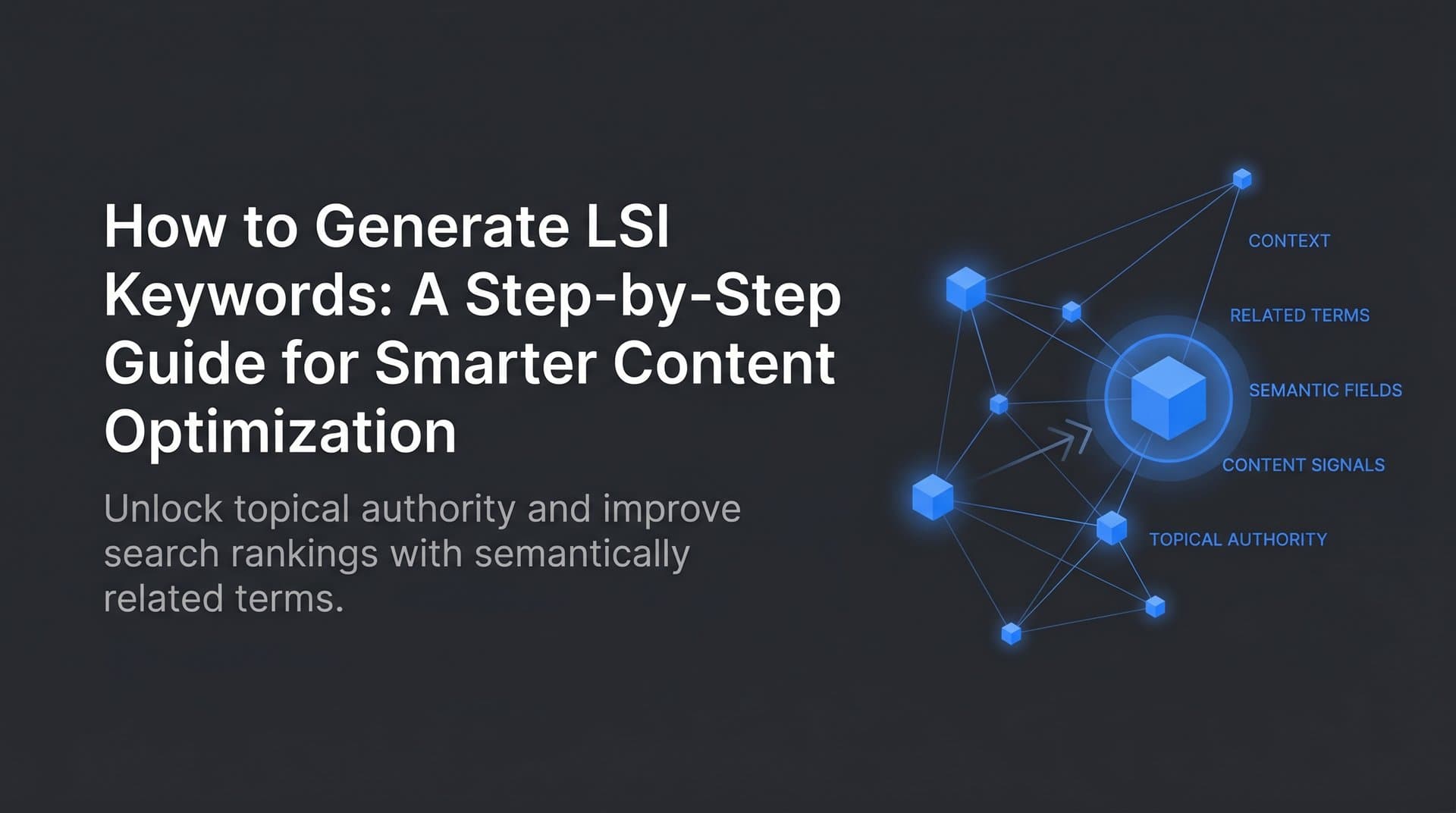
This is the core idea behind LSI keywords. Latent Semantic Indexing keywords are contextually related terms that signal topical depth to search engines and, just as importantly in 2026, to AI models like ChatGPT, Claude, and Perplexity. When an AI system is deciding which sources to reference when answering a user's question, it gravitates toward content that demonstrates comprehensive understanding of a subject, not content that hammers a single phrase repeatedly.
Think of it this way: if you were hiring an expert to write about coffee brewing, you'd expect their article to naturally include terms like grind size, water temperature, extraction ratio, and bloom time. You wouldn't need to hand them a list. That natural vocabulary coverage is exactly what finding LSI keywords is about: identifying the terms that a genuinely knowledgeable piece of content would include, then making sure yours includes them too.
For marketers, founders, and agencies focused on organic traffic growth and AI visibility, this matters on two levels. First, LSI keywords help your content rank for a broader cluster of related queries, not just the seed keyword you started with. Second, they build the kind of topical authority that AI models recognize when deciding which brands and sources deserve a mention in their responses.
This guide gives you a practical, repeatable seven-step process for finding LSI keywords and putting them to work. No guesswork, no keyword stuffing, no reliance on a single tool. Just a clear workflow you can apply to any piece of content you publish.
Step 1: Define Your Seed Keyword and Map the Topic Landscape
Before you open a single tool, you need to do something that most guides skip entirely: think like a subject matter expert. Your seed keyword is just the entry point. The real work of finding LSI keywords begins with understanding the full topical territory that keyword represents.
Start by writing down your primary keyword and asking yourself: what would a genuinely comprehensive article on this topic need to cover? Not what keywords should I include, but what does a reader actually need to understand this subject completely?
For "finding LSI keywords," a thorough treatment would naturally need to address what LSI keywords actually are, why they matter for modern SEO and AI search, how to discover them using different methods, how to evaluate which ones are worth using, and how to measure whether they're working. That's your initial semantic map, built from first principles before any tool touches it.
This step matters because semantic SEO operates at the topic level, not the keyword level. You're not optimizing a page for a phrase; you're establishing your content as the authoritative resource on a subject. Tools can help you discover terms you've missed, but they can't replace the conceptual understanding of what your topic actually encompasses. Understanding what keyword research in SEO truly involves gives you the foundation for this kind of deeper semantic work.
Map reader questions across three stages: Think about what a reader would ask before engaging with your topic (what is this, why does it matter), during (how do I do this, what tools do I need), and after (how do I measure results, what do I do next). Each of these question categories generates a cluster of semantically related terms that belong in your content.
Identify the broader topic cluster: Your seed keyword belongs to a larger subject area. "Finding LSI keywords" sits within semantic SEO, which connects to content strategy, topical authority, keyword research, and AI-driven search. Understanding these adjacencies helps you recognize which related terms are genuinely valuable versus which are too tangential to include.
Write all of this down in a simple document before moving to the next step. This brainstormed semantic map becomes your reference point for evaluating everything the tools surface later. When a tool suggests a term, you'll be able to quickly judge whether it genuinely belongs in your content or just happens to correlate statistically.
The goal of this step is clarity, not comprehensiveness. You're not trying to list every possible related term; you're building a mental framework for your topic that will guide smarter decisions throughout the rest of the process.
Step 2: Mine Google's Own Suggestions for Semantic Clues
Google is the most valuable LSI keyword research tool available, and it's completely free. The suggestions Google surfaces are derived directly from real user behavior and its own semantic understanding of how topics relate to each other. That makes them uniquely reliable signals.
Here's how to work through Google's built-in research opportunities systematically.
Google Autocomplete: Type your seed keyword into the search bar and pause before hitting enter. Note every suggestion that appears in the dropdown. Then try variations: add a space after your keyword, try it as a question ("how to find LSI keywords"), and experiment with different prepositions ("LSI keywords for," "LSI keywords in"). Each variation surfaces different semantic associations. Document everything in a spreadsheet as you go.
People Also Ask boxes: Run your search and look for the "People Also Ask" accordion on the results page. Each question in this box represents a semantically related query that Google has determined is relevant to users searching your topic. Click to expand a few answers, because doing so often triggers additional related questions to appear. These question-based terms are particularly valuable: they reveal the specific subtopics and angles that real users want addressed. Understanding search intent in SEO helps you interpret these questions more effectively.
Related Searches at the bottom of the SERP: Scroll past all the results to the "Related Searches" section. These eight to ten phrases represent Google's semantic neighbors for your query. They're often more specific than autocomplete suggestions and can surface subtopics you hadn't considered. For "finding LSI keywords," you might see terms like "semantic keyword research tools," "topical authority SEO," or "NLP keyword extraction," each pointing to a legitimate subtopic worth covering.
Bold terms in search snippets: Look at the text snippets beneath each search result. Google bolds terms it considers semantically relevant to your query, not just exact matches to your keyword. These bolded phrases reveal what Google's algorithm considers part of the same semantic neighborhood as your topic.
As you collect these terms, organize them in your spreadsheet by intent cluster. Group definitional terms together, procedural terms together, tool-related terms together, and so on. This organization will pay off when you reach the prioritization step.
One practical note: do this research in a private or incognito browser window to avoid personalization effects skewing your results. Google's suggestions can vary based on your search history, so a clean session gives you more representative data.
By the time you've worked through autocomplete, People Also Ask, related searches, and snippet analysis, you'll typically have collected between thirty and sixty semantically related terms. That's a solid foundation to build on.
Step 3: Analyze Top-Ranking Content to Extract Proven LSI Patterns
The pages ranking in the top five to ten positions for your seed keyword have already passed Google's semantic relevance test. Analyzing them isn't about copying competitors; it's about identifying the vocabulary and subtopics that Google has repeatedly rewarded for this topic.
Open the top five to ten results and read each one thoroughly. You're looking for patterns, not individual pages. A term that appears in one top-ranking article might be coincidental. A term that appears across four or five of them is a strong semantic signal.
Pay special attention to headings: The H2 and H3 headings in top-ranking content reveal the subtopics that authors and SEOs have determined are essential to comprehensive coverage of the subject. When multiple competitors use similar heading structures, that's Google indirectly telling you what a complete treatment of this topic looks like. Document these heading terms as high-priority LSI candidates.
Note recurring terminology in body content: As you read, highlight terms that appear repeatedly across multiple articles. These aren't necessarily the exact same phrases; they might be variations of the same concept. If three different top-ranking articles all discuss "semantic relationships," "contextual relevance," and "topic modeling," those concepts belong in your semantic map even if the exact phrasing varies. A structured approach to competitor SEO research makes this analysis far more efficient.
Identify coverage gaps: Look for subtopics that some top results cover but others don't. These gaps represent opportunities. If only two of the top ten results address how LSI keywords relate to AI visibility, and you cover it thoroughly, you have a genuine differentiation advantage in both traditional search and AI-driven responses.
Use a word frequency counter: Copy the text from two or three top-ranking articles into a free word frequency tool. This surfaces commonly used terms that might not have stood out during a normal read. Filter out common stop words and look for content-specific terms appearing with high frequency. These are often the semantic building blocks of the topic.
A common mistake at this stage is treating competitor content analysis as a keyword scraping exercise. The goal isn't to produce a list of every term your competitors use. It's to understand the semantic structure of the topic: which concepts are central, which are supporting, and which are peripheral. That understanding shapes how you'll eventually integrate LSI keywords into your own content.
After completing this step, cross-reference your findings with the terms you collected from Google's suggestions in Step 2. Terms that appear in both sources have particularly strong semantic signal and should move to the top of your priority list.
Step 4: Use Dedicated LSI and Semantic Keyword Tools
Manual research gets you far, but dedicated tools can surface related terms at a scale and depth that's difficult to match by hand. The key is using them to validate and expand your existing research, not as a replacement for the conceptual work you've already done.
LSIGraph: This tool is purpose-built for semantic keyword discovery. Enter your seed keyword and it returns a list of related terms derived from semantic analysis. The free version provides a useful starting set; the paid version offers more depth. Use it to cross-reference terms you've already identified and to catch any semantically relevant phrases your manual research missed.
Google's Natural Language API: This is a more technical option, but it's genuinely powerful. Paste the text from top-ranking articles into Google's Natural Language demo and it returns entity extraction results with salience scores. Entities with high salience are the concepts Google's NLP considers most central to the content. These are prime LSI keyword candidates.
Surfer SEO's content editor: Surfer analyzes top-ranking pages for your target keyword and surfaces terms that correlate with high rankings. Its content editor shows you which terms to include and how frequently they appear in competing content. For a broader look at the landscape, our roundup of SEO content tools covers several platforms with similar semantic analysis capabilities.
Google Keyword Planner: While primarily a volume tool, Keyword Planner's "ideas" section surfaces semantically related terms with search volume data attached. This helps you identify which LSI terms have enough search demand to be worth targeting explicitly, versus which are useful for context but unlikely to drive direct traffic.
AI content platforms with semantic analysis: Tools like Sight AI's content writer go a step further by identifying LSI terms as part of the content generation process itself. Rather than running separate research and writing workflows, the semantic analysis is built into how the content is structured and drafted. This is particularly valuable for teams publishing at scale, where manual LSI research for every article becomes a bottleneck.
The most important principle for this step is triangulation. A term that surfaces in LSIGraph, appears in your Google suggestions research, and shows up repeatedly in competitor headings has strong semantic signal from multiple independent sources. That convergence is your clearest signal that a term genuinely belongs in your content.
Avoid the trap of treating any single tool's output as definitive. Each tool uses different methodologies and data sources, which means each has its own blind spots. Using three or four tools together and looking for overlap gives you a much more reliable picture of your topic's semantic landscape.
Step 5: Categorize and Prioritize Your LSI Keywords by Intent and Value
By this point, you've likely collected between sixty and one hundred related terms from your manual research and tool outputs. That's too many to use strategically in a single piece of content. This step is about bringing discipline to your list so you end up with a focused, intentional set of LSI keywords that genuinely strengthen your content.
Start by organizing your collected terms into four broad categories.
Definitional terms: These explain what your topic is and establish foundational understanding. For "finding LSI keywords," definitional terms might include "latent semantic indexing," "semantic relevance," "topical authority," and "NLP keyword research." These belong early in your content and in your metadata.
Procedural terms: These describe how to do something related to your topic. Examples include "keyword research process," "semantic analysis," "content optimization workflow," and "SERP analysis." These terms naturally support step-by-step content and belong in your how-to sections. A well-defined SEO keywords strategy helps you determine which procedural terms deserve the most emphasis.
Comparative and evaluative terms: These help readers make decisions or understand trade-offs. Terms like "LSI keywords vs. semantic keywords," "best LSI tools," and "keyword research methods" fall into this category. They're particularly valuable for content that helps readers choose between approaches or tools.
Entity-based terms: These are specific tools, platforms, concepts, and proper nouns associated with your topic. Google BERT, Surfer SEO, Google Search Console, and ChatGPT are examples in this context. Entities are increasingly important for AI visibility, because AI models organize knowledge around named entities and their relationships.
Once categorized, assess each term against two criteria: how well it aligns with your content's primary intent, and how likely it is to support both traditional search rankings and AI model references. Terms that score well on both criteria go into your must-include tier.
Identify which LSI terms AI models commonly associate with your topic. If you're tracking AI visibility, you can observe which related terms appear in AI-generated responses about your subject area. These terms deserve elevated priority because including them increases the likelihood that AI models will reference your content when users ask related questions.
Your final working list should contain roughly fifteen to thirty LSI keywords organized into three priority tiers: must-include (eight to ten terms), should-include (eight to ten terms), and nice-to-have (five to ten terms). This structure gives you clear guidance during the writing process without overwhelming you with terms to track. For guidance on how many terms to actually target per page, see our deep dive on how many keywords you should use for SEO.
Step 6: Integrate LSI Keywords Naturally Into Your Content
This is where research becomes writing, and where many SEOs make a critical mistake: treating LSI keywords like a checklist to complete rather than vocabulary to internalize. The goal is content that reads like it was written by an expert who naturally uses the full vocabulary of their field, not content that visibly strains to include specific phrases.
Strategic placement for high-priority terms: Your must-include LSI keywords should appear in locations that carry the most semantic weight. This means your title tag, meta description, at least one H2 or H3 heading, the first hundred words of your content, and image alt text where relevant. These locations signal to both search engines and AI systems that these concepts are central to your content, not peripheral. For a complete framework on optimizing these placements, our guide to SEO content optimization walks through each element in detail.
Use LSI terms to structure your outline: The most natural way to integrate related terms is to let them inspire your content structure. If "semantic keyword research," "SERP analysis," and "topical authority" are on your must-include list, each can become a section or subsection of your article. This approach ensures deep coverage of each term rather than a passing mention, which is far more valuable for both search rankings and AI visibility.
Vary your language deliberately: Don't repeat the same LSI keyword in the same form throughout your content. Use synonyms, related phrases, and natural variations. If "semantic relevance" is on your list, you might use "contextual relevance," "topic relevance," and "semantic relationships" across different sections. This variation signals vocabulary breadth to search engines while keeping your writing from feeling repetitive to readers.
Internal linking with descriptive anchor text: When you link to other pages on your site, use anchor text that includes semantically related terms rather than generic phrases like "click here." This reinforces the semantic relationships between your content pages and helps search engines understand how your content cluster is structured. It's a small detail that compounds over time as you build out your content library.
The read-aloud test: After drafting your content, read it aloud. If an LSI keyword sounds awkward or forced when you say it out loud, the sentence needs to be rewritten. Forced keyword insertion is immediately obvious to readers and increasingly detectable by sophisticated algorithms. If a term doesn't fit naturally, either rephrase the surrounding sentence or move the term to a different section where it fits more organically.
Write for your reader first. The best LSI integration is invisible: the reader gets comprehensive, authoritative coverage of the topic, and the search engine sees the full semantic vocabulary of an expert. Those two outcomes are not in conflict. They're the same outcome, achieved through genuinely good writing.
Step 7: Measure Impact and Refine Your LSI Strategy Over Time
Publishing your content is not the end of the LSI keyword process. It's the beginning of a feedback loop that will make every subsequent piece of content stronger.
Start by tracking ranking changes for both your primary keyword and the LSI terms you targeted. In Google Search Console, check the Queries report for your page's URL. You'll often find that your content is generating impressions for semantically related queries you didn't explicitly target. This is one of the clearest signals that your LSI strategy is working: your content is being recognized as relevant to a broader cluster of related searches, not just the seed keyword. Learning how to check your position in Google search for these expanded queries gives you the data you need to validate your approach.
Monitor your content's appearance in People Also Ask boxes and featured snippets for related queries. These SERP features are heavily influenced by semantic relevance and topical authority. Earning a featured snippet for a related question is a strong indicator that Google considers your content authoritative on the broader topic.
For AI visibility, use tools like Sight AI to track whether AI models are referencing your content when users ask questions related to your topic. As AI-driven search continues to grow, this metric becomes increasingly important. Content that demonstrates genuine topical depth through comprehensive LSI coverage is more likely to be cited by AI systems, which drives brand visibility in a channel that traditional rank tracking doesn't capture. Understanding the AI search engine ranking factors that influence these citations helps you refine your strategy with precision.
Review your LSI keyword list quarterly. Search trends evolve, new tools and concepts emerge, and AI model behaviors shift as these systems are updated. A keyword list that was comprehensive six months ago may have gaps today. Refreshing your content with updated LSI terms keeps it competitive over time and signals to search engines that your content remains current.
The success indicator to watch for is a growing cluster of ranked terms around your seed keyword. If you published targeting one primary keyword and you're now ranking for fifteen related queries, your LSI strategy is compounding. That cluster growth is the clearest evidence that you've built genuine topical authority, not just optimized a single page for a single phrase.
Your Complete LSI Keyword Workflow at a Glance
Finding LSI keywords is not a one-time task. It's a research discipline that, when built into your standard content workflow, compounds in value over time. Every piece of content you optimize for semantic depth strengthens your overall topical authority, which makes the next piece easier to rank and more likely to earn AI model references.
Here's a quick checklist to run through before publishing any piece of content:
✅ Seed keyword and topic cluster defined with a brainstormed semantic map
✅ Google Autocomplete, People Also Ask, and Related Searches documented and organized
✅ Top-ranking content analyzed for recurring terms and heading structures
✅ Dedicated tools used to surface and validate additional semantic terms
✅ LSI keywords categorized by type and prioritized into three tiers
✅ High-priority terms integrated naturally into headings, body content, and metadata
✅ Tracking set up in Google Search Console and AI visibility tools for semantic ranking expansion
The shift toward semantic search and AI-driven discovery is not a future trend; it's the current reality. Content that covers a topic comprehensively, using the natural vocabulary of the subject, will consistently outperform content optimized for a single keyword. That's true in Google's traditional search results and it's equally true in the AI model responses that are becoming a primary discovery channel for many audiences.
Build this workflow into every content project you take on, and you'll see compounding returns: more ranked queries per page, stronger topical authority across your content library, and growing visibility in AI-generated responses. That's the real payoff of finding LSI keywords done right.
Start tracking your AI visibility today and see exactly where your brand appears across top AI platforms, which content opportunities you're missing, and how to close the gap between where you are and where AI models think you should be.