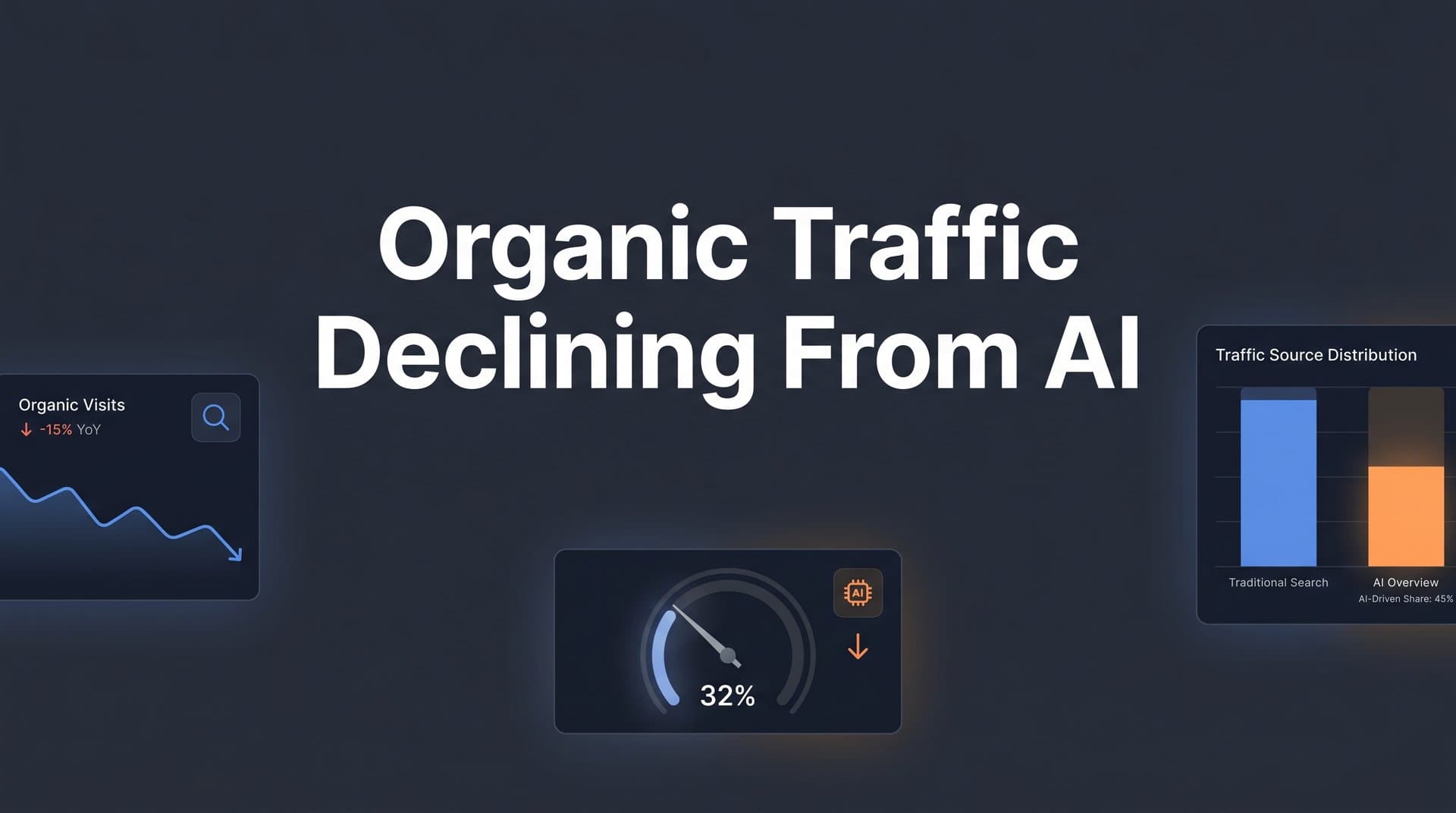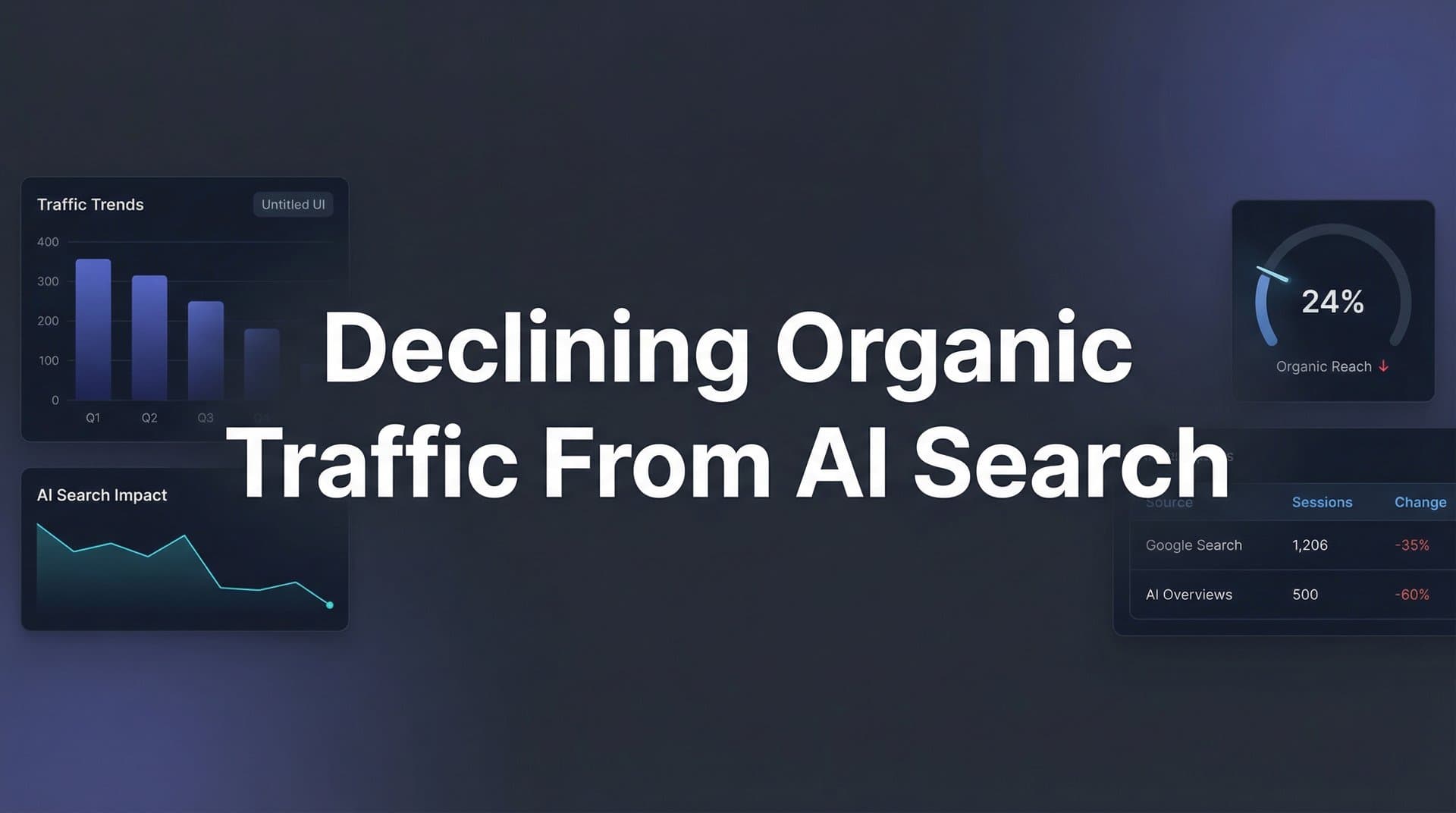
Your analytics dashboard tells a story you didn't want to read. Rankings for your top keywords? Still solid. Domain authority? Climbing steadily. But traffic? Down 15% quarter over quarter, and you can't figure out why.
You're not alone. Marketers across industries are experiencing the same unsettling pattern: SEO fundamentals remain strong while actual visitor numbers quietly erode. The culprit isn't a Google algorithm update or a technical penalty. It's something far more fundamental—a complete transformation in how people find and consume information online.
AI search has fundamentally altered user behavior. When someone asks ChatGPT for marketing advice or queries Perplexity about industry trends, they get comprehensive answers without ever clicking through to your carefully optimized content. Your site might be the source, but you'll never see that visitor in your analytics.
Here's the truth: AI search isn't killing SEO. It's forcing it to evolve faster than most strategies can keep pace. The brands that understand this shift—and adapt their approach accordingly—will dominate the next decade of organic discovery. Those that don't will watch their traffic reports deteriorate while wondering what went wrong.
This article breaks down exactly why your SEO results are declining despite doing everything "right," how AI search fundamentally changes the game, and most importantly, what you need to do differently to protect and grow your organic visibility in this new landscape.
The Zero-Click Revolution: How AI Search Changes User Behavior
Think back to how you searched for information five years ago. You'd type a query into Google, scan the top results, click through to two or three websites, and piece together an answer from multiple sources. That behavior is rapidly becoming obsolete.
Today's search experience looks dramatically different. A user asks ChatGPT "What's the best approach to content marketing for B2B SaaS?" and receives a detailed, synthesized response drawing from dozens of sources—complete with strategic frameworks, tactical recommendations, and implementation steps. No clicking required. No website visits generated. The answer is the destination.
This represents the most significant shift in search behavior since the mobile-first revolution. Google's AI Overviews, Perplexity's conversational search, ChatGPT's web browsing capabilities, and Claude's research features have created what industry observers call the "zero-click" phenomenon—queries that are fully satisfied without the user ever leaving the search interface.
The impact isn't uniform across all query types. Informational searches have been hit hardest. Questions like "how does SEO work," "what is content marketing," or "best practices for email campaigns" now generate comprehensive AI responses that eliminate the need to visit source websites. Users get their answer, close the chat, and move on with their day.
How-to queries follow a similar pattern. When someone asks an AI assistant how to set up Google Analytics or optimize meta descriptions, they receive step-by-step instructions synthesized from multiple authoritative sources. The AI becomes both search engine and content aggregator, delivering value without driving traffic to the sites that created that value.
Definition searches have virtually disappeared from traditional search engines for AI-native users. Why visit a glossary page when you can ask an AI model to explain any term in plain language, tailored to your existing knowledge level? The personalized, conversational nature of AI responses makes static definition pages feel archaic by comparison.
The shift extends beyond individual queries to entire research sessions. A marketer investigating a new strategy might have previously opened ten browser tabs, reading articles from various sources. Now, they conduct an entire research conversation with an AI assistant, asking follow-up questions, requesting clarification, and exploring tangents—all without generating a single website visit.
This doesn't mean traditional search is dead. Transactional queries—"buy running shoes," "book hotel in Paris," "download project management software"—still drive clicks because users need to complete actions that AI assistants can't handle. But the informational queries that once drove the majority of content marketing traffic? Those are increasingly being satisfied without you ever seeing the visitor. Understanding search intent in SEO becomes critical for identifying which queries still drive clicks.
Diagnosing the Drop: Separating AI Impact from Other SEO Issues
Before you overhaul your entire strategy, you need to confirm that AI search is actually the problem. Traffic declines have many potential causes: algorithm updates, technical issues, increased competition, or seasonal fluctuations. Misdiagnosing the issue leads to wasted effort on solutions that don't address the real problem.
Start by analyzing your impression-to-click ratio in Google Search Console. This metric reveals whether your visibility is holding while user behavior changes. If you're seeing stable or growing impressions but declining clicks, you're witnessing the zero-click phenomenon in action. Your content still ranks, but users are getting their answers from AI overviews instead of clicking through.
Segment your data by query type to identify patterns. Create categories for informational queries (how to, what is, why does), transactional queries (buy, download, sign up), and navigational queries (brand name searches). If informational queries show the steepest CTR decline while transactional queries remain stable, AI search is likely the culprit rather than a broad algorithmic penalty.
Compare your traffic patterns against major Google algorithm updates. If your decline doesn't correlate with known update dates and you haven't received manual actions or algorithmic penalties, the cause likely lies outside traditional ranking factors. AI search operates independently of these traditional SEO dynamics.
Examine which specific pages are losing traffic. Content that answers straightforward questions—glossaries, basic how-to guides, definition pages—typically experiences the most severe declines. If your in-depth case studies, original research, and opinion pieces maintain stable traffic while your foundational content suffers, you're seeing AI cannibalization in action. Many brands discover their content not appearing in search results the way it once did.
Here's where it gets interesting: start monitoring whether your brand appears in AI-generated responses. Ask ChatGPT, Claude, and Perplexity questions related to your industry and expertise. Are they citing your content? Mentioning your brand? Recommending your solutions? This emerging metric—AI visibility—matters more than traditional rankings for understanding your actual reach.
Track your traffic sources over time. A gradual decline in organic search traffic while direct traffic remains stable or grows suggests users are finding you through AI recommendations rather than traditional search. They're asking AI assistants for recommendations, getting your brand name, and then visiting directly. You're still getting discovered—just through a different path that doesn't show up in your organic search metrics.
The diagnostic process requires looking beyond surface-level traffic numbers to understand the full picture of how users discover and engage with your content in an AI-augmented search landscape.
The New Visibility Equation: Getting Cited by AI Models
Understanding how AI models select and cite sources fundamentally changes how you approach content creation. These models don't simply regurgitate the top-ranking pages from Google. They evaluate content through a different lens, prioritizing factors that traditional SEO has historically undervalued.
Authority signals matter enormously in AI citation decisions. Models favor content from recognized experts, established publications, and authoritative domains. But authority in this context extends beyond backlinks and domain age. AI models analyze the depth of expertise demonstrated in your content, the consistency of your topical focus, and the quality of your explanations.
Entity recognition plays a crucial role that most marketers overlook. AI models need to clearly understand who you are, what you do, and why you're qualified to speak on a topic. This means your content must explicitly establish your expertise and credentials. Don't assume the AI will infer your authority—state it clearly within your content.
Content structure dramatically affects citation likelihood. AI models excel at extracting information from well-organized content with clear hierarchies, descriptive headings, and logical flow. A 3,000-word wall of text might rank well in traditional search, but it's far less likely to be cited by AI than a structured piece with clear sections, bullet points, and explicit takeaways.
This brings us to Generative Engine Optimization—the practice of optimizing content specifically to be cited by AI models. GEO differs from traditional SEO in fundamental ways. While SEO focuses on ranking for specific keywords, GEO focuses on being recognized as an authoritative source that AI models reference when answering related queries. Learning how to optimize for AI search results requires understanding these distinctions.
GEO prioritizes clarity over keyword density. AI models parse meaning, not just matching terms. Your content needs to directly answer questions, provide clear definitions, and explain concepts in accessible language. The keyword-stuffed content that once gamed search algorithms actively works against you in AI citation.
Structured data becomes more valuable in a GEO context. Schema markup helps AI models understand your content's context, relationships, and meaning. Marking up authors, organizations, articles, FAQs, and how-to content makes it easier for AI to extract and attribute information correctly.
The citation format matters too. AI models are more likely to reference content that includes quotable insights, clear statistics, and definitive statements. Hedging language and vague generalizations make content less useful for AI synthesis. Be direct, be specific, and make claims you can support.
Building topical authority requires consistent, comprehensive coverage of your subject area. AI models recognize sites that thoroughly cover a topic from multiple angles. Publishing one excellent article on content marketing is good. Publishing a complete library covering strategy, execution, measurement, and optimization signals true expertise that AI models reward with citations.
Content Strategy Shifts That Protect Your Traffic
The most important strategic question becomes: what content still drives clicks in an AI search world? The answer lies in creating value that AI assistants cannot replicate or deliver without sending users to your site.
Original research stands as your strongest defense against zero-click cannibalization. When you publish proprietary data, industry surveys, or unique case studies, AI models can reference your findings but cannot recreate the full value. Users who want the complete dataset, methodology details, or deeper analysis must visit your site. This transforms your content from answerable-by-AI to must-visit-source.
Experience-driven content creates similar protection. First-person accounts, detailed implementation stories, and lessons learned from actual projects provide value that AI cannot synthesize from other sources. When you share specific challenges you faced, mistakes you made, and solutions you discovered, you create genuinely unique content that drives traffic even when AI models discuss the general topic.
Opinion-based content forces clicks by its very nature. AI models can summarize various perspectives on a controversial topic, but they cannot replace thought leadership and expert commentary. Taking strong positions, offering contrarian viewpoints, and providing expert analysis creates content that users want to engage with directly rather than consume through AI summaries.
The pivot toward commercial and transactional intent queries protects traffic by focusing on content where users still need to visit websites. Product comparisons, buying guides, pricing analysis, and feature breakdowns drive traffic because users need current information and must visit sites to complete purchases or sign up for services. AI can recommend options, but cannot complete transactions.
Interactive tools and calculators provide value that static AI responses cannot match. A content marketing ROI calculator, an SEO audit tool, or a personalized recommendation engine requires users to visit your site and interact directly. These resources generate traffic while building authority that improves your AI visibility for related topics. Leveraging SEO tools with AI integration can help you identify these opportunities.
Visual and multimedia content creates another layer of protection. AI models can describe concepts, but cannot replace infographics, video tutorials, interactive diagrams, or visual case studies. Content that relies on visual communication drives traffic because users need to see, not just read about, the information.
Brand building becomes more critical than ever. When users know your brand and trust your expertise, they search for you directly rather than asking generic questions. This shift from "how to do content marketing" to "Sight AI content marketing approach" protects your traffic by making your brand the destination rather than one of many potential sources.
Focus on creating content clusters that establish comprehensive authority while driving users deeper into your site. A single article might be fully answered by AI, but a interconnected series of resources that builds progressively complex knowledge encourages site visits and extended engagement that AI summaries cannot replace.
Measuring Success in the AI Search Era
Your analytics dashboard needs new metrics. Traditional SEO KPIs—rankings, organic traffic, click-through rates—still matter, but they no longer tell the complete story of your organic visibility and brand reach.
AI visibility scores represent the new frontier of search measurement. This metric tracks how frequently AI models mention, cite, or recommend your brand when answering relevant queries. Think of it as share of voice for the AI search era. You need to know whether ChatGPT recommends your solution when users ask for alternatives, whether Claude cites your research when explaining industry concepts, and whether Perplexity includes your brand in competitive comparisons. Learning how to monitor AI search results is essential for tracking these metrics.
Brand mention frequency across AI platforms reveals your true organic reach. Set up a systematic process to query major AI assistants with industry-related questions and track whether your brand appears in responses. This isn't vanity metrics—it's measuring your visibility in the channels where users increasingly discover solutions.
Sentiment analysis of AI mentions adds crucial context. Are AI models describing your brand positively, neutrally, or negatively? Are they accurately representing your positioning and value proposition? Monitoring the quality of AI-generated descriptions helps you understand how your brand is being introduced to potential customers who never visit your website directly.
Track the share of voice in AI responses for competitive intelligence. When users ask about solutions in your category, which brands get mentioned most frequently? Which competitors dominate AI recommendations? Understanding competitor ranking in AI search results reveals your competitive position in the emerging AI discovery landscape.
Measure the correlation between AI visibility and direct traffic. As your brand appears more frequently in AI responses, you should see corresponding increases in direct traffic and branded search queries. Users discover you through AI assistants, then visit your site directly. This validates that AI visibility translates to actual business value.
Create a balanced scorecard that combines traditional and AI-era metrics. Track organic rankings and traffic alongside AI mention frequency and sentiment. Monitor both click-through rates from traditional search and direct traffic increases from AI discovery. This comprehensive view reveals the full picture of your organic performance.
Establish benchmarks for AI visibility improvement. Set quarterly goals for increasing mention frequency, improving sentiment scores, and expanding the range of queries that trigger brand recommendations. Treat AI visibility optimization with the same rigor you apply to traditional SEO campaigns.
Report AI metrics alongside traditional SEO performance to stakeholders. When organic traffic declines but AI visibility increases dramatically, that context transforms the narrative from failure to strategic evolution. Help leadership understand that reach and influence now extend beyond website visits to include AI-mediated discovery.
Moving Forward: Your Organic Strategy for the Next Decade
Declining SEO results don't signal the death of organic strategy. They signal its evolution into something more complex, more challenging, and ultimately more valuable for brands that adapt successfully.
The dual approach defines success in this new landscape: optimize for AI citation while doubling down on content types that preserve click-through value. Build comprehensive topical authority that makes AI models reference you as a source. Simultaneously, create original research, experience-driven content, and interactive resources that drive direct engagement no matter how sophisticated AI search becomes.
This transformation requires new skills, new metrics, and new ways of thinking about organic visibility. You're no longer optimizing solely for search engines—you're optimizing for AI models that synthesize information, human users who consume that synthesis, and traditional search engines that still drive significant traffic for the right query types.
The brands that thrive in this environment will be those that view AI search not as a threat to organic traffic, but as an expansion of the organic discovery landscape. Your content can now reach users through traditional search, AI-powered overviews, conversational assistants, and direct recommendations—if you optimize for all these channels rather than just one.
Start with visibility. You cannot optimize for AI search if you don't know how AI models currently discuss your brand and industry. Stop guessing how AI models like ChatGPT and Claude talk about your brand—get visibility into every mention, track content opportunities, and automate your path to organic traffic growth. Start tracking your AI visibility today and see exactly where your brand appears across top AI platforms.
The next decade of organic strategy belongs to brands that master both traditional SEO and AI visibility optimization. The declining traffic you're experiencing today is not an ending—it's the beginning of a more sophisticated, more comprehensive approach to organic discovery that will define marketing success for years to come.