Running a one-person business means wearing every hat: strategist, writer, publisher, and analyst. The content stack you choose can either drain your day or multiply your output. But with hundreds of tools competing for your attention, finding the ones that actually move the needle on organic traffic and AI visibility is harder than it sounds.
This list cuts through the noise. We evaluated tools specifically for solopreneurs who need to create SEO and GEO-optimized content, track how their brand appears in AI search results, and publish consistently without a team. Whether you're building a personal brand, a niche SaaS, or a consulting practice, these tools cover the full content workflow: from ideation and writing to indexing and AI mention tracking.
Pricing notes and ideal-user guidance are included for each tool so you can match them to your actual workflow, not just a theoretical one.
1. Sight AI
Best for: Solopreneurs who want content creation, AI visibility tracking, and website indexing in one platform.
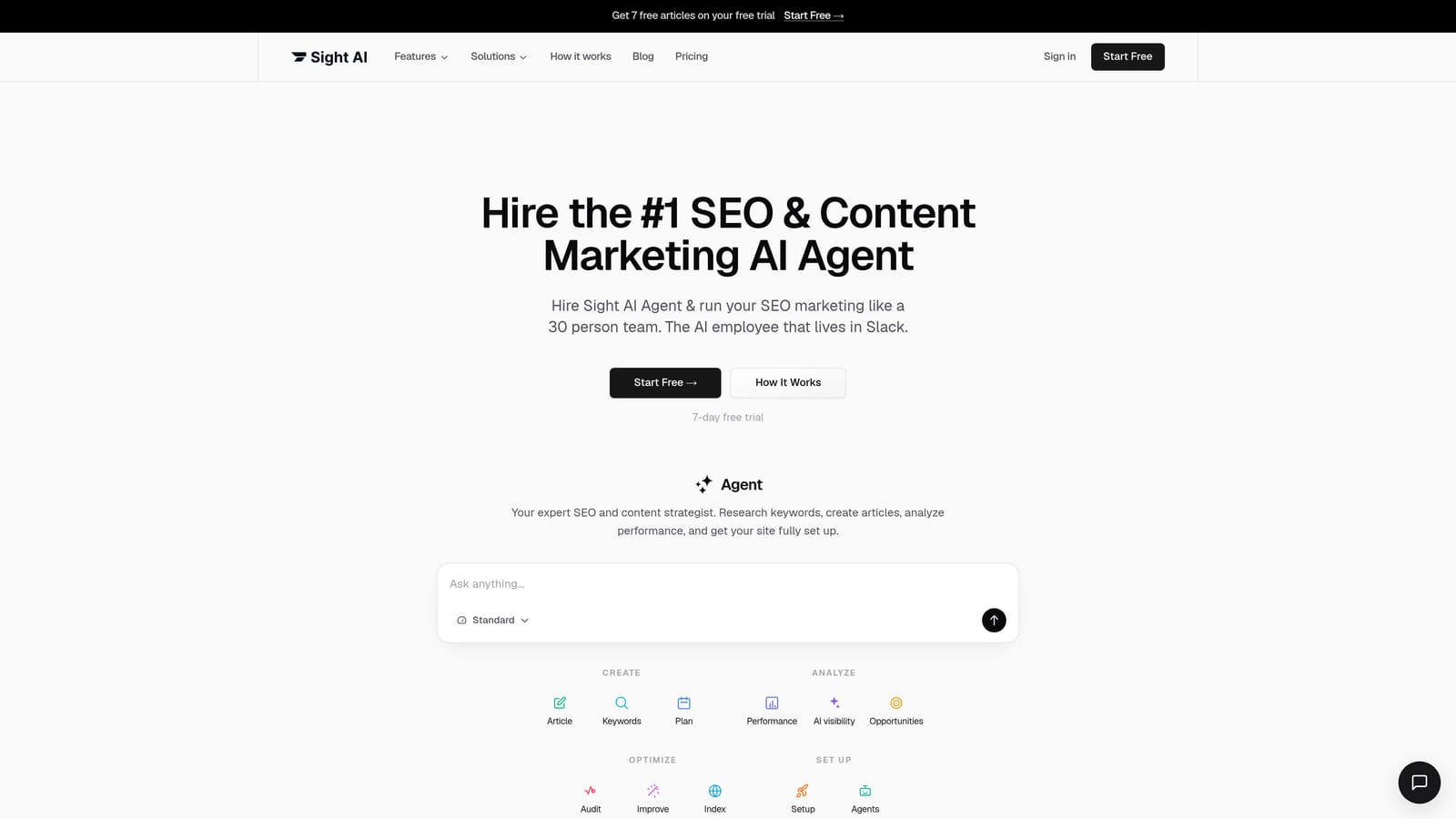
Sight AI is an all-in-one platform that combines SEO and GEO-optimized content generation with brand mention tracking across major AI platforms, making it one of the most comprehensive single-tool options for solo operators.
Where This Tool Shines
Most solopreneurs end up stitching together three or four separate tools to handle content writing, publishing, and performance monitoring. Sight AI addresses this directly by putting content creation, AI visibility scoring, and website indexing under one roof. That consolidation alone saves meaningful time when you're the only person managing the workflow.
The AI Visibility Score is particularly useful for founders who want to know how AI models like ChatGPT, Claude, and Perplexity describe their brand without manually querying each platform. Instead of guessing, you get structured data on how often your brand appears, in what context, and with what sentiment.
Key Features
AI Visibility Score: Tracks brand mentions across ChatGPT, Claude, Perplexity, and three or more additional AI platforms, giving you a consolidated view of your AI search presence.
Sentiment Analysis: Shows whether AI models describe your brand in positive, neutral, or negative terms, so you can identify reputation gaps before they compound.
AI Content Writer: Powered by 13+ specialized agents, the writer produces listicles, guides, and explainers optimized for both traditional search and generative engine results.
Website Indexing with IndexNow: Automatically notifies Google and Bing when new content is published, accelerating discovery without manual submission steps.
CMS Auto-Publishing and Autopilot Mode: Enables hands-off content deployment and scaling, so your publishing cadence doesn't depend on how much manual time you have that week.
Best For
Solopreneurs who want to replace multiple point solutions with a single platform. Particularly well-suited for founders building a personal brand or niche SaaS who care about both content output and how AI models represent their brand over time. If you're new to GEO strategy, the AI Visibility Score gives you a concrete starting point.
Pricing
Paid plans are available. Visit trysight.ai for current pricing tiers, as plans are updated regularly.
2. Writesonic
Best for: Solopreneurs who prioritize writing volume, speed, and content variety across multiple formats.
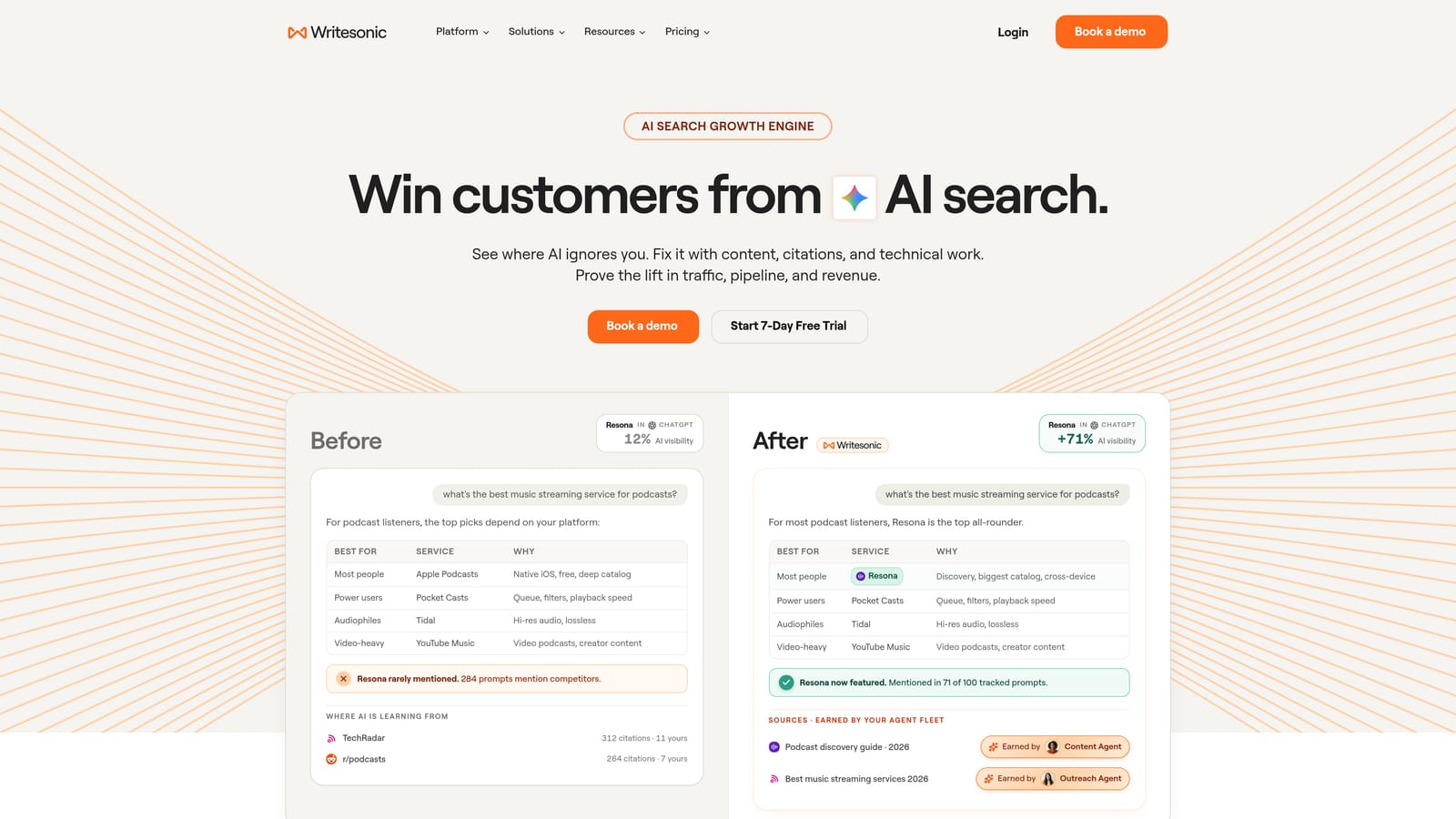
Writesonic is an established AI writing platform with a broad template library covering blog posts, landing pages, ads, and social content, plus a research-integrated conversational assistant called Chatsonic.
Where This Tool Shines
If your bottleneck is raw content output, Writesonic is built for exactly that. The template library is extensive, covering formats that solopreneurs actually need: long-form articles, product descriptions, email sequences, and ad copy. Switching between formats doesn't require learning a new tool or workflow.
Chatsonic, the platform's conversational assistant, adds web access to the mix. That means you can ask it to research a topic and draft content from current information rather than working from a static training cutoff. For solopreneurs writing about fast-moving industries, that's a practical advantage.
Key Features
Template Library: Covers blog posts, product descriptions, ads, landing pages, and social content in a single interface.
Chatsonic Assistant: A web-connected conversational AI that supports research-backed writing without switching between tabs or tools.
Long-Form Article Writer with SEO Mode: Generates structured, keyword-aware articles designed for search performance.
Brand Voice Customization: Lets you define and maintain a consistent tone across all content types, which matters when you're the only person writing.
Free Tier: Available with limited credits, making it accessible for solopreneurs who want to test before committing to a paid plan.
Best For
Content-first solopreneurs who need to produce high volumes of varied content quickly. Also a good fit for those who are early in their content strategy and want a broad tool before narrowing their stack. Note that Writesonic does not include AI visibility monitoring, so you'd need a separate tool for that layer.
Pricing
Free tier available; paid plans start at approximately $16 per month billed annually. Verify current pricing directly on Writesonic's website, as tiers change periodically.
3. AirOps
Best for: Solopreneurs with a defined content process who want to systematize and automate it at scale.
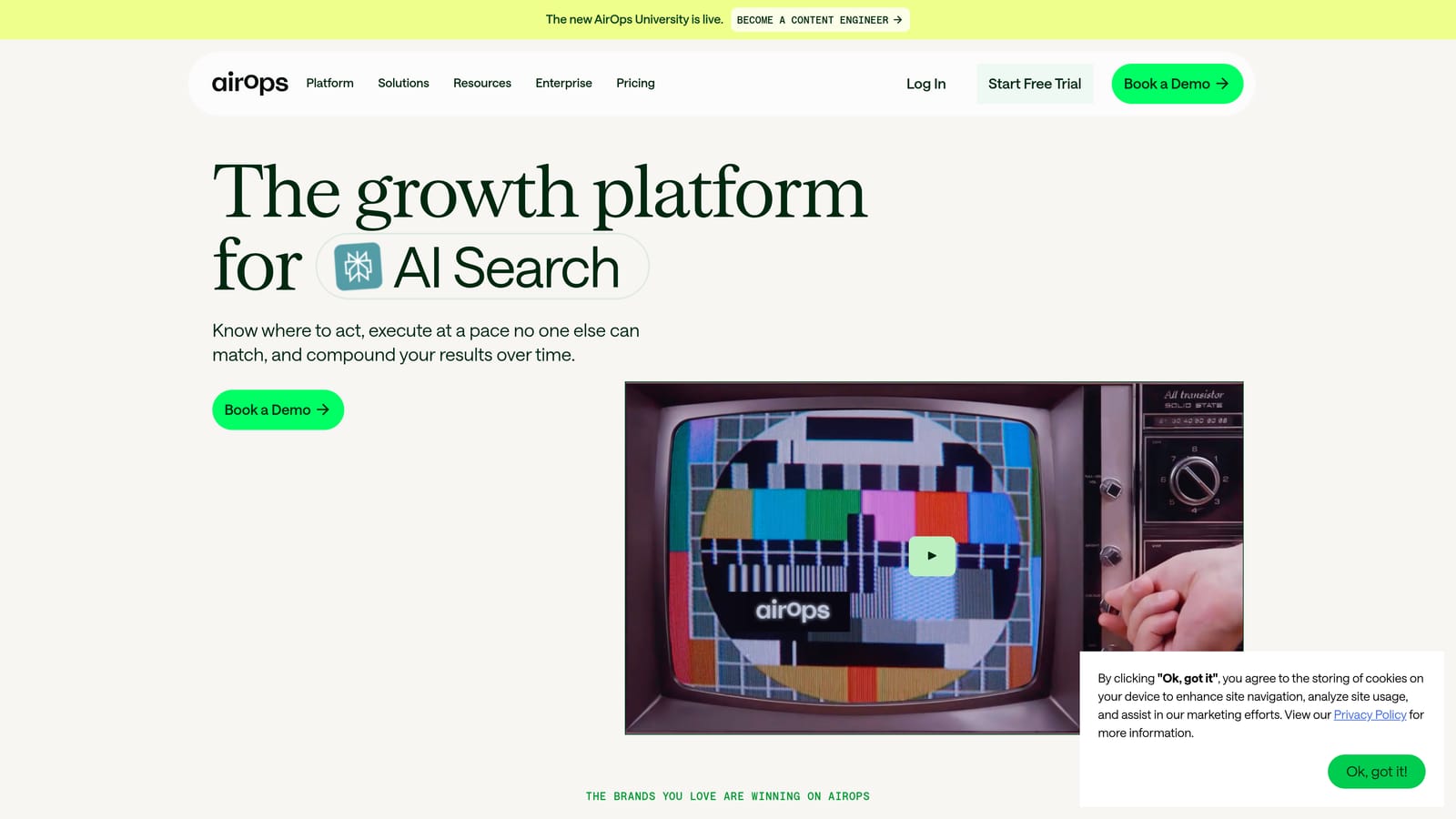
AirOps is a visual AI workflow builder that lets you create repeatable, automated content pipelines by connecting large language models to your existing data sources and processes.
Where This Tool Shines
Think of AirOps less as a writing tool and more as a content operations layer. If you've already figured out what content you need to produce and how, AirOps helps you stop doing it manually every time. You build the workflow once using a drag-and-drop interface, then run it repeatedly without rebuilding from scratch.
The ability to connect multiple LLM providers within a single workflow is a meaningful differentiator. You're not locked into one model's strengths. If one provider handles research summaries better and another handles tone, you can route tasks accordingly inside the same pipeline.
Key Features
Drag-and-Drop Workflow Builder: Creates multi-step AI content processes visually, without requiring code for most use cases.
External Data Connections: Connects to databases, APIs, and data sources so your content pipelines can pull from real inputs rather than static prompts.
Multi-LLM Support: Lets you use different AI providers within a single workflow, routing tasks to the model best suited for each step.
Reusable Templates: Pre-built workflow templates for common content operations reduce setup time for standard use cases.
Usage-Based Pricing: Scales with your actual usage rather than locking you into a fixed seat cost, which suits variable solopreneur workloads.
Best For
Operations-oriented solopreneurs who have a repeatable content process and want to automate it systematically. Less suited for those still figuring out their content strategy, since AirOps works best when you know what you're automating.
Pricing
Usage-based pricing with solo and team plans available. Verify current pricing on the AirOps website, as plan structures evolve with the platform.
4. Profound
Best for: Solopreneurs focused on measuring and improving their GEO performance across AI search platforms.
Profound is an AI search analytics platform that tracks how a brand appears in AI-generated answers, giving solopreneurs structured visibility into their generative engine optimization performance.
Where This Tool Shines
GEO is still a relatively new discipline, and most solopreneurs are working without a clear baseline. Profound addresses that by providing dashboard-level reporting on how your brand surfaces across AI search platforms. Rather than manually testing queries to see if your brand shows up, you get ongoing tracking with trend data over time.
The competitive benchmarking feature is worth noting. Knowing that your brand appears in AI responses is useful; knowing how that compares to alternatives in your niche is more actionable. For solopreneurs in competitive markets, that context shapes content strategy in a concrete way.
Key Features
AI Search Visibility Tracking: Monitors how your brand appears across major AI search platforms in a single reporting interface.
Dashboard Reporting: Surfaces AI search performance trends over time so you can measure whether your content strategy is improving your presence.
Query and Topic Identification: Shows which specific queries and topic areas are surfacing your brand in AI-generated responses.
Competitive Visibility Benchmarking: Compares your AI search presence against competitors so you can contextualize your performance.
Actionable Improvement Insights: Translates tracking data into recommendations for improving AI search presence, not just reporting on it.
Best For
Visibility-first solopreneurs who want to understand and systematically improve their GEO performance. Profound is an analytics and reporting tool, not a content creator, so it works best paired with a content generation tool in your stack.
Pricing
Verify current pricing directly on Profound's website, as plans are subject to change.
5. Peec
Best for: Solopreneurs in competitive niches who want to benchmark their AI mention frequency against direct competitors.
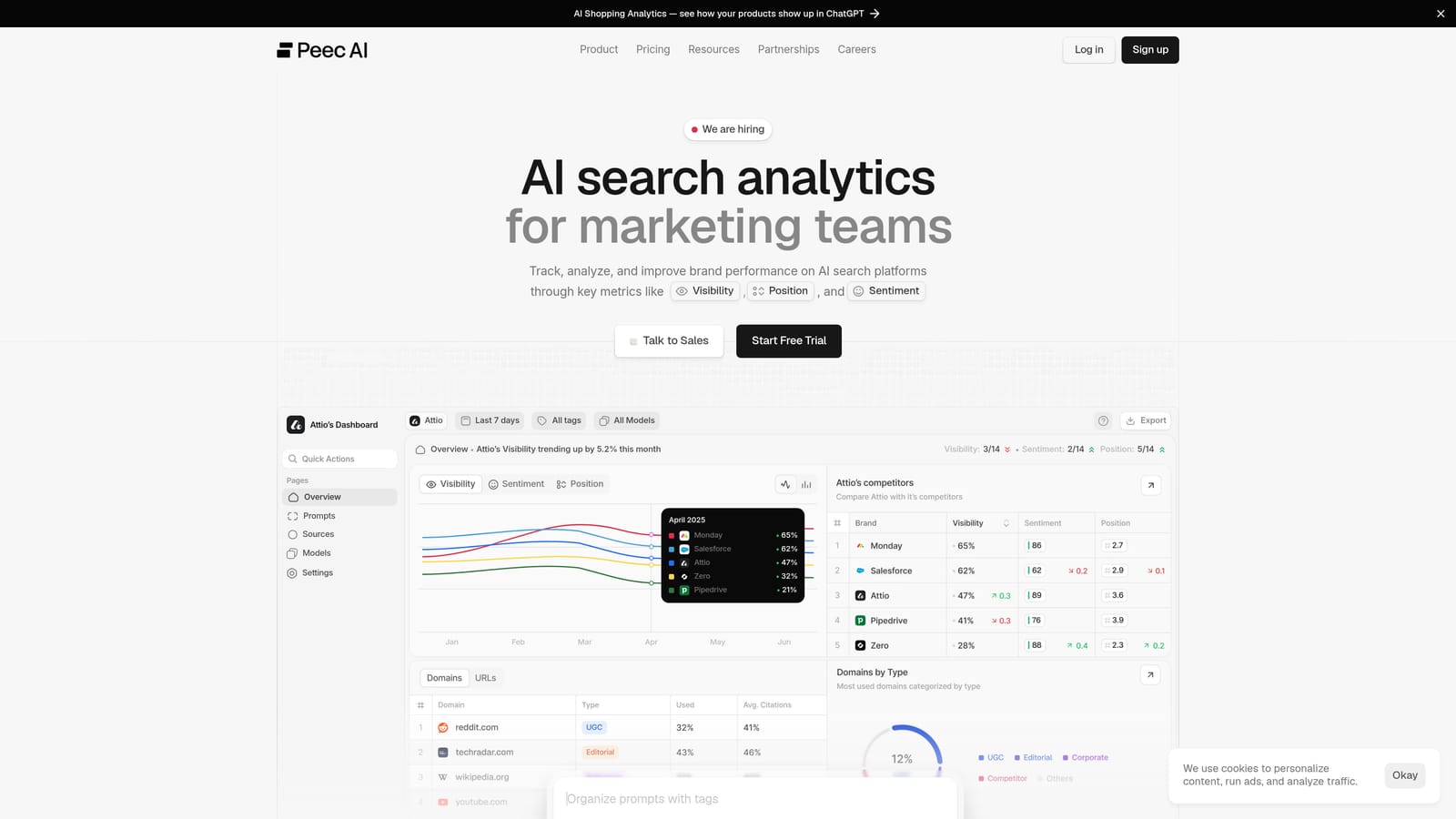
Peec is an AI mention monitoring tool focused on competitive benchmarking, tracking how your brand and its competitors appear in AI model outputs over time.
Where This Tool Shines
Where some AI visibility tools focus on your brand in isolation, Peec is built around the competitive context. The side-by-side benchmarking view makes it easy to see not just whether your brand appears in AI responses, but how frequently it appears relative to the alternatives your target audience might encounter.
For solopreneurs in crowded niches, this framing is more actionable than raw mention counts. If a competitor is consistently surfacing ahead of you in AI-generated recommendations, that's a content gap worth addressing. Peec surfaces that gap explicitly rather than leaving you to infer it.
Key Features
Brand Mention Monitoring: Tracks how often your brand appears in AI-generated responses across platforms.
Side-by-Side Competitive Benchmarking: Compares your AI search presence against named competitors in the same view.
Frequency and Context Tracking: Monitors changes in how often and in what context your brand is mentioned over time.
Mention Pattern Alerts: Notifies you when significant changes occur in your AI mention patterns, so you're not checking manually.
Niche Market Reporting: Reporting is designed to be useful for focused, competitive markets rather than broad enterprise use cases.
Best For
Solopreneurs who are actively competing for AI search presence in a defined niche and want competitive intelligence alongside their own visibility data. Like Profound, Peec is a monitoring tool, not a content generator.
Pricing
Verify current pricing directly on Peec's website.
6. Promptwatch
Best for: Data-oriented solopreneurs who want to systematically test and optimize how AI models respond to queries about their brand or niche.
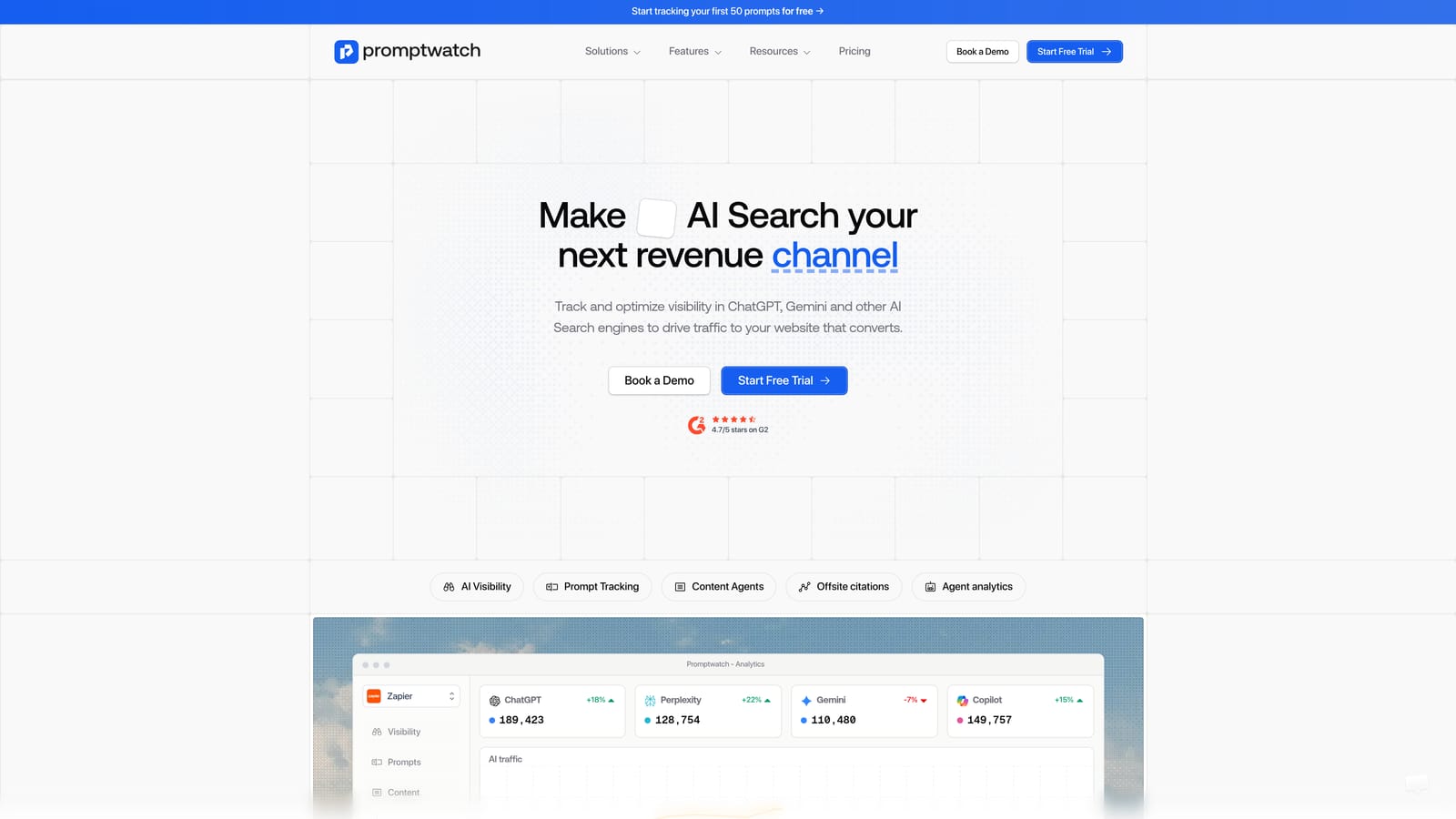
Promptwatch is a prompt performance tracking tool that monitors how AI models respond to specific queries over time, helping solopreneurs optimize their brand's representation in LLM outputs.
Where This Tool Shines
GEO content strategy often involves a lot of experimentation: trying different content framings, brand narratives, or topic angles to see what improves how AI models respond to relevant queries. Promptwatch gives that experimentation structure. Instead of running tests informally and losing track of what you tried, you get a logged history of prompts and their outputs that you can analyze systematically.
The developer-friendly interface and API access make it a natural fit for technically inclined solopreneurs who want to integrate prompt tracking into a broader content or analytics workflow. It's more of a research and optimization layer than a publishing tool, but for founders who take GEO seriously, that layer matters.
Key Features
Prompt Response Tracking: Monitors how AI models respond to specific queries over time, capturing changes as models update.
Prompt History Logging: Stores prompt inputs and output variations so you can analyze patterns and compare results across testing periods.
Content Framing Analysis: Identifies which content framings and brand narratives tend to improve AI model representation for your target queries.
GEO Strategy Testing: Supports structured experimentation with generative engine optimization approaches before committing to a content direction.
API Access: Developer-friendly integration options for solopreneurs who want to connect prompt tracking to their existing tooling.
Best For
Technical solopreneurs who treat GEO as an ongoing optimization discipline rather than a one-time content effort. Promptwatch works best as a complement to a content creation tool, not as a standalone solution for publishing at scale.
Pricing
Verify current pricing directly on Promptwatch's website.
Choosing the Right Tool for Your Solopreneur Content Stack
The right combination depends on where your biggest bottleneck actually sits. Here's a quick framework for matching tools to your situation.
If you're content-first: Start with Sight AI for SEO and GEO-optimized writing, or Writesonic if you need high-volume content across multiple formats quickly. Both cover the creation side, though Sight AI adds AI visibility tracking that Writesonic doesn't include.
If you're visibility-first: Profound and Peec both address AI search monitoring, with Peec leaning more toward competitive benchmarking and Profound offering broader analytics and trend reporting. Promptwatch adds a testing layer if you want to go deeper into how specific content choices affect AI responses. Sight AI also covers this ground with its AI Visibility Score and sentiment analysis, making it a strong single-platform option if you want creation and monitoring together.
If you're operations-first: AirOps is the clear choice for solopreneurs who have a defined content process and want to automate it. It works well alongside any of the content creation or monitoring tools listed here.
For most solopreneurs, the most efficient starting point is a platform that handles multiple needs without requiring you to manage integrations between separate tools. Sight AI is the most comprehensive single-platform option on this list, covering content generation, AI visibility tracking, website indexing, and automated publishing in one place. Pairing it with AirOps for workflow automation covers most solopreneur content needs without overcomplicating the stack.
Stop guessing how AI models like ChatGPT and Claude talk about your brand. Start tracking your AI visibility today and see exactly where your brand appears across top AI platforms, which content opportunities you're missing, and how to build a faster path to organic traffic growth.