The best generative AI SEO tools in 2026 cover three jobs: generating search-optimized content (Sight AI, Writesonic, AirOps), monitoring how AI answer engines like ChatGPT, Claude and Perplexity mention your brand (Profound, Peec, Promptwatch), and publishing and indexing that content quickly. Sight AI is the only tool on this list that combines all three in one platform. The others are strongest when paired with each other.
That matters because of Generative Engine Optimization (GEO). Ranking in Google is no longer the whole job. AI models now surface brand recommendations directly, so the tools below don't all fit into a single "content generation" box. Some are writers. Others are GEO monitoring platforms that tell you what to write. Together they represent the workflow serious SEO teams use in 2026: monitor, generate, publish.
Quick comparison
| Tool | Primary role | Generates content | Tracks AI visibility | Best for |
|---|---|---|---|---|
| Sight AI | All-in-one SEO + GEO | Yes | Yes | Teams wanting one platform |
| Writesonic | AI writer | Yes | No | Volume SEO articles |
| AirOps | Workflow automation | Yes (custom pipelines) | No | Agencies and enterprise ops |
| Profound | GEO analytics | No | Yes | Enterprise strategy |
| Peec | GEO monitoring | No | Yes | Competitive benchmarking |
| Promptwatch | Prompt-level tracking | No | Yes | Technical SEOs |
How to evaluate a generative SEO tool
- Output quality and structure: Check whether drafts include clear headings, direct answers, and factual specifics. AI answer engines favor content they can extract and cite cleanly.
- Search data inputs: Check whether the tool works from real keyword, SERP or prompt data, or only from your instructions.
- AI visibility feedback: Without monitoring, you can't tell whether published content changes how AI models mention you.
- CMS integration and publishing: Direct publishing, sitemap updates and IndexNow submission shorten the time from draft to indexed page.
- Multi-client scale: Agencies need workspaces, templates and per-client brand settings.
- Editorial control: Look for human review steps. Unedited mass output is a quality risk under Google's scaled content abuse policy.
1. Sight AI
Best for: Teams that want content generation, AI visibility tracking, and automated indexing in one platform.
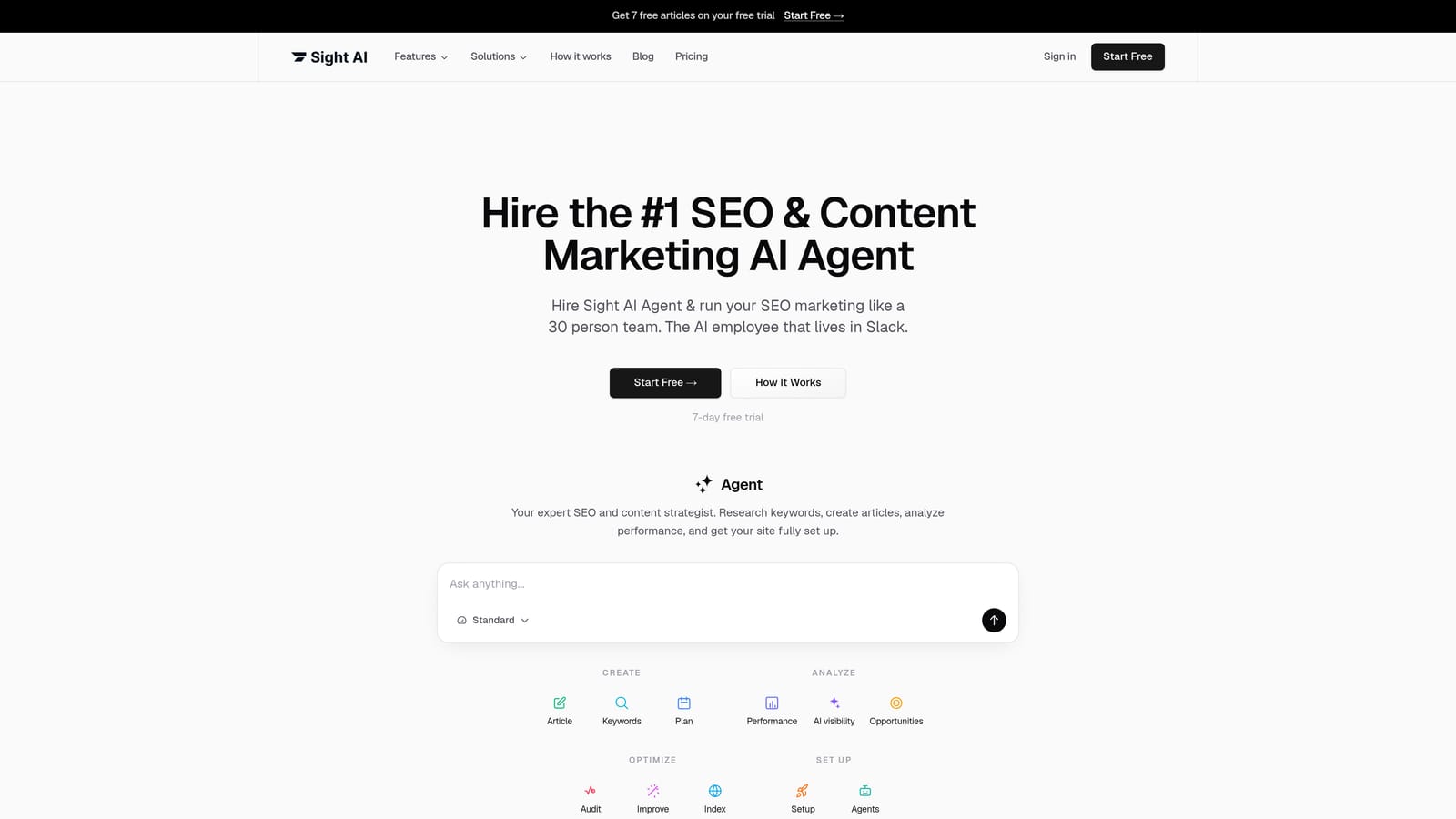
Sight AI is an all-in-one platform combining AI content generation, AI visibility tracking, and automated website indexing for SEO and GEO growth.
Where This Tool Shines
Most content tools stop at the draft. Sight AI goes further by connecting what you publish to how AI models actually talk about your brand. That closed-loop approach, from content creation to AI mention monitoring, is rare. It matters more as AI search interfaces become primary discovery channels.
The platform's 13+ specialized AI agents handle distinct content formats, so a listicle gets a different treatment than a how-to guide or an explainer. Autopilot Mode takes the operational burden off teams that need to publish consistently without managing every step by hand. With IndexNow integration, content gets discovered faster than it would through standard crawl cycles.
Key Features
13+ Specialized AI Agents: Purpose-built agents for listicles, guides, explainers, and other formats generate content optimized for both traditional search and AI retrieval patterns.
AI Visibility Score: Tracks brand mentions across ChatGPT, Claude, Perplexity, and three or more additional AI platforms, giving you a consolidated view of your AI search presence.
Sentiment Analysis: Goes beyond mention counts to analyze how AI models frame your brand in generated answers, surfacing context and tone alongside frequency data.
Autopilot Mode: Handles hands-off content publishing so teams can maintain output without manual intervention at every step.
IndexNow Integration: Automatically submits new content to search engines for faster indexing, reducing the lag between publishing and discovery.
CMS Auto-Publishing: Pushes content directly to your CMS with automatic sitemap updates, cutting the manual steps between draft and live page.
Best For
Sight AI is the strongest fit for marketers, founders, and agencies who want a single platform to cover content creation and AI visibility in one workflow. If you run SEO and GEO programs at the same time and don't want to stitch together multiple tools, this platform is built for that scenario.
Pricing
Paid plans are available. Visit trysight.ai for current pricing tiers and plan details, as offerings are updated regularly.
2. Writesonic
Best for: Content teams and agencies needing scalable, keyword-targeted long-form article generation.
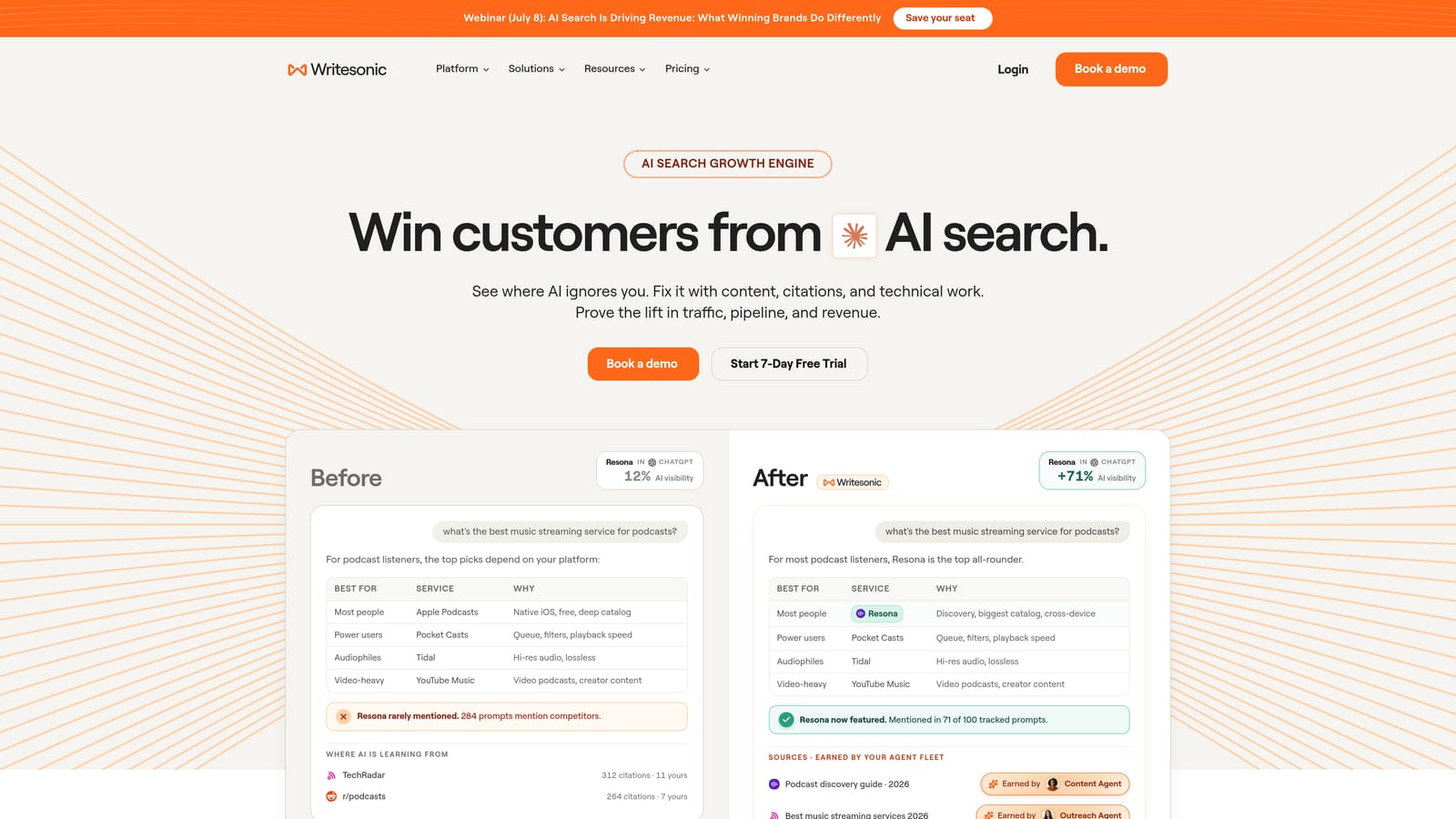
Writesonic is a widely used AI writing platform with dedicated SEO article generation, keyword targeting, and long-form content workflows.
Where This Tool Shines
Writesonic has a strong reputation for producing structured, SEO-ready long-form content at speed. Its article writer builds keyword targeting into the generation process, which saves the back-and-forth of optimizing drafts afterward.
The Chatsonic feature adds a conversational layer for research, ideation, and quick content briefs before you commit to a full article. For teams producing high volumes of blog content, product pages, or landing copy, Writesonic's workflow handles that kind of throughput well. Note that Writesonic is primarily a content generation tool. It doesn't offer AI visibility or GEO monitoring.
Key Features
Long-Form SEO Article Writer: Generates structured articles with keyword integration, headers, and meta elements built into the output.
Chatsonic: A conversational AI interface for research, content ideation, and quick drafts that complements the full article workflow.
Meta Description and Title Tag Generation: Produces on-page SEO elements alongside article content to reduce post-generation editing time.
Multi-Language Support: Generates content across multiple languages, making it useful for teams running international content programs.
Browser Extension and API Access: Enables content generation directly in-browser and supports integration into existing content pipelines via API.
Best For
Writesonic suits content teams and agencies focused on traditional SEO content volume. If your main need is well-structured, keyword-optimized articles at scale, without AI visibility monitoring, it's a capable and accessible option.
Pricing
A free tier is available for getting started. Paid plans scale with usage and seat count. Check writesonic.com for current plan structures, as they change periodically.
3. AirOps
Best for: Agencies and enterprise teams building custom, high-volume AI content pipelines.
AirOps is an AI workflow automation platform that lets teams build custom prompt chains and content pipelines for structured, scalable content operations.
Where This Tool Shines
AirOps isn't a traditional content writer. It's an operational layer that sits on top of AI models. Instead of generating content through a single interface, teams use AirOps to build repeatable workflows that chain and automate each step of the content process: brief, outline, draft, optimization.
For agencies running templated content programs at scale, this workflow control is valuable. You can standardize how content gets produced across clients, feed live data sources into prompts, and share workflows across teams. The tradeoff is more setup work than a plug-and-play writing tool requires. For a broader look at this category, see our roundup of content pipeline automation software.
Key Features
Custom AI Workflow Builder: Drag-and-drop prompt chaining lets teams design multi-step content workflows without writing code.
Data Source Integrations: Connect external data inputs such as keyword lists, product catalogs, and briefs to feed dynamic content into automated workflows.
Team Collaboration and Workflow Sharing: Shared workflow libraries let teams standardize processes and onboard new members onto proven content pipelines.
API Access: Lets AirOps workflows connect to broader content infrastructure and publishing systems.
Templates for Content Operations: Pre-built templates for common content tasks reduce setup time for standard SEO content formats.
Best For
AirOps is best suited to agencies and enterprise content teams that need process control over high-volume content production. If you manage multiple clients or content programs and need consistency at scale, AirOps provides the automation layer that simpler writing tools lack.
Pricing
Pricing is usage- and seat-based, aimed at teams and enterprise customers. Visit airops.com for current plan details and to request a demo if you're evaluating it for a larger team.
4. Profound
Best for: Enterprise marketing teams that want GEO analytics to drive AI-informed content strategy.
Profound is a GEO analytics platform that monitors brand presence in AI-generated answers and turns those insights into content strategy recommendations.
Where This Tool Shines
Profound sits where AI answer engine monitoring meets strategic content planning. It doesn't generate content. It tells you what content to create by analyzing where your brand appears, and where it doesn't, in AI-generated responses across major platforms.
That intelligence is increasingly central to SEO strategy. If AI models consistently recommend competitors in your category and leave your brand out, you have a content and authority gap to address. Profound surfaces those gaps and frames them as actionable content opportunities, which is a different kind of value than a writing tool provides.
Key Features
AI Answer Engine Monitoring: Tracks how your brand appears across major AI platforms in response to category-relevant queries.
Content Gap Identification: Analyzes AI response patterns to surface topics and formats where your brand is underrepresented.
Competitor Visibility Benchmarking: Compares your AI answer presence against competitors to put performance in context and prioritize content investments.
Strategic Content Recommendations: Turns GEO monitoring data into specific content recommendations aligned with AI answer patterns.
Enterprise Reporting and Dashboards: Team-level reporting tools designed for enterprise marketing organizations managing large content programs.
Best For
Profound is built for enterprise marketing teams and agencies that need structured GEO intelligence at scale. If your organization is investing seriously in AI search presence and needs data-driven content strategy rather than more content output, Profound is worth evaluating.
Pricing
Profound uses enterprise pricing. Contact the Profound team directly for current plan details and to discuss fit for your organization's scale.
5. Peec
Best for: SEO and content teams tracking brand and competitor AI visibility to find content opportunities.
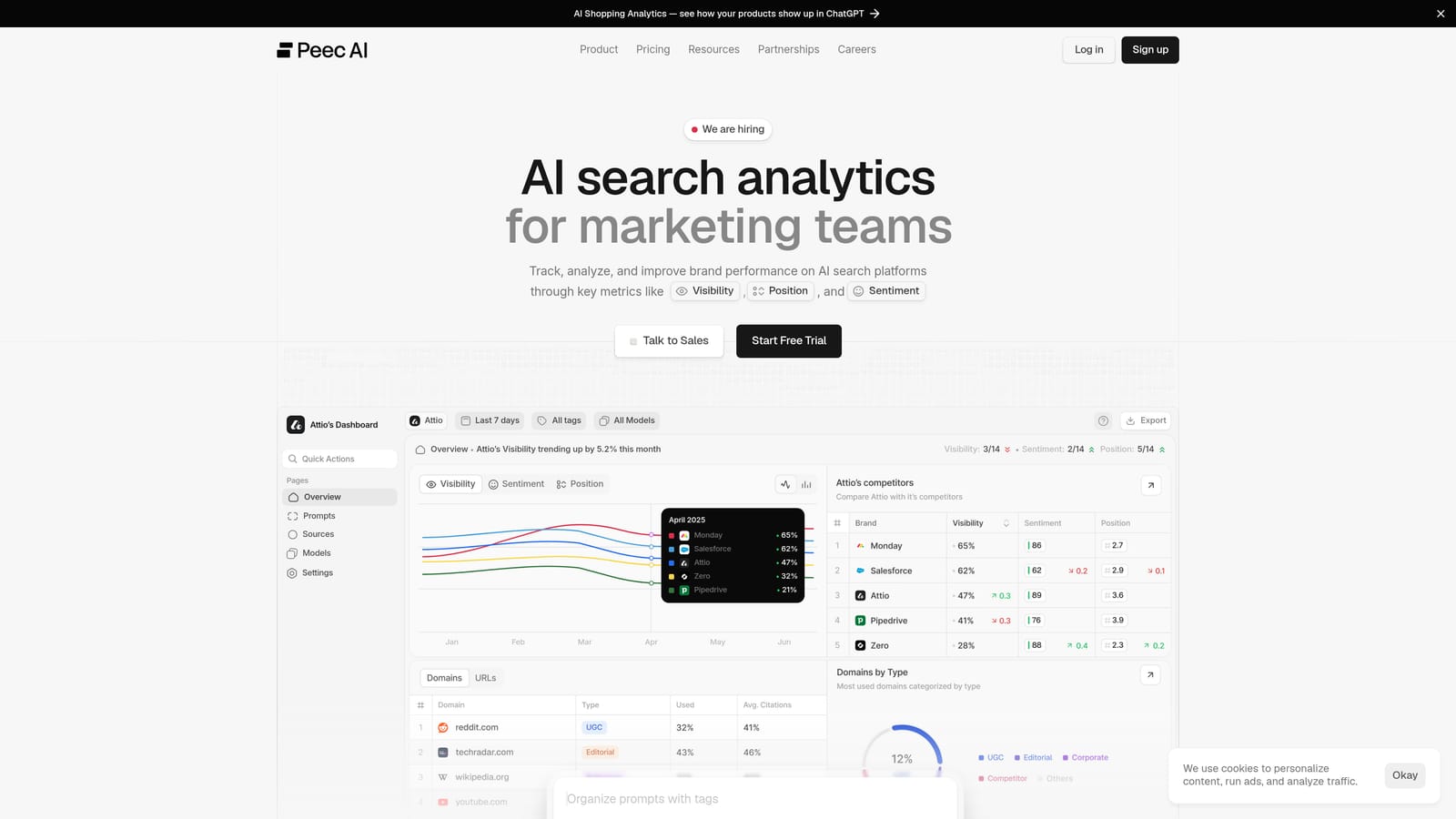
Peec is an AI search visibility monitoring tool that tracks brand and competitor mentions across AI interfaces and surfaces content opportunities where your brand is underrepresented.
Where This Tool Shines
Peec takes a monitoring-first approach to GEO. Its core function is tracking how often, and in what context, your brand appears in AI-generated answers, then benchmarking that against competitors to show where you're losing visibility. That competitive framing makes it practical for teams that want to understand relative AI search performance, not just absolute mention counts.
Like Profound, Peec is an intelligence tool rather than a content generator. Its value is in informing content decisions, specifically which topics, formats, and queries to target to improve AI answer presence. Teams typically pair a tool like Peec with a content generation platform to connect insight and execution.
Key Features
Brand Mention Tracking: Monitors how frequently and in what context your brand appears across AI search platforms.
Competitor AI Visibility Benchmarking: Compares your brand's AI answer presence against named competitors to surface relative performance gaps.
Content Opportunity Identification: Highlights queries and topic areas where AI models mention competitors but not your brand.
Keyword and Prompt-Level Monitoring: Tracks performance at the individual prompt level, giving granular data on which queries drive AI mentions.
SEO and GEO Reporting: Consolidated reporting across traditional SEO signals and GEO performance metrics for unified team visibility.
Best For
Peec suits SEO managers, content strategists, and agency teams that want clear competitive intelligence on AI search visibility. It's especially useful when competitive benchmarking is a priority alongside content gap identification.
Pricing
Visit peec.ai for current pricing tiers. Plans may vary based on the number of brands tracked and monitoring frequency.
6. Promptwatch
Best for: Technical SEOs and brand managers who need granular, prompt-level AI citation tracking.
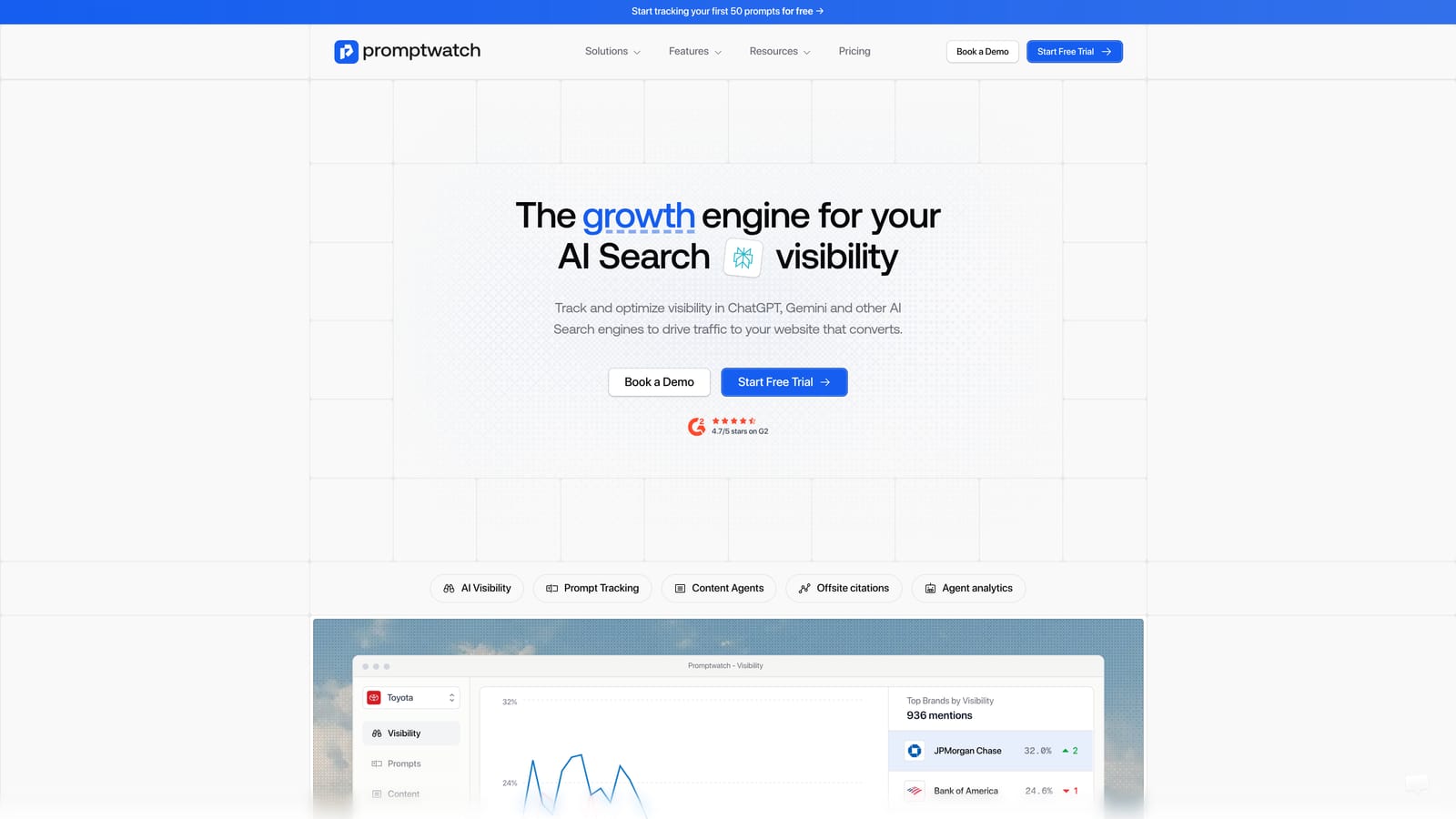
Promptwatch is a prompt-level monitoring tool that tracks how specific queries return brand mentions across AI models, helping technical SEOs understand which content drives AI citations.
Where This Tool Shines
Other monitoring tools give you brand-level visibility data. Promptwatch goes deeper. It tracks individual prompts and queries to show exactly which inputs produce brand mentions across AI platforms, and which don't. That granularity is especially valuable for technical SEOs who want to understand how specific content topics relate to AI citation behavior.
Promptwatch is the most technical tool on this list. It isn't a content generator, and it doesn't produce strategy recommendations the way Profound does. What it offers is raw, detailed data on AI model response patterns, which supports content decisions at a level of precision that higher-level tools don't reach.
Key Features
Prompt-Level Tracking: Monitors how specific queries and prompts produce brand mentions across multiple AI models at once.
Brand Mention Frequency and Context Analysis: Captures not just whether your brand is mentioned, but how it's framed in AI-generated responses.
Query Library Management: Organize and maintain a library of tracked prompts for ongoing, systematic AI visibility monitoring.
Alerts for AI Response Changes: Notifies you when AI model responses about your brand shift, so you can catch changes in AI perception quickly.
Data Export for Content Strategy: Exports monitoring data into formats usable for content planning and SEO workflows.
Best For
Promptwatch is best suited to technical SEOs, brand managers, and growth teams who want detailed, prompt-level data on AI citation behavior. It's a specialist tool and is most valuable when paired with a content generation platform that can act on its insights.
Pricing
Visit promptwatch.io for current pricing. Plans likely vary based on query volume and the number of AI models monitored.
Which Tool Is Right for Your SEO Stack?
The tools above serve different parts of the same workflow. The most effective SEO and GEO programs in 2026 don't rely on a single platform. They combine content generation with AI visibility monitoring in a continuous loop:
- Find where you're missing from AI answers.
- Create content to fill those gaps.
- Publish and index it fast.
- Track whether your AI presence improves.
Here's a quick guide by use case:
Solo founders and small teams: Sight AI is the strongest starting point. It covers content generation, AI visibility tracking, and automated indexing in one platform, so you aren't managing three separate tools or manually connecting insights to execution.
Agencies running high-volume content programs: AirOps gives you the workflow automation and process control needed to produce consistent content across multiple clients. Pair it with Sight AI or one of the monitoring tools to track AI visibility.
Enterprise marketing teams: Profound offers the structured GEO analytics and reporting depth that enterprise organizations typically need. For teams that want content generation and monitoring under one roof, Sight AI's all-in-one approach is also worth evaluating at the enterprise level.
Technical SEOs who want granular AI data: Promptwatch and Peec both provide prompt-level and competitive monitoring data that informs precise content decisions. They work best as intelligence layers feeding a broader content operation. For a deeper comparison of monitoring platforms, see our guide to AI visibility software tools.
Frequently asked questions
What is the best AI content generator for improving search rankings?
No generator improves rankings on its own. Rankings come from useful, accurate, well-structured pages that match search intent and get indexed. Tools that start from real keyword and SERP data, enforce structure, and support human editing perform best. Sight AI and Writesonic both generate keyword-targeted articles. Sight AI also handles indexing and tracks AI visibility, so you can see whether the content actually earns citations.
What is the difference between a generative AI SEO tool and a GEO tool?
Generative AI SEO tools produce content, such as articles, briefs, meta tags and outlines, aimed mainly at ranking in search engines. GEO tools measure and improve how AI answer engines like ChatGPT, Perplexity and Google AI Mode mention and cite your brand. Most teams need both: monitoring shows the gaps, and generation fills them. The comparison table above shows which tools on this list do each.
Which tools help agencies produce AI-optimized content at scale for multiple clients?
AirOps is built for templated, multi-client pipelines with shared workflows and data integrations. Sight AI combines specialized writing agents, Autopilot publishing and per-brand AI visibility tracking, so agencies can produce content and report AI presence from one platform. Whichever you choose, keep a human review step for each client. Unreviewed bulk output risks quality and brand-accuracy problems.
What GEO tools integrate with a CMS to read and publish content?
Among the tools here, Sight AI publishes directly to your CMS, updates sitemaps automatically and submits new URLs through IndexNow. AirOps can push content into publishing systems through its API and integrations. Monitoring-only tools like Profound, Peec and Promptwatch don't write to your CMS. They export data you then act on in a separate content tool.
What tools generate continuous content opportunity feeds from shifting search trends?
Look for tools that refresh keyword, SERP and AI-prompt data regularly and turn changes into prioritized topics. GEO monitors such as Peec and Profound flag prompts where competitors are cited and you aren't. Sight AI pairs AI visibility tracking with content opportunity suggestions and can generate drafts from them, which turns the feed into published pages rather than a backlog.
If you're just getting started with GEO-aware content strategy and want one platform that handles the full cycle, Sight AI is the natural place to begin. Start tracking your AI visibility today to see exactly where your brand appears across top AI platforms, then use that data to build the content strategy that closes the gaps.