Brand monitoring has evolved far beyond Google Alerts and social listening dashboards. In 2026, the real question isn't just "who's talking about your brand online?" It's "what are AI models telling people about your brand when they ask?"
Marketers, founders, and agencies now need visibility across two distinct worlds: traditional web and social channels, and the growing universe of AI-generated answers from ChatGPT, Claude, Perplexity, and Gemini. These AI responses are shaping purchasing decisions, vendor comparisons, and brand perception in ways that standard monitoring tools simply weren't built to track.
This guide covers the best brand monitoring platforms available in 2026, with honest pricing breakdowns for each. Sight AI leads the list as the only platform here built specifically for AI visibility monitoring alongside SEO content generation. The remaining tools each serve distinct use cases, from enterprise AI analytics to workflow automation to broad content creation.
A quick note on pricing: several platforms on this list don't publish fixed rates publicly, and pricing changes frequently. Where live figures weren't confirmable, we've described tiers qualitatively rather than invent numbers. Always verify current pricing directly with each vendor before making a decision.
1. Sight AI
Best for: Marketers and agencies that need AI visibility monitoring and SEO content generation in one platform
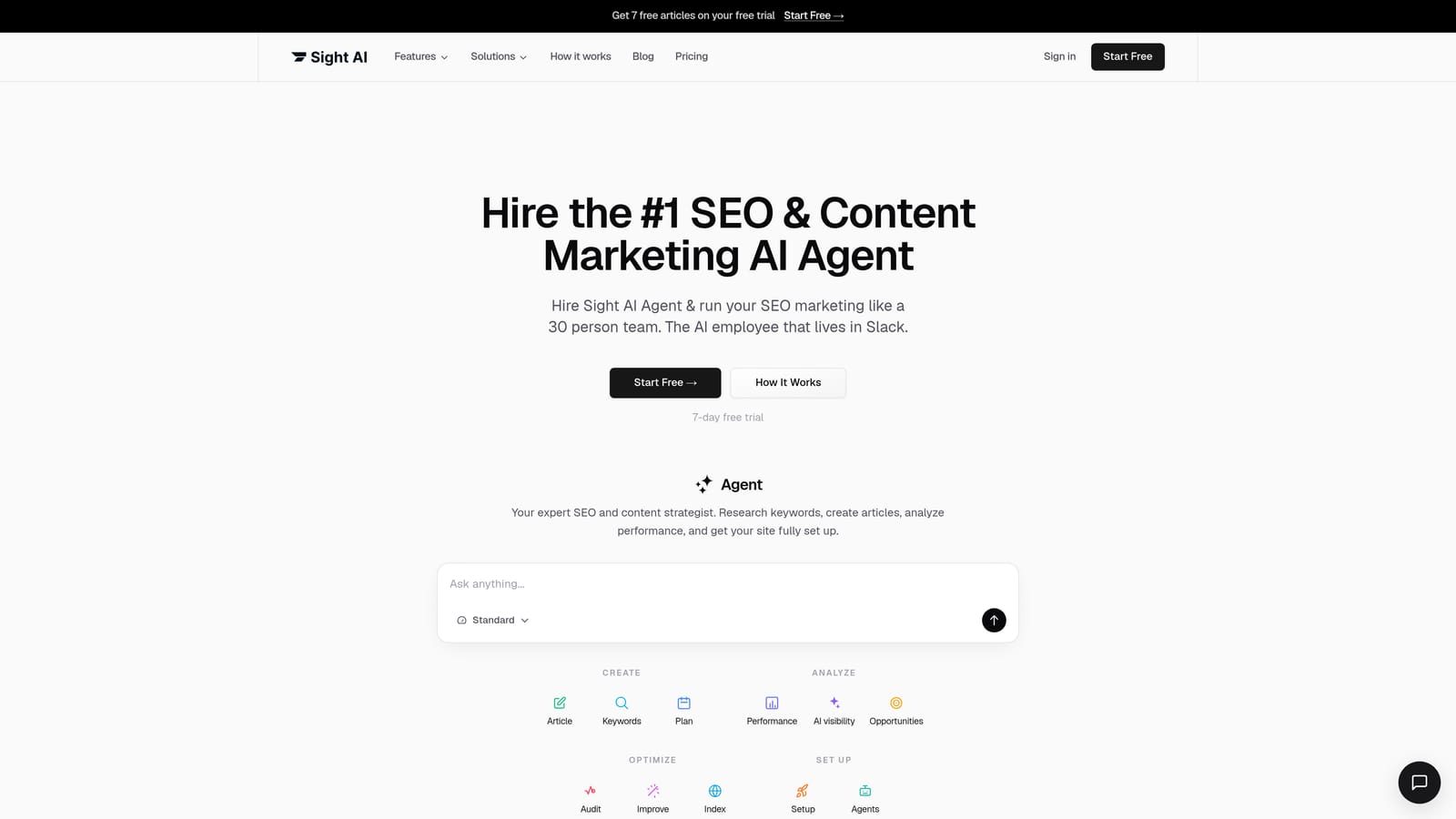
Sight AI is an all-in-one AI visibility and content platform that tracks how your brand appears across 6+ major AI models and generates the SEO and GEO-optimized content needed to improve that presence.
Where This Tool Shines
Most brand monitoring tools tell you what's happening on the web. Sight AI tells you what's happening inside AI. Its AI Visibility Score gives you a consolidated view of how your brand is being mentioned, framed, and recommended across ChatGPT, Claude, Perplexity, Gemini, and other leading models, complete with sentiment analysis so you know whether those mentions are positive, neutral, or problematic.
What separates Sight AI from every other platform on this list is the closed loop between monitoring and action. When you discover that competitors are getting mentioned in AI responses where your brand isn't, you can immediately deploy Sight AI's 13+ specialized content agents to produce the listicles, guides, and explainers most likely to close that gap. The platform then handles indexing and publishing automatically, so the path from insight to ranked content is shorter than on any comparable tool.
Key Features
AI Visibility Score: A consolidated metric tracking your brand's presence and sentiment across 6+ AI platforms, updated regularly so you can spot trends over time.
Prompt Tracking: See exactly which user queries in AI models are surfacing your brand, and which ones are surfacing competitors instead.
13+ Specialized AI Content Agents: Purpose-built agents for listicles, how-to guides, explainers, and more, with an Autopilot Mode that handles content production at scale.
IndexNow Integration: Automated sitemap updates and IndexNow submission ensure newly published content gets discovered by search engines faster.
CMS Auto-Publishing: Connect your CMS and publish AI-generated content directly without manual copy-paste workflows.
Best For
Sight AI is the strongest fit for growth-focused marketers, SaaS founders tracking early brand traction, and agencies managing multiple client brands who need both AI visibility data and the content infrastructure to act on it. If you want a single platform rather than stitching together a monitoring tool, a content tool, and an indexing tool separately, this is the most cohesive option available.
Pricing
Sight AI offers tiered plans suited to individual founders, marketing teams, and agencies. Verify current pricing at trysight.ai, as plans are updated regularly. A trial is available to evaluate the platform before committing.
2. Promptwatch
Best for: Teams that want focused, prompt-level brand tracking inside LLMs
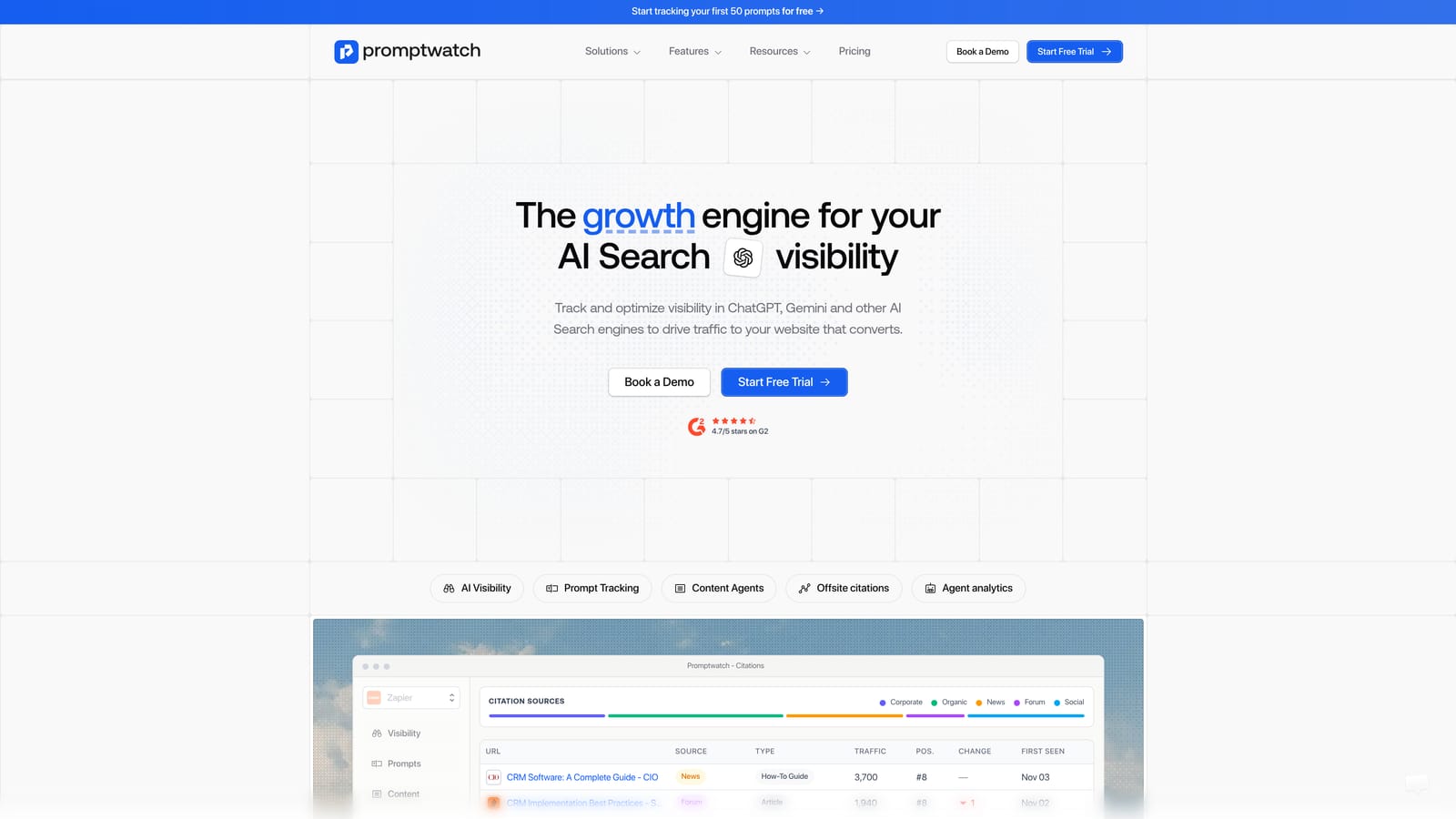
Promptwatch is a dedicated AI monitoring tool that tracks brand mentions at the prompt level, showing which specific user queries inside large language models trigger your brand to appear in responses.
Where This Tool Shines
Promptwatch takes a granular approach to AI monitoring. Rather than giving you a broad visibility score, it focuses on the prompt layer: which questions, when typed into an LLM, cause your brand to be mentioned? This level of specificity is genuinely useful for understanding how your brand is being surfaced in AI conversations and where gaps exist.
For teams whose primary concern is understanding the "why" behind their AI visibility, Promptwatch's prompt-level data provides a useful diagnostic lens. It's a narrower tool than Sight AI, with monitoring as its core function rather than a combined monitoring-and-content workflow.
Key Features
Prompt-Level Brand Tracking: Identifies the specific user queries that cause your brand to appear in LLM-generated responses.
Multi-Platform Monitoring: Tracks brand presence across major AI platforms and models.
Visibility Trend Reporting: Shows how your brand's presence in AI responses changes over time.
Query Intelligence: Surfaces which AI queries are driving brand mentions, enabling more targeted content strategy decisions.
Best For
Promptwatch suits teams that are specifically focused on understanding their LLM presence at a granular level and don't yet need integrated content generation capabilities. It's a good starting point for founders and marketers beginning to explore AI visibility monitoring as a discipline.
Pricing
Verify current pricing at promptwatch.io. Pricing details were not publicly confirmed at time of writing, so contact the team directly for current plan options.
3. Profound
Best for: Enterprise teams that need deep analytics on brand positioning inside AI-generated answers
Profound is an enterprise-grade AI answer engine monitoring platform that provides detailed analytics on how brands appear within AI-generated responses across major platforms.
Where This Tool Shines
Profound is built with enterprise reporting depth in mind. It goes beyond simply flagging when a brand appears in an AI response, offering analytics around positioning, framing, and competitive context within those responses. For large marketing teams or enterprise brands where AI answer engine presence is a strategic priority, the reporting granularity is a genuine differentiator.
Team collaboration features and structured reporting make Profound a reasonable fit for organizations where multiple stakeholders need to track and act on AI visibility data. That said, like most enterprise tools, its strength is in analysis rather than in generating the content needed to improve that visibility.
Key Features
AI Answer Engine Monitoring: Tracks how and where your brand appears in AI-generated answers with detailed positioning analytics.
Multi-Platform Coverage: Monitors brand presence across major AI platforms and answer engines.
Enterprise Reporting: Structured reporting designed for team sharing and stakeholder presentations.
Competitive Benchmarking: Compares your brand's AI presence against named competitors within AI-generated content.
Best For
Profound is best suited to enterprise marketing teams and large agencies where AI visibility is a board-level concern and reporting depth matters more than content generation capabilities. Organizations that already have separate content workflows and need a dedicated analytics layer will find it a strong fit.
Pricing
Profound likely operates on custom enterprise pricing. Verify current plans and whether a trial is available at helloprofound.com. Budget accordingly for enterprise-level investment.
4. Peec
Best for: Brands focused on competitive AI share-of-voice and benchmarking
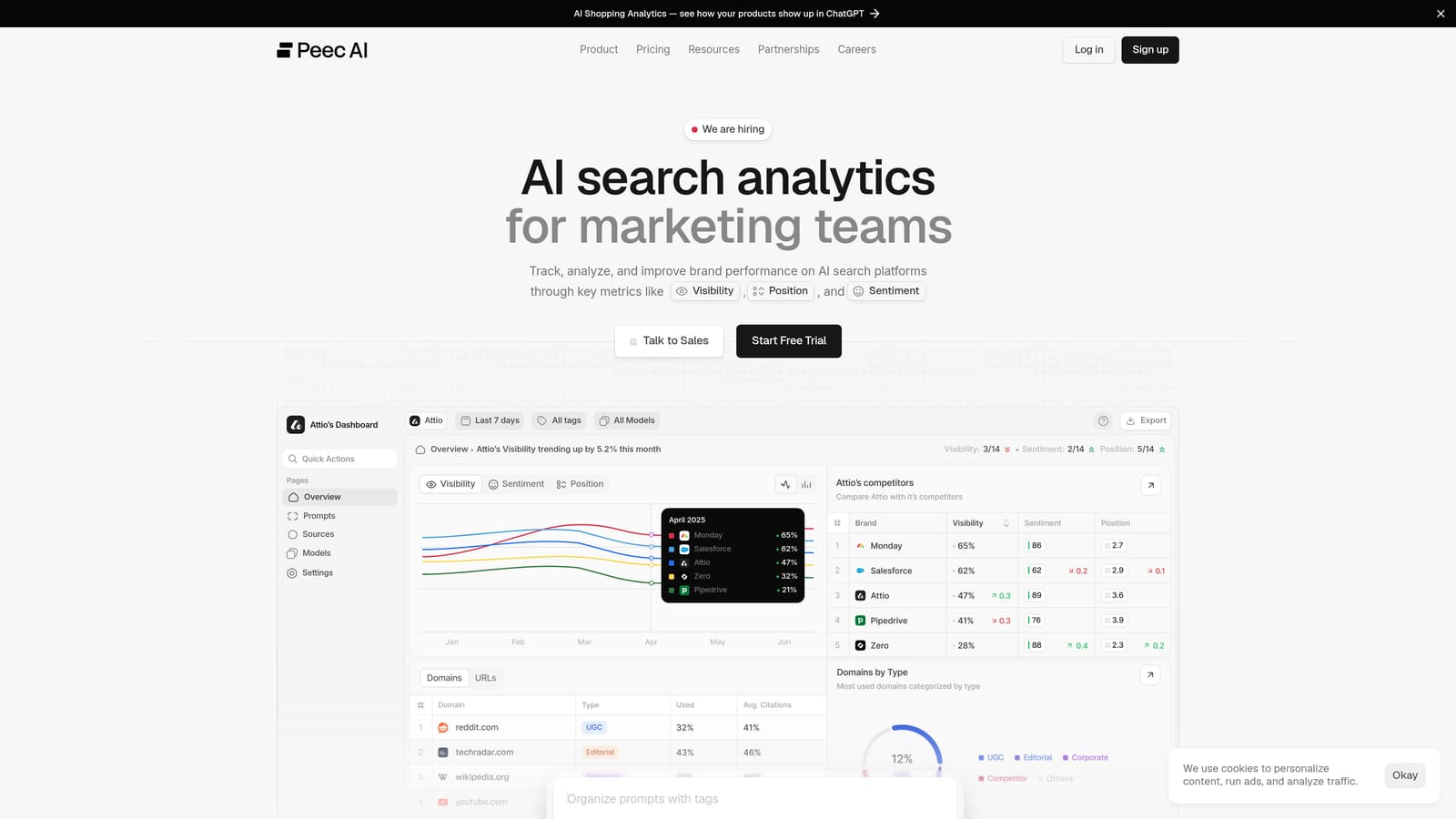
Peec is a competitive AI share-of-voice tool that benchmarks how frequently your brand appears in AI responses relative to named competitors across platforms.
Where This Tool Shines
Peec approaches AI monitoring through a competitive intelligence lens. The core question it answers isn't just "do I appear in AI responses?" but "how often do I appear compared to my competitors?" That framing makes it particularly useful for brands in crowded categories where AI recommendation frequency is a meaningful proxy for market positioning.
The competitive benchmarking dashboards give marketing teams a clear view of share-of-voice trends over time, which is useful for tracking whether content and SEO investments are moving the needle relative to the competitive set. It's a more specialized angle than broad brand monitoring, but a valuable one for competitive markets.
Key Features
AI Share-of-Voice Tracking: Measures how frequently your brand appears in AI responses compared to named competitors.
Competitive Intelligence Dashboards: Visual reporting on brand presence relative to the competitive set across AI platforms.
Multi-Platform Benchmarking: Tracks competitive positioning across different AI models and response types.
Trend Tracking: Shows how competitive share-of-voice shifts over time as content and SEO strategies evolve.
Best For
Peec is a strong fit for brands in competitive verticals where understanding AI recommendation frequency relative to rivals is a strategic priority. Marketing teams that already have content workflows in place and need a competitive intelligence layer will find it more useful than teams still building out their content operations.
Pricing
Verify current pricing at peec.ai. Pricing was not publicly confirmed at time of writing, so reach out directly for plan details and trial availability.
5. AirOps
Best for: Teams that need LLM-powered workflow automation for content and brand operations
AirOps is an LLM-powered workflow automation platform that enables teams to build custom AI pipelines for content generation, processing, and brand operations.
Where This Tool Shines
AirOps is fundamentally a workflow automation tool that happens to have strong content and brand operations capabilities. If your team needs to build custom AI-powered pipelines, such as pulling data from multiple sources, processing it through an LLM, and pushing outputs to publishing tools, AirOps provides the infrastructure to do that without heavy engineering involvement.
It's worth being clear about what AirOps is not: it's not a dedicated brand monitoring platform. Its brand content capabilities are a product of its broader automation flexibility rather than a purpose-built monitoring feature set. Teams looking specifically for AI visibility tracking will find it a less direct fit than Sight AI or Profound. For teams that need AI workflow automation as a primary use case, it's worth evaluating. You can also explore how AirOps compares to other tools in this space.
Key Features
LLM Workflow Automation: Build custom AI-powered pipelines for content generation, processing, and brand operations without engineering resources.
Data Source Integration: Connect to external data sources and feed structured inputs into AI workflows.
Publishing Tool Integration: Push workflow outputs directly to publishing platforms and CMS tools.
Team Collaboration: Shared workspaces for teams building and managing AI content pipelines collaboratively.
Best For
AirOps suits operations-focused teams that need flexible AI workflow automation and have the internal resources to configure custom pipelines. It's less suited to teams that want a ready-to-use brand monitoring solution and more suited to those comfortable building bespoke AI workflows.
Pricing
AirOps has offered tiered subscription plans. Verify current pricing at airops.com for up-to-date plan details and trial options.
6. Writesonic
Best for: Content teams that need high-volume AI writing with brand voice consistency
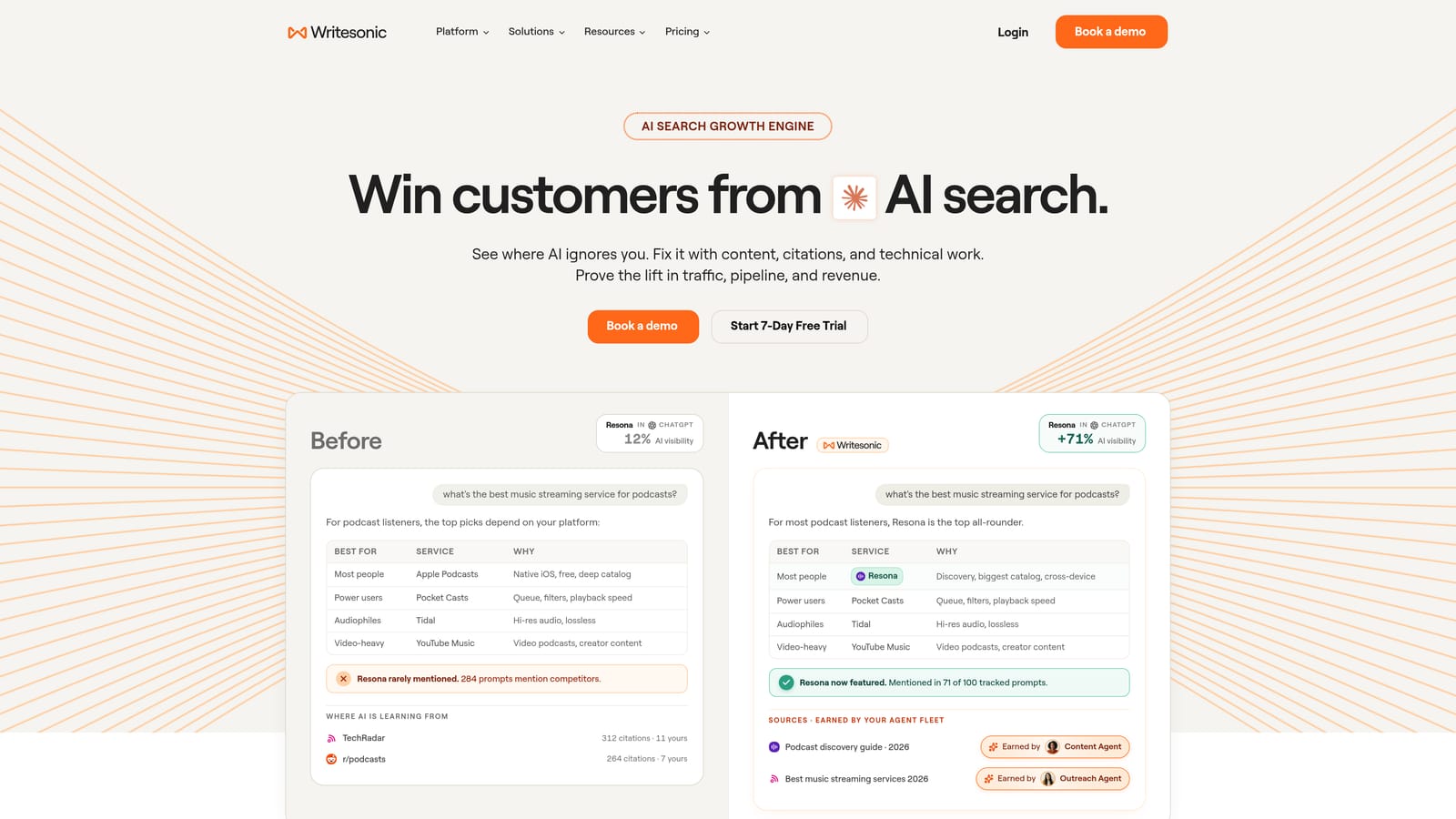
Writesonic is a broad AI writing platform with brand voice controls and content generation capabilities across multiple formats, with some brand monitoring features included.
Where This Tool Shines
Writesonic's primary strength is content volume and format variety. Teams that need to produce large amounts of written content across blog posts, ads, landing pages, and social copy will find its template library and AI writing tools genuinely capable. The brand voice customization features help maintain consistency across high-volume output, which is a real operational challenge for content teams.
However, it's important to set accurate expectations: Writesonic is a content generation tool first. Its brand monitoring capabilities are not its core focus, and teams specifically looking for AI visibility tracking will find it falls short compared to purpose-built monitoring platforms. For a detailed look at how it compares to alternatives, see Writesonic alternatives worth considering.
Key Features
Multi-Format AI Writing: Generates content across blog posts, ads, landing pages, product descriptions, and social copy.
Brand Voice Controls: Customizable brand voice settings that maintain consistency across high-volume content production.
SEO Writing Tools: Built-in SEO-focused templates and writing tools designed to improve content discoverability.
Team Workspaces: Collaborative workspaces for content teams working across multiple projects simultaneously.
Best For
Writesonic is best suited to content-heavy teams that need a capable AI writing assistant with brand voice guardrails. It's a reasonable choice for teams whose primary need is content production volume rather than AI visibility monitoring or competitive intelligence.
Pricing
Writesonic has historically offered a free tier alongside paid plans at various price points. Verify current pricing at writesonic.com, as plan structures and limits change regularly.
Choosing the Right Platform for Your Situation
The six platforms above serve meaningfully different needs, and the right choice depends on what kind of visibility you're actually trying to achieve.
For teams that need both AI visibility monitoring and the content infrastructure to act on what they find, Sight AI is the clearest choice. It's the only platform on this list that closes the loop between tracking AI mentions and generating the GEO-optimized content designed to improve them, all with automated indexing and publishing built in.
If your primary need is competitive intelligence, Peec's share-of-voice benchmarking gives you a focused view of how your brand stacks up against rivals in AI responses. If you're an enterprise team with deep reporting requirements, Profound's analytics depth is worth evaluating. For prompt-level granularity without the broader platform overhead, Promptwatch is a reasonable starting point.
AirOps and Writesonic are better understood as adjacent tools. AirOps excels at AI workflow automation, and Writesonic at high-volume content production. Neither was built primarily for brand monitoring, and teams with that as their core need should look elsewhere.
One thing is clear across all of these categories: AI search monitoring is no longer optional. Brands that aren't tracking their presence in LLM-generated responses are making strategic decisions without a meaningful piece of the picture. Consumers and B2B buyers increasingly discover, compare, and evaluate brands through AI-generated answers, and that channel is only growing.
If you're ready to stop guessing how AI models like ChatGPT and Claude talk about your brand, start tracking your AI visibility today and see exactly where your brand appears across the top AI platforms, alongside the tools to improve that presence.