Brand monitoring has evolved far beyond setting up a few Google Alerts and calling it done. In 2026, your brand exists across traditional search results, social platforms, review sites, and increasingly inside AI-generated answers from ChatGPT, Claude, Perplexity, and other large language models. Marketers who only track one or two of these channels are missing a significant portion of how their brand is actually being perceived and discussed.
The challenge is that each channel requires a different monitoring approach, different tools, and different response strategies. Miss a critical mention on an AI platform, and you could be losing potential customers to competitors who are being recommended in your place without ever knowing it.
This guide covers eight actionable brand monitoring strategies designed for marketers, founders, and agencies who want a complete picture of their brand's presence. From tracking AI-generated recommendations to monitoring organic search signals, each strategy addresses a distinct gap that most monitoring setups leave wide open.
Whether you're building your brand monitoring framework from scratch or looking to plug specific holes in your current process, these strategies will help you move from reactive damage control to proactive brand intelligence. Let's get into what actually works.
1. Monitor How AI Models Describe and Recommend Your Brand
The Challenge It Solves
AI answer engines have become a primary research tool for buyers comparing software, services, and vendors. When a potential customer asks ChatGPT or Perplexity to recommend a tool in your category, the answer they receive can directly influence their decision. If your brand is absent from that answer, misrepresented, or described less favorably than a competitor, you're losing ground in a channel that doesn't show up in your standard analytics.
The Strategy Explained
AI visibility monitoring means systematically querying the major language models with prompts your target audience would realistically use, then analyzing how your brand appears in the responses. This includes whether you're mentioned at all, how your brand is described, what sentiment comes through, and how you're positioned relative to competitors.
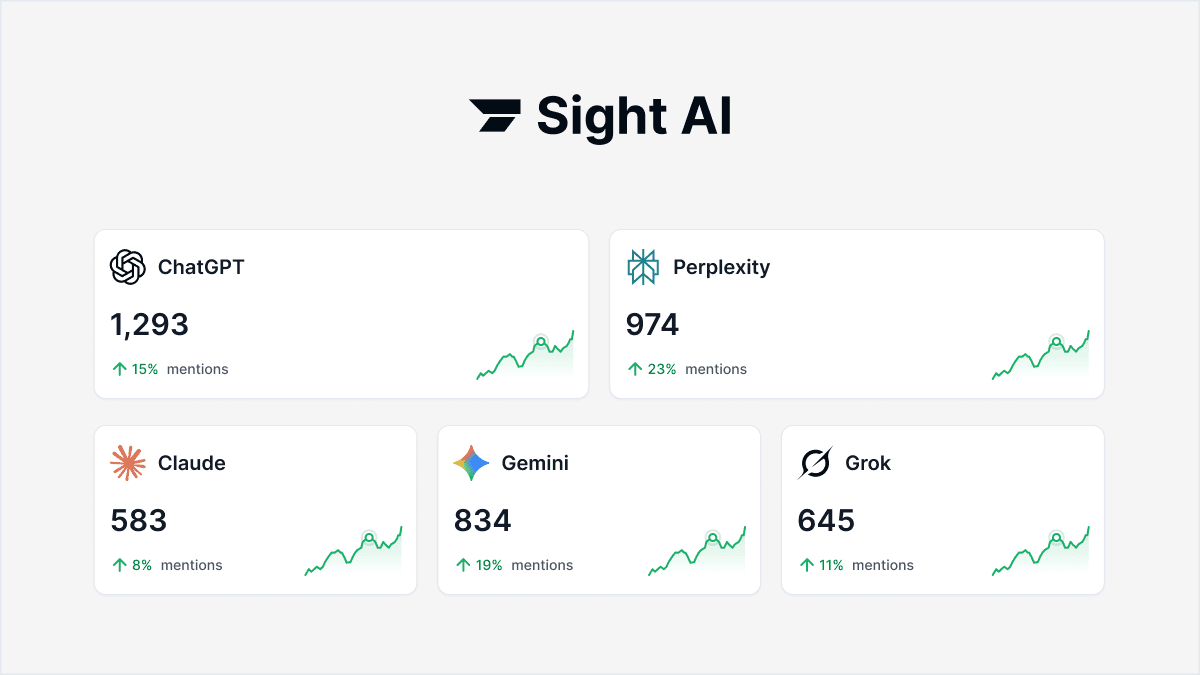
The goal is to build a consistent picture over time. A single query tells you very little. A structured set of prompts run regularly across multiple AI platforms gives you a genuine signal about your brand's presence in AI-generated answers. Tools like Sight AI are built specifically for this, tracking brand mentions across six or more AI platforms with sentiment analysis and competitive positioning data.
Implementation Steps
1. Build a prompt library covering your core use cases: "What's the best [tool category] for [specific use case]?" and "Compare [your brand] vs [competitor]" are good starting points.
2. Run these prompts across ChatGPT, Claude, Perplexity, and Gemini on a consistent schedule, at minimum weekly.
3. Log whether your brand appears, what it says, and how it compares to competitors in each response.
4. Track changes over time to identify whether your content and GEO efforts are improving your AI presence.
Pro Tips
Don't just track your brand name. Track your product names, key features, and the specific problems you solve. AI models often recommend solutions by use case rather than brand name, so prompt coverage needs to reflect how buyers actually search for solutions in your category.
2. Build a Keyword-Driven Mention Tracking System Across the Web
The Challenge It Solves
Web mentions of your brand happen constantly across news sites, industry blogs, comparison pages, and niche publications. Without a structured system, you're relying on stumbling across these mentions by accident. High-authority mentions that could support link building go unnoticed. Negative coverage on influential sites goes unaddressed. You lose the opportunity to respond, amplify, or learn from what others are saying about you.
The Strategy Explained
A keyword-driven mention tracking system captures brand references across the open web by monitoring variations of your brand name, product names, key personnel, and even your core value propositions. The key word here is "layered." Your brand name alone won't catch everything. Misspellings, abbreviations, and informal references all need to be part of your tracking setup.
Once mentions are captured, prioritize by source authority. A mention on a high-domain-authority publication is worth more attention than a low-traffic blog post. High-authority mentions deserve a response strategy: reach out for a link if one isn't present, engage with the author, or use the coverage to amplify your own content.
Implementation Steps
1. Create a complete list of brand mention variations: official name, common abbreviations, product names, founder names, and any branded terms specific to your company.
2. Set up monitoring across tools like Google Alerts, Mention, or Ahrefs Alerts to capture new web mentions as they appear.
3. Build a triage workflow: categorize mentions by sentiment (positive, neutral, negative) and by source authority (high, medium, low).
4. Assign response owners for high-priority mentions so nothing sits unaddressed for more than 24 to 48 hours.
Pro Tips
Set up separate alerts for your competitors' brand names using the same system. This gives you a parallel stream of competitive intelligence without any additional setup cost. You'll start to see patterns in where competitors are being mentioned and covered, which directly feeds Strategy 3.
3. Track Competitor Mentions to Identify Content and Positioning Gaps
The Challenge It Solves
Most marketers monitor their own brand but treat competitor monitoring as optional. This is a missed opportunity. When a competitor is consistently mentioned or recommended in content your brand doesn't appear in, that's a content gap you can close. When a competitor is being cited by AI models in response to queries relevant to your category, that tells you exactly what content signals those models are picking up on and what you need to create.
The Strategy Explained
Competitor mention tracking goes beyond knowing what your competitors are doing in their own marketing. It's about understanding where third parties are choosing to reference them: which publications, which review aggregators, which Reddit threads, which AI-generated answers. Each of these represents a placement where your brand could and should appear.
The intelligence you gather here directly shapes your content roadmap. If a competitor is consistently mentioned in "best tools for X" roundups on high-authority sites and you're not, that's a clear outreach and content opportunity. If a competitor appears in AI answers for a specific use case query and you don't, that tells you what content to create to close the gap.
Implementation Steps
1. Identify your top three to five competitors and set up web mention tracking for each using the same system you built in Strategy 2.
2. Run your AI prompt library (from Strategy 1) and log which competitors appear in answers where your brand is absent.
3. Audit the content assets that are driving competitor mentions: what pages, articles, or resources are being cited most often?
4. Build a content gap list based on your findings and prioritize topics where competitor presence is high and yours is low.
Pro Tips
Pay particular attention to comparison content. Pages that compare your competitor to other tools in the market are often highly visible in both search and AI answers. If those pages don't mention you as an alternative, that's a gap worth addressing directly through content creation or outreach.
4. Use Organic Search Data as a Brand Health Signal
The Challenge It Solves
Organic search data is often treated purely as a traffic and ranking metric. But branded search volume trends and SERP feature presence carry a different kind of signal: they reflect brand awareness, audience intent, and reputation health in near real-time. Sudden drops in branded search volume, changes in the People Also Ask questions associated with your brand, or the appearance of negative review snippets in your branded SERP are all early warning signals that most marketers miss because they're not looking for them.
The Strategy Explained
Treat your branded keywords as a monitoring layer, not just a traffic source. Set up regular tracking of branded search volume trends in Google Search Console and your preferred SEO tool. Monitor the SERP features that appear for your brand name: knowledge panel accuracy, review snippets, news results, and People Also Ask boxes all tell you something about how search engines are interpreting your brand.
Connecting organic search patterns to external events gives you a feedback loop. If a PR mention, product launch, or controversy drives a spike or dip in branded search volume, you can correlate the two and understand the actual impact of those events on brand awareness.
Implementation Steps
1. Set up a branded keyword group in Google Search Console and your SEO platform to track impressions, clicks, and position trends over time.
2. Do a weekly SERP audit for your primary brand name: screenshot the features present, note any changes to review snippets, knowledge panel information, or news results.
3. Set up alerts for any new content appearing in the top ten results for your brand name so you can respond quickly to new coverage, whether positive or negative.
4. Create a simple correlation log connecting external events to branded search volume changes to build a clearer picture of what drives brand interest.
Pro Tips
People Also Ask boxes on your branded SERP are particularly valuable. The questions surfaced there reflect what your audience is actually uncertain or curious about. They're also often the exact prompts that users bring to AI answer engines, creating a direct connection between your organic search monitoring and your AI visibility strategy.
5. Monitor Review Platforms and Community Discussions Systematically
The Challenge It Solves
Review platforms like G2, Capterra, and Trustpilot are not just reputation management concerns. They're actively cited by AI models when answering software recommendation queries, which means the sentiment and content of your reviews has a direct line to your AI visibility. Community platforms like Reddit have also gained significant search visibility and are indexed by AI training datasets, making them relevant far beyond traditional social listening.
The Strategy Explained
Systematic review and community monitoring means establishing a regular cadence for checking these platforms rather than responding only when you happen to notice something. It also means treating the content of reviews and discussions as intelligence, not just reputation risk. Negative reviews often surface product friction points before they show up in churn data. Community discussions reveal the language your audience uses to describe their problems, which is invaluable for content and positioning.
The connection to AI visibility is worth emphasizing. When an AI model is asked to recommend software in your category, it frequently draws on review platform data and community discussions as part of its response. A strong, well-reviewed presence on G2 or a positive thread on a relevant subreddit can influence how AI models describe your brand.
Implementation Steps
1. Claim and fully optimize your profiles on the review platforms most relevant to your category: G2, Capterra, Trustpilot, and any industry-specific review sites.
2. Set up keyword monitoring for your brand name on Reddit and niche community forums relevant to your industry.
3. Establish a response protocol for reviews: respond to all negative reviews within 48 hours with a constructive, non-defensive reply.
4. Create a monthly review analysis process: categorize feedback themes, identify recurring friction points, and route product insights to the appropriate team.
Pro Tips
Don't just respond to negative reviews. Engage with positive ones too, and use them as content material. The specific language customers use to describe what they love about your product is often more persuasive than anything your marketing team would write, and it signals to AI models the specific use cases your product excels at.
6. Publish GEO-Optimized Content That Shapes How AI Talks About You
The Challenge It Solves
Monitoring tells you what's happening. Content creation determines what will happen next. If AI models are describing your brand inaccurately, recommending competitors in your place, or simply not mentioning you in relevant queries, the root cause is almost always a content gap. AI models synthesize answers from the content available to them, which means your content directly shapes the answers they produce.
The Strategy Explained
Generative Engine Optimization, or GEO, is the practice of creating content structured to appear in AI-generated answers. This is distinct from traditional SEO, though the two overlap significantly. GEO-optimized content tends to be authoritative, clearly structured, directly answers specific questions, and covers topics comprehensively rather than superficially.
The content types that perform particularly well in AI answers include comparison pages that clearly position your brand against alternatives, use-case articles that explain exactly what problems your product solves and for whom, and definitive guides on topics central to your category. These formats give AI models the kind of clear, citable information they need to include your brand in relevant responses.
Sight AI's content generation platform includes 13 specialized AI agents designed to produce SEO and GEO-optimized articles across these formats, with Autopilot Mode for teams that need to scale content production without scaling headcount.
Implementation Steps
1. Use your AI visibility monitoring data (from Strategy 1) to identify the specific queries where competitors appear and you don't, then build a content plan to address each gap.
2. Create comparison pages for your top three to five competitors that clearly explain how your product differs and who each option is best suited for.
3. Develop use-case articles for each primary audience segment and problem your product solves, using the language your audience actually uses.
4. Publish authoritative guides on the core topics in your category that position your brand as a credible, knowledgeable source.
Pro Tips
Structure matters as much as content for GEO. Use clear headings, direct answers to questions early in each section, and include specific details like feature names, pricing context, and use-case specifics. Vague, general content rarely gets cited by AI models. Precise, specific content does.
7. Automate Content Indexing to Ensure New Brand Content Gets Discovered Fast
The Challenge It Solves
Publishing great content is only half the equation. If search engines and AI platforms don't discover and index that content quickly, it can sit unread for days or weeks while the window of relevance passes. For brand monitoring purposes, this matters because your latest messaging, product updates, and positioning content needs to influence search and AI answers as soon as possible after publication, not weeks later.
The Strategy Explained
IndexNow is a real, verifiable protocol supported by Microsoft Bing, Yandex, and other search engines that allows publishers to notify search engines of new or updated content immediately upon publication. Rather than waiting for a search engine crawler to discover your content on its own schedule, IndexNow pushes a notification that new content is available, prompting faster crawling and indexing.
Google's documentation confirms that crawl frequency varies by site authority and update frequency, meaning newer or lower-authority sites can experience significant delays between publication and indexing. Proactive indexing signals help close that gap. Sight AI's website indexing tools include IndexNow integration and automated sitemap updates, so every new article you publish is pushed to search engines immediately without manual intervention.
Implementation Steps
1. Implement IndexNow on your website to enable immediate notification to supported search engines when new content is published or updated.
2. Set up automated sitemap updates so your sitemap always reflects your current content inventory without requiring manual updates.
3. Connect your CMS to your indexing workflow so publication triggers the indexing process automatically, removing the manual step entirely.
4. Monitor indexing speed in Google Search Console by checking the Coverage report regularly to identify any content that isn't being indexed promptly.
Pro Tips
Prioritize indexing for time-sensitive content: product announcements, comparison pages updated to reflect new features, and responses to competitive developments. The faster this content is indexed, the faster it can begin influencing both search rankings and the content pool that AI models draw from when generating answers.
8. Build a Brand Monitoring Dashboard That Connects All Your Signals
The Challenge It Solves
Running seven separate monitoring processes across different tools creates a fragmentation problem. Insights stay siloed. Patterns that span multiple channels go unnoticed because no one is looking at the full picture at once. Without a unified view, brand monitoring becomes a collection of disconnected tasks rather than an intelligence system that actually informs decisions.
The Strategy Explained
A brand monitoring dashboard brings together AI visibility data, web mention tracking, organic search signals, and review platform monitoring into a single view with a regular review cadence. The goal isn't to replace the individual tools but to create a layer above them where patterns become visible and priorities become clear.
The dashboard also needs an escalation process: a defined threshold for what constitutes a high-priority alert that requires immediate action versus a routine signal that gets reviewed weekly. Without this, everything feels equally urgent, and nothing gets the focused attention it deserves.
Platforms like Sight AI are designed to bring these monitoring layers together, combining AI visibility tracking, content performance data, and indexing status in one place so your monitoring insights directly feed your content response strategy.
Implementation Steps
1. Define the core metrics you'll track across each monitoring channel: AI mention frequency and sentiment, web mention volume by authority tier, branded search volume trend, review rating trends, and community discussion sentiment.
2. Build or configure a dashboard that pulls these signals into a single view, updated at least weekly if not in real time.
3. Establish a weekly review meeting or solo review session where you assess the dashboard, identify emerging patterns, and adjust your content and response priorities accordingly.
4. Define your escalation criteria: what triggers an immediate response versus a scheduled review, and who owns each type of alert.
Pro Tips
Include a "trend" view alongside your current-state metrics. Knowing your AI mention frequency today is useful. Knowing whether it's been trending up or down over the past 90 days is far more actionable. The trend tells you whether your content and monitoring efforts are working, which is ultimately what you need to know to make smarter decisions.
Putting It All Together
Brand monitoring in 2026 is not a single-tool problem. It's a multi-channel discipline that requires deliberate strategy across traditional search, social, review platforms, and the increasingly influential world of AI-generated answers. The eight strategies outlined here work best when implemented together, not in isolation.
Start by auditing where your current monitoring has gaps. If you're not tracking how AI models describe your brand, that's the highest-priority blind spot to address first. AI answer engines are now directly influencing purchase decisions in ways that don't always show up in your analytics, and the brands appearing consistently in those answers are capturing consideration that never registers as a click or session in your data.
From there, layer in competitor mention tracking, organic search signals, and review platform monitoring to build a complete picture. Each layer adds context that makes the others more meaningful. A drop in branded search volume means more when you can correlate it with a surge in competitor mentions or a shift in how AI models are describing your category.
The final step is ensuring your content strategy actively shapes what gets monitored. Publishing GEO-optimized content that positions your brand correctly, and using automated indexing to make sure that content gets discovered quickly, closes the loop between monitoring and action.
Tools like Sight AI bring these pieces together by combining AI visibility tracking, content generation, and automated indexing in one platform, so your monitoring insights directly feed your content response. The goal is to move from reactive brand management to a proactive intelligence system that keeps your brand accurately represented everywhere your audience is looking.
Start tracking your AI visibility today and see exactly where your brand appears across top AI platforms, uncover the content opportunities your competitors are capitalizing on, and automate your path to organic traffic growth.