AI assistants like ChatGPT, Claude, and Perplexity have quietly become primary discovery channels for buyers and decision-makers. When someone asks an AI model to recommend a project management tool, a marketing agency, or a SaaS platform, the brands that appear in those responses win the consideration. The brands that don't? They might as well be invisible.
LLM monitoring software exists to answer the question every marketer should be asking right now: "What does AI say about us?" But the category is still maturing rapidly, and tools vary widely in what they actually track, how actionable their data is, and whether they help you do anything about what they find.
This guide covers the top LLM monitoring tools available in 2026, evaluated on AI platform coverage, sentiment analysis quality, prompt tracking flexibility, and whether the platform helps you close the loop from insight to content action. If you're serious about growing organic and AI-driven traffic, these are the tools worth your attention.
1. Sight AI
Best for: Marketers and agencies who want to monitor AI visibility and act on it with optimized content
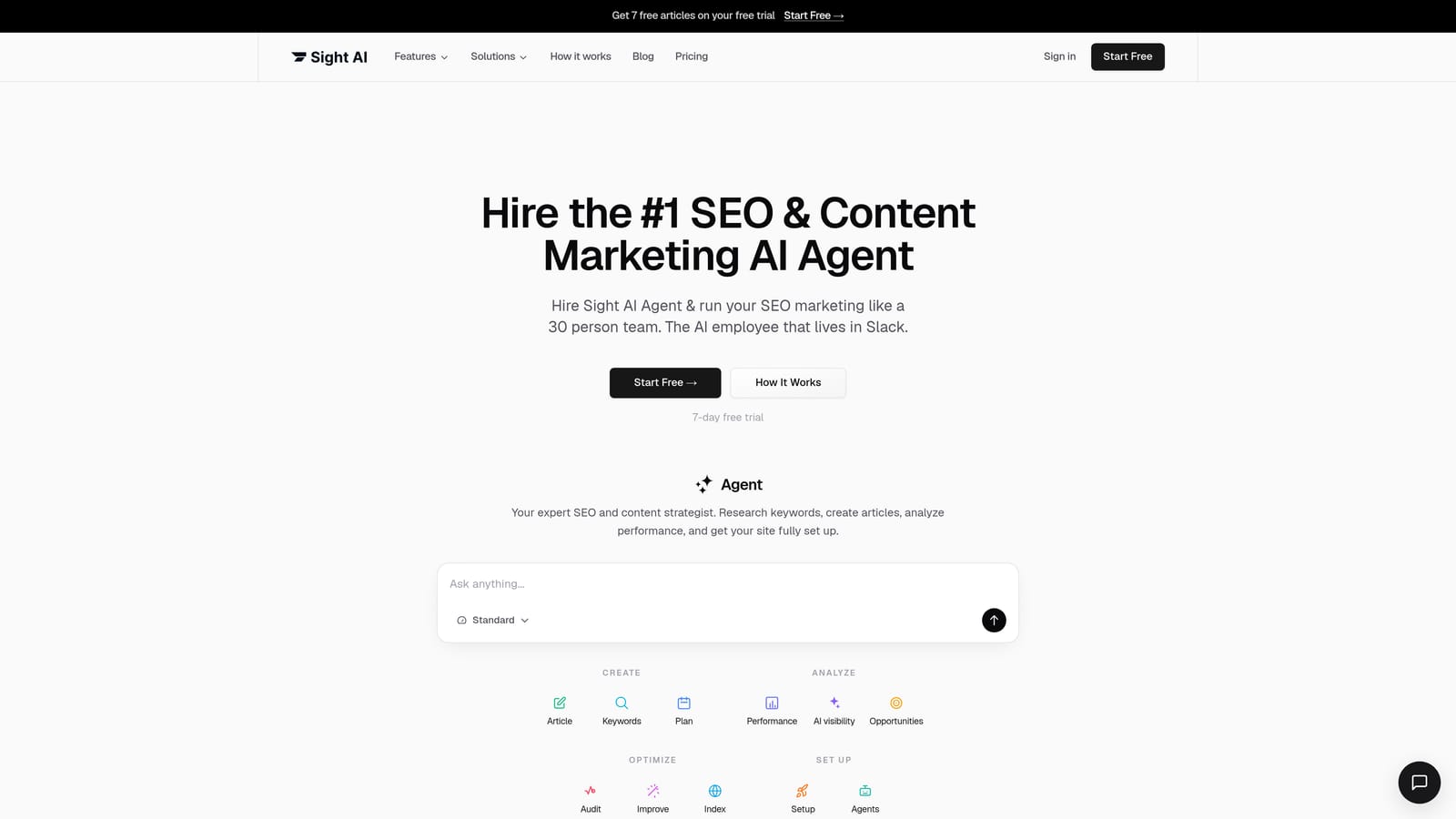
Sight AI is an all-in-one AI visibility platform that monitors brand mentions across 6+ AI models, generates SEO and GEO-optimized content to improve those mentions, and auto-indexes published content for faster discovery.
Where This Tool Shines
Most LLM monitoring tools stop at the data. They'll tell you that your brand appeared in 12% of relevant AI responses last month, and then leave you to figure out what to do next. Sight AI is built around the premise that data without action is just a dashboard. Its track-to-publish workflow connects what AI models say about your brand directly to a content creation and indexing pipeline designed to improve those mentions over time.
The AI Visibility Score gives you a single, trackable metric that aggregates sentiment and mention frequency across platforms. Pair that with prompt tracking, which shows you exactly which queries surface or miss your brand, and you have a genuinely actionable intelligence layer that most teams can start using immediately without a data analyst on call.
Key Features
AI Visibility Score: A unified metric tracking brand mention frequency and sentiment across ChatGPT, Claude, Perplexity, and more AI platforms.
Prompt Tracking: See exactly which queries surface your brand in AI responses and which relevant prompts are missing you entirely.
13+ Specialized AI Writing Agents: Purpose-built agents for generating listicles, guides, explainers, and other SEO/GEO-optimized content formats at scale.
Autopilot Mode: Automated content generation pipelines that keep your publishing cadence consistent without requiring manual intervention on every piece.
IndexNow Integration: Automated sitemap updates and IndexNow integration to push newly published content to search engines faster.
CMS Auto-Publishing: Direct publishing to your CMS, particularly useful for agencies managing multiple client sites from a single platform.
Best For
Sight AI is the right fit for growth-focused marketers, founders, and agencies who don't just want to know where they stand in AI search but want a system to improve it. If you're managing content operations at scale or running AI visibility strategies for multiple clients, the Autopilot Mode and CMS publishing features add real operational leverage.
Pricing
Sight AI offers tiered pricing for individuals, teams, and agencies. Verify current plans and trial options at trysight.ai, as plans are updated regularly.
2. Promptwatch
Best for: Developer and product teams tracking how specific prompts return brand or keyword mentions in LLM outputs
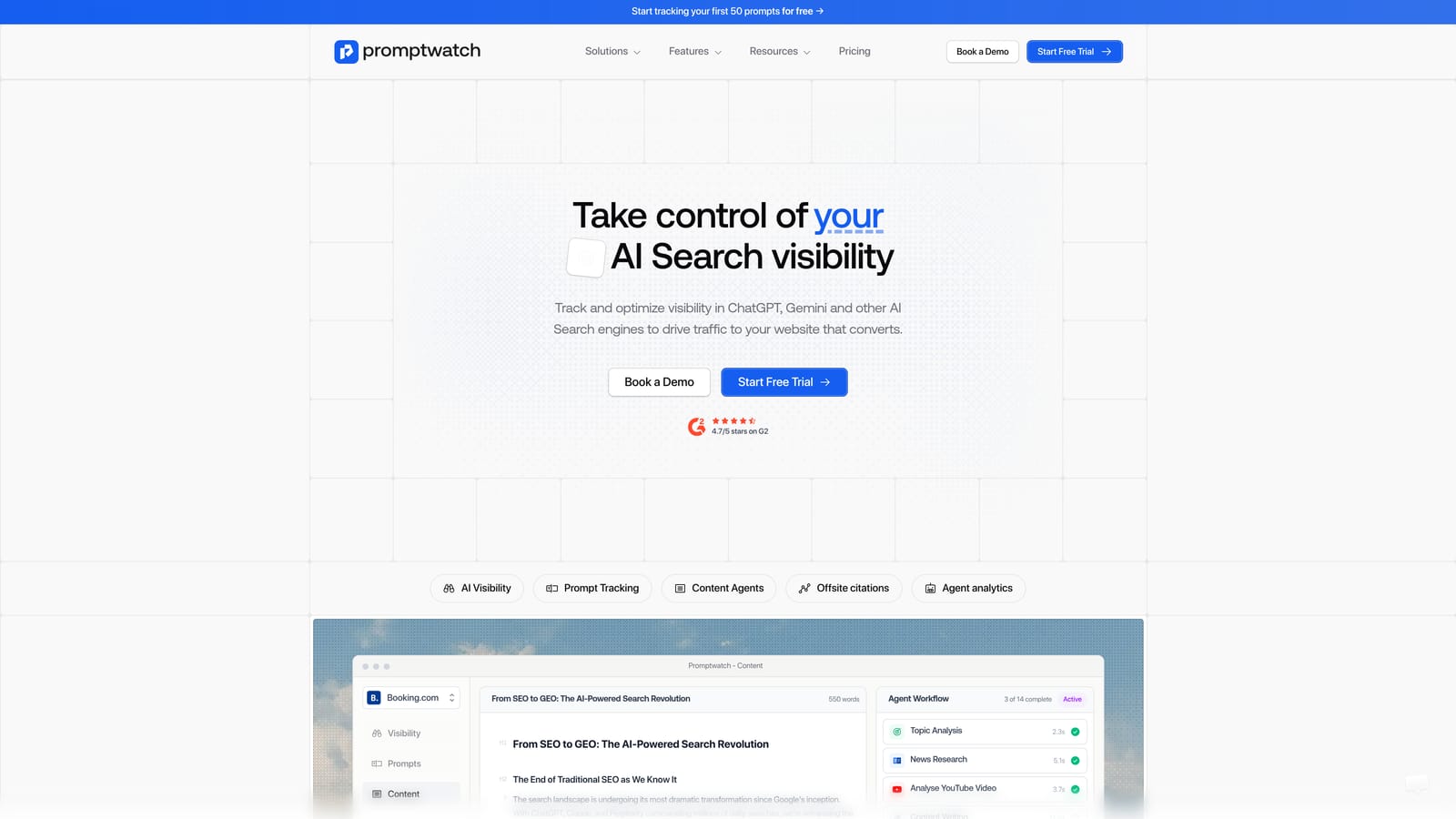
Promptwatch is a prompt monitoring tool that logs and analyzes LLM responses, useful for teams tracking how specific queries surface brand or product mentions across AI models.
Where This Tool Shines
Promptwatch takes a more technical, granular approach to LLM monitoring. Rather than offering a high-level brand visibility score, it focuses on prompt-level response logging, giving teams a detailed record of how specific inputs produce specific outputs over time. This makes it particularly valuable for teams that want to run controlled experiments around prompt variations and track the results systematically.
The response history and trend analysis features let you see how AI model outputs shift over time for the same queries, which is genuinely useful for teams trying to understand whether their content efforts are moving the needle in AI responses.
Key Features
Prompt-Level Response Logging: Detailed records of how specific prompts generate LLM outputs, stored and searchable over time.
Brand and Keyword Mention Detection: Automated detection of brand names and target keywords within AI-generated responses.
Response History and Trend Analysis: Track how AI outputs for specific queries evolve over weeks and months.
Developer-Friendly Interface: Built with product and engineering teams in mind, with integrations suited to technical workflows.
Best For
Promptwatch is best suited for product teams, developers, and technically oriented marketers who want granular prompt-level data rather than high-level brand dashboards. It's a strong fit if you're building internal tools or workflows that depend on understanding LLM response behavior at a detailed level.
Pricing
Verify current pricing and plan options directly at promptwatch.io, as pricing details are subject to change.
3. Profound
Best for: Enterprise brands benchmarking share-of-voice in AI-generated answers and tracking competitive positioning at scale
Profound is an AI search analytics platform designed for enterprise brands that want to understand and benchmark their visibility in AI-generated answers relative to competitors.
Where This Tool Shines
Profound is built for scale and sophistication. Where many tools in this category are designed for SMBs or individual marketers, Profound targets larger organizations with dedicated brand analytics and SEO teams. Its share-of-voice benchmarking capability is particularly strong, allowing enterprise brands to track not just their own AI mentions but how they stack up against a defined competitive set across different AI answer engines.
The enterprise-grade reporting and dashboard layer makes it easier to bring AI visibility data into broader brand performance conversations, which is often a challenge when presenting this kind of emerging metric to leadership teams.
Key Features
AI Search Share-of-Voice Benchmarking: Quantify how often your brand appears in AI-generated answers relative to competitors across defined topic sets.
Competitive Intelligence: Track competitor mention frequency, context, and positioning across major AI answer engines.
Brand Mention Frequency and Context Analysis: Go beyond raw mention counts to understand how and in what context your brand is being referenced.
Enterprise Reporting and Dashboards: Structured reporting designed for stakeholder presentations and cross-functional brand analytics teams.
Best For
Profound is the right choice for enterprise marketing and brand analytics teams that need rigorous competitive benchmarking in AI search. If your organization already invests heavily in traditional share-of-voice tracking and wants to extend that discipline into AI channels, Profound fits naturally into that workflow.
Pricing
Profound operates on enterprise pricing. Verify current plans and request a demo at getprofound.com.
4. Peec
Best for: Growth teams wanting side-by-side competitive visibility comparison across AI answer engines
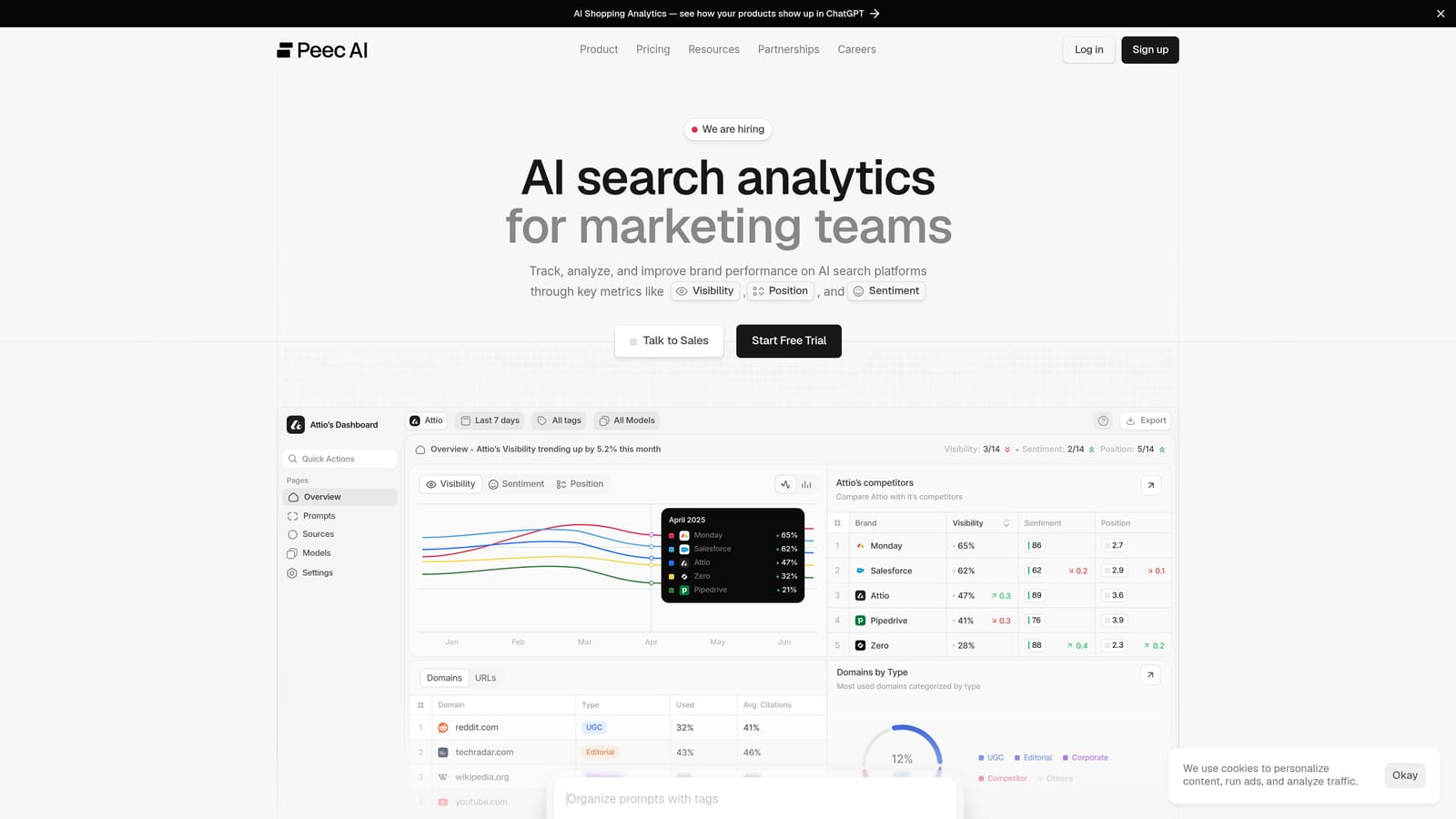
Peec is an AI answer engine monitoring tool that tracks brand and competitor mentions across AI platforms, with a focus on competitive visibility comparison and trend reporting.
Where This Tool Shines
Peec's competitive comparison features are its clearest differentiator. The side-by-side benchmarking view lets you see not just how your brand performs in AI responses, but how that performance compares to specific competitors across the same prompts and topics. This makes it easier to identify gaps where competitors are getting mentioned and you're not, which is often the most actionable starting point for an AI visibility strategy.
The visibility trend reporting over time adds an important longitudinal dimension, letting teams track whether their content and optimization efforts are producing measurable shifts in how often and how favorably their brand appears in AI outputs.
Key Features
Brand Presence Tracking: Monitor how frequently and in what context your brand appears across AI answer engines.
Competitor Mention Comparison: Side-by-side benchmarking of your brand visibility against defined competitors across shared topic areas.
Visibility Trend Reporting: Track changes in brand mention frequency and positioning over time to measure the impact of optimization efforts.
Prompt and Topic Coverage Analysis: Identify which prompts and topic categories your brand is winning and where you're being left out of the conversation.
Best For
Peec is well-suited for growth marketers and SEO teams that are competitive by nature and want to understand AI visibility in the context of their market landscape. If knowing exactly where competitors outperform you in AI responses motivates your content strategy, Peec gives you that comparative lens clearly.
Pricing
Verify current pricing and plan details at peec.ai, as the platform is actively evolving its offering.
5. AirOps
Best for: Content and marketing teams building scalable AI-powered content operations workflows
AirOps is an LLM workflow automation platform that helps content and marketing teams build scalable AI-powered content pipelines, with relevance to teams managing AI visibility improvement at operational scale.
Where This Tool Shines
AirOps approaches the AI content space from an operational angle rather than a monitoring one. It's worth including here because teams serious about improving their AI visibility need more than dashboards: they need a reliable content production system. AirOps excels at letting teams build repeatable LLM-powered workflows that can pull from data sources, apply custom logic, and push outputs to publishing tools without manual bottlenecks at every step.
For agencies or in-house teams managing high content volume, the workflow builder and team collaboration features make it practical to run AI-assisted content operations at a scale that would otherwise require significant headcount. It's less about tracking what AI says and more about systematizing what you publish in response to that intelligence.
Key Features
LLM Workflow Builder: A visual interface for constructing multi-step content and data workflows powered by large language models.
Automated Content Pipelines: Build pipelines that use multiple AI models in sequence, enabling complex content generation at scale.
Data Source and Publishing Integrations: Connect AirOps workflows to external data sources and downstream publishing tools.
Team Collaboration Features: Shared workflow libraries and team management tools suited for agencies and larger content operations.
Best For
AirOps is best for content operations leads, agency teams, and growth marketers who need to systematize AI-assisted content production. It's a strong operational layer for teams that already have an AI visibility monitoring tool and need a scalable way to act on what they learn.
Pricing
AirOps uses tiered pricing based on workflow usage and team size. Verify current plans at airops.com.
6. Writesonic
Best for: Content teams wanting AI writing with built-in SEO and GEO optimization features
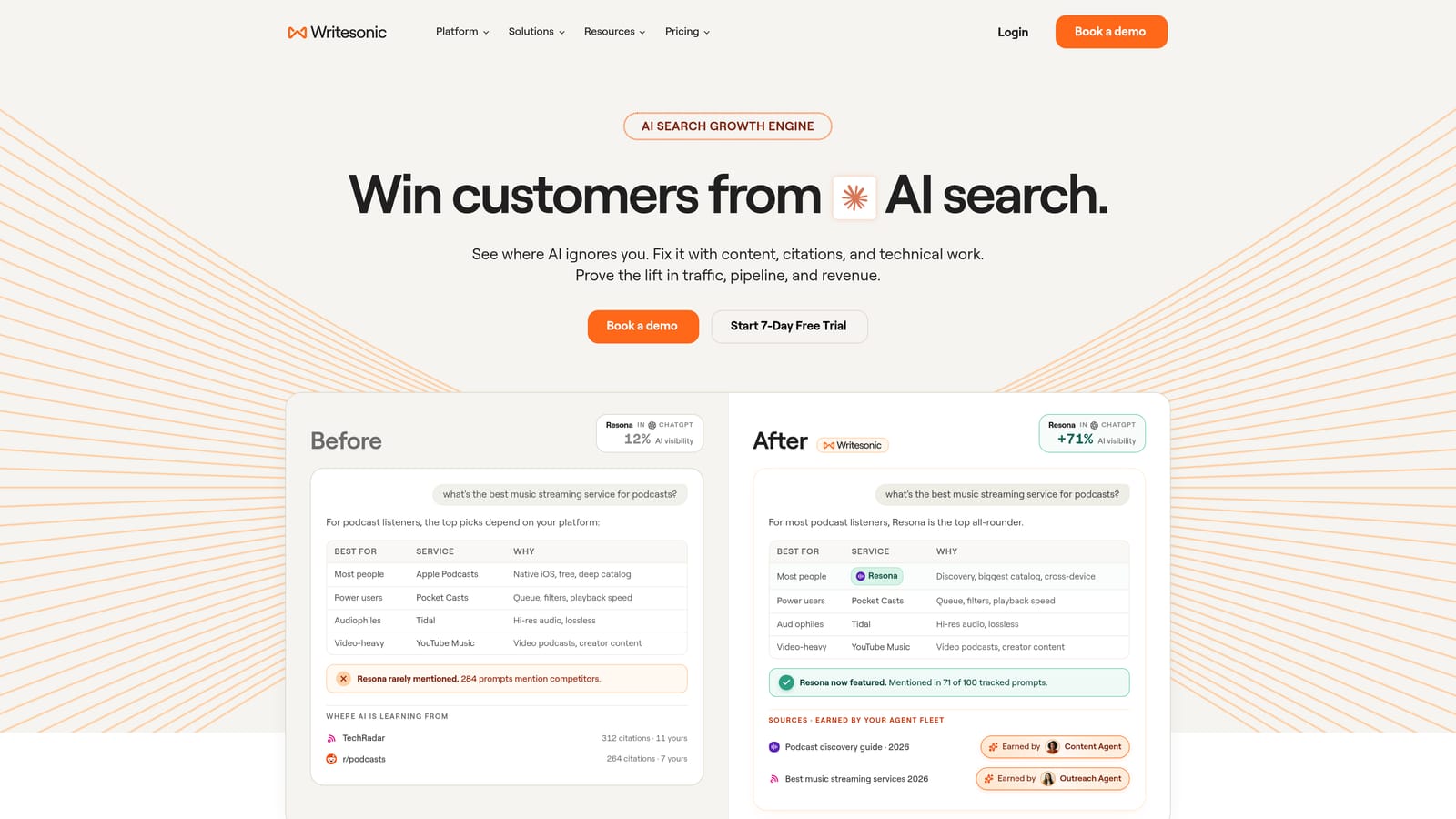
Writesonic is a widely-used AI content generation platform that has expanded into SEO and GEO-oriented features, making it relevant for content teams wanting AI writing with AI search visibility support.
Where This Tool Shines
Writesonic has built a large user base by making AI content generation accessible and versatile. Its recent expansion into GEO content features reflects the broader market shift toward optimizing content for AI answer engines, not just traditional search. For teams that are newer to AI visibility as a concept, Writesonic offers a relatively low-friction entry point because it builds optimization guidance into the content creation process itself rather than requiring a separate analytics layer.
The brand voice customization and team collaboration features are particularly useful for content teams that need to maintain consistency across a high volume of AI-generated output, which is often a challenge as publishing cadence increases.
Key Features
AI Article and Content Generation: Multi-format content generation covering articles, landing pages, social content, and more.
SEO-Focused Writing Modes: Keyword targeting and on-page optimization guidance built into the content generation workflow.
GEO Content Features: Writing modes and optimization suggestions oriented toward AI search visibility and generative engine optimization.
Brand Voice Customization: Train the platform on your brand's tone and style to maintain consistency across generated content.
Best For
Writesonic is a good fit for SMBs and content marketing teams that want an accessible, all-in-one AI writing tool with growing AI search optimization capabilities. It's particularly suited to teams that are earlier in their AI visibility journey and want to combine content production and basic GEO optimization without managing multiple platforms.
Pricing
Writesonic offers tiered plans including a free trial option. Verify current pricing at writesonic.com.
Which Tool Is Right for Your AI Visibility Strategy
The right LLM monitoring tool depends on a single, clarifying question: do you need pure monitoring, or do you need a full workflow from insight to content action?
If your priority is deep, granular prompt-level tracking with a developer-friendly interface, Promptwatch is built for that use case. If you're an enterprise brand that needs rigorous competitive benchmarking and stakeholder-ready reporting, Profound is the natural fit. If competitive comparison is your primary lens and you want to see exactly where rivals outperform you in AI responses, Peec delivers that clarity directly.
For teams that need to systematize content production at scale as part of their AI visibility response, AirOps provides the operational infrastructure to do that efficiently. And for content teams that want an accessible AI writing platform with growing GEO capabilities, Writesonic is a practical starting point.
But if you're looking for a platform that connects monitoring to action in a single workflow, tracking what AI models say about your brand and then generating and publishing the optimized content to improve those mentions, Sight AI is the only tool on this list built specifically around that end-to-end loop. The combination of AI Visibility Score, prompt tracking, 13+ writing agents, and IndexNow-powered indexing means you're not just watching your AI presence: you're actively building it.
Stop guessing how AI models like ChatGPT and Claude talk about your brand. Start tracking your AI visibility today and see exactly where your brand appears across top AI platforms, with the content tools to improve it built right in.