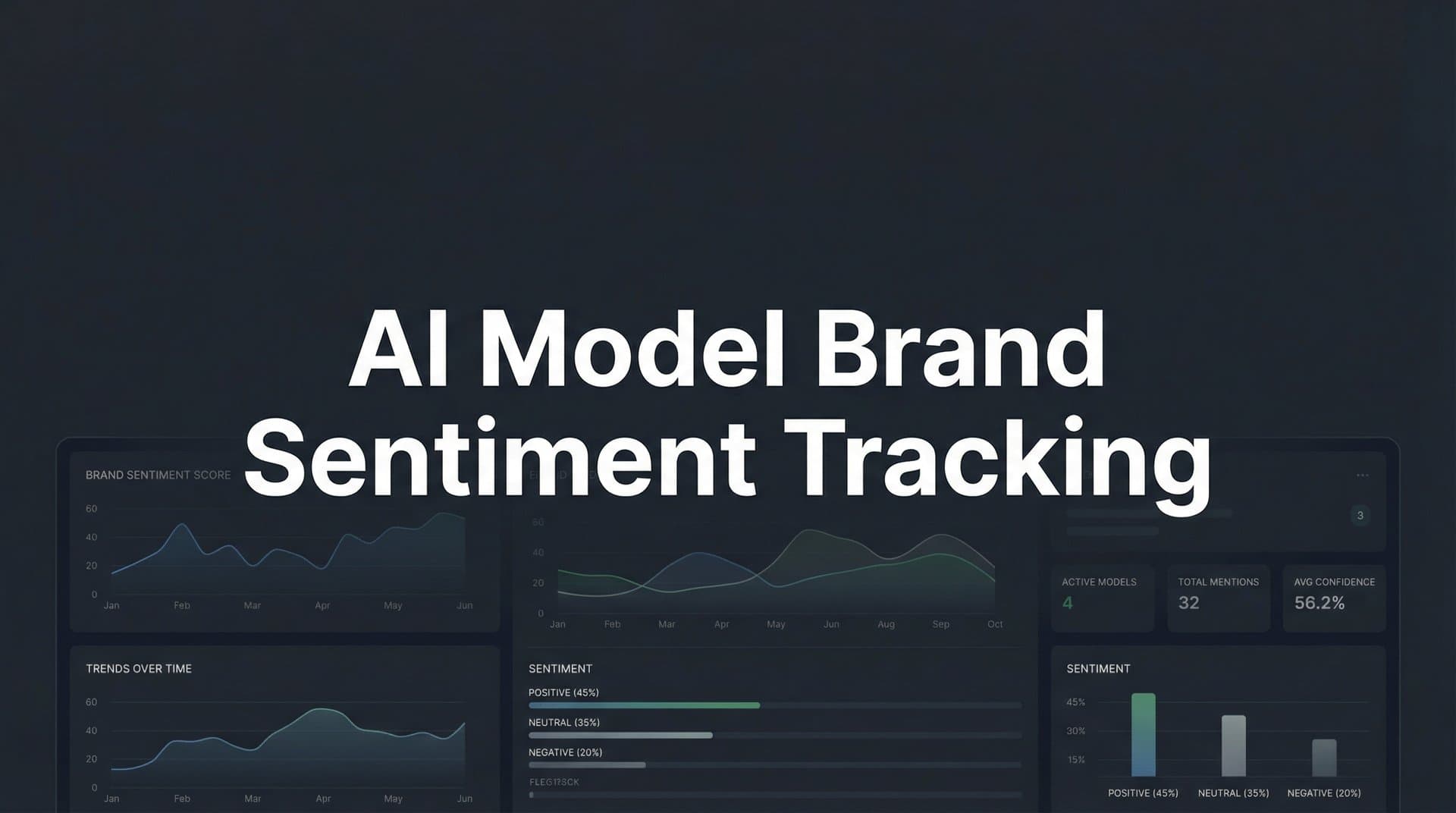
Something significant has shifted in how people discover brands. Not long ago, the journey started with a Google search, a scroll through results, and a click to a website. Today, a growing number of users skip that process entirely. They open ChatGPT, Claude, or Perplexity and ask: "What's the best tool for X?" or "Is [Brand] worth using?" And they receive a confident, synthesized answer — one that characterizes your brand, compares it to competitors, and shapes perception before a single click ever happens.
The problem is that most brands have no idea what those answers say. Traditional sentiment monitoring was built for a different era: social listening tools crawl Twitter, Reddit, and review platforms. Reputation management software tracks star ratings and media mentions. These tools are genuinely useful, but they're structurally blind to a new and influential channel. AI models are forming and broadcasting opinions about your brand to millions of users every day, and conventional monitoring infrastructure simply cannot see it.
This is why AI sentiment tracking for brands has moved from a niche technical curiosity to a strategic necessity. For marketers, founders, and agencies focused on organic growth, understanding how AI models characterize your brand is now as important as tracking keyword rankings or review scores. This article breaks down exactly what AI sentiment tracking measures, how AI models form their opinions, and how to build a practical system for monitoring and improving your brand's standing in AI-generated responses.
Why Traditional Sentiment Tools Miss the Biggest Conversation
Social listening platforms were engineered for human-generated content. They index public posts, forum threads, review submissions, and news articles. They work by crawling URLs and ingesting text that humans have published in discoverable locations. That architecture is well-suited for what it was designed to do. But it has a fundamental limitation: it cannot query an AI model and capture what that model says in response to a user's question.
When someone asks ChatGPT to recommend a project management tool, the response isn't a webpage you can crawl. It's a dynamically generated output synthesized from training data and, in some cases, live retrieval. No social listening tool captures that exchange. No review aggregator indexes it. The conversation happens, shapes the user's decision, and disappears from any monitoring dashboard entirely.
This creates a structural blind spot. AI models like ChatGPT, Claude, and Perplexity are increasingly used as the first stop for product research, category exploration, and brand comparisons. They present their characterizations of brands as authoritative, confident recommendations. A user who receives a lukewarm or absent description of your brand from an AI model may never visit your website at all. Yet your sentiment monitoring dashboard shows nothing unusual because the tool never saw the exchange.
The compounding risk is significant. If an AI model consistently describes your brand in neutral or unfavorable terms, or consistently recommends a competitor when users ask about your category, that pattern repeats across thousands or millions of queries. The brand perception gap between what you believe your reputation to be and what AI models are actively telling users grows wider over time. And without measurement, there's no signal that anything is wrong.
Traditional tools also can't capture the specific framing AI models use. It's not just whether a brand is mentioned, but how. Is it described as a leader or an also-ran? Is it compared favorably to competitors or positioned as a budget alternative? Is it mentioned in the context of a use case you actually serve, or mischaracterized based on outdated training data? These nuances matter enormously for brand perception, and they're invisible to conventional monitoring infrastructure.
The gap isn't a failure of existing tools. It's a category mismatch. AI sentiment tracking requires a fundamentally different approach: one that actively queries AI platforms with relevant prompts, captures and analyzes the responses, and surfaces the patterns that define how your brand is characterized in the AI-first discovery layer.
What AI Sentiment Tracking Actually Measures
AI sentiment tracking for brands isn't a vague concept. It produces specific, measurable signals that marketers can act on. Understanding what the data actually captures is the foundation for using it effectively.
At its core, AI sentiment tracking works by submitting relevant queries to AI platforms and analyzing the responses. These queries mirror the kinds of questions real users ask: "What's the best tool for [use case]?", "Compare [Brand A] and [Brand B]", "Is [Brand] good for [specific need]?" The system captures whether your brand appears in the response, how it's described, and what context surrounds the mention.
Mention Frequency: The most fundamental metric is how often your brand appears in AI-generated responses to relevant queries. A brand with strong AI visibility appears consistently across a wide range of related prompts. A brand with weak AI visibility may be entirely absent from responses to questions it should be answering. Frequency data, tracked over time, reveals whether your AI presence is growing, declining, or stagnant.
Sentiment Polarity: When your brand is mentioned, what tone surrounds it? AI sentiment analysis categorizes responses as positive, neutral, or negative based on the language and framing used. A response that describes your product as "a popular choice for teams that need simplicity" reads differently than one that says "some users find it limited for advanced use cases." Both are mentions; only one is favorable.
Share of Voice Against Competitors: Perhaps the most strategically useful metric is comparative positioning. When users ask about your category, which brands appear most frequently? How does your mention rate compare to competitors? Share of voice in AI responses is a direct indicator of how AI models weight your brand's authority and relevance relative to alternatives.
Prompt-Level Tracking: This is where AI sentiment tracking becomes a genuine competitive intelligence tool. By mapping which specific queries trigger your brand to appear (or not appear), you gain a precise view of where your content is working and where gaps exist. If a competitor consistently appears in responses to a query that describes your core use case, that's an actionable content signal, not just a data point.
Platforms like Sight AI aggregate these signals into an AI Visibility Score: a single, trackable metric that reflects your brand's overall standing across AI platforms. This score enables benchmarking over time and makes it possible to correlate content changes with shifts in how AI models characterize your brand. When you publish a new guide and your AI Visibility Score improves two weeks later, the connection becomes measurable rather than assumed.
Tracking these metrics across multiple AI platforms simultaneously matters because different models behave differently. ChatGPT, Claude, Perplexity, and Gemini each have distinct training data, retrieval approaches, and response tendencies. A brand may be well-represented on one platform and nearly invisible on another. Comprehensive AI sentiment tracking captures this variation rather than treating all AI models as equivalent.
How AI Models Form Opinions About Your Brand
To improve how AI models characterize your brand, you need to understand where those characterizations come from. The process is more transparent than it might seem, and that transparency is actually good news for brands willing to engage with it strategically.
Large language models develop brand associations from their training data. That training data includes a vast corpus of published content: articles, blog posts, documentation, reviews, forum discussions, comparison pages, and authoritative third-party coverage. The way your brand is described across that body of content directly shapes the associations an LLM forms. A brand with extensive, well-structured, factual content explaining its value proposition is more likely to be characterized accurately and favorably than a brand with thin or inconsistent published material.
This means your content strategy is not just an SEO asset. It is a direct input to AI sentiment outcomes. The articles you publish, the use cases you explain, the comparisons you address, and the authority signals you accumulate all contribute to the mental model an AI system builds around your brand.
Retrieval-Augmented Generation adds another layer. Many AI answer engines, including Perplexity and certain configurations of other platforms, don't rely solely on static training data. They retrieve live web content at query time and incorporate it into their responses. This is a significant opportunity for brands. It means that freshly published, well-indexed content can influence AI-generated sentiment faster than waiting for the next model training cycle. The path from "we published this guide" to "AI models are referencing it" can be measured in days rather than months, provided the content is indexed promptly and structured clearly.
What makes content more likely to be cited positively by AI models? Several characteristics consistently matter. Factual specificity is important: content that makes clear, verifiable claims about what a product does, who it's for, and how it compares to alternatives gives AI models accurate material to draw from. Structural clarity helps too. Content with logical headers, defined use cases, and explicit positioning is easier for AI systems to parse and summarize accurately.
Authoritative sourcing also plays a role. Content that references credible external sources, includes data where available, and demonstrates subject matter expertise is more likely to be treated as a reliable reference by AI systems. Vague marketing language, by contrast, tends to produce either absent mentions or characterizations that miss the brand's actual positioning.
The practical implication is direct: improving AI sentiment starts with auditing what your published content actually communicates about your brand, then filling the gaps where AI models lack good source material to draw from.
Turning Sentiment Data Into a Content Action Plan
Measurement without action is just observation. The real value of AI sentiment tracking for brands emerges when the data drives a concrete content strategy. Here's how to translate what you're seeing into what you should be creating.
The first step is identifying content gaps through sentiment analysis. When AI models describe your brand in neutral or unfavorable terms, or when your brand is absent from responses to relevant queries, the most common underlying cause is a content gap. The AI system lacks good source material that accurately represents your brand's positioning for that specific topic or use case. Negative or absent sentiment is often less about a reputational problem and more about a publishing problem.
Prompt tracking makes these gaps precise. When you see that a competitor is consistently recommended in response to a query like "best tool for [specific workflow]" and your brand doesn't appear, you've identified a specific content opportunity. That prompt is telling you exactly what topic to address, what user intent to serve, and what positioning to establish. This is fundamentally more targeted than traditional keyword research because it reflects actual AI model behavior rather than search volume estimates.
The content format that most directly addresses AI sentiment gaps is what practitioners call GEO content: Generative Engine Optimization. GEO-focused articles, guides, and explainers are written with the explicit goal of being cited by AI models in generated responses. They differ from traditional SEO content in meaningful ways.
Factual Clarity Over Keyword Density: GEO content prioritizes clear, accurate statements about what a product does, how it works, and who it serves. AI models are looking for reliable information to synthesize, not keyword repetition.
Explicit Positioning: GEO content directly addresses the comparisons and questions that users bring to AI platforms. If users ask "How does [Brand] compare to [Competitor]?", a well-crafted comparison guide gives AI models accurate, favorable source material for that specific query.
Structured for Synthesis: Content that uses clear headers, defined sections, and logical progression is easier for AI systems to parse and incorporate into generated responses. Structure is not just a readability consideration; it's a discoverability signal for AI retrieval systems.
Use Case Specificity: Broad, general content tends to produce broad, general AI characterizations. Content that addresses specific use cases, industries, or user types gives AI models the material to recommend your brand accurately in response to specific queries.
Platforms like Sight AI combine prompt tracking with a content generation layer that includes over 13 specialized AI agents capable of producing GEO-optimized articles, guides, and explainers. This integration between sentiment data and content creation closes the loop: you identify where AI models are mischaracterizing or ignoring your brand, then produce the content needed to correct it, without switching between disconnected tools.
Making Your Content Discoverable to AI Systems
Writing excellent GEO content is necessary but not sufficient. Content that isn't indexed promptly and crawled effectively by AI retrieval systems cannot influence AI-generated sentiment, regardless of its quality. The technical infrastructure that supports content discoverability is a direct component of your AI sentiment strategy.
Indexing speed is particularly important for RAG-based AI systems. When a platform like Perplexity retrieves live web content to inform its responses, it draws from what's currently indexed and accessible. Content that sits unindexed for days or weeks after publication effectively doesn't exist from the AI's perspective during that window. Every day of indexing delay is a day when that content cannot contribute to improved AI sentiment.
Protocols like IndexNow address this directly. IndexNow allows publishers to notify search engines immediately when new content is published or updated, triggering faster indexing rather than waiting for a routine crawl cycle. For brands actively managing AI sentiment, this speed advantage is material. Sight AI's indexing tools integrate IndexNow directly, ensuring that newly published GEO content enters the crawl cycle as quickly as possible after publication.
Beyond indexing speed, the foundational technical structure of your content matters. Clean crawl paths, properly configured sitemaps, and logical site architecture ensure that AI retrieval systems can discover and navigate your content without friction. Broken links, orphaned pages, and poorly structured sitemaps create barriers that reduce the likelihood of your content being retrieved and referenced in AI responses.
Publishing cadence also compounds over time. AI models are more likely to treat a brand as authoritative when there is a consistent, sustained body of content across relevant topics rather than occasional bursts of publishing. A brand that publishes one authoritative guide per week across its core use cases builds a cumulative AI presence that a brand publishing sporadically cannot match. Automated workflows and CMS auto-publishing capabilities support this consistency by reducing the manual overhead of maintaining a regular cadence.
Think of it this way: your content strategy sets the direction, your GEO optimization shapes the message, and your indexing infrastructure determines how quickly that message reaches the AI systems forming opinions about your brand. All three components need to work together for AI sentiment improvement to be reliable and measurable.
Building a Sustainable AI Sentiment Monitoring Practice
AI sentiment tracking for brands is not a project with a completion date. It's an ongoing practice, similar to how mature organizations treat SEO or brand reputation management: as a continuous discipline with regular measurement, defined protocols, and iterative improvement.
The starting point is establishing a baseline. Before you can measure improvement, you need to know where you stand today. Running a comprehensive AI sentiment audit across relevant platforms and prompt categories gives you the reference point against which future performance is measured. Your AI Visibility Score at baseline becomes the benchmark everything else is compared to.
From there, monitoring cadence matters. Weekly or bi-weekly tracking across a defined set of prompts allows you to detect sentiment shifts promptly, correlate them with content changes, and identify emerging issues before they compound. Monthly reporting against baseline gives leadership a clear view of trajectory. The goal is to make AI sentiment a routine metric in your marketing dashboard, not an occasional audit.
Integrating AI sentiment data alongside traditional performance metrics creates a more complete picture of brand health. When you can see organic traffic trends, keyword rankings, content performance, and AI visibility scores in the same view, patterns become clearer. A piece of content that drives both traditional search traffic and improved AI mention frequency is performing across multiple channels simultaneously, and that compounding effect is worth understanding and replicating.
Response protocols are the final piece. When sentiment shifts negatively, or when a new competitor begins capturing share of voice in AI responses for your core use cases, your team should have a defined playbook: identify the prompts involved, audit the content gap, prioritize and produce targeted GEO content, ensure fast indexing, and monitor for improvement. This cycle transforms AI sentiment tracking from passive observation into active brand management.
The brands that build this infrastructure now, before AI-first search becomes the dominant discovery channel, will have a measurable advantage. The monitoring systems, content workflows, and indexing practices established today compound in value as AI usage continues to grow. Waiting to build this capability until it feels urgent means starting from zero in a more competitive environment.
The Bottom Line: Your Brand Reputation Now Lives in AI Responses
AI models are characterizing your brand in real-time, in response to millions of user queries, with no input from you unless you deliberately create the conditions for accurate and favorable representation. That's the core reality that makes AI sentiment tracking for brands a strategic priority rather than a technical novelty.
The framework is straightforward, even if the execution requires sustained effort. Monitor how AI platforms describe your brand across relevant prompts and track those signals over time. Use prompt tracking to identify the specific content gaps where competitors are winning AI recommendations that should be yours. Publish GEO-optimized content that gives AI models accurate, authoritative source material, and ensure that content is indexed fast enough to actually influence AI retrieval systems.
Each of these steps is actionable independently, but they produce compounding results when integrated into a unified practice. Sight AI is built to support exactly this workflow: AI Visibility tracking across ChatGPT, Claude, Perplexity, and other platforms, sentiment analysis with prompt-level detail, a content generation layer with 13+ specialized AI agents for producing GEO-optimized articles, and IndexNow integration to ensure fast content discovery.
Stop guessing how AI models like ChatGPT and Claude talk about your brand. Start tracking your AI visibility today and see exactly where your brand appears across top AI platforms, what's being said, and what content opportunities are waiting to be captured.