When someone asks ChatGPT "What's the best project management software?" or queries Claude about "top cybersecurity vendors for mid-sized companies," your brand is either being recommended, ignored, or worse—mischaracterized. Right now, millions of these conversations are happening, and most companies have absolutely no visibility into what AI models are saying about them.
This isn't traditional sentiment analysis. You're not tracking tweets or review site comments. You're monitoring an entirely new reputation layer that exists inside large language models—a layer that's increasingly influencing purchase decisions, vendor selections, and brand perceptions. And unlike public social media posts you can search and monitor, these AI conversations happen in private, one-on-one interactions between users and their AI assistants.
The stakes are significant. When a potential customer asks an AI assistant for recommendations, the response they receive carries enormous weight. It feels personalized, authoritative, and unbiased. If your brand isn't mentioned, or if the AI characterizes you inaccurately, you've lost an opportunity you didn't even know existed. Welcome to AI model brand sentiment tracking—the practice of systematically monitoring how large language models describe, recommend, and characterize your brand across thousands of potential queries.
The New Reputation Layer You Can't See
AI model brand sentiment tracking is fundamentally different from the sentiment analysis tools you already know. Traditional sentiment monitoring scrapes social media platforms, review sites, news articles, and forums to gauge public opinion about your brand. These tools tell you what people are saying publicly about you on Twitter, Reddit, G2, or TechCrunch.
AI model brand sentiment tracking, by contrast, reveals what large language models like ChatGPT, Claude, Perplexity, and Gemini tell users when they ask for recommendations, comparisons, or information about your industry. It's the difference between monitoring the conversation about you versus monitoring what an influential intermediary says about you to millions of people in private.
Think of it this way: traditional sentiment analysis is like reading restaurant reviews on Yelp. AI sentiment tracking is like discovering what the concierge at every major hotel tells guests when they ask for restaurant recommendations. The concierge's opinion reaches far more people than any single review, and those recommendations happen in conversations you'll never see.
This matters now because AI assistants have become primary research tools across both B2B and consumer contexts. Product managers use ChatGPT to research competitive landscapes. Marketing directors ask Claude to compare analytics platforms. IT buyers query Perplexity about security vendors. Understanding Perplexity AI brand visibility tracking has become essential for companies competing in these spaces.
The shift is profound. When someone searches Google, you can at least see the search results page and know where you rank. When someone asks an AI assistant, you're completely blind to the interaction unless you're actively monitoring these models. You don't know if you were mentioned, how you were characterized, or whether the AI recommended your competitors instead.
Many companies discover through AI sentiment tracking that models are providing outdated information about their products, confusing them with competitors, or simply ignoring them entirely when users ask for recommendations in their category. When you find AI models giving wrong information about your brand, these aren't hypothetical problems—they're happening right now, shaping purchase decisions and brand perceptions in a reputation layer most companies don't even know exists.
How AI Models Form Opinions About Brands
Large language models don't have opinions in the human sense, but they do develop patterns in how they characterize brands based on their training data. Understanding this process helps explain why AI models might recommend your competitors, provide inaccurate information, or characterize your brand in ways that don't align with your current positioning.
The foundation is training data—the massive corpus of text that models learn from. This includes product documentation, customer reviews, news articles, forum discussions, blog posts, comparison sites, and countless other sources. When an AI model encounters your brand name repeatedly in certain contexts during training, those associations shape how it responds to queries about your category.
Here's where it gets complicated: if your brand received significant negative press coverage three years ago, or if outdated forum threads dominate discussions about your product category, that historical content influences how AI models characterize you today—even if you've completely transformed your offering. Understanding how AI models choose brands to recommend reveals the model doesn't distinguish between current and historical information unless it's explicitly trained to prioritize recency.
The knowledge cutoff factor amplifies this challenge. Many AI models have a specific training data cutoff date, meaning they have no knowledge of events, announcements, or content published after that date. If you launched a major product overhaul or rebranding six months ago, models with older cutoffs will describe your brand based on your previous positioning—creating a persistent gap between reality and AI perception.
AI models also sometimes recommend competitors or provide inaccurate brand information because of how they weight different information sources. If your competitor has more comprehensive documentation, more detailed comparison content, or more prominent mentions across authoritative sites, the model may characterize them more favorably or mention them more frequently—regardless of actual product quality.
This isn't bias in the traditional sense. It's a reflection of information density and prominence in the training data. The brands that have invested in creating detailed, helpful content across multiple channels naturally appear more prominently in AI responses because the models have more high-quality information to draw from when generating responses about that category.
The implication is clear: your current marketing content, documentation quality, and digital presence directly influence how AI models will characterize your brand in future training cycles. But you can't improve what you don't measure, which is why systematic sentiment tracking becomes essential.
Key Metrics for AI Brand Sentiment Analysis
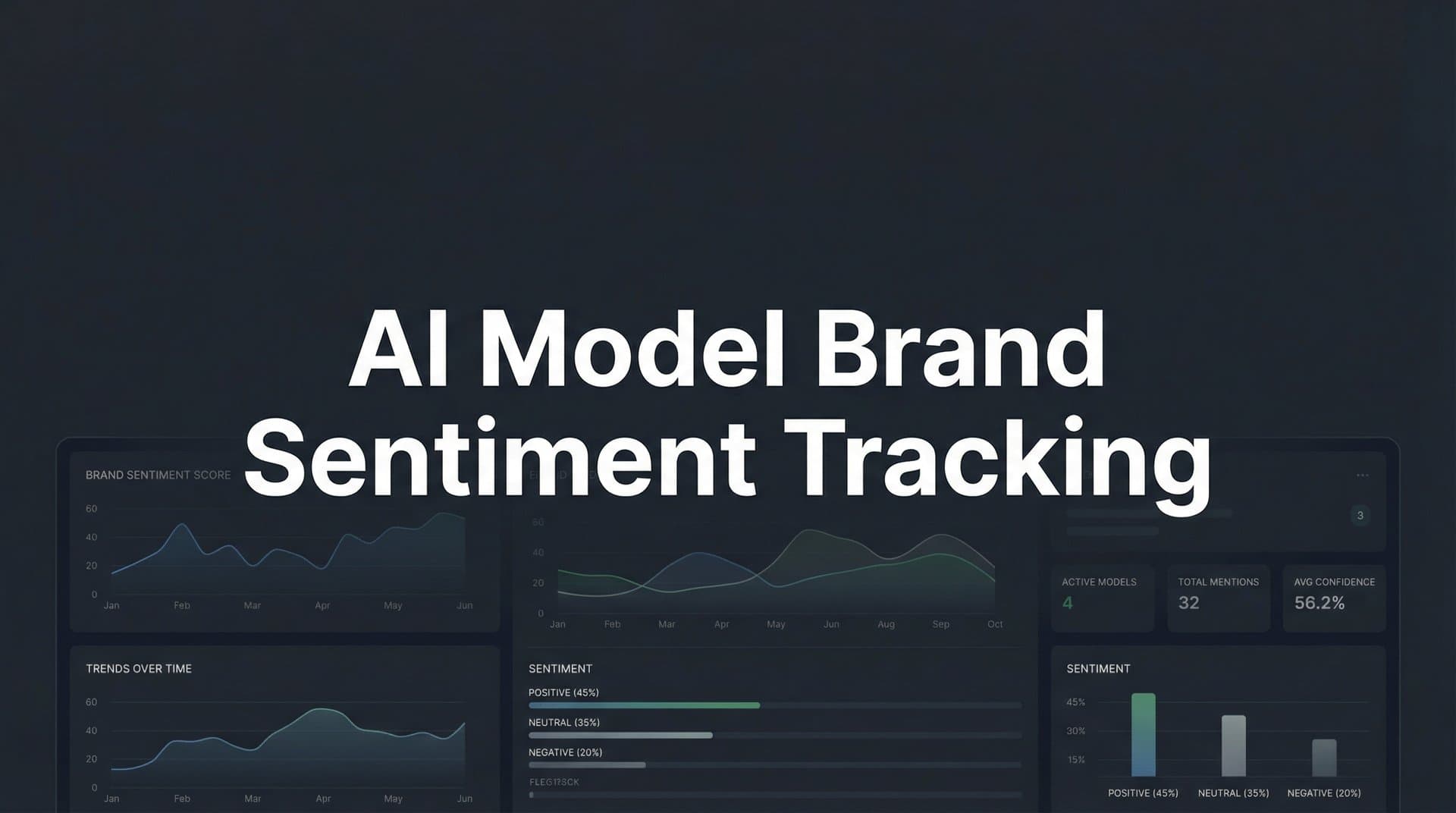
Effective AI model brand sentiment tracking requires measuring specific, actionable metrics that reveal both your current AI visibility and opportunities for improvement. Three core metrics form the foundation of comprehensive brand sentiment analysis in AI.
Mention Frequency: This measures how often your brand appears when users query AI models about your product category, industry, or use cases. If someone asks "What are the best email marketing platforms?" or "Which CRM works well for small businesses?", does your brand get mentioned? Mention frequency tells you whether you're even in the conversation when potential customers research your category through AI assistants.
Low mention frequency often indicates insufficient content presence or weak associations between your brand and key category terms in the model's training data. If you discover AI models not mentioning your brand, this becomes a critical priority. High mention frequency suggests strong category association, but doesn't guarantee positive sentiment—which is where the next metric becomes critical.
Sentiment Classification: Beyond simply being mentioned, you need to understand how AI models characterize your brand. Are the descriptions positive, neutral, or negative? When the model mentions your product, does it highlight strengths, note limitations, or present a balanced view? Analyzing sentiment tracking in AI responses reveals the tone and framing of AI responses about your brand.
This goes deeper than simple positive/negative scoring. You want to understand the specific language patterns AI models use when discussing your brand. Do they describe you as "innovative" or "traditional"? "Enterprise-focused" or "suitable for small teams"? "User-friendly" or "feature-rich but complex"? These characterizations shape how potential customers perceive your brand before they ever visit your website.
Competitive Positioning: Perhaps the most revealing metric is where AI models rank you against alternatives when users explicitly ask for recommendations or comparisons. When someone queries "What are the top five alternatives to [your competitor]?", does your brand appear in that list? When they ask "Compare [your brand] versus [competitor]", how does the model frame the comparison?
Competitive positioning metrics reveal your share of voice in AI-mediated research conversations. You might discover that AI models consistently recommend three competitors before mentioning your brand, or that they position you as a budget alternative when you're actually a premium offering. These insights expose gaps between your intended positioning and how AI models actually characterize you relative to competitors.
Together, these three metrics create a comprehensive picture of your AI brand sentiment. You can see whether you're being mentioned (frequency), how you're being described (sentiment), and where you rank against alternatives (positioning). This diagnostic data becomes the foundation for strategic content decisions that improve your AI visibility over time.
Setting Up Your AI Sentiment Monitoring System
Building an effective AI sentiment tracking system starts with identifying the specific prompts and queries that matter for your brand. This isn't about monitoring every possible mention—it's about systematically tracking the high-value queries that potential customers actually use when researching your category.
Start by mapping your customer research journey. What questions do prospects ask during the awareness and consideration stages? For a project management software company, relevant queries might include "best project management tools for remote teams," "alternatives to [major competitor]," "how to choose project management software," and dozens of variations. Understanding AI model prompt tracking helps you identify these become your core tracking prompts.
The key is thinking like your customer, not like your marketing team. Avoid brand-centric queries like "What do people think about [your brand]?" and focus on category queries where your brand should naturally appear: "What CRM integrates with HubSpot?", "Which analytics platforms offer real-time reporting?", "Best cybersecurity solutions for healthcare companies."
Once you've identified your tracking prompts, establish baseline measurements across multiple AI platforms. Don't assume ChatGPT, Claude, Perplexity, and Gemini all characterize your brand identically—they often don't. Implementing multi-platform brand tracking software is essential because each model has different training data, different architectures, and different tendencies in how they generate recommendations.
Run your core tracking prompts across each platform and document the responses. Note whether your brand is mentioned, how it's characterized, which competitors appear alongside you, and the overall framing of the response. This baseline becomes your reference point for measuring improvement over time.
Creating a tracking cadence is essential because AI model responses can shift as models are updated, retrained, or fine-tuned. Monthly tracking provides enough frequency to spot meaningful trends without creating overwhelming data volume. For each tracking cycle, run the same core prompts and compare results against your baseline and previous measurements.
Look for patterns across tracking cycles. Is mention frequency increasing or decreasing? Are sentiment characterizations becoming more positive or more aligned with your positioning? Are you appearing more frequently in competitive comparison responses? These trends reveal whether your content strategy is successfully influencing AI model perceptions.
Document unexpected responses carefully. When an AI model provides inaccurate information about your brand, mischaracterizes your positioning, or omits you from relevant category discussions, these become high-priority content opportunities. You've identified specific gaps in how AI models understand your brand—gaps you can address through strategic content creation.
Turning Sentiment Insights Into Action
AI sentiment tracking only creates value when you act on the insights. The data reveals problems—inaccurate characterizations, low mention frequency, unfavorable competitive positioning—but solving these problems requires strategic content creation that influences how AI models learn about and describe your brand.
This is where Generative Engine Optimization (GEO) comes into play. GEO strategies focus on creating content specifically designed to improve brand visibility in AI models. Unlike traditional SEO that optimizes for search engine rankings, GEO optimizes for AI model training and response generation.
When sentiment tracking reveals that AI models characterize your product as "complex" when you want to be known for "user-friendly," you need content that explicitly demonstrates ease of use. Create detailed getting-started guides, video tutorials, case studies highlighting quick implementation, and comparison content that positions your interface as more intuitive than alternatives. This content becomes training data that influences future AI model characterizations.
If tracking shows low mention frequency in your category, you need to strengthen the association between your brand and core category terms. Publish comprehensive guides on industry topics, create detailed comparison content, contribute expert perspectives to industry discussions, and ensure your documentation thoroughly covers use cases and capabilities. The goal is creating a robust content footprint that AI models can draw from when generating responses about your category.
Addressing negative brand sentiment in AI models requires direct correction through authoritative content. If an AI model states outdated information about your pricing model, publish clear, comprehensive pricing documentation. If it mischaracterizes your target market, create detailed case studies and use case content that explicitly defines your ideal customer profile. Make the accurate information easily discoverable and authoritative.
The feedback loop between sentiment data and content priorities is crucial. Your tracking data should directly inform your content calendar. When you identify gaps in AI model knowledge about your brand, those gaps become content opportunities. When you detect negative sentiment patterns, those patterns reveal topics where you need stronger, more positive content presence.
This isn't about manipulating AI models—it's about ensuring they have access to accurate, comprehensive, current information about your brand. You're filling information gaps and correcting inaccuracies through legitimate content creation. Over time, as AI models retrain on newer data that includes your improved content footprint, their characterizations become more accurate and more favorable.
Putting It All Together: Your AI Visibility Strategy
AI model brand sentiment tracking represents a fundamental shift in brand reputation management. For decades, companies monitored what people said about them publicly through social media, reviews, and news coverage. Now, you must also monitor what AI assistants tell people privately when they ask for recommendations and information.
This new reputation layer matters because it's increasingly influential. When a potential customer receives a personalized recommendation from ChatGPT or Claude, that response carries significant weight in their decision-making process. If your brand isn't mentioned, or if it's characterized inaccurately, you've lost an opportunity in a channel you can't afford to ignore.
Starting your AI sentiment tracking journey begins with three concrete steps. First, identify the 10-15 core queries that represent how your target customers research your category through AI assistants. These become your foundational tracking prompts. Second, establish baseline measurements by running these prompts across major AI platforms and documenting current mention frequency, sentiment, and competitive positioning. Third, create a monthly tracking cadence to measure changes over time.
The competitive advantage of early adoption is substantial. Most companies remain completely unaware of how AI models characterize their brands. They're investing in traditional SEO and social media monitoring while ignoring an increasingly important channel for brand discovery and evaluation. Early adopters who systematically track their brand in AI models are building advantages that compound over time as AI-assisted research becomes more prevalent.
Your AI visibility strategy should integrate with your broader content marketing efforts. Use sentiment tracking data to inform content priorities, identify gaps in your digital presence, and measure the effectiveness of GEO-focused content. The brands that win in this new landscape will be those that recognize AI model characterization as a critical reputation layer requiring dedicated monitoring and strategic optimization.
Stop guessing how AI models like ChatGPT and Claude talk about your brand—get visibility into every mention, track content opportunities, and automate your path to organic traffic growth. Start tracking your AI visibility today and see exactly where your brand appears across top AI platforms.