Picture this: a founder opens ChatGPT and types, "What's the best project management tool for remote teams?" Within seconds, the AI delivers a confident recommendation—Asana, Monday.com, maybe ClickUp. Your product? Nowhere to be seen. Not buried on page two. Simply absent from the conversation.
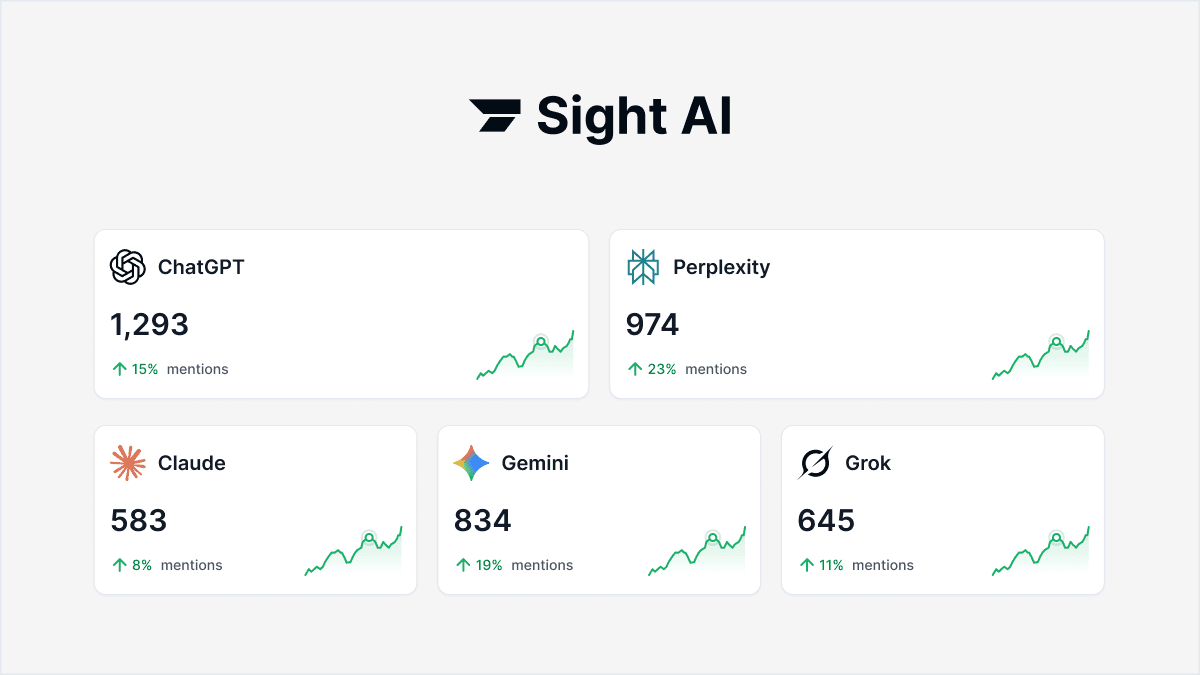
This scenario plays out millions of times daily across ChatGPT, Claude, Perplexity, and Gemini. Users have shifted from typing queries into search bars to asking AI assistants for direct recommendations. They trust these tools to synthesize information, weigh options, and deliver authoritative answers. The problem? Traditional SEO metrics tell you nothing about whether your brand exists in these AI-generated responses.
Brand visibility in AI search results has emerged as a distinct discipline requiring entirely new strategies. It's not about keywords or backlinks—it's about training AI models to recognize your brand as the authoritative answer when users ask questions in your category. The brands establishing this visibility now will compound their advantage as AI search adoption accelerates throughout 2026 and beyond.
The Architecture Behind AI Recommendations
Understanding how AI search engines decide which brands to mention requires abandoning everything you know about traditional search indexing. Google crawls, indexes, and ranks pages based on relevance signals and authority metrics. AI platforms work fundamentally differently—they synthesize information from training data and retrieval systems to generate original responses.
Think of it like this: Google is a librarian pointing you to specific books. AI platforms are experts who've read the entire library and now answer questions from memory, occasionally checking recent sources to verify facts. Your brand needs to be embedded in that "memory"—the training data—and consistently reinforced through retrieval systems that pull fresh information.
Brand authority signals carry enormous weight in AI recommendations. When multiple authoritative sources mention your brand in specific contexts, AI models learn to associate your company with those use cases. A software tool mentioned across TechCrunch articles, G2 reviews, and industry comparison guides becomes strongly linked to its category. The AI doesn't need to see your website directly—it synthesizes these third-party signals into confident recommendations.
Content comprehensiveness matters more than you'd expect. AI models favor sources that provide complete, structured information over fragmented content. A detailed comparison chart explaining your product's features, use cases, and differentiators gives AI systems clear material to quote. Shallow marketing copy leaves them with nothing substantive to cite.
Here's where it gets interesting: recency matters far less than perceived expertise. Traditional SEO rewards fresh content heavily. AI models, by contrast, often favor established thought leadership. An authoritative guide published two years ago may outweigh a recent blog post if the older content demonstrates deeper expertise. The AI isn't checking publication dates the way Google does—it's assessing which source sounds most credible and comprehensive.
Cross-platform consistency reinforces these signals. When your brand messaging, positioning, and key differentiators remain consistent across your website, third-party reviews, social platforms, and industry publications, AI models develop a coherent understanding of what your brand represents. Inconsistent messaging confuses the synthesis process, leading to vague or absent recommendations.
Structured data presence accelerates AI comprehension. When information about your brand appears in tables, comparison charts, feature lists, and clearly labeled sections, AI systems can extract and synthesize it more effectively. Unstructured narrative content requires more interpretation, making it less likely to surface in AI responses. Understanding brand visibility in large language models helps you optimize for these extraction patterns.
Auditing Your Current AI Presence
Before optimizing for AI visibility, you need baseline measurements. Manual testing across multiple AI platforms reveals where your brand currently stands—and where competitors dominate the conversation.
Start by crafting systematic prompts that mirror how real users ask questions. Don't test with your brand name directly ("Tell me about [Your Company]")—that's not how discovery works. Instead, use category queries: "What are the best tools for [use case]?" or "I need software that helps with [problem], what do you recommend?" Test variations with different phrasing, specificity levels, and user personas.
Run these prompts across ChatGPT, Claude, Perplexity, and Gemini. Each platform synthesizes information differently and may have different training data cutoffs. A brand strongly represented in ChatGPT's responses might be absent from Claude's recommendations, revealing gaps in your cross-platform presence. Effective AI search visibility monitoring requires testing across all major platforms.
Document not just whether your brand appears, but how it appears. Context and sentiment matter enormously. Being mentioned as "another option to consider" differs vastly from being the primary recommendation. Being cited for a specific strength ("best for enterprise teams") positions you differently than a generic mention. Negative context—appearing in lists of tools with common complaints—actively damages visibility.
Track competitor mentions alongside your own. When you ask about project management tools and consistently see Asana, Monday.com, and Notion recommended, you've identified the brands dominating AI visibility in your category. Analyze what contexts trigger their mentions. Do they appear for specific use cases? Are they recommended for particular company sizes or industries?
Establish a testing frequency that balances thoroughness with practicality. Monthly audits across your core prompt set reveal trends over time. As AI models update their training data and retrieval systems, your visibility will shift. Some brands see dramatic improvements after major model updates; others experience unexplained drops that require investigation.
Create a simple tracking framework: prompt used, date tested, AI platform, whether your brand appeared, position in recommendations, context of mention, and competing brands mentioned. This baseline becomes invaluable for measuring the impact of optimization efforts. Learning how to track brand in AI search systematically will transform your optimization efforts.
Crafting Content That AI Systems Quote
Earning AI recommendations requires creating content specifically structured for AI consumption. Traditional content marketing focuses on engagement metrics—time on page, scroll depth, conversions. AI-optimized content prioritizes quotability and extractability.
Start with clear, definitive statements that AI models can confidently cite. Avoid hedging language and marketing fluff. Instead of "We believe our platform offers one of the most comprehensive solutions for modern teams," write "The platform includes 47 native integrations, real-time collaboration features, and enterprise-grade security." The second version gives AI systems concrete facts to extract and synthesize.
Structure comparisons explicitly. When you create content comparing your product to alternatives, use consistent frameworks: feature tables, side-by-side capability lists, and clearly labeled pros and cons. AI models excel at synthesizing structured comparisons but struggle with narrative-style evaluations buried in paragraphs.
Build topical authority clusters that establish your brand as the definitive source on specific subjects. If you sell email marketing software, don't just write about your product—create comprehensive resources on deliverability best practices, compliance requirements, segmentation strategies, and automation workflows. When AI models search for authoritative information on these topics, your content becomes the source they synthesize from.
Think of it like this: you're not optimizing for a single ranking position. You're establishing expertise across an entire topic ecosystem. The more comprehensively you cover adjacent subjects, the more contexts trigger your brand's mention in AI responses.
Third-party mentions and citations carry disproportionate weight. AI models treat external validation as strong credibility signals. A detailed review on G2, a case study published by a customer, or a feature comparison from an industry analyst all reinforce your brand's authority more effectively than self-published content. Tracking your brand mentions in AI search results reveals which external sources drive the most visibility.
Actively cultivate these external signals. Encourage satisfied customers to leave detailed reviews that mention specific use cases and outcomes. Participate in industry comparison guides and analyst reports. Contribute expert insights to publications covering your category. Each external mention becomes training data that influences future AI recommendations.
Create glossaries and definition content. When users ask AI systems "What is [concept]?" and your brand consistently appears in authoritative definitions, you build association between that concept and your company. If you've defined the terminology your industry uses, AI models will naturally reference your brand when explaining those concepts.
Technical Infrastructure for AI Discovery
While content quality drives long-term AI visibility, technical optimization accelerates how quickly AI systems discover and incorporate your brand information. Think of technical SEO as the foundation—without it, even exceptional content reaches AI training pipelines slowly or incompletely.
The llms.txt file represents an emerging standard for communicating with AI crawlers. Similar to robots.txt for traditional search engines, llms.txt helps AI systems understand your site's structure, primary expertise areas, and most authoritative content. While not yet universally adopted, forward-thinking brands are implementing these files to guide AI systems toward their strongest content.
A well-structured llms.txt file identifies your brand's core topics, links to authoritative resources, and provides context about your expertise. It's essentially a roadmap telling AI systems, "Here's what we're authoritative on, and here's where to find our best content on each topic."
Accelerating content discovery through IndexNow integration ensures your newest content reaches AI retrieval systems faster. Traditional search engines may take days or weeks to discover and index new pages. IndexNow allows you to notify search engines and AI platforms immediately when content is published or updated, dramatically reducing the lag between publication and visibility.
Automated sitemap updates complement IndexNow by maintaining a current inventory of your content. When AI systems query retrieval databases for recent information on specific topics, up-to-date sitemaps ensure your latest content appears in those results. Many brands publish excellent content that languishes in discovery limbo simply because their technical infrastructure doesn't proactively notify AI systems.
Schema markup and structured data help AI systems extract information efficiently. Product schema, FAQ schema, and organization schema provide clear signals about content type and context. When an AI model encounters properly structured data, it can confidently extract facts without ambiguity. Unstructured content requires interpretation, increasing the chance of misunderstanding or omission.
Consider your website architecture from an AI perspective. Can systems easily identify your product categories, use cases, and differentiators? Is your pricing information clearly structured? Are customer testimonials marked up in ways that AI can extract sentiment and specific outcomes? Technical clarity translates directly to AI comprehension.
Why Strong Brands Sometimes Disappear
One of the most puzzling phenomena in AI visibility is watching established brands with strong traditional SEO performance vanish from AI recommendations while newer competitors dominate the conversation. Understanding these visibility gaps reveals opportunities to reclaim lost ground.
The most common culprit is content format mismatch. Your expertise exists, but it's packaged in ways AI systems struggle to synthesize. Long-form narrative content, video-heavy resources, and PDF whitepapers may work beautifully for human audiences but create extraction challenges for AI models. A competitor with simpler, more structured content often wins AI recommendations despite having less comprehensive expertise.
Think of it like this: you've written a brilliant 50-page strategic guide to your industry. A competitor published a straightforward comparison chart and a clear feature list. When an AI system needs to quickly synthesize an answer, which source is easier to extract from? The structured content wins not because it's better, but because it's more accessible to AI synthesis. If your content not showing in AI search results, format mismatch is often the culprit.
Training data cutoffs create another visibility gap. If your brand's strongest content and most authoritative mentions occurred before an AI model's training data cutoff, you're essentially invisible in that model's "memory." Newer competitors with recent momentum may dominate simply because their growth happened within the model's awareness window.
Inconsistent brand positioning confuses AI synthesis. If your website emphasizes one set of use cases, review sites highlight different strengths, and industry analysts categorize you in yet another way, AI models struggle to develop a coherent understanding of what your brand represents. They may mention you vaguely or not at all, defaulting to competitors with clearer positioning.
The competitor analysis approach reveals exactly why certain brands dominate AI responses in your category. Systematically study the brands consistently recommended: What content formats do they use? How do they structure product information? Where do they earn third-party mentions? What language and positioning do they use consistently across platforms? Understanding why competitors appearing in AI search results outrank you provides actionable insights.
Often you'll discover they're not necessarily better—they're just more AI-legible. They've structured their content for extraction, maintained consistent positioning, and earned mentions in sources that AI models heavily weight. These insights become your roadmap for closing visibility gaps.
Integrating AI Visibility Into Your Marketing Workflow
Building sustainable AI visibility requires integrating new practices into existing workflows rather than creating parallel processes that overwhelm your team. The goal is continuous improvement without operational chaos.
Start by adding AI visibility checks to your content creation process. Before publishing major content pieces, test how AI models might extract and synthesize the information. Ask yourself: Could an AI system confidently quote this? Are key facts clearly stated? Is the structure conducive to extraction? Small adjustments during creation prevent visibility gaps later.
Incorporate AI prompt testing into your regular competitive analysis. Monthly or quarterly, run your core category queries across major AI platforms and document the results. Track not just your brand's presence but shifts in the competitive landscape. Which brands are gaining mentions? What new positioning or messaging appears in AI responses? These insights inform both content strategy and product positioning.
Balance traditional SEO with AI optimization—they complement rather than compete. Content that ranks well in Google often needs only minor restructuring to perform well in AI recommendations. Add clearer subheadings, extract key facts into bulleted lists, and ensure definitions are explicit. These changes typically improve traditional SEO performance while dramatically enhancing AI legibility. Exploring how to improve AI search visibility reveals strategies that benefit both channels.
Set realistic timelines for visibility improvements. AI model updates happen on irregular schedules, and training data incorporation can lag months behind publication. Unlike traditional SEO where you might see ranking changes within weeks, AI visibility improvements often require patience. Focus on consistent execution rather than immediate results.
Create feedback loops between AI visibility tracking and content strategy. When you discover your brand mentioned strongly in specific contexts, double down on content for those use cases. When you identify gaps—categories where competitors dominate mentions—prioritize creating authoritative content to close those gaps. Let AI visibility data guide resource allocation.
Automate where possible to reduce manual overhead. AI brand visibility tracking tools that monitor mentions, track sentiment, and alert you to changes in visibility eliminate repetitive testing. Automated indexing systems ensure new content reaches AI platforms quickly without manual submission. The goal is continuous monitoring without continuous manual effort.
Your Path Forward in AI Search
Brand visibility in AI search results represents a fundamental shift in how customers discover and evaluate products. The traditional search paradigm—where ranking determined visibility—has given way to a synthesis model where AI platforms recommend brands based on perceived authority, content structure, and cross-platform consistency.
The framework is straightforward: measure your current visibility through systematic prompt testing across major AI platforms, optimize your content for AI consumption by prioritizing structure and quotability, accelerate indexing through technical infrastructure like IndexNow and llms.txt files, and monitor continuously to track improvements and identify new opportunities.
The urgency cannot be overstated. AI search adoption is accelerating throughout 2026, and the brands establishing visibility now will compound their advantage as more users shift from traditional search to AI-powered recommendations. Every month you delay gives competitors time to dominate the conversation in your category.
Stop guessing how AI models like ChatGPT and Claude talk about your brand—get visibility into every mention, track content opportunities, and automate your path to organic traffic growth. Start tracking your AI visibility today and see exactly where your brand appears across top AI platforms.