Something significant has shifted in how buyers discover brands. A growing number of people are skipping the search results page entirely and asking AI assistants directly: "What's the best project management tool for a small team?" or "Which email marketing platform should I use?" They get a synthesized answer, often with a short list of recommendations, and they act on it. No scrolling through ten blue links required.
For marketers, this creates a problem that most analytics stacks are completely blind to. You might be tracking keyword rankings, monitoring backlinks, and running monthly SEO audits — and still have no idea what ChatGPT, Claude, or Perplexity are telling potential customers about your brand right now. That blind spot is where consideration is being won and lost.
This is where AI model monitoring for marketers becomes essential. It's the practice of systematically tracking how AI models represent your brand: whether they mention you at all, how they describe you, and whether they recommend you over competitors when buyers ask the questions that matter most. If you're already comfortable with SEO and you're starting to hear about Generative Engine Optimization (GEO), this is the foundational discipline that connects both worlds. Let's break down exactly how it works.
The Blind Spot in Your Marketing Stack
Picture this: your brand ranks on the first page of Google for your most important category keyword. Your SEO is solid. Your content team is publishing consistently. By every traditional metric, your organic strategy is working. And yet, when a buyer asks ChatGPT for a recommendation in your category, your brand doesn't appear in the response. A competitor does, described favorably, with a clear reason to choose them.
This isn't a hypothetical edge case. It's the structural reality of how AI-powered search operates. AI assistants like ChatGPT, Claude, Perplexity, and Gemini have created an entirely new discovery layer that functions independently of traditional search rankings. A language model doesn't consult Google's index to rank your page. It synthesizes information from its training data and, in retrieval-augmented systems, from real-time web content, and generates a response that reflects its learned associations with your brand.
The types of outputs that shape brand perception in this layer are varied. Direct recommendations are the most obvious: "Here are three tools I'd suggest for X use case." But there are also comparative answers where a buyer asks how two brands stack up, category-level queries where AI models describe the landscape of options, and sentiment-laden descriptions that users treat as authoritative assessments. Being described as "the enterprise option with a steep learning curve" versus "the most intuitive platform for growing teams" can meaningfully influence a buying decision, even if both descriptions appear in a neutral-seeming AI response.
Here's the structural problem with your existing tools: rank trackers measure where a page appears in a search index. They query search engines, capture position data, and track movement over time. They cannot query a language model, capture the text of an AI-generated response, analyze how your brand is described, or tell you whether you were mentioned at all. This isn't a feature gap that a software update will fix. It's a fundamentally different measurement problem.
Traditional analytics tools were built for a world where discovery happened through indexed links. AI-powered search doesn't work that way. The output is a synthesized narrative, not a ranked list of URLs. Measuring your presence in that narrative requires a different approach entirely, which is exactly what AI model monitoring is designed to provide.
What AI Model Monitoring Actually Measures
Once you understand the blind spot, the natural question is: what exactly should you be tracking? AI model monitoring for marketers centers on a set of core metrics that together give you a clear picture of your brand's presence and positioning across AI platforms.
Brand Mention Frequency: The most basic metric is how often your brand appears in AI responses to relevant queries. This sounds simple, but it requires running a consistent set of prompts across platforms and tracking whether your brand is included in the output. Frequency alone doesn't tell the whole story, but it establishes whether you have a presence problem or a positioning problem.
Share of Voice Across AI Platforms: In category-level queries, AI models typically recommend a handful of options. Share of voice measures how often your brand appears relative to competitors when buyers ask questions like "What are the best tools for X?" or "Which platforms should I consider for Y?" This competitive view is often more actionable than raw mention frequency because it directly reflects how AI models rank your brand against alternatives.
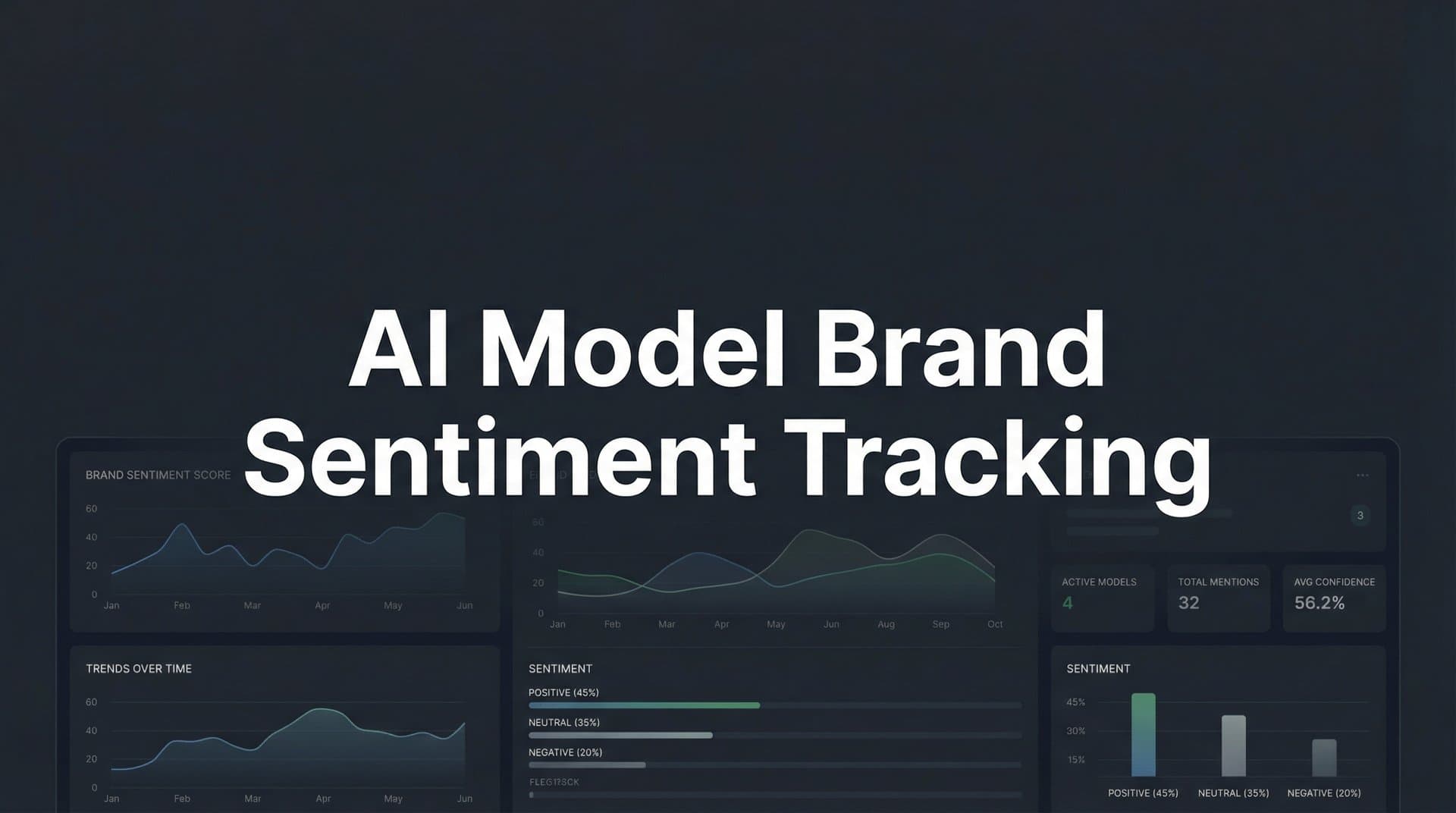
Sentiment and Contextual Framing: This is where monitoring goes beyond simple counting. AI models don't just mention brands; they describe them with qualitative framing. "Known for ease of use," "best for enterprise teams," "the affordable option," "can be complex to set up" — these contextual descriptions shape buyer perception in ways that a mention count doesn't capture. Effective monitoring needs to surface not just whether you were mentioned, but how.
Prompt tracking is the operational practice that makes all of this measurable. It involves building a library of queries that mirror real buyer questions across different stages of the purchase journey: awareness-stage questions about a category, consideration-stage comparisons between specific tools, and decision-stage prompts about specific use cases or requirements. These prompts are run systematically across AI platforms, and the responses are captured, analyzed, and tracked over time.
The reason multi-platform coverage matters is that AI models don't return identical responses. ChatGPT, Claude, and Perplexity each have different training data, different retrieval mechanisms, and different tendencies in how they frame recommendations. A brand that appears prominently in Perplexity responses might be underrepresented in Claude outputs. Monitoring a single platform gives you an incomplete picture.
To make this data actionable at a glance, the concept of an AI Visibility Score is useful. Think of it as a composite benchmark that aggregates mention frequency, sentiment quality, and platform coverage into a single number you can track over time. When you publish new content, run a PR campaign, or update your website's core messaging, the AI Visibility Score gives you a way to measure whether those activities are shifting how AI models represent your brand. It's the equivalent of a domain authority score for the AI search layer.
Why Sentiment and Context Matter More Than Mentions
Here's something worth sitting with: being mentioned in an AI response is not automatically a good thing. If ChatGPT consistently describes your brand as "the expensive option" or "better suited for larger organizations" when a small business owner is asking for recommendations, that mention is actively working against you. In some cases, no mention at all would be preferable to a negative or limiting contextual framing.
This distinction between a raw mention and a meaningful one is central to understanding why AI model monitoring needs to go deeper than simple brand detection. The context in which your brand appears, the language used to describe it, and the position it occupies in a list of recommendations all carry weight. A buyer reading an AI response treats that framing as an authoritative synthesis, not as an opinion. That's the dynamic that makes sentiment and context so consequential.
So how do AI models form these "opinions" about your brand? The answer lies in how language models are trained and how retrieval-augmented systems work. Base LLMs develop associations based on the volume and nature of content they were trained on. If the majority of content about your brand emphasizes a particular use case, a particular price point, or a particular type of customer, the model will reflect those associations in its outputs. RAG-based systems go further, pulling from indexed web content in real time, which means the content that exists about your brand right now is actively shaping what AI models say about you today.
This is the connection between content strategy and AI monitoring that many marketers haven't fully internalized yet. The content you publish, the way you structure it, the use cases you cover, and the authority signals you build are all inputs into how AI models contextualize your brand. A brand that has published thorough, well-sourced content around its core use cases, clearly defining what it does well and for whom, is more likely to be described accurately and favorably in AI responses than a brand with sparse or inconsistent web presence.
The practical implication is that monitoring and content creation are not separate disciplines in the AI search era. Monitoring tells you how AI models currently describe your brand and where the gaps are. Content creation is how you influence those descriptions over time. If your monitoring data reveals that AI models consistently describe a competitor as the go-to option for a specific use case that you also serve well, that's a direct signal to publish authoritative content that establishes your brand's credibility in that space. The content you create today will influence how AI models describe you in future responses, creating a feedback loop that makes monitoring data directly actionable.
Building a Monitoring Workflow That Scales
Understanding what to measure is one thing. Building a workflow that actually delivers consistent, actionable data is another. An effective AI monitoring workflow operates across three layers, each building on the last.
Layer 1: Prompt Library Construction. The foundation of any monitoring workflow is a well-designed set of queries. These prompts should mirror the actual questions your target buyers ask at different stages of the purchase journey. Awareness-stage prompts cover broad category questions: "What are the best tools for managing social media?" Consideration-stage prompts get more specific: "How does [your brand] compare to [competitor] for mid-sized teams?" Decision-stage prompts are highly targeted: "Which platform is best for a B2B SaaS company with a small marketing team?" A comprehensive prompt library typically covers dozens of queries across these stages, and it should be reviewed and updated regularly as buyer language evolves.
Layer 2: Multi-Platform Coverage. Running your prompt library across a single AI platform is insufficient. ChatGPT, Claude, Perplexity, and other AI assistants each return different responses to the same query, and your brand's representation can vary significantly across them. A complete monitoring workflow covers all major platforms your target buyers are likely to use, capturing response text, brand mentions, and contextual framing from each.
Layer 3: Change Tracking Over Time. A single snapshot of AI responses is interesting but not particularly actionable. The real value comes from tracking how responses change over time. When you publish a major piece of content, earn a significant press mention, or update your website's core messaging, does your AI visibility improve? Change tracking lets you correlate content and PR activity with shifts in AI model outputs, turning monitoring into a feedback mechanism for your broader marketing strategy.
The practical challenge here is scale. Running dozens of prompts across six or more AI platforms, capturing full response text, analyzing sentiment, and tracking changes over time is not a workflow that can be managed manually at any meaningful frequency. Manual spot-checks are useful for qualitative insight — getting a feel for how AI models describe your brand — but they don't provide the consistent, comparable data that makes monitoring genuinely strategic.
This is where automated platforms become necessary. Sight AI, for example, tracks brand mentions across 6+ AI models continuously, surfaces sentiment and contextual framing, and alerts you to changes without requiring manual query runs. The difference between checking AI responses manually once a month and having continuous automated monitoring is the difference between a snapshot and a live feed.
The output of a well-functioning monitoring workflow isn't just a report. It's a prioritized list of content opportunities: specific prompts and topics where competitors are being recommended and your brand is absent or underrepresented. That list becomes the input for your content strategy, creating a direct line between monitoring data and content decisions.
From Monitoring Data to GEO-Optimized Content
Once your monitoring workflow is producing reliable data, the next step is translating those insights into content that actually shifts AI model outputs. This is the domain of Generative Engine Optimization, and it's worth being precise about what makes it distinct from traditional SEO.
GEO isn't about keyword density or meta descriptions. It's about creating content that AI models are likely to cite, reference, and draw from when synthesizing responses. The principles that make content GEO-effective include clear entity definitions (explicitly stating what your brand does, for whom, and in what context), authoritative sourcing and factual grounding, structured formatting that makes information easy to extract, and comprehensive topic coverage that signals depth of expertise. These principles overlap significantly with quality SEO practices, but the emphasis is different: GEO prioritizes being a reliable source that AI models trust, not just a page that ranks for a keyword.
Here's how monitoring insights translate into concrete content briefs. Suppose your prompt tracking reveals that when buyers ask about project management tools for remote teams, AI models consistently recommend two competitors and don't mention your brand at all. That's a specific, actionable gap. The response isn't to write a generic blog post about remote work. It's to publish a comprehensive, well-sourced article that directly addresses that use case, clearly positions your brand's capabilities in that context, and provides the kind of structured, authoritative information that AI models draw from when answering that exact type of query.
Over subsequent training cycles and through real-time retrieval in RAG-based systems, content that addresses these gaps can shift AI model outputs. This isn't instant, and it requires consistent effort, but the directional relationship between content quality and AI model representation is well-established in how these systems work.
Indexing speed adds another layer of strategic importance here. For RAG-based AI systems that pull from real-time web content, content that gets indexed quickly is more likely to be retrieved in AI responses. This makes the time between publishing and indexing a competitive variable, not just a technical detail. Tools that integrate with IndexNow and automate sitemap updates, like Sight AI's website indexing features, compress this window significantly. Publishing a well-crafted GEO-optimized article and having it indexed within hours rather than days means it enters the retrieval pool faster, giving it a better chance of influencing AI responses to the prompts you're actively monitoring.
The complete content loop looks like this: monitoring data identifies a gap, a GEO-optimized article addresses that gap, fast indexing gets the content into retrieval systems quickly, and re-monitoring measures whether the AI model outputs shift in response. Each cycle produces better data and more targeted content, compounding over time.
Your Complete AI Visibility Stack
Bringing this all together, the workflow for AI model monitoring for marketers follows a clear sequence. Monitor AI model outputs across platforms to establish your baseline visibility. Identify where your brand is absent, underrepresented, or described in ways that don't serve your positioning. Create GEO-optimized content that directly addresses those gaps. Ensure that content gets indexed rapidly. Re-monitor to measure impact and identify the next set of opportunities.
It's worth being explicit about the relationship between this workflow and traditional SEO. AI model monitoring is not a replacement for organic search strategy. AI models, particularly those using retrieval-augmented generation, draw heavily from indexed web content. Brands with strong SEO fundamentals, high-quality content, and authoritative backlink profiles tend to fare better in AI search as well, because the same signals that help a page rank also make it a more credible source for AI models to reference. The brands that win in AI search are typically those executing strong organic SEO alongside deliberate GEO strategy.
What makes early investment in AI visibility particularly valuable is the compounding nature of AI model associations. Language models tend to reinforce existing brand associations over time. A brand that establishes strong, positive representation in AI responses now is building an advantage that becomes harder for competitors to displace as those associations solidify. Waiting until AI-powered search is undeniably dominant to start monitoring means starting from a deficit, playing catch-up against brands that have been actively shaping their AI visibility for months or years.
The marketers and founders who treat AI model monitoring as a core discipline today, rather than an experimental side project, are building the kind of compounding organic advantage that's difficult to replicate quickly. The tools exist to make this systematic and scalable. The question is whether you're using them.
Making AI Visibility a Core Marketing Discipline
The core insight of this entire discipline is straightforward: if you're not monitoring how AI models represent your brand, you're operating with a significant blind spot in your marketing stack. Buyers are making decisions based on AI-generated recommendations, and those recommendations are shaped by content, training data, and retrieval systems that you can directly influence — but only if you know where you stand.
The action steps are clear. Build a prompt library that mirrors real buyer questions across your purchase funnel. Run those prompts across the major AI platforms your buyers use and establish a baseline for your AI visibility. Identify the specific gaps where competitors are being recommended and you're not. Publish GEO-optimized content that addresses those gaps with authority and structure. Ensure fast indexing to get that content into retrieval systems quickly. Re-monitor to measure impact and iterate.
Each of these steps is manageable. What makes them scalable is automation. Manually running dozens of prompts across six AI platforms, capturing response text, analyzing sentiment, and tracking changes over time is not a sustainable workflow for a busy marketing team. That's the gap that purpose-built AI visibility platforms are designed to close.
Stop guessing how AI models like ChatGPT and Claude talk about your brand. Start tracking your AI visibility today with Sight AI and get full visibility into every mention, uncover content opportunities you're currently missing, and automate your path to stronger organic discovery across every major AI platform. Your brand's AI presence is being shaped right now — the only question is whether you're the one shaping it.