Picture this: A potential customer opens ChatGPT and types, "What are the best AI-powered SEO tools for tracking brand visibility?" Within seconds, they receive a confident, articulate response that mentions three competitors—but not your brand. Or worse, your brand appears with qualifiers like "limited features" or "mixed reviews." This interaction just shaped a purchasing decision, and you had no idea it even happened.
This scenario plays out millions of times daily across ChatGPT, Claude, Perplexity, and other AI platforms. We've entered an era where AI models don't just retrieve information—they synthesize it, form perspectives, and present conclusions with an air of objectivity that human-written content rarely achieves. When someone asks an AI model about your industry, product category, or specific brand, the model's response becomes your brand narrative for that user.
Here's the uncomfortable truth: if you're not monitoring how AI models describe your brand, you're operating blind in the landscape that's rapidly becoming the primary discovery channel for informed buyers. Traditional SEO taught us to obsess over search rankings. AI model brand sentiment monitoring demands we obsess over something more fundamental—the actual words AI uses when it talks about us, the context in which we're mentioned, and whether we're mentioned at all.
The Hidden Conversation: How AI Models Form Brand Opinions
AI models don't have opinions in the human sense, but they create something functionally identical: consistent patterns in how they describe brands based on their training data. When Claude or ChatGPT encounters a question about your brand, it synthesizes information from millions of text sources it was trained on—articles, reviews, forum discussions, technical documentation, social media posts—and generates a response that reflects the aggregate sentiment of that data.
This creates what we might call "algorithmic brand perception." Unlike a single negative review that a customer can contextualize and weigh against other factors, AI-generated sentiment feels authoritative and objective. The model doesn't say "some users reported issues"—it confidently states characteristics about your brand as if presenting established facts. Understanding brand sentiment in AI models has become essential for modern marketers.
The mechanics matter here. Traditional social sentiment monitoring tracks what people actively say about your brand on Twitter, Reddit, or review sites. That's reactive and human-generated. AI model sentiment is fundamentally different—it's synthesized and algorithmic. The AI isn't reporting what it read; it's creating new text that reflects patterns in its training data.
This distinction has profound implications. A negative incident that generated significant online discussion months ago becomes embedded in the model's training data. Even after you've resolved the issue and moved on, the AI continues generating responses that reflect that historical negativity. The sentiment persists, influencing every future interaction, until the model is retrained on more recent data.
Consider the cascade effect: one problematic pattern in training data doesn't just affect one response. It influences thousands of AI-generated answers across countless user interactions. If your brand consistently appears in contexts associated with "expensive" or "complicated setup" in the training corpus, the AI model will naturally generate responses that echo these associations—even when answering questions where cost or complexity wasn't the primary concern.
The perceived objectivity amplifies the impact. When a human writes "I found this tool difficult to use," readers understand it's one person's subjective experience. When an AI model generates "This tool has a steep learning curve," it reads as objective assessment. Users trust AI-generated information differently than they trust individual reviews, which makes AI model sentiment uniquely powerful in shaping brand perception.
Core Components of AI Sentiment Monitoring Systems
Effective AI model brand sentiment monitoring rests on three interconnected pillars, each addressing a different dimension of how AI platforms discuss your brand.
Prompt Tracking: This pillar focuses on understanding which questions and prompts trigger mentions of your brand. Are you appearing in response to direct brand queries ("Tell me about [Your Brand]"), category searches ("What are the best tools for X"), comparison requests ("Compare Brand A vs Brand B"), or problem-solving queries ("How do I solve X problem")? Each prompt type reveals different aspects of your AI visibility and competitive positioning.
The sophistication lies in tracking prompt variations. Users don't ask questions in standardized formats. They might ask "What's the best AI SEO tool," "Which AI platform helps with organic traffic," or "How can I track my brand in ChatGPT." Your monitoring system needs to capture the full spectrum of query patterns that should logically trigger your brand mention—and identify the gaps where you're absent. Implementing AI model brand mention tracking helps you understand these patterns systematically.
Response Analysis: Once you know which prompts mention your brand, you need to understand how AI models describe you. This goes beyond simple positive/negative classification. You're analyzing the specific language used, the context in which you're mentioned, the attributes highlighted, and the competitive frame of reference.
Does the AI emphasize your strengths or lead with caveats? Are you positioned as a premium option, a budget-friendly alternative, or an innovative newcomer? Do responses include outdated information about features you've since added or problems you've solved? Response analysis reveals the narrative AI models construct about your brand—the story they tell thousands of users daily.
Sentiment Scoring: The third pillar quantifies what the first two pillars reveal. Sentiment scoring assigns measurable values to AI responses, creating metrics you can track over time. This typically involves categorizing mentions as positive, negative, or neutral, but sophisticated systems go further—measuring sentiment intensity, tracking specific attribute mentions, and calculating relative positioning against competitors.
The technical challenge emerges when you realize that different AI platforms behave differently. ChatGPT, Claude, Perplexity, and Gemini each have distinct response patterns, knowledge cutoffs, and retrieval mechanisms. Perplexity incorporates real-time search results, while Claude relies more heavily on training data. ChatGPT's responses vary between GPT-3.5 and GPT-4. Your monitoring system needs to account for these platform-specific behaviors while providing unified visibility across the AI landscape.
Competitor tracking completes the picture. Your brand sentiment exists in context—relative to alternatives users might consider. Monitoring how AI models position competitors alongside your brand reveals your share of AI visibility and identifies positioning opportunities. If competitors consistently appear in prompts where you're absent, that's not just a visibility gap—it's a strategic vulnerability.
Building Your AI Visibility Baseline
You can't improve what you don't measure, which makes establishing baseline metrics the critical first step in AI sentiment monitoring. This baseline becomes your reference point for tracking progress and identifying trends that matter.
Start with mention frequency—how often does your brand appear in AI responses across relevant prompt categories? This raw visibility metric tells you whether you're part of the conversation in your industry. Learning how to track your brand in multiple AI models ensures comprehensive coverage across platforms. A brand that appears frequently in ChatGPT responses but rarely in Claude or Perplexity has platform-specific visibility gaps to address.
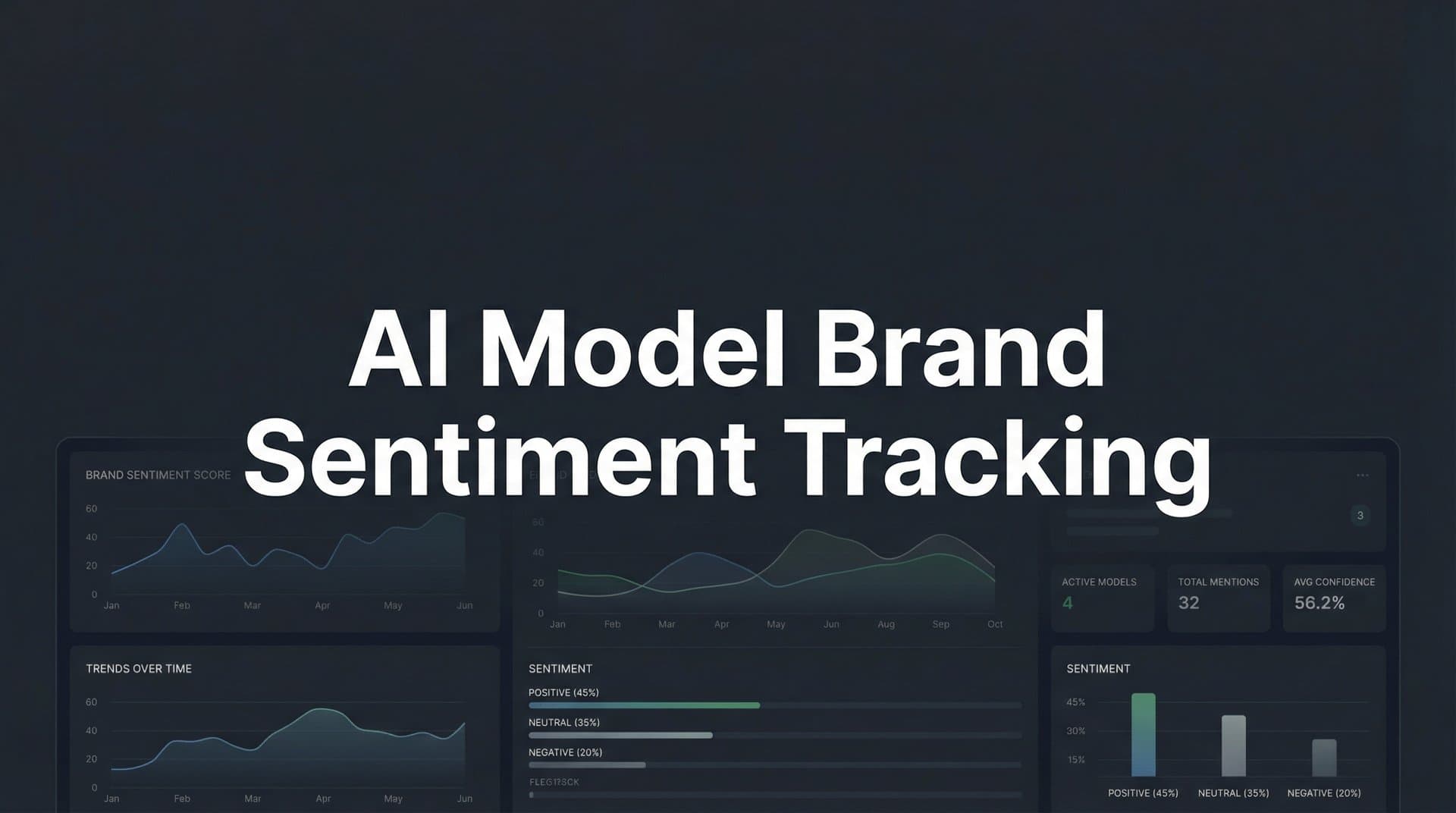
Sentiment distribution provides the qualitative layer. Of the mentions you receive, what percentage are positive, negative, or neutral? This distribution reveals your overall AI brand health. A brand with high mention frequency but predominantly negative sentiment faces a different challenge than a brand with low mention frequency but positive sentiment when mentioned.
Context accuracy matters more than many realize. AI models sometimes generate responses that contain outdated information, conflate your brand with competitors, or attribute features you don't have. Your baseline should document these accuracy issues because they represent specific content opportunities—gaps where authoritative information could correct AI model understanding.
The process of identifying relevant prompts requires industry knowledge and strategic thinking. Start with obvious queries: direct brand mentions, category searches, and top-of-funnel problem statements your product addresses. Then expand to adjacent territories—related problems, complementary solutions, and broader industry trends where your brand should logically appear.
Think like your target customer. What questions would they ask an AI model during their research process? Map the customer journey from problem awareness through solution evaluation, and identify the AI prompts that correspond to each stage. Your brand should have visibility across this entire journey, not just at the final decision point.
Competitive prompt mapping reveals positioning opportunities. Which queries trigger competitor mentions but not yours? These gaps represent immediate opportunities to improve visibility through targeted content creation. Conversely, prompts where you appear but competitors don't reveal your positioning strengths—areas where you've successfully established authority that AI models recognize.
Temporal tracking transforms static metrics into actionable trends. Your baseline isn't a single snapshot—it's a time-series dataset that reveals patterns. Is your mention frequency increasing or declining? Are sentiment scores improving as you publish new content? Are competitor mentions growing faster than yours? These trend lines guide strategic decisions about where to invest resources.
From Monitoring to Action: Improving AI Brand Perception
Monitoring reveals the current state. Strategy transforms that knowledge into improved outcomes. The connection between AI sentiment monitoring and content strategy forms the core of effective AI brand optimization.
When monitoring identifies prompts where your brand should appear but doesn't, you've discovered a content gap. The solution isn't to stuff keywords or game algorithms—it's to create genuinely authoritative content that AI models can reference when generating responses. If AI models don't mention your brand for "how to improve organic traffic with AI," it's because they lack sufficient high-quality training data associating your brand with that solution.
Content that influences AI model sentiment has specific characteristics. It needs depth that establishes expertise, structure that AI models can parse and synthesize, and consistency that reinforces brand associations across multiple touchpoints. One blog post won't shift AI sentiment, but a comprehensive content ecosystem addressing related topics from multiple angles creates the data density that influences model training. Understanding how AI models rank brands helps you create content that resonates with these systems.
Structured data amplifies content impact. When you publish articles, case studies, or product documentation, implementing schema markup helps AI systems understand the content's context and authority. This structured approach to information architecture makes your content more likely to influence AI model responses because it's easier for algorithms to extract and synthesize.
Expert content carries disproportionate weight. AI models trained on diverse internet text learn to recognize authority signals—author credentials, citation patterns, technical depth, and consistent expertise across topics. Content that demonstrates genuine expertise rather than surface-level coverage has greater influence on how AI models understand and describe your brand.
The feedback loop becomes your operational framework: monitor to identify gaps, create targeted content to fill those gaps, measure impact on AI visibility and sentiment, then iterate. This cycle should run continuously because AI models update, competitors create content, and industry conversations evolve. What worked to improve sentiment last quarter may need refinement this quarter.
Consistency matters across all brand touchpoints. AI models synthesize information from diverse sources—your website, third-party reviews, news coverage, social media, forum discussions. Mixed messaging creates confused AI responses. When your website emphasizes ease of use but reviews complain about complexity, AI models generate hedged responses that reflect this tension. Consistent brand messaging across channels creates coherent AI sentiment.
The timeline for results requires patience. Unlike paid advertising where you can see immediate impact, AI model sentiment shifts gradually. Models don't update in real-time—they're retrained periodically on new data. Content you publish today might not influence AI responses for weeks or months, depending on model update cycles. This delayed feedback loop demands sustained commitment rather than quick fixes.
Common Pitfalls and How to Avoid Them
The novelty of AI sentiment monitoring creates predictable mistakes. Understanding these pitfalls helps you avoid wasted effort and strategic missteps.
The most common error is treating AI sentiment like social media sentiment. The monitoring tools might look similar, and both involve tracking brand mentions, but the underlying mechanics are fundamentally different. Social sentiment responds to events in real-time and reflects individual human opinions. AI sentiment synthesizes historical data and generates new text that feels objective. Strategies that work for social listening often fail for AI monitoring because they address different problems.
Over-optimization creates its own problems. When brands discover they can influence AI responses through content, the temptation emerges to game the system—creating thin content stuffed with keywords, generating fake reviews, or manipulating structured data. This approach backfires. AI models are increasingly sophisticated at detecting low-quality content, and future model updates will likely penalize obvious manipulation attempts. More importantly, content optimized for AI but useless to humans fails at the ultimate goal: converting awareness into customers.
The expectation of immediate results leads to premature strategy abandonment. Brands launch AI monitoring, create content, and expect to see sentiment shifts within days or weeks. When changes don't materialize quickly, they conclude the approach doesn't work. This misunderstands the timeline of AI model updates. Meaningful sentiment changes typically require months of consistent effort, not weeks. The brands that succeed are those that commit to long-term strategy rather than seeking quick wins.
Focusing exclusively on direct brand mentions misses the bigger picture. Your AI visibility isn't just about responses to "Tell me about [Your Brand]"—it's about appearing in the countless category, problem-solving, and comparison queries where users discover solutions. A brand that ranks well for direct mentions but is absent from category searches has limited AI visibility where it matters most. Effective AI visibility monitoring for brands captures this complete picture.
Ignoring competitor positioning creates strategic blind spots. Your brand sentiment exists in context. If monitoring reveals that you're consistently described as "more expensive" or "less feature-rich" relative to competitors, that comparative positioning matters more than your absolute sentiment scores. Effective monitoring tracks not just how AI describes you, but how it positions you relative to alternatives users consider.
Putting It Into Practice: Your Monitoring Framework
Theory becomes valuable only when translated into consistent practice. Here's a practical framework for implementing AI sentiment monitoring that balances thoroughness with sustainability.
Weekly Reviews: Track mention frequency and sentiment distribution across your core prompt categories. This weekly pulse check identifies sudden shifts that might indicate new content appearing in AI training data or platform updates affecting your visibility. Weekly monitoring should be quick—15-30 minutes to review dashboards and flag anomalies for deeper investigation. Using AI model sentiment tracking software streamlines this process significantly.
Monthly Analysis: Conduct deeper dives into response quality and context accuracy. Review sample AI responses about your brand, analyze the specific language used, and identify outdated information or positioning issues. This monthly analysis informs content strategy by revealing specific gaps where authoritative content could improve AI understanding. Allocate 2-3 hours monthly for this strategic review.
Quarterly Strategy Sessions: Step back to examine trends, competitive positioning, and strategic priorities. How has your AI visibility evolved over the quarter? Are content investments translating into improved sentiment? Where are competitors gaining ground? These quarterly sessions should involve stakeholders across content, product, and marketing to align AI optimization with broader business goals.
Integration between monitoring and content creation completes the framework. Monitoring shouldn't exist in isolation—it should directly inform your content calendar. When monitoring identifies prompts where you're underrepresented, those become content priorities. When sentiment analysis reveals misconceptions about your product, those become topics for clarifying content. The monitoring-to-content pipeline should be systematic, not ad hoc.
Automation accelerates this framework. Manual monitoring across multiple AI platforms for dozens of prompt variations quickly becomes unsustainable. Selecting the right AI model monitoring tools frees your team to focus on strategic interpretation and content creation rather than data gathering. The most effective teams combine automated monitoring with human strategic thinking.
The New Reality of Brand Perception
We've crossed a threshold in how brands are discovered and evaluated. AI model brand sentiment monitoring isn't a nice-to-have capability for forward-thinking brands—it's foundational infrastructure for any company that depends on organic discovery and brand reputation. The brands that will dominate their categories in the coming years are those that recognize this shift early and build systematic approaches to AI visibility.
The opportunity is significant. Most brands still don't monitor their AI presence, which means early movers gain disproportionate advantage. While competitors remain unaware of how AI models describe them, you can systematically improve your positioning, correct misconceptions, and claim visibility in high-value prompt categories. This visibility compounds over time as improved AI sentiment drives more organic traffic, which generates more brand signals, which further improves AI sentiment.
The risk of inaction is equally significant. As more consumers default to asking AI models for recommendations and research, brands absent from these conversations become progressively more invisible. You can have the best product in your category, but if ChatGPT doesn't mention you when users ask for solutions, you've lost the opportunity to compete for that customer's business.
The integration of monitoring and content creation forms the complete strategy. Monitoring without action is just data. Action without monitoring is guesswork. The brands winning in AI search are those that systematically track their AI visibility, identify specific opportunities for improvement, create authoritative content that addresses those opportunities, and measure the impact on their AI brand sentiment. This closed loop becomes a sustainable competitive advantage.
Stop guessing how AI models like ChatGPT and Claude talk about your brand—get visibility into every mention, track content opportunities, and automate your path to organic traffic growth. Start tracking your AI visibility today and see exactly where your brand appears across top AI platforms.