Something significant is happening to how people find products, services, and answers. A growing share of buyers now skip the search results page entirely, typing their questions directly into ChatGPT, Claude, or Perplexity and trusting the response they get. For many categories, that AI-generated answer is the discovery moment: the point where a brand either enters the consideration set or doesn't exist at all.
Here's the uncomfortable reality for most marketers: your SEO dashboard has no idea what these AI systems are saying about your brand. Your social listening tool doesn't either. Neither does your backlink tracker, your rank monitoring software, or your Google Analytics account. The entire infrastructure of traditional brand monitoring was built for a world where discovery happened through indexed web pages, and that world is quietly changing beneath us.
AI model brand awareness tracking is the discipline of systematically monitoring what AI language models say about your brand when users ask the kinds of questions your buyers actually ask. It means querying AI platforms with real buyer prompts, recording the responses, and analyzing patterns: how often your brand appears, how it's framed, where you're absent, and how you compare to competitors who show up in the same answers. This is a fundamentally different data source from anything traditional brand monitoring captures, and it requires a fundamentally different approach.
This article covers exactly that approach. By the end, you'll understand what AI model brand awareness tracking measures, how to build a prompt tracking strategy, what actually influences AI mentions, and how to turn that data into content and growth decisions that expand your brand's footprint across AI-driven discovery.
The Blind Spot in Your Current Brand Monitoring Stack
Traditional brand monitoring tools were engineered for a specific environment: the open web. Social listening platforms scan public posts and comments. Google Alerts watches for new indexed pages that mention your brand name. Backlink trackers record when other websites link to yours. These tools are genuinely useful for what they were designed to do, and that design assumption was reasonable for years.
The assumption was that discovery happens on indexed pages. A user searches, a results page appears, they click through. Brand visibility meant appearing in those results, either organically or through paid placement. Monitoring meant tracking where your brand appeared across that indexed landscape.
AI language models break this assumption completely. When a user asks ChatGPT "What's the best project management tool for a small agency?" or asks Claude "Which SEO platforms are worth using in 2026?", the response isn't drawn from a ranked list of indexed pages. It's synthesized from training data, retrieval-augmented content, and probabilistic language patterns. The output is a direct answer, often with specific brand recommendations, delivered without a single click to a website.
None of that interaction is captured anywhere in your analytics stack. The user never visited a search results page. There's no referral source in your traffic data. No impression was recorded. No click happened. From the perspective of every traditional monitoring tool, that discovery moment simply didn't occur.
What makes this commercially significant is the confidence with which AI models deliver their answers. When a potential customer asks an AI assistant which platform to use in your category and receives a confident, well-structured recommendation that doesn't include your brand, they have no reason to question whether the answer is complete. They received what feels like expert guidance. The consideration set was formed without you in it, and your monitoring tools reported nothing unusual.
The factors that determine whether your brand appears in AI-generated answers are also quite different from what drives keyword rankings. AI models weight content clarity, entity definition, how frequently authoritative sources associate your brand with specific problems or categories, and how well your published content aligns with common user intents. A brand with strong keyword rankings but thin, jargon-heavy content may rank well in traditional search while being nearly absent from AI responses. The inverse is also possible: a brand with exceptional thought leadership content and strong third-party citations may punch above its SEO weight in AI-generated answers.
This divergence is exactly why AI model brand tracking has emerged as a distinct discipline rather than a feature bolt-on to existing SEO tools. The data sources are different, the signals are different, and the strategic levers are different. Understanding what you're actually measuring is the necessary starting point.
The Metrics That Define AI Brand Visibility
AI brand tracking has a specific operational definition: systematically querying AI platforms with prompts that reflect real buyer questions, then recording and analyzing the responses. But "recording and analyzing" covers a lot of ground. What are you actually measuring, and why does each metric matter?
Mention Frequency: The foundational metric. Across a defined set of prompts run against one or more AI platforms, how often does your brand name appear in the responses? This gives you a baseline visibility rate that can be tracked over time. A brand mentioned in 30 out of 100 prompts has measurably more AI presence than one appearing in 8 of the same 100 prompts.
Share of Voice Within AI Responses: AI-generated answers often mention multiple brands in a category. Share of voice measures how frequently your brand appears relative to the competitors who show up in the same response sets. This is a competitive intelligence layer: you may be present in AI responses, but if a competitor is mentioned twice as often across the same prompt set, that gap is strategically meaningful.
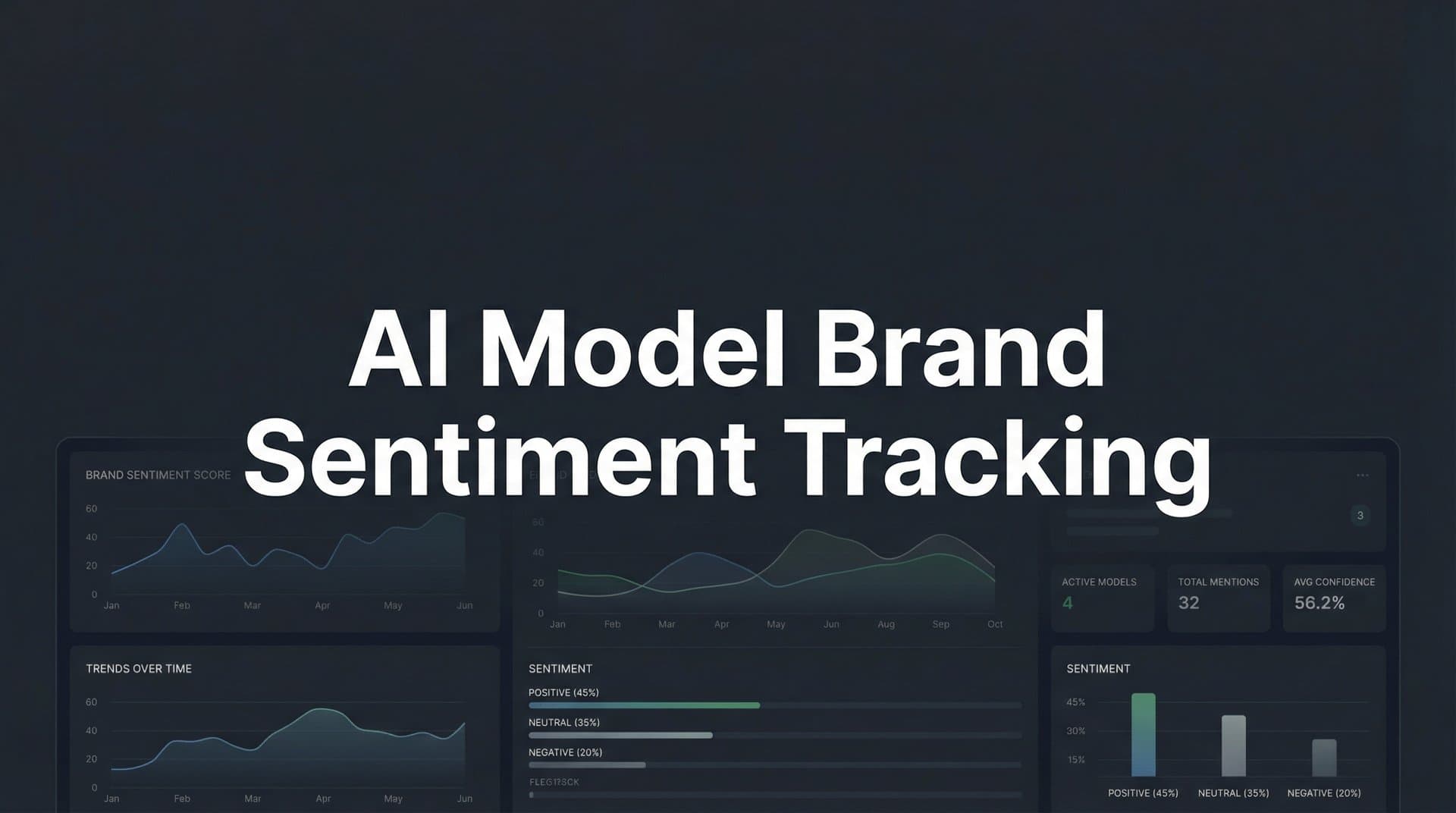
Sentiment and Framing: Not all mentions are equal. An AI model might mention your brand as a leading solution, as a niche option with specific limitations, as a legacy platform being displaced by newer tools, or with a cautionary note about pricing or complexity. Sentiment analysis of AI mentions reveals how your brand is being characterized, not just whether it appears. A brand that appears frequently but is consistently framed with caveats has a different problem than a brand that simply doesn't appear.
Prompt Coverage: This metric maps which buyer-intent queries trigger your brand mention and which ones don't. A brand might appear consistently when users ask direct comparison questions but be absent from top-of-funnel awareness queries. Prompt coverage gaps are direct content strategy signals: they show you exactly where your AI footprint has holes.
AI Visibility Score: An aggregated metric that combines mention frequency, share of voice, and sentiment signals into a single trackable number. The value of an AI Visibility Score isn't the absolute number; it's the trend over time. When you publish a new content campaign, earn coverage in a major industry publication, or update your core product pages, does your AI Visibility Score move? That correlation is what turns AI brand tracking from a curiosity into a performance signal tied to real marketing activity.
Platforms like Sight AI are built around exactly this metrics framework, querying AI models including ChatGPT, Claude, and Perplexity with your tracked prompts, recording the responses, and surfacing these signals in a unified AI visibility dashboard so you can see trends rather than just snapshots.
Building a Prompt Library That Actually Reflects Buyer Behavior
The quality of your AI brand tracking is only as good as the prompts you track. This is the part of the process most analogous to keyword research in traditional SEO, but the mechanics are different enough that it deserves careful attention.
Effective prompt library construction starts with mapping the questions your target buyers actually ask AI systems across the full awareness-to-decision arc. These aren't the queries you wish people were asking. They're the natural language questions someone types when they're trying to solve a problem in your category.
At the awareness stage, prompts tend to be category-level and problem-focused: "What tools help with [specific problem]?" or "How does [your category] work?" These queries are where you want to be present even before a buyer knows your brand name exists. If you're absent here, you're missing the earliest and often most influential moment of the discovery process.
At the consideration stage, prompts become more comparative and evaluative: "What are the best [category] platforms?" or "How does [approach A] compare to [approach B]?" These are the queries where share of voice matters most, because the AI response is directly shaping the consideration set a buyer will carry into their evaluation process.
At the decision stage, prompts get more specific: "Which [category] tool is best for [specific use case or company type]?" or "What should I look for when choosing a [category] platform?" At this stage, framing and sentiment become critical. Being mentioned is necessary but not sufficient; how you're characterized in the answer shapes conversion intent.
Prompt diversity within each stage matters because AI models can return meaningfully different brand mentions depending on phrasing, specificity, and framing. Asking "What's the best SEO tool?" may produce different results than "Which SEO platform is best for content marketing agencies?" Testing variations of each core query surfaces whether your brand appears consistently or only under narrow conditions. Narrow appearance is a risk: it means your AI visibility is fragile and dependent on very specific query patterns.
Tracking prompt cadence is the operational layer that turns a prompt library into a performance system. Running your prompt set on a weekly or bi-weekly schedule allows you to correlate changes in AI mention patterns with specific events: a content publishing push, a press mention in an industry publication, a competitor's product launch, or an update to your website structure. Without consistent cadence, you have data points. With it, you have a signal you can act on.
What Actually Moves the Needle on AI Mentions
Understanding what AI models say about your brand is valuable. Understanding what influences those outputs is where the strategic leverage lives.
AI language models generate responses by drawing on publicly available content: the articles, product pages, documentation, reviews, and third-party references that exist on the open web. This means the quality, clarity, and authority of your published content has a direct relationship with whether and how your brand appears in AI-generated answers. Content that clearly defines what your brand is, what category it belongs to, what problems it solves, and who it's for is more likely to be synthesized into AI responses than content that obscures these things behind vague positioning or keyword-stuffed copy.
Structural clarity matters more here than in traditional SEO. AI models extract information; they don't just index pages. Content organized around clear definitions, direct answers to common questions, and explicit problem-solution framing gives AI systems cleaner material to work with. A well-structured FAQ section that directly answers "What is [your brand] used for?" is more useful to an AI model trying to describe your brand than a narrative product page that buries the same information in marketing prose.
Third-party citations amplify AI visibility in ways that are distinct from their SEO value. When authoritative publications, review platforms, and industry directories reference your brand in the context of specific problems or categories, those associations reinforce your brand's relevance to AI systems processing similar queries. A brand mentioned in a respected industry publication as a solution to a specific problem is more likely to appear when an AI model answers a question about that problem than a brand that only describes itself that way on its own website. This makes earned media and digital PR meaningful levers for improving brand awareness in AI, not just traditional reputation management.
GEO, or Generative Engine Optimization, is the emerging practice of structuring content specifically to improve how AI models represent your brand. The core principles of GEO include entity clarity (making it unambiguous what your brand is and what category it belongs to), structured answer formats (FAQs, definition sections, direct problem-solution framing that AI systems can cleanly extract), and consistent use of specific, attributable claims rather than vague superlatives.
GEO doesn't replace traditional SEO. The content that performs well for AI visibility tends to also perform well in traditional search: it's clear, authoritative, well-structured, and directly useful to readers. The disciplines reinforce each other. But GEO adds a specific layer of intentionality around how content is structured for machine extraction, not just human reading, and that distinction matters when AI-generated answers are increasingly the first thing a buyer sees.
From AI Visibility Data to Content and Growth Decisions
Tracking AI mentions is only valuable if it changes what you do. The real return on AI model brand awareness tracking comes from translating the data into concrete content and strategy decisions.
Prompt gap analysis is the most direct path from data to action. When you run your prompt library and identify which buyer-intent queries don't trigger your brand mention, you have a prioritized content opportunity list. Each gap represents a topic area where your brand has no meaningful presence in AI-generated answers, which typically means you either haven't published authoritative content on that topic or the content you have isn't structured clearly enough for AI systems to extract and attribute.
These gaps are different from keyword gaps in traditional SEO. A keyword gap tells you there's search volume you're not capturing. A prompt gap tells you there's a buyer question being answered by AI systems right now, and your brand isn't in the answer. The buyer is receiving a recommendation set that doesn't include you. Publishing well-structured, authoritative content that directly addresses the topic behind that prompt gap is the mechanism for closing it. If you're finding that AI models aren't mentioning your brand, prompt gap analysis is typically the fastest way to diagnose why.
Sentiment and framing data adds a positioning intelligence layer. If your AI visibility tracking reveals that an AI model consistently describes your brand with qualifiers like "more suitable for enterprise users" when you're targeting mid-market, or "best known for [older use case]" when you've expanded significantly, that's a signal your content and positioning haven't successfully communicated your current identity to the systems that are now representing you to buyers. That's actionable intelligence for your messaging strategy, not just your content calendar.
AI visibility metrics belong in your broader performance reporting alongside organic traffic, keyword rankings, and indexing health. When these signals are tracked together, you can see how changes in one area affect others. A content push that improves your AI Visibility Score but doesn't move organic traffic suggests AI models are picking up the new content before it gains traditional search traction. A press mention that improves your share of voice in AI responses but not your keyword rankings reflects the different mechanisms at work in AI versus traditional search. Seeing both in the same view gives you a more complete picture of how your brand is performing across the full discovery landscape.
Building a Sustainable AI Brand Presence for the Long Term
AI model brand awareness tracking is not a one-time audit you complete and file away. It's an ongoing discipline, and the brands that treat it that way now will be significantly better positioned as AI-driven discovery continues to grow as a channel.
The operational requirements are real: consistent prompt execution, regular reporting cadence, cross-functional alignment between SEO, content, and PR teams, and a feedback loop between what the data shows and what the content team publishes. These aren't complicated processes, but they do require treating AI visibility as a first-class metric rather than an experimental side project.
The strategic case for acting now rather than later is straightforward. AI-generated answers are still a relatively new discovery channel, and competition for mentions within those answers is less intense than it will be once the majority of marketing teams have formalized their AI visibility strategies. The brands investing in GEO-optimized content, structured entity definitions, and systematic AI brand visibility tracking today are building a compounding advantage. The brands waiting for AI discovery to become obviously dominant before acting will be competing for AI mentions in a much more crowded field.
Platforms like Sight AI are designed to make this discipline operationally manageable. By consolidating AI visibility tracking across ChatGPT, Claude, Perplexity, and other AI platforms, content generation optimized for GEO, and website indexing with IndexNow integration into a single workflow, Sight AI lets teams close the loop between identifying AI mention gaps and publishing the content needed to fill them. Instead of managing tracking, content creation, and indexing as separate processes, teams can move from insight to action in a single platform, which matters when prompt gaps are discovered and the competitive window to fill them is limited.
The Bottom Line on AI Brand Visibility
The core shift is this: AI models are becoming a primary interface between buyers and information. When someone asks ChatGPT or Claude which platform to use in your category, the answer they receive shapes their consideration set with the same authority as a trusted recommendation. If your brand isn't in that answer, you're not in the running, and your current analytics stack won't tell you that's happening.
AI model brand awareness tracking closes that blind spot. It gives you visibility into what AI systems are saying about your brand, how you compare to competitors in AI-generated responses, which buyer questions you're not showing up for, and how your content and PR activity influences those outcomes over time. The three action areas are clear: measure your AI visibility systematically, influence it through GEO-optimized content and earned media, and activate the data by turning prompt gaps and sentiment signals into a content strategy that expands your AI footprint.
Stop guessing how AI models like ChatGPT and Claude talk about your brand. Get visibility into every mention, track content opportunities, and automate your path to organic traffic growth. Start tracking your AI visibility today and see exactly where your brand appears across top AI platforms.