When someone opens ChatGPT and types "What's the best project management tool for remote teams?" your brand either gets mentioned or it doesn't. When a potential customer asks Claude to recommend email marketing platforms, your company either appears in that response or gets left out entirely. This isn't hypothetical—it's happening millions of times every day, and most brands have absolutely no idea where they stand.
The discovery landscape has fundamentally shifted. People aren't just searching anymore—they're conversing. They're asking AI assistants for recommendations, comparisons, and buying advice. And unlike traditional search where you could track rankings and impressions, AI conversations happen in a black box. You can't see the queries. You can't monitor the recommendations. At least, you couldn't until recently.
AI model brand preference tracking is the emerging discipline that pulls back the curtain on this invisible influence layer. It's how forward-thinking marketers answer the critical question: when AI models recommend solutions in your category, does your brand make the cut? More importantly, it's how you understand which prompts trigger mentions, which competitors dominate specific use cases, and what content gaps are keeping you invisible in AI-powered discovery.
How AI Models Actually Form Brand Opinions
Understanding AI brand preference tracking starts with understanding how these models actually "think" about brands in the first place. When someone asks ChatGPT or Claude for a recommendation, the model isn't accessing a database of sponsored listings or paid placements. It's synthesizing patterns from its training data, applying contextual relevance filters, and constructing a response based on what it has learned about brand authority, use cases, and sentiment signals.
The training data component is foundational. Large language models consume vast amounts of text from across the internet—articles, reviews, documentation, social media, forums, and more. Brands that appear frequently in authoritative contexts, with positive sentiment and clear use case associations, naturally become more likely to surface in recommendations. A brand mentioned in hundreds of credible articles about "enterprise CRM solutions" builds a stronger association with that category than one mentioned sporadically or only in promotional contexts.
But training data alone doesn't tell the whole story. Many AI models now incorporate retrieval mechanisms that pull in recent information beyond their knowledge cutoff dates. When you ask Perplexity a question, it actively searches the web and synthesizes current sources. When you use ChatGPT with search enabled, it can access recent content. This creates a dynamic layer where fresh, well-optimized content can influence recommendations even if it wasn't part of the original training corpus.
Contextual relevance is where things get interesting. The same brand might get recommended for one prompt but ignored for a slightly different variation. Ask "What's the best analytics tool for startups?" and you might get one set of brands. Ask "What analytics platform handles enterprise-scale data?" and the recommendations shift entirely. AI models are remarkably sensitive to context clues—industry, company size, budget signals, technical requirements, and use case specifics all influence which brands surface. Understanding how AI models mention brands is essential for optimizing your visibility.
This is why the same prompt can yield completely different brand recommendations across ChatGPT, Claude, Gemini, and Perplexity. Each model has different training data, different retrieval mechanisms, different fine-tuning approaches, and different tendencies in how they weight various signals. ChatGPT might favor brands with strong developer community presence. Claude might emphasize brands with detailed documentation and clear value propositions. Perplexity might prioritize brands with recent, well-cited content.
Sentiment and authority signals play a crucial role in shaping these recommendations. Brands associated with positive user experiences, industry awards, expert endorsements, and thought leadership content build stronger positive associations in the model's understanding. Conversely, brands primarily mentioned in complaint forums or negative reviews face an uphill battle for favorable recommendations. The model isn't making moral judgments—it's pattern matching based on the sentiment distribution it encountered during training and retrieval.
Content structure matters more than most marketers realize. AI models are particularly responsive to clear, well-structured information that explicitly connects brands to specific use cases, features, and outcomes. A scattered blog post that mentions your brand in passing has far less influence than a detailed comparison article that clearly articulates what your product does, who it's for, and what problems it solves. The models are looking for signal, not noise.
The Core Metrics That Actually Matter
AI model brand preference tracking isn't about vanity metrics—it's about measuring the signals that predict discovery and conversion in AI-mediated research. The metrics that matter fall into several distinct categories, each revealing different aspects of your brand's AI visibility landscape.
Mention Frequency: The most basic metric is how often your brand appears in AI responses across a defined set of relevant prompts. If you test 100 prompts related to your category and your brand appears in 23 responses, that's your baseline mention frequency. This metric reveals your overall visibility footprint, but it's just the starting point. Implementing AI model brand mention tracking gives you the foundation for understanding your presence.
Recommendation Position: When your brand does get mentioned, where does it appear in the response? Being the first recommendation carries significantly more weight than being the fifth option in a list. Position tracking reveals whether you're a primary recommendation or an afterthought. Many AI responses follow a pattern of leading with the most established or contextually relevant option, then providing alternatives. Your position in that hierarchy matters.
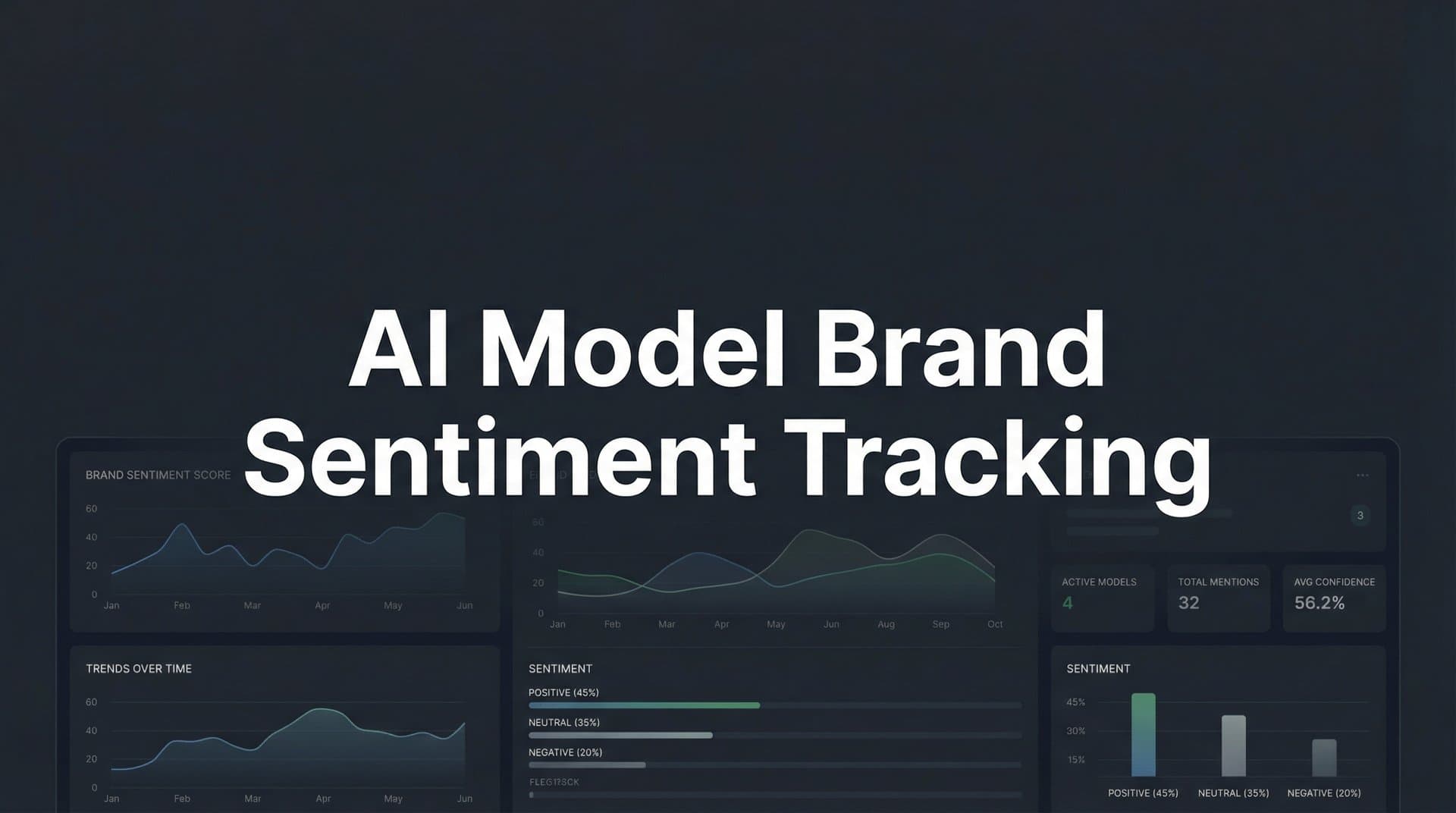
Sentiment Polarity: Not all mentions are created equal. A brand mentioned with positive framing ("known for excellent customer support") carries different weight than neutral mentions ("also offers this feature") or negative framing ("while X has these limitations"). Tracking the sentiment distribution across your mentions reveals whether AI models are positioning you favorably or highlighting weaknesses. Effective AI model brand sentiment tracking helps you understand this critical dimension.
Competitive Share of Voice: Perhaps the most strategically valuable metric is how your mention frequency and positioning compare to direct competitors. If you appear in 23 out of 100 relevant prompts but your main competitor appears in 67, that gap represents lost opportunity. Share of voice tracking reveals competitive dynamics in the AI recommendation landscape.
There's a critical distinction between passive mentions and active recommendations that many marketers miss. A passive mention might be: "Other options in this space include Brand X, Brand Y, and Brand Z." An active recommendation sounds like: "For your specific use case, I'd recommend Brand X because it excels at handling enterprise-scale data with strong security features." Active recommendations demonstrate that the AI model has formed a clear association between your brand and specific value propositions.
Prompt variation analysis adds another dimension to tracking. The same brand might perform well for broad category queries ("best marketing automation tools") but poorly for specific use case queries ("marketing automation for e-commerce brands with complex customer journeys"). Testing systematic prompt variations reveals the true breadth and depth of your AI visibility—where you're strong, where you're weak, and where opportunity gaps exist.
Designing a Systematic Monitoring Framework
Effective AI brand preference tracking requires structure. Ad hoc testing of random prompts might reveal interesting anecdotes, but it won't give you the strategic intelligence needed to make informed optimization decisions. Building a proper monitoring framework starts with identifying the prompts and use cases that actually matter for your business.
The first step is mapping your category's prompt landscape. Think about the questions your potential customers actually ask when researching solutions. These typically fall into several categories: broad discovery prompts ("what are the best tools for X"), use case-specific prompts ("which tool handles Y scenario"), comparison prompts ("X vs Y comparison"), and problem-solution prompts ("how do I solve Z problem"). Your tracking framework should include representative prompts from each category.
Don't limit yourself to obvious brand-name queries. The real opportunity lies in capturing recommendation moments where users don't yet know which brands to consider. Someone asking "what's the best way to track website analytics without cookies" represents a discovery opportunity—if your brand appears in that response, you've entered their consideration set. Someone asking "Google Analytics alternatives for privacy-focused companies" is further along but still open to recommendations. Using AI model prompt tracking software helps you systematically capture these opportunities.
Setting up systematic tracking across multiple AI platforms simultaneously is essential because each platform has distinct recommendation patterns. A brand that dominates ChatGPT recommendations might barely appear in Claude responses. Testing the same prompt set across ChatGPT, Claude, Gemini, and Perplexity reveals platform-specific visibility gaps and opportunities. This multi-platform approach also protects against over-optimizing for a single model while neglecting others. A multi AI model tracking platform makes this process manageable.
Creating baseline measurements establishes your starting point and makes improvement measurable. Run your complete prompt set across all target platforms and document the results: mention frequency, positioning, sentiment, competitive comparisons. This baseline becomes your benchmark for measuring the impact of optimization efforts. Without it, you're flying blind—you might improve your AI visibility significantly but have no way to prove it.
Establishing meaningful benchmarks requires both internal and competitive context. Internally, you're tracking changes over time—did this month's content push improve mention frequency? Did optimizing for specific use cases improve positioning in those categories? Competitively, you're measuring against rivals—are you gaining or losing share of voice? Are competitors dominating specific prompt categories where you're absent?
The monitoring framework should also include frequency and consistency protocols. AI model responses can shift as models are updated, as new content gets indexed, and as competitive dynamics evolve. Monthly tracking provides enough data to identify trends without becoming overwhelming. More frequent tracking might be warranted during active optimization campaigns or product launches when you're specifically working to improve AI visibility.
Turning Data Into Strategic Intelligence
Raw tracking data is just noise until you translate it into actionable strategic intelligence. The real value of AI brand preference tracking emerges when you connect mention patterns to content gaps, competitive threats, and optimization priorities.
Content gap analysis is the most direct application of tracking data. When you identify prompt categories where your brand should appear but doesn't, you've found a content gap. If competitors consistently get mentioned for "enterprise security features" prompts but you don't, despite having strong security capabilities, that signals a content problem. The AI models don't associate your brand with that value proposition because the content reinforcing that association doesn't exist or isn't authoritative enough.
These gaps typically manifest in several ways. Sometimes you have the product capability but lack the content that explicitly connects your brand to that use case. Sometimes you have basic content but it lacks the depth, structure, or authority signals that influence AI recommendations. Sometimes you're entirely absent from a conversation that matters to a segment of your target market. Leveraging brand tracking for competitive analysis reveals exactly where these gaps exist.
Competitive threat identification becomes systematic rather than anecdotal when you track share of voice across prompt categories. If a competitor suddenly starts dominating recommendations in a category where you previously had strong presence, that's an early warning signal. Maybe they published comprehensive new content. Maybe they earned coverage in authoritative publications. Maybe their product evolved and the AI models picked up on that evolution. Whatever the cause, the tracking data alerts you to the threat before it impacts your pipeline.
The most sophisticated use of tracking data involves connecting AI visibility trends to broader marketing and content strategy decisions. If you notice strong performance in prompts related to specific use cases, that might inform product positioning, content themes, and even product development priorities. If you see weak performance despite significant content investment in a particular area, that signals a need to revisit content quality, distribution, or optimization approach.
Tracking data can also reveal unexpected opportunities. You might discover that your brand gets mentioned in adjacent categories you hadn't actively targeted. These serendipitous mentions often indicate organic brand associations that could be deliberately strengthened. If AI models are already connecting your brand to use cases you hadn't emphasized, leaning into those associations might be easier than fighting for visibility in oversaturated categories.
The analysis process should include regular reporting that highlights trends, opportunities, and threats. Which prompt categories showed improvement? Which showed decline? Where are competitors gaining ground? What new content themes are emerging in AI recommendations? These insights feed directly into content planning, SEO strategy, and product marketing decisions. An AI model tracking dashboard centralizes this intelligence for your team.
Converting Insights Into Improved AI Visibility
Tracking reveals where you stand. Optimization is what you do about it. The connection between AI brand preference tracking and actual visibility improvement creates a feedback loop that compounds over time—track, optimize, measure improvement, refine approach, repeat.
Content optimization for AI visibility follows different principles than traditional SEO, though there's significant overlap. AI models are particularly responsive to content that clearly and comprehensively addresses specific use cases, explicitly connects brands to capabilities, and demonstrates authority through depth and structure. A thin blog post optimized for keywords won't move the needle. A detailed guide that thoroughly explores a use case, compares approaches, and provides genuine value has far more influence.
The structure of that content matters enormously. AI models excel at extracting information from well-organized content with clear headings, logical flow, and explicit connections between problems and solutions. When you're creating content intended to influence AI recommendations, think about how an AI model would parse and synthesize that information. Are your key value propositions clearly stated? Are use cases explicitly described? Are competitive differentiators articulated in concrete terms? Understanding tracking AI model recommendations helps you reverse-engineer what works.
Authority signals amplify content impact. Content published on your own blog has less influence than content published in industry publications, cited in authoritative sources, or referenced in technical documentation. Building AI visibility often requires a distributed content strategy—creating valuable content across multiple channels, earning coverage in publications that AI models consider authoritative, and building citation networks that reinforce brand associations.
The feedback loop is where systematic tracking becomes truly powerful. You identify a gap—your brand doesn't appear in prompts about "real-time collaboration features" despite having strong capabilities in that area. You create optimized content addressing that gap—detailed guides, comparison content, use case documentation. You wait for that content to get indexed and incorporated into AI model knowledge. You re-test your prompts and measure whether mention frequency improved in that category.
This cycle reveals what works and what doesn't. Maybe your first content attempt didn't move the needle—perhaps it wasn't comprehensive enough, wasn't distributed widely enough, or didn't earn enough authority signals. You refine your approach based on what tracking data reveals. Maybe you need deeper content. Maybe you need better distribution. Maybe you need to build more citations from authoritative sources. Exploring AI model citation tracking methods can help you understand these authority dynamics.
Measuring improvement over time requires patience and consistency. AI model knowledge doesn't update instantly. Content needs to be discovered, indexed, and incorporated into model understanding—whether through training data updates or retrieval mechanisms. Meaningful improvement typically shows up over weeks or months, not days. But when it does show up, it compounds. Improved visibility leads to more brand mentions, which reinforces brand associations, which leads to even more visibility.
The most sophisticated practitioners connect AI visibility optimization to their broader content and SEO strategy. The same content that improves AI recommendations often improves traditional search visibility. The same authority-building activities that influence AI models—earning quality backlinks, getting cited in authoritative publications, building comprehensive resource libraries—also strengthen domain authority and search rankings. AI visibility optimization isn't a separate discipline—it's an extension of content marketing best practices with AI-specific nuances.
Mastering the New Visibility Landscape
AI model brand preference tracking isn't a nice-to-have capability for brands serious about future-proofing their discovery strategy—it's foundational infrastructure for competing in the AI-mediated research landscape. As more buyers start their research conversations with ChatGPT, Claude, and Perplexity instead of Google, the brands that appear in those recommendations capture attention and consideration. The brands that don't become invisible.
The core workflow is straightforward: monitor systematically, analyze strategically, optimize deliberately, measure improvement, and refine your approach. Start by mapping the prompt landscape that matters for your category. Build a tracking framework that measures mention frequency, positioning, sentiment, and competitive dynamics across multiple AI platforms. Translate that data into content gaps and optimization priorities. Create content designed to influence AI recommendations. Measure whether your efforts are working. Adjust and iterate.
This isn't a one-time project—it's an ongoing discipline. AI models evolve. Competitive dynamics shift. New content gets published. Your tracking framework needs to run continuously, revealing trends and opportunities as they emerge. The brands that master this discipline now, while the practice is still emerging, will dominate AI-powered discovery as these platforms become primary research tools for buyers across every category.
The opportunity window won't stay open forever. As more brands recognize the importance of AI visibility and begin optimizing deliberately, competition for AI recommendations will intensify. The early movers who build systematic tracking capabilities, understand what influences AI brand mentions, and optimize their content accordingly will establish positions that become harder to displace over time. The brands that wait will find themselves fighting for scraps in an increasingly crowded landscape.
Stop guessing how AI models like ChatGPT and Claude talk about your brand—get visibility into every mention, track content opportunities, and automate your path to organic traffic growth. Start tracking your AI visibility today and see exactly where your brand appears across top AI platforms.