Content marketing used to have one job: rank on Google. Build the right pages, earn the right backlinks, and your brand shows up when people search. That playbook worked for years. It still works, partly. But something has shifted underneath it.
A growing share of searches never reach a results page anymore. Instead, users type a question into ChatGPT, Claude, or Perplexity and get a direct answer. No clicking through. No scrolling past ads. Just a response, often with a handful of cited sources. If your brand isn't one of those sources, you simply don't exist in that moment.
This is the tension at the center of modern content marketing: teams are already stretched producing enough content to compete in traditional search, and now there's a second audience to satisfy. AI models don't rank pages the way Google does. They retrieve, synthesize, and cite. The content that earns citations is structured differently, signals authority differently, and requires a different kind of intentionality to produce at scale.
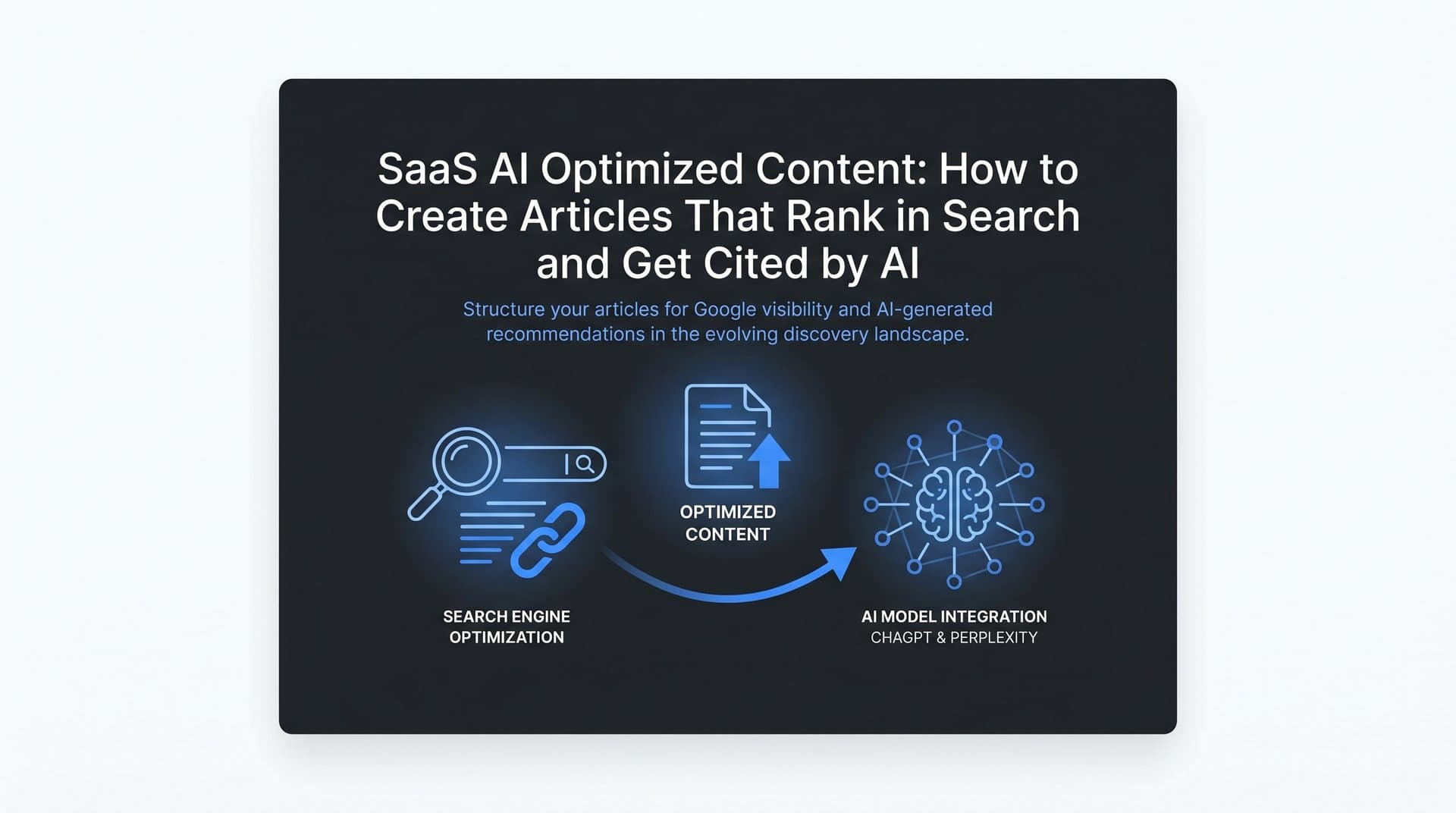
An AI generated content strategy addresses both channels at once. It's not about replacing your SEO efforts. It's about extending them into the AI layer of search, where brand visibility is increasingly being won or lost. This article breaks down what that strategy looks like in practice: how to find the right topics, create content that earns AI citations, get it indexed fast, and measure performance across both traditional and AI-powered search. By the end, you'll have a clear framework for building a content engine that compounds over time.
Why Traditional Content Planning Falls Short in an AI-First World
Most content strategies are built around a familiar workflow: keyword research, competitive analysis, content briefs, publishing, and tracking rankings. It's a solid foundation. The problem is that this workflow was designed for one audience, search engine crawlers, and optimized for one outcome, organic rankings on a results page.
AI answer engines work differently. When a user asks ChatGPT or Perplexity a question, the model doesn't return a list of links. It synthesizes an answer from the information it has access to, and it selects sources to cite based on factors that traditional SEO tools don't measure: how clearly the content answers the question, how authoritative the source appears, how well-structured the information is for extraction. A page can rank on page one of Google and still never appear in an AI-generated response.
This is where Generative Engine Optimization, or GEO, enters the picture. GEO is a distinct discipline from SEO, focused specifically on optimizing content so that AI language models retrieve and cite it accurately. The formatting requirements are different. Instead of optimizing for click-through rate and dwell time, you're optimizing for extractability: clear definitions, direct answers at the top of the page, structured headings, and comprehensive topic coverage that signals depth and authority.
The authority signals differ too. AI models tend to favor content that demonstrates original thinking, cites credible sources, and covers a topic with enough depth to be genuinely useful. Thin, generic content that might rank for a low-competition keyword rarely earns a citation in an AI-generated answer. The bar for what counts as "good enough" is higher in the AI retrieval context.
Here's the blind spot most marketing teams are operating with right now: they have no idea how AI models are describing their brand, or whether they're being mentioned at all. Traditional SEO dashboards track rankings, traffic, and impressions. None of those metrics tell you whether ChatGPT recommends your product when someone asks for solutions in your category, or whether Claude describes your brand accurately when a user asks about it directly.
Brands without an intentional AI visibility strategy are essentially flying blind in a channel that is growing in influence every month. The teams that recognize this gap early and build a systematic response to it are the ones that will hold a compounding advantage as AI-generated answers become an even larger share of how information is consumed online.
The Four Pillars of a Functional AI Content Strategy
An AI generated content strategy is more than a collection of AI-assisted writing tools. It's a system with interconnected components, each feeding the next. Strip it down and you get four core pillars: topic discovery, content creation, indexing, and visibility tracking. Miss any one of them and the system leaks value.
Topic Discovery: Before you write a word, you need to know what AI models are actually being asked in your industry. This is different from traditional keyword research, which tells you what people type into Google. AI prompt tracking reveals which questions are generating AI-generated responses in your niche, and more importantly, which of those responses don't include your brand. Those gaps are your highest-priority content opportunities.
Content Creation: Once you know what to write, the creation process needs to be built for two audiences simultaneously. SEO optimization for search engine rankings and GEO optimization for AI citation are not mutually exclusive, but they require deliberate attention to structure, depth, and formatting. Producing this kind of content at scale requires specialized AI agents, not generic writing tools. An agent trained to write explainers applies different logic than one trained to write comparison guides, and both need to apply GEO principles from the first draft.
Indexing: Publishing is not the same as being discovered. Content that sits unindexed for days or weeks after publication is content that isn't earning rankings or citations. Rapid indexing through protocols like IndexNow, combined with automated sitemap updates, compresses the time between publishing and discoverability. In a high-volume content operation, this step is often the difference between content that compounds quickly and content that takes months to gain traction.
Visibility Tracking: The feedback loop that makes the whole system intelligent is measurement. Tracking whether your brand appears in AI-generated responses, how it's described, and which content is earning citations tells you what's working. Without this data, you're optimizing blind. With it, you can continuously refine your topic priorities, content formats, and publishing cadence based on what actually drives AI visibility.
One more distinction worth making: there's a meaningful difference between using AI to write content and having an AI content strategy framework. The former is a tool. The latter is a system. Plenty of teams are using AI to produce more words faster. Far fewer are using AI visibility data to decide what to write, specialized agents to produce content optimized for citation, and automated indexing to ensure that content reaches its audience as quickly as possible. The strategy is what turns the tool into a compounding asset.
Finding the Right Topics: AI Visibility and Content Gap Analysis
The question "what should we write about?" has always been the hardest one in content marketing. Traditional keyword research gives you search volume and competition data, which is useful. But in an AI-first content strategy, the more important question is: what are AI models being asked about my industry, and where is my brand absent from those answers?
This requires a different kind of research. Prompt tracking tools monitor the queries being directed at AI models in a given category and surface which responses include your brand and which don't. Think of it as a new layer of competitive intelligence. You're not just asking "who ranks above me on Google?" You're asking "who is ChatGPT recommending when someone asks about solutions like mine, and why isn't it me?"
Content gap analysis in this context is particularly powerful. When you can see that a competitor is being cited by Claude or Perplexity for a specific topic and your brand is absent, that's a concrete, actionable signal. It tells you there's a content opportunity with demonstrated demand, where AI models have already decided the topic is worth answering, and where you have a clear path to earning a citation if you produce the right content.
Sentiment analysis adds another dimension. It's not enough to know whether your brand appears in AI responses. How it's described matters enormously. If an AI model mentions your brand but frames it negatively, or if it describes your product inaccurately, that's a different kind of problem than simply being absent. Prompt tracking with sentiment analysis lets you identify both gaps and misrepresentations, each of which requires a different content response.
The output of this research process should feed directly into your editorial calendar. Topics where competitors are being cited and you're absent become high-priority content projects. Topics where your brand appears but sentiment is neutral or negative become candidates for deeper, more authoritative content that gives AI models better material to work with. Topics where you're consistently cited and described accurately can inform the formats and structures that are working, giving you a template to replicate.
Sight AI's platform is built around exactly this workflow. The AI Visibility Score tracks brand mention frequency and sentiment across more than six AI platforms, and the prompt tracking feature surfaces the specific queries where your brand is missing from AI-generated answers. That data feeds directly into content planning, turning what used to be guesswork into a data-driven editorial process.
Creating Content AI Models Actually Cite
Understanding what to write is only half the challenge. The other half is writing it in a way that AI models will actually retrieve and cite. This is where GEO principles become practical and specific.
Structure is the most immediate lever. AI models favor content that leads with a direct answer, uses clear and descriptive headings, breaks complex information into numbered steps or distinct sections, and defines terms explicitly. The pattern makes sense when you think about how AI retrieval works: the model is looking for content it can extract a clean, accurate answer from. Content that buries its main point in paragraph four, or that uses vague headings like "More Information," is harder to extract from reliably.
A practical rule: write as if the first sentence of every section needs to stand alone as a useful answer. If someone asked the question implied by your heading, could they get a satisfactory response from just the opening line? That discipline forces clarity and makes your content far more extractable.
Authority signals are the second major factor. AI systems are trained to favor content that demonstrates credibility: original insights that go beyond what's already published, cited sources that support claims, author expertise signals, and comprehensive coverage that shows genuine depth on a topic. Thin content that aggregates existing information without adding perspective rarely earns citations. Content that offers a distinct point of view, backs it up with real evidence, and covers the topic thoroughly is far more likely to be surfaced.
This has implications for how you use AI in the creation process. AI agents can dramatically accelerate content production, but the output needs to be shaped by real expertise and original thinking to earn AI citations. The goal isn't to produce more generic content faster. It's to produce well-structured, authoritative content at a pace that would be impossible without AI assistance.
Format selection matters too. Explainers, listicles, how-to guides, and comparison articles tend to be cited more frequently by AI models because they contain discrete, extractable answers. A listicle of "10 ways to improve X" gives an AI model ten distinct facts to work with. A comparison guide gives it structured, side-by-side information it can reference accurately. These formats are inherently more citable than long-form narrative essays.
Sight AI's content generation system uses 13+ specialized AI agents, each trained for a specific content type. An agent built for explainers applies different structural logic than one built for comparison guides, and both apply SEO and GEO optimization principles from the first draft. This is the difference between using a generic AI writer and using a multi-agent content writing system designed specifically to produce content that earns citations.
Getting Your Content Indexed and Discovered Fast
Here's a problem that doesn't get enough attention in content strategy discussions: the gap between when you publish content and when it actually gets discovered. In a traditional content operation producing a handful of articles per month, a few days of indexing lag is manageable. In a high-volume AI content strategy, that lag compounds into a serious drag on performance.
Search engines and AI crawlers can't rank or cite content they haven't found yet. Every day a piece of content sits unindexed is a day it's not earning traffic or citations. For teams publishing at scale, this means dozens of articles per month are sitting in a discovery queue, waiting for crawlers to find them on their own schedule.
IndexNow is the most direct solution to this problem. It's a real protocol, supported by Microsoft Bing, Yandex, and other search engines, that allows websites to instantly notify search engines when new content is published or updated. Instead of waiting for a crawler to discover your new article on its next scheduled visit, IndexNow pushes a notification the moment the content goes live. The result is dramatically faster indexing, which means faster ranking potential and faster exposure to AI crawlers.
Automated sitemap updates work alongside IndexNow to ensure that your site's structure always reflects your latest content. When a new article is published, the sitemap should update automatically to include it. This sounds like a minor technical detail, but in high-volume operations it's a meaningful efficiency. Manual sitemap management doesn't scale, and an outdated sitemap means crawlers are working from incomplete information about your content library.
CMS auto-publishing integrations remove another bottleneck. When AI-generated content moves through a review workflow and is approved, it should publish automatically without requiring manual intervention. This keeps publishing velocity high without creating operational debt, where content is written and approved but sitting in a queue waiting for someone to hit publish.
Sight AI's indexing tools combine IndexNow integration with automated sitemap updates, and the CMS auto-publishing capability connects content generation directly to publication. For teams running an Autopilot Mode workflow, this means content can move from AI generation to live publication to indexed discoverability with minimal manual touchpoints.
Measuring What Matters: AI Visibility Alongside Traditional SEO Metrics
Most marketing teams have a well-established measurement framework: organic traffic, keyword rankings, impressions, click-through rates. These metrics are valuable and shouldn't be abandoned. But they have a significant blind spot: they tell you nothing about how your brand performs in AI-generated answers.
A brand can see strong organic traffic growth while simultaneously being absent from every AI-generated response in its category. Those two realities can coexist because they're measuring different channels. As AI-generated answers capture a growing share of user queries, a measurement framework that ignores AI visibility is increasingly incomplete.
The core addition to any AI content strategy measurement framework is an AI Visibility Score: a metric that tracks how frequently your brand is mentioned across AI platforms, in what context, and with what sentiment. This gives you a comparable signal to organic rankings, but for the AI channel. Are you being cited more or less often than last month? Are you appearing for the queries that matter most to your business? Is the sentiment around your brand improving or declining?
Cross-platform monitoring is essential here because each AI model behaves differently. ChatGPT, Claude, and Perplexity have different training data, different retrieval behaviors, and different tendencies around which sources they cite. A brand might appear consistently in Perplexity responses and be largely absent from Claude's answers for the same queries. Without monitoring across multiple platforms, you can't see the full picture of your AI visibility.
The most valuable aspect of AI visibility measurement is the feedback loop it creates. When you can see which content formats are earning more citations, which topics are generating consistent brand mentions, and which platforms are most responsive to your content, that data should directly inform your next editorial cycle. Topics that earn strong AI citations should generate more content in similar formats. Topics where you're absent despite publishing should prompt a review of structure and authority signals.
This is how an AI content strategy becomes self-improving over time. Each cycle of measurement feeds better decisions into the next cycle of content creation. Teams that build this feedback loop early will accumulate a compounding advantage over those still measuring success purely through traditional SEO metrics.
Building Your AI Content Engine: The Strategic Sequence
Pull everything together and the strategic sequence becomes clear. Start with AI visibility tracking to understand where your brand stands across AI platforms and where the gaps are. Use that data to identify high-priority topics where competitors are being cited and you're absent. Create structured, authority-rich content in formats that AI models favor, using specialized agents that apply GEO optimization from the first draft. Index that content rapidly through IndexNow and automated sitemap updates. Measure citation performance alongside traditional SEO metrics. Feed those results back into the next round of topic discovery.
That loop, running continuously, is an AI content engine. It's not a one-time project or a quarterly initiative. It's an ongoing system that gets smarter with every cycle because each measurement cycle informs better content decisions, and better content decisions generate stronger citation performance.
The brands that will dominate AI-generated answers over the next few years are not necessarily the ones with the biggest content teams or the largest budgets. They're the ones building and refining this engine systematically, compounding their AI visibility while competitors are still trying to figure out whether the channel matters.
Sight AI's platform is designed to be the operational backbone of this system. AI visibility tracking, prompt monitoring across 6+ platforms, sentiment analysis, 13+ specialized content agents, Autopilot Mode, IndexNow integration, automated sitemap updates, and CMS auto-publishing all connect into a single workflow. Instead of stitching together separate tools for each component, teams can run the entire AI content engine from one place.
The content landscape has fundamentally shifted. Visibility now requires being present in both traditional search and AI-generated responses, and the two channels reward different things. An AI generated content strategy is how you address both simultaneously, systematically, and at scale. The four pillars, topic discovery, content creation, indexing, and visibility tracking, give you the structure. The right platform gives you the execution speed. Start tracking your AI visibility today and see exactly where your brand appears across top AI platforms, where the gaps are, and what content you need to close them.