Something fundamental shifted in how people find software. Not long ago, a SaaS marketer's entire discovery strategy revolved around one question: "Can we rank on page one of Google?" Today, that question is necessary but no longer sufficient. A growing segment of buyers now opens ChatGPT, Claude, or Perplexity and simply asks, "What's the best tool for managing customer onboarding?" or "Compare the top project management platforms for remote teams." The answer they receive isn't a list of blue links. It's a synthesized recommendation, often citing specific products by name.
This is the new content reality for SaaS companies. Your potential customers are getting answers from AI models that pull from the web, synthesize information, and deliver confident recommendations without ever sending the user to a search results page. If your content isn't structured to be retrieved and cited by those models, your brand is invisible in that interaction, regardless of your Google rankings.
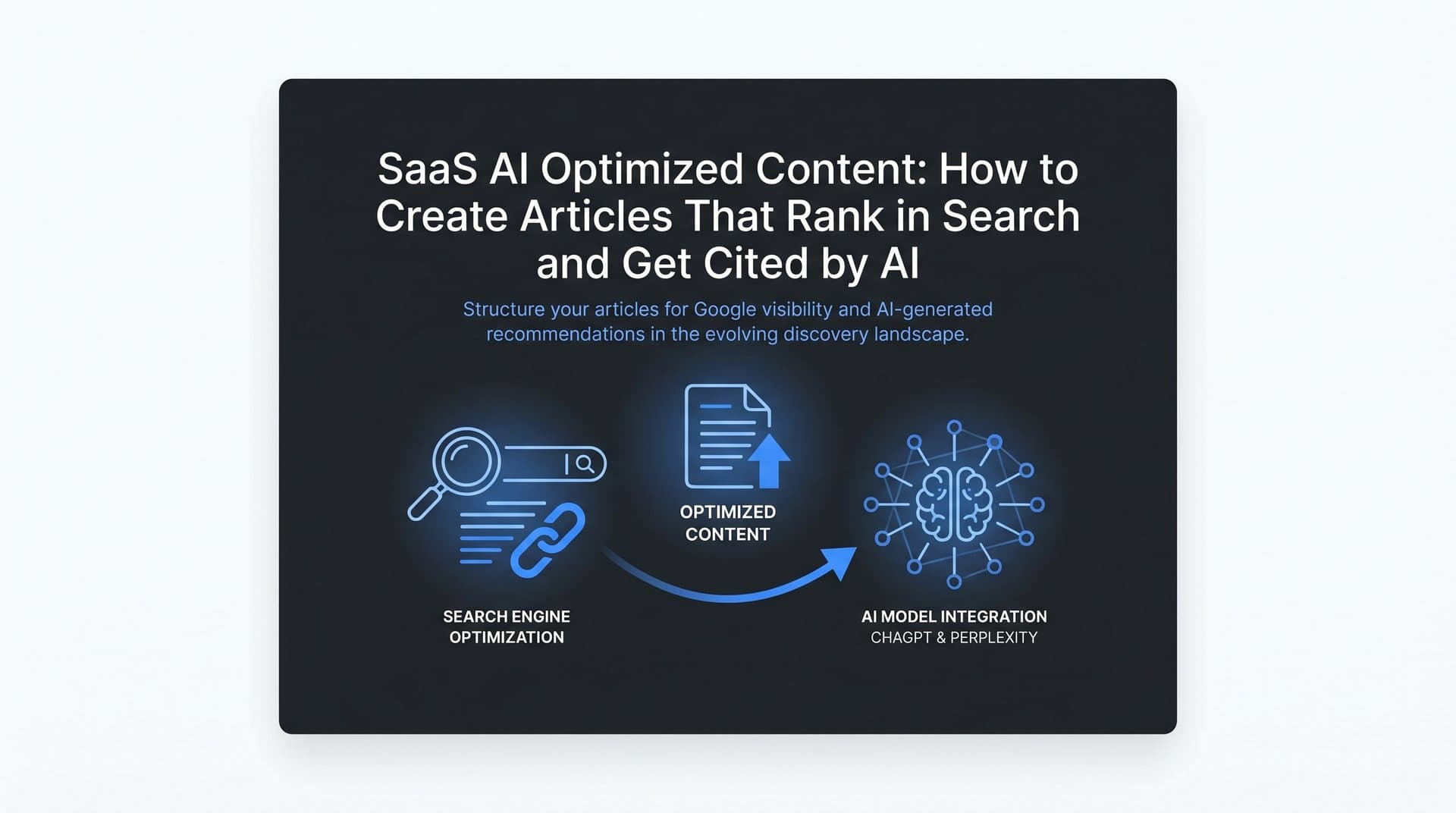
SaaS AI optimized content is the practice of writing, structuring, and distributing articles so they perform well across both traditional search engines and generative AI platforms. It combines the discipline of SEO with an emerging practice called Generative Engine Optimization, or GEO. This article is a practical explainer for marketers, founders, and agencies who want their SaaS brand mentioned across AI-powered search. We'll cover why traditional SEO content often falls short, what AI-optimized content actually looks like, how to build the workflow, and how to measure results across both channels.
The Visibility Gap Traditional SEO Can't Close
Here's a scenario that's becoming increasingly common. A SaaS company invests heavily in content marketing, earns page-one rankings for competitive keywords, and sees solid organic traffic. Then someone asks Claude or Perplexity for a recommendation in their category, and the brand never comes up. A competitor with fewer backlinks and lower domain authority gets cited instead. What happened?
The answer lies in how AI models retrieve and synthesize information compared to how Google ranks pages. Google's algorithm evaluates hundreds of signals to determine which pages best match a query, then presents a ranked list. The user clicks and reads. AI models do something fundamentally different: they retrieve relevant content from across the web, extract key facts and entities, and synthesize a coherent answer. The user never visits your page. The AI speaks for you.
This means the signals that drive Google rankings don't fully overlap with the signals that drive AI citation. AI models tend to favor content that is factually dense, clearly structured with defined entities, and published on domains with strong topical authority. Thin paragraphs, hedging language, and content built primarily around keyword density are less likely to be extracted and used in AI-generated answers. A page optimized purely for search crawlers may rank well but offer AI models very little to work with. Teams still relying on manual SEO content writing processes often find their output lacks the structural precision AI retrieval demands.
The visibility gap is real and it's growing. As more users shift discovery behavior toward conversational AI, the compounding effect of being absent from AI-generated answers becomes more significant over time. SaaS brands that only optimize for traditional search are building on a foundation that covers less and less of the discovery surface.
The solution isn't to abandon SEO. It's to adopt a dual-optimization framework where every piece of content is built to satisfy both audiences simultaneously. Search crawlers need clean technical signals, strong keyword relevance, and quality backlinks. AI retrieval systems need factual clarity, entity richness, authoritative sourcing, and well-defined structure. These goals are compatible, but they require intentional execution.
The good news for SaaS companies specifically is that your content category, which includes software comparisons, use-case explainers, integration guides, and how-to tutorials, is exactly what AI users are frequently asking about. Exploring content writing for organic SEO through an AI-first lens reveals just how significant this opportunity is. But only if the content is built to be extracted, not just indexed.
What SaaS AI Optimized Content Actually Looks Like
Understanding the theory is one thing. Knowing what to actually write and how to structure it is where the real work begins. SaaS AI optimized content has a distinct anatomy, and each element serves a specific purpose for either search engines, AI retrieval systems, or both.
Clear entity definitions: AI models build understanding through entities, meaning named concepts, products, companies, and categories. When your content clearly defines what your product is, what category it belongs to, and how it relates to adjacent tools and concepts, you make it easier for AI systems to accurately represent your brand. Don't assume the model knows what your product does. State it explicitly, early, and consistently.
Factual density over filler: AI models extract value from factual statements, not from padding. Every paragraph should contain at least one concrete, useful claim. If a paragraph exists primarily to transition or to hit a word count, it's not contributing to your AI visibility. Write tight, declarative sentences that communicate specific information. The best SEO optimized AI content generation workflows prioritize this factual density from the drafting stage.
Concise Q&A formatting: Conversational AI is built around questions and answers. Content that directly poses a question and immediately answers it is structurally aligned with how AI models retrieve and synthesize information. This doesn't mean turning every article into an FAQ. It means building sections around clear questions that your target audience is likely to ask, then answering them without burying the response in preamble.
Schema markup and structured data: Technical signals like FAQ schema, HowTo schema, and Article schema help search crawlers understand your content's structure. They also make it easier for AI retrieval pipelines to parse and extract relevant information. Schema markup is one of the lower-effort, higher-impact technical investments for SaaS content teams.
Authoritative sourcing: AI models are more likely to cite content from domains that are recognized as authoritative within a topic area. Citing credible external sources within your content, linking to primary research, official documentation, and recognized publications, signals that your content is grounded in verified information rather than opinion.
SaaS content has a natural structural advantage here. Product comparisons, integration guides, and use-case explainers are inherently factual and entity-rich. When someone asks an AI chatbot which tools integrate with Salesforce or which platforms offer the best API documentation, the AI is looking for exactly the kind of content SaaS companies produce. The key is making sure that content is written with AI extraction in mind, not just human readability.
Topical authority ties all of this together. Publishing a single well-optimized article isn't enough. Both search algorithms and AI retrieval systems favor domains that demonstrate consistent, deep coverage of a subject. For SaaS companies, this means building content clusters: a central pillar on your core category, supported by interlinked articles covering use cases, comparisons, integrations, and how-to guidance. Developing a strong blog writing content strategy around these clusters signals expertise and increases the probability that your domain becomes a source AI models draw from regularly.
Building a Workflow That Serves Both SEO and GEO
Knowing what AI-optimized content looks like is only useful if you have a repeatable process for producing it at scale. Here's how a modern SaaS content workflow can be structured to serve both search engines and generative AI platforms.
Step 1: Keyword and prompt research. Traditional keyword research identifies what people search for on Google. Prompt research is a newer discipline that identifies what people ask AI chatbots in your category. These aren't always the same. A keyword might be "project management software for startups," while the corresponding AI prompt might be "what project management tool should a 10-person startup use?" Mapping both gives you a fuller picture of the questions your content needs to answer. Tools that track AI platform queries and user prompts are becoming increasingly useful at this stage.
Step 2: Content brief with GEO signals built in. A standard content brief covers target keyword, audience, and outline. A GEO-enhanced brief adds the specific AI prompts the content should answer, the entities that need to be defined, the factual claims that need to be included, and the schema markup to be implemented. This brief becomes the blueprint for both the writer and any AI writing tools used in production.
Step 3: AI-assisted drafting with specialized agents. A multi-agent content writing system that uses dedicated agents for listicle formatting, explainer structure, comparison frameworks, and technical guides can dramatically accelerate production while maintaining structural quality. The key is using agents that are trained to produce GEO-aligned content, not just readable prose. An agent that understands the difference between content optimized for human engagement and content optimized for AI extraction will produce meaningfully better output for this purpose.
Step 4: Human review for accuracy and depth. AI-assisted drafts need expert review. This is where your subject matter expertise adds the factual density and nuanced perspective that distinguishes authoritative content from generic output. Review specifically for entity clarity, factual accuracy, and whether the content directly answers the target prompts identified in step one.
Step 5: Technical optimization. Before publishing, implement the schema markup identified in your brief, check internal linking to ensure the article connects to your content cluster, verify meta descriptions are informative and entity-rich, and confirm that canonical tags and URL structures are clean. A reliable SEO content writing tool can streamline many of these technical checks.
Step 6: Publishing and immediate indexing. The moment your content is published, it should be submitted for indexing. This is covered in more detail in the next section, but the principle is simple: the faster your content is indexed, the sooner it can influence AI retrieval systems. Delays in indexing are delays in visibility.
Technical Foundations That Make AI Visibility Possible
Even the best-written, most thoroughly optimized content can fail to reach its audience if the technical foundations aren't in place. For SaaS AI optimized content, technical SEO isn't a secondary concern. It's a prerequisite.
Fast indexing has always mattered for SEO, but its importance has increased in the context of AI visibility. AI models update their knowledge and retrieval capabilities from freshly indexed web content. If your article sits unindexed for days or weeks after publication, you're losing time in which that content could be influencing AI-generated answers. In competitive SaaS categories where new content is published constantly, indexing delays translate directly into visibility gaps.
The IndexNow protocol is one of the most practical tools available for addressing this. IndexNow is an open protocol supported by Bing, Yandex, and other search engines that allows websites to notify search engines instantly when new content is published or existing content is updated. Instead of waiting for a crawler to discover your new article on its next scheduled pass, IndexNow pushes a notification the moment the page goes live. Combining IndexNow with SEO content automation software creates a system where your content enters the indexing pipeline as quickly as technically possible.
Crawl budget is another consideration that SaaS content teams often overlook. Search engine crawlers have a finite amount of resources to allocate to any given domain. If your site has a large number of low-quality pages, duplicate content, broken links, or redirect chains, crawlers spend budget on those issues instead of your new content. Keeping your site technically clean ensures that crawlers prioritize your high-value articles.
Structured data deserves special attention in this context. Implementing Article, FAQ, HowTo, and Product schema markup doesn't just help search engines understand your content. It creates machine-readable structure that makes it easier for AI retrieval systems to parse and extract specific information. A page with well-implemented schema is essentially pre-formatted for AI extraction.
Clean URL structures, proper canonical tags, and logical site architecture round out the technical foundation. Teams evaluating content publishing platforms should prioritize those that support these technical requirements natively. These aren't glamorous topics, but they determine whether your carefully crafted content actually reaches the AI models and search crawlers you're trying to influence. Technical hygiene is the infrastructure that makes everything else work.
Measuring AI Visibility Alongside Traditional SEO Performance
One of the challenges of the dual-optimization era is that traditional SEO metrics don't capture the full picture of content performance. Organic traffic, keyword rankings, and click-through rates tell you how your content is performing in Google. They tell you nothing about whether your brand is being mentioned in AI-generated answers on ChatGPT, Claude, or Perplexity.
AI visibility tracking is an emerging metric layer that fills this gap. It involves monitoring how often your brand is mentioned across AI platforms, in what context, with what sentiment, and in response to which prompts. This gives SaaS marketers a new dimension of performance data that directly reflects the growing share of discovery happening outside traditional search. The right content marketing software can help unify these data streams into a single dashboard.
Combining these two data streams creates a genuinely complete picture of content performance. A piece of content might rank well for a target keyword but generate no AI mentions, suggesting it needs structural improvements to be more extractable. Conversely, a piece might generate frequent AI citations but drive limited organic traffic, suggesting opportunities to strengthen its search optimization. The intersection of these signals is where the most actionable insights live.
The feedback loop this creates is one of the most powerful aspects of a dual-optimization strategy. When you know which prompts are triggering AI mentions of your competitors but not your brand, you have a clear signal for content creation. When you can see that a specific article is being cited by Perplexity but not by ChatGPT, you can investigate what structural differences might explain the gap. This level of specificity transforms content strategy from educated guessing into data-driven iteration.
Tracking AI visibility also helps you prioritize content updates. Not every article needs to be refreshed on a fixed schedule. AI visibility data tells you which pieces are underperforming in AI retrieval specifically, so you can focus your update efforts where they'll have the most impact on brand mentions across AI platforms.
For SaaS companies, this measurement layer is particularly valuable because the purchase consideration process often involves multiple AI interactions. A buyer might ask ChatGPT for a category overview, then ask Perplexity for a specific comparison, then ask Claude for implementation guidance. Being cited consistently across those interactions compounds your brand's authority in the buyer's mind. Tracking that presence is how you know whether your content strategy is actually working.
Putting It All Together: Your SaaS AI Content Playbook
The shift toward AI-mediated discovery isn't a future trend to prepare for. It's a present reality to act on. SaaS brands that build dual-optimization into their content strategy now will compound their visibility advantage as AI search adoption continues to grow. Those that don't will find themselves increasingly absent from the conversations that drive discovery and consideration.
The core principles are straightforward. Structure content for AI extraction with clear entities, factual density, and direct Q&A formatting. Optimize for search crawlers with strong technical foundations, clean architecture, and proper schema markup. Index rapidly using protocols like IndexNow to minimize the gap between publication and AI retrieval. And measure across both traditional SEO metrics and AI visibility scores to close the loop and continuously improve.
Here's a practical action checklist to get started:
Audit your existing content for GEO readiness. Review your top-performing articles for entity clarity, factual density, and direct question-answer formatting. Identify which pieces are structurally strong for AI extraction and which need revision.
Implement IndexNow and automated sitemap submission. If you're not already using IndexNow, integrate it into your publishing workflow. Every new article should be submitted for indexing the moment it goes live.
Begin tracking AI visibility. Identify which prompts in your category are driving AI-generated answers and whether your brand is appearing in those answers. This baseline data will shape your content priorities.
Establish a dual-optimization publishing cadence. Build GEO signals into your content brief template. Make prompt research a standard part of your keyword research process. Use specialized AI writing agents that produce structurally optimized content, not just readable prose.
Build your topical authority cluster. Map out the content pillars and supporting articles that will establish your domain as an authoritative source in your SaaS category. Prioritize depth and interlinking over volume.
The SaaS brands that will win the AI search era are those that treat content as infrastructure: built to last, built to be extracted, and built to be cited. The playbook is clear. The question is whether you start executing it now or after your competitors have already claimed the AI visibility advantage.
Start tracking your AI visibility today and see exactly where your brand appears across top AI platforms. Stop guessing how ChatGPT and Claude talk about your SaaS product, and start using that data to build content that gets cited, drives discovery, and compounds your organic growth over time.