Something fundamental has shifted in how people find information. A growing number of users now open ChatGPT, Claude, or Perplexity before they ever type a query into Google. They ask conversational questions, get synthesized answers, and often never visit a traditional search results page at all. For content teams that have spent years perfecting their SEO playbooks, this creates a genuinely new challenge: the rules of discovery are being rewritten in real time.
The uncomfortable truth is that most content strategies are still built entirely around Google's ranking signals. Keyword density, backlink profiles, Core Web Vitals — these remain important, but they only address one of the two major discovery channels that exist today. AI-powered answer engines operate on different logic. They favor authoritative, clearly structured, entity-rich content that they can extract, synthesize, and reference when answering user queries. A brand that ranks on page one of Google but never appears in an AI-generated response is already leaving visibility on the table.
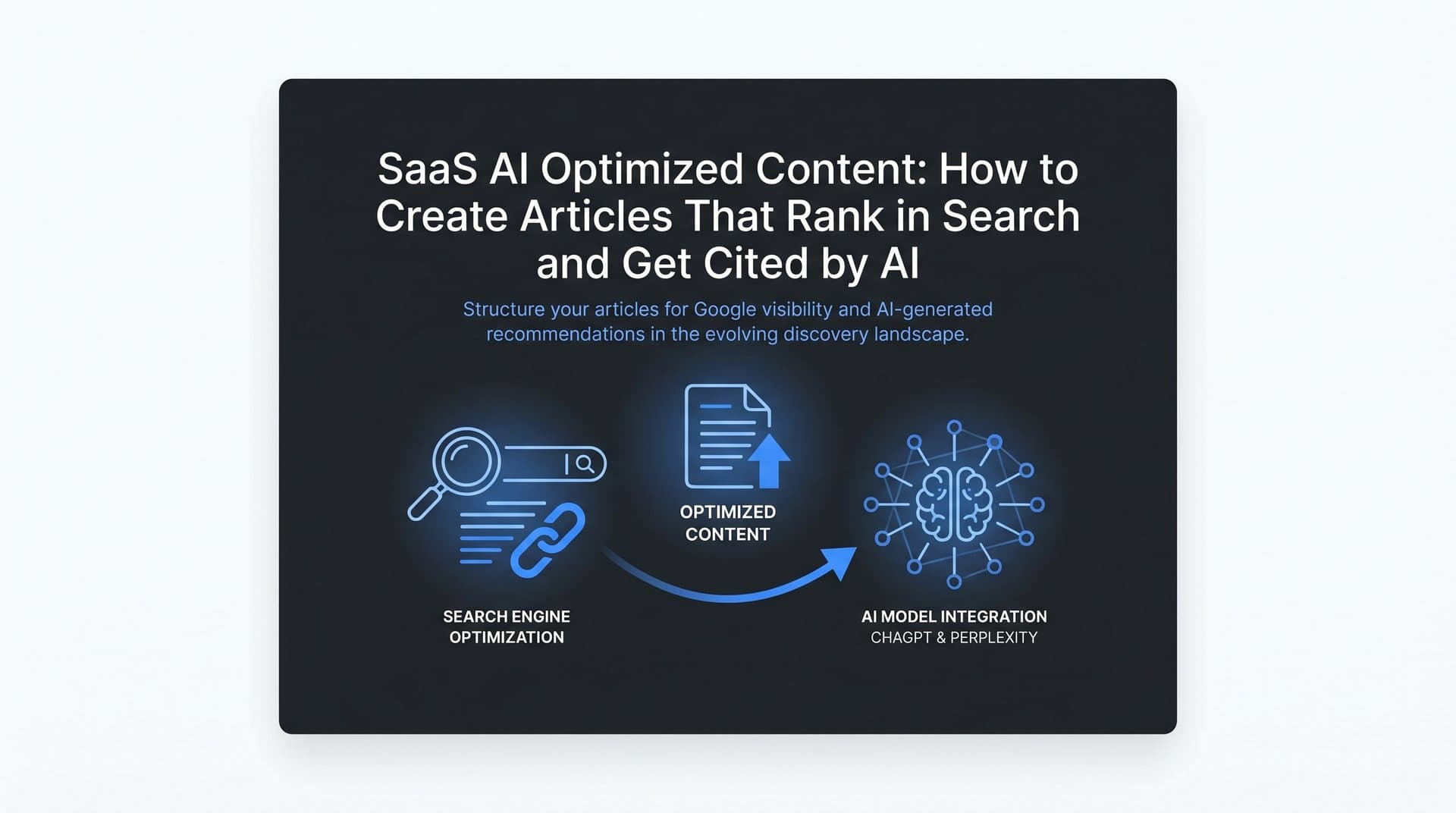
This is where a generative AI content strategy comes in. It is not a replacement for traditional SEO thinking. It is an expansion of it — a framework that accounts for both search engine rankings and AI model visibility simultaneously. In this article, you will understand exactly what this strategy involves, why it matters right now, and how to build one that compounds your organic reach across both traditional and AI-powered discovery channels.
The Discovery Gap Most Content Teams Are Missing
Traditional search engines work through crawling and indexing. A bot visits your page, processes its content, evaluates hundreds of ranking signals, and decides where your page appears in results. Content teams have optimized for this process for decades, and it remains a critical channel. But AI answer engines operate differently, and that difference has significant implications for how content gets surfaced.
Platforms like ChatGPT with Browse, Perplexity AI, Google AI Overviews, and Claude do not simply rank pages. They synthesize information from across the web to produce direct answers. They pull from sources they consider authoritative, well-structured, and clearly attributed. In many cases, they cite those sources. In others, they absorb the information and present it without explicit attribution. Either way, the content that gets referenced and the content that gets ignored depends on factors that traditional SEO optimization does not fully address.
Consider what this means for brand visibility. If a potential customer asks an AI model "what is the best tool for tracking AI brand mentions," the response they receive is shaped by which sources the model has encountered, how clearly those sources described the relevant concepts, and how authoritatively those sources covered the topic. A brand that has never thought about AI content strategy and discoverability may be entirely absent from that answer, regardless of its Google rankings.
The dual-channel reality facing content teams in 2026 is this: traditional search ranking signals and AI model citation patterns share some common ground but diverge in important ways. Both reward quality and authority. But traditional SEO prioritizes keyword placement, backlink profiles, and technical crawlability. AI visibility prioritizes entity clarity, topical depth, structured content that answers discrete questions, and consistent expertise signals across a content ecosystem.
Content teams that only optimize for one channel are telling an incomplete story. The brands building durable organic visibility today are the ones addressing both simultaneously, which requires a deliberate strategy rather than a lucky overlap.
What a Generative AI Content Strategy Actually Looks Like
A generative AI content strategy is built on three core components layered on top of traditional SEO fundamentals: prompt-informed research, Generative Engine Optimization principles, and content architecture designed for AI extractability. Understanding each component helps clarify why this approach differs from simply writing good content and hoping for the best.
Prompt-Informed Research: Traditional keyword research tells you what people type into search engines. But users phrase queries to AI tools differently. They tend to be more conversational, more specific, and more intent-driven. "Best project management software" becomes "what project management tool should a 10-person remote team use if they already use Slack?" Content briefs built only on keyword data miss the full picture of how your audience is actually seeking information. Effective generative AI content strategy incorporates both.
Generative Engine Optimization (GEO): GEO is the emerging discipline of optimizing content so it is more likely to be cited, referenced, or summarized by AI-powered answer engines. Where SEO targets crawlers and ranking algorithms, GEO targets the retrieval and synthesis patterns of large language models. Practically speaking, this means prioritizing clarity of attribution, structured factual content, explicit definitions, and entity recognition over keyword density alone. A page that clearly defines what a concept is, who it applies to, and why it matters is far more extractable than a page that mentions a keyword seventeen times.
Content Architecture for AI Extractability: The formats you choose are a strategic decision, not just a stylistic one. Explainer articles, comparison guides, how-to content, and structured listicles tend to be heavily referenced by AI models because they answer discrete questions in a clear, scannable format. A comprehensive explainer that defines a concept, explains its components, and addresses common questions gives an AI model exactly what it needs to synthesize a useful answer. Vague, meandering content that buries its key points in long narrative paragraphs is far less likely to be extracted.
The distinction between GEO and SEO is worth emphasizing because the two disciplines are complementary but not identical. An SEO-optimized page might use a keyword in the H1, the first paragraph, and several subheadings. A GEO-optimized page ensures that the brand, product, and key concepts are explicitly named and defined, that claims are clearly attributed, and that the content demonstrates genuine expertise rather than surface-level coverage. When you layer GEO principles onto solid SEO foundations, you create content that performs across both discovery channels.
Building Topical Authority That AI Models Recognize
Topical authority is not a new concept in SEO, but it has taken on renewed importance in the context of AI visibility. AI models do not simply retrieve individual pages. They develop an understanding of which sources consistently demonstrate deep expertise across a subject area. A brand with one excellent article on a topic carries less weight than a brand with a comprehensive, interconnected content ecosystem covering that topic from multiple angles.
This is why pillar content and supporting article clusters are foundational to a generative AI content strategy. A pillar page establishes your authoritative position on a broad topic. Supporting articles explore specific subtopics, answer related questions, and link back to the pillar. Together, they signal to both search engines and AI models that your brand is a genuine subject matter expert, not a one-off contributor.
Mapping these clusters requires thinking about your core themes and then systematically identifying every meaningful question, subtopic, and related concept within each theme. For a brand in the AI-powered SEO space, a cluster around "AI content strategy" might include supporting articles on GEO principles and implementation, prompt research techniques, AI visibility measurement, content production workflows, and entity optimization. Each article reinforces the others and collectively builds a signal of deep expertise.
Prompt-based keyword research adds another dimension to this process. Beyond using traditional keyword tools, content teams should research what prompts users are actually submitting to AI tools in their niche. The phrasing of AI queries differs meaningfully from search queries, and those differences should directly inform content briefs. A query like "explain the difference between SEO and GEO for a non-technical founder" reveals both a content opportunity and a specific angle that a purely keyword-driven approach might miss.
Entity Optimization: Ensuring your brand, product names, and key concepts are clearly and consistently defined across your content ecosystem is critical for AI model accuracy. When an AI model encounters your brand name repeatedly in well-structured, authoritative contexts, it builds a more accurate and favorable representation of what your brand does. Inconsistent naming, vague descriptions, or a lack of explicit definitions can lead to AI models misrepresenting or omitting your brand entirely. Every piece of content you publish is an opportunity to reinforce clear, consistent entity signals.
Content Production at Scale Without Sacrificing Quality
Here is the practical challenge that most content teams run into: AI visibility rewards consistent, comprehensive coverage. Building topical authority clusters across multiple themes requires significant content volume. For lean teams, this creates a genuine production bottleneck. The answer is not to compromise on quality. It is to build smarter production workflows.
AI-assisted content production, when structured responsibly, allows teams to increase velocity without sacrificing accuracy or brand voice. The key is using specialized agents for distinct tasks rather than treating AI as a single-step content generator. A research agent can gather and synthesize background information. An outlining agent can structure the content architecture. A drafting agent can produce the initial copy. An SEO optimization agent can review keyword integration and meta elements. Each agent handles a specific function, and human editorial review connects the steps.
This kind of pipeline is only effective when quality guardrails are built in at every stage. Fact-checking is non-negotiable. Brand voice consistency requires human review, not just automated checks. And the final editorial pass should ensure that the content actually demonstrates expertise rather than simply assembling accurate information in a generic format. AI-assisted production is a force multiplier for skilled content teams, not a replacement for editorial judgment.
Publishing Velocity and Indexing: Producing content is only half the equation. Getting it indexed and discoverable quickly matters for both traditional SEO and AI model awareness. Content that sits unindexed for days or weeks after publication is losing potential visibility in both channels. Tools that integrate the IndexNow protocol allow publishers to notify search engines and indexing services instantly when content is published or updated, rather than waiting for scheduled crawls. Automated sitemap updates ensure your content architecture stays current. These technical details are easy to overlook but meaningfully accelerate the time from publication to discovery.
Platforms like Sight AI combine AI-assisted content generation with 13+ specialized agents and automated IndexNow integration, which means the production-to-indexing pipeline can be managed in a single workflow rather than stitched together across multiple tools. For teams trying to build content volume without adding headcount, this kind of integrated approach makes a meaningful operational difference.
Measuring What Actually Matters: AI Visibility Metrics
You cannot optimize what you cannot measure, and traditional SEO metrics tell only part of the story for a generative AI content strategy. Rankings, organic sessions, and backlink counts remain important indicators of search engine performance. But they tell you nothing about how your brand appears in AI-generated responses, which is increasingly where your audience is forming first impressions.
This is where the concept of an AI Visibility Score becomes essential. Unlike traditional rank tracking, which measures where a page appears in a list of results, AI visibility measurement tracks how often and how favorably your brand appears in AI-generated responses across platforms like ChatGPT, Claude, and Perplexity. It answers questions that traditional analytics simply cannot: Is your brand being mentioned when users ask about your category? What context surrounds those mentions? Are AI models describing your product accurately?
Sentiment and Context Tracking: Being mentioned by an AI model is not inherently positive. The context and sentiment of those mentions shapes brand perception in ways that matter. An AI model that describes your product as "a tool some teams use, though it has significant limitations" is technically mentioning your brand, but the framing is damaging. Monitoring the sentiment and context of AI mentions across multiple platforms gives content and marketing teams actionable intelligence about how their brand is being represented, not just whether it is being represented.
Closing the Loop: The most powerful application of AI visibility data is feeding it back into your content strategy. When you can see which topics generate positive AI mentions, which formats are being cited, and which questions your brand is not appearing in, you have a direct signal for where to focus your next content cycle. This creates a closed-loop strategy: publish content, measure AI visibility, identify gaps and opportunities, produce targeted content, measure again. Over time, this compounding approach builds progressively stronger AI visibility alongside traditional search performance.
Sight AI's platform is designed specifically to provide this kind of intelligence, tracking brand mentions across six or more AI platforms with sentiment analysis and prompt tracking built in. For content teams making decisions about where to invest their production capacity, this data replaces guesswork with evidence.
From Strategy to Execution: Your Path Forward
Building a generative AI content strategy is a progressive process, not a one-time project. The strategic arc moves through five connected stages: audit, build, implement, scale, and measure.
Start with an audit of your existing content for AI extractability. Are your key concepts clearly defined? Are your brand and product names consistently referenced? Do your high-value pages answer discrete questions in a structured, scannable format? This audit reveals quick wins and informs your content architecture going forward.
From there, build your topical authority clusters. Map pillar content and supporting articles around your core themes, informed by both traditional keyword research and prompt-based research that reflects how your audience actually queries AI tools. Implement GEO principles in every new piece of content: clear attribution, structured formatting, explicit entity definitions, and genuine expertise signals layered on top of solid SEO fundamentals.
Scale production responsibly using AI-assisted workflows with human editorial oversight, and ensure your publishing pipeline includes automated indexing so new content enters the discoverable web as quickly as possible. Then measure AI visibility alongside traditional SEO metrics, and use that data to continuously refine your content calendar.
The critical point to internalize is that generative AI content strategy is not a replacement for SEO. It is an expansion of it. The teams that will compound their organic reach most effectively are those that treat traditional search and AI-powered discovery as complementary channels, optimizing for both with a unified strategic framework.
Sight AI's platform brings all of these capabilities together in one place: AI visibility tracking across ChatGPT, Claude, Perplexity, and more; a content generation suite with 13+ specialized agents for producing SEO and GEO-optimized articles; and automated indexing with IndexNow integration to ensure your content gets discovered fast. It is built specifically for the dual-channel reality that content teams are navigating right now.
The shift toward AI-powered discovery is not approaching. It is already here. Content strategies built only for traditional search are already incomplete, and the gap will only widen as AI answer engines become more deeply embedded in how people seek information. Brands that invest in generative AI content strategy today are building compounding visibility across both channels simultaneously, and that compounding effect is significant over time.
Start tracking your AI visibility today and see exactly where your brand appears across top AI platforms — because the first step to optimizing your presence in AI-generated answers is understanding what those answers currently say about you.