AI content writing platforms have moved well beyond basic text generation. Today's best tools help marketers research, draft, optimize, and publish content that ranks in traditional search and gets cited by AI models like ChatGPT, Claude, and Perplexity. That second capability is rapidly becoming a competitive necessity, and not every platform is built for it.
Some tools are generic writing assistants. Others are purpose-built for SEO and GEO (Generative Engine Optimization) workflows. This guide covers the best AI content writing platforms for marketers who care about organic growth, AI visibility, and publishing at scale.
We evaluated each tool on content quality, SEO/GEO optimization features, workflow automation, integrations, and value for marketing teams. Whether you're a solo founder, an in-house marketer, or an agency managing multiple clients, you'll find a clear recommendation below.
1. Sight AI
Best for: Marketers who want content creation, AI visibility tracking, and indexing in one platform.
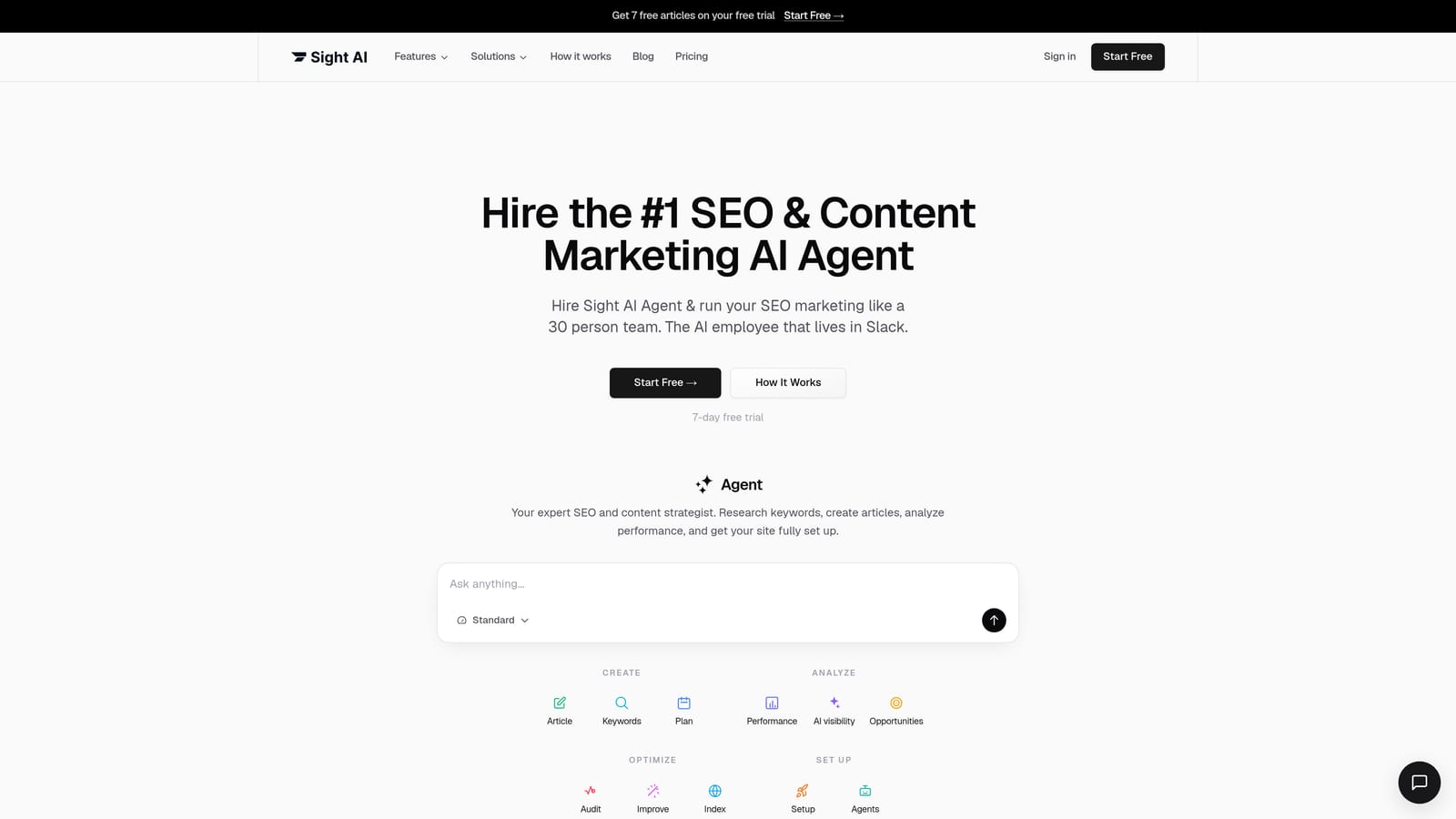
Sight AI is an all-in-one platform combining AI-powered content writing, AI visibility tracking across major AI models, and automated website indexing — purpose-built for marketers who want organic and AI search growth from a single tool.
Where This Tool Shines
Most AI content tools stop at the draft. Sight AI goes further. It connects content creation directly to AI visibility tracking, so you can see whether the content you're publishing is actually getting your brand mentioned by ChatGPT, Claude, Perplexity, and other AI platforms. That closed-loop approach is genuinely rare in this market.
The platform's Autopilot Mode is particularly useful for teams that need to publish consistently without manual oversight at every step. Combined with CMS auto-publishing and IndexNow integration, it removes a significant amount of operational friction from the content workflow.
Key Features
13+ Specialized AI Agents: Purpose-built agents for generating SEO/GEO-optimized listicles, guides, explainers, and other content formats commonly needed by marketing teams.
Autopilot Mode: Hands-off content generation and CMS publishing that keeps your content calendar moving without constant manual input.
AI Visibility Score: Tracks brand mentions across ChatGPT, Claude, Perplexity, and 3+ additional AI platforms, with sentiment analysis and prompt tracking built in.
IndexNow Integration: Automated sitemap updates and IndexNow submission for faster content discovery by search engines.
Prompt Tracking: Monitors which prompts and queries surface your brand in AI model responses, giving you actionable data for GEO content strategy.
Best For
Sight AI is the strongest fit for marketers, founders, and agencies who need to both produce content at scale and understand how that content performs in AI search. If you're tired of managing separate tools for writing, visibility tracking, and indexing, this platform was built for exactly that use case.
Pricing
Multiple tiers available for individuals, teams, and agencies. Check current pricing at trysight.ai for the most up-to-date plans.
2. Writesonic
Best for: High-volume content production teams needing a broad template library and research-backed drafting.
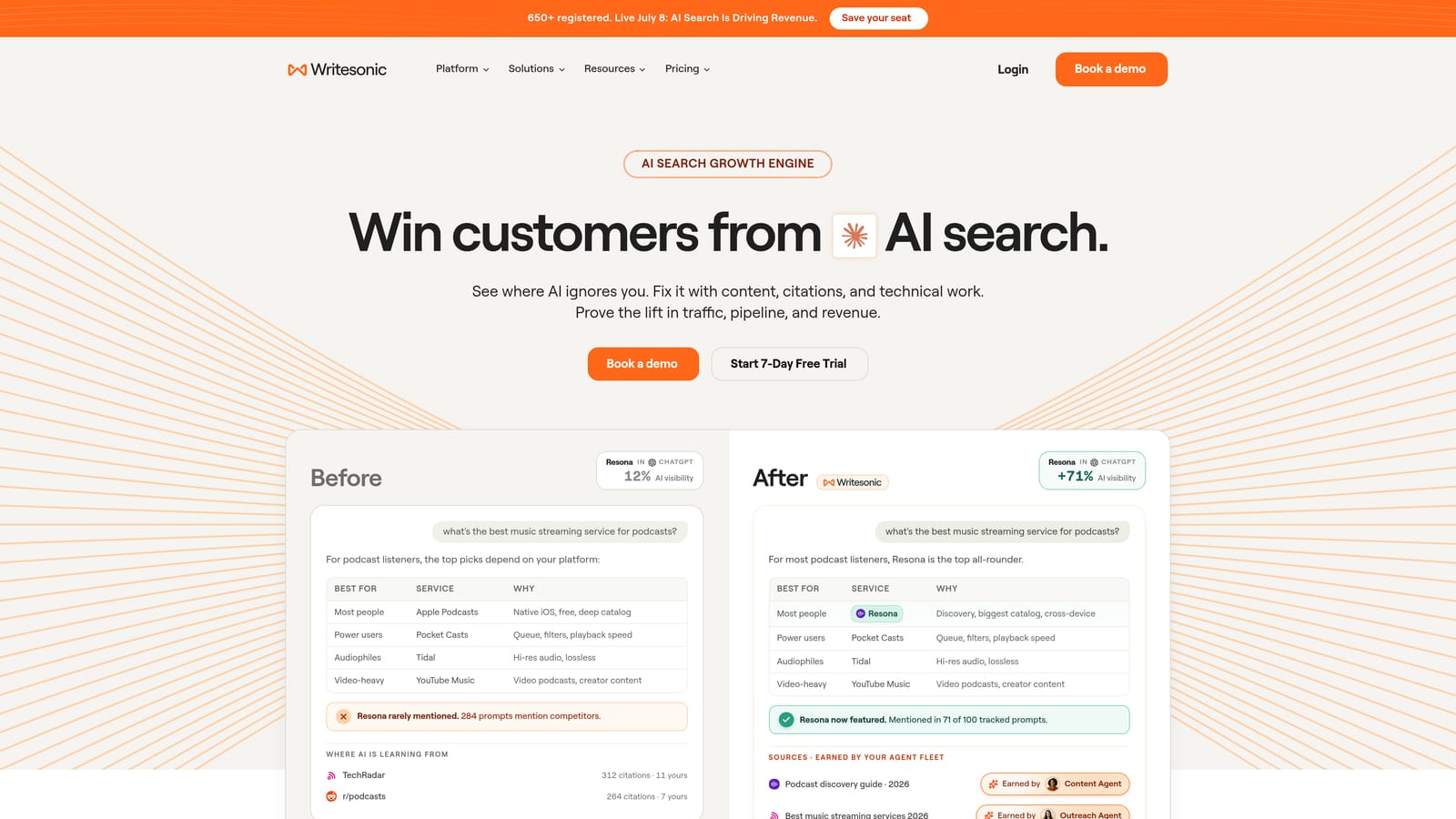
Writesonic is a high-volume AI content platform with an extensive template library covering blog posts, ads, landing pages, and more, plus a web-connected AI assistant for research-informed drafts.
Where This Tool Shines
Writesonic has built one of the broader template libraries in the AI writing space, making it a practical choice for marketing teams that produce a variety of content types. The ability to switch between blog drafts, ad copy, and landing page content within a single platform reduces context-switching for busy teams.
Chatsonic, its conversational AI assistant, has real-time web access — which means drafts can be informed by current information rather than static training data. For marketers covering fast-moving topics, that's a meaningful advantage over tools that rely solely on pre-trained knowledge.
Key Features
Extensive Template Library: Pre-built templates for blog content, ad copy, landing pages, and product descriptions to accelerate content production.
Chatsonic: A conversational AI assistant with real-time web access for research-backed drafts on current topics and trends.
SEO Mode: Keyword integration and readability optimization built into the drafting workflow.
Team Collaboration: Content review workflows for teams managing multiple contributors or approval stages.
Bulk Generation: Supports high-frequency publishing schedules with batch content creation capabilities.
Best For
Writesonic suits content teams and agencies that need to produce high volumes of varied content types quickly. It's particularly useful when real-time research capability matters, such as for news-adjacent content or trend-based marketing campaigns.
Pricing
Freemium plan available; paid tiers scale with word count and features. Check current pricing at writesonic.com as plans are updated regularly.
3. AirOps
Best for: Marketing ops teams and agencies building repeatable, scalable AI content pipelines.
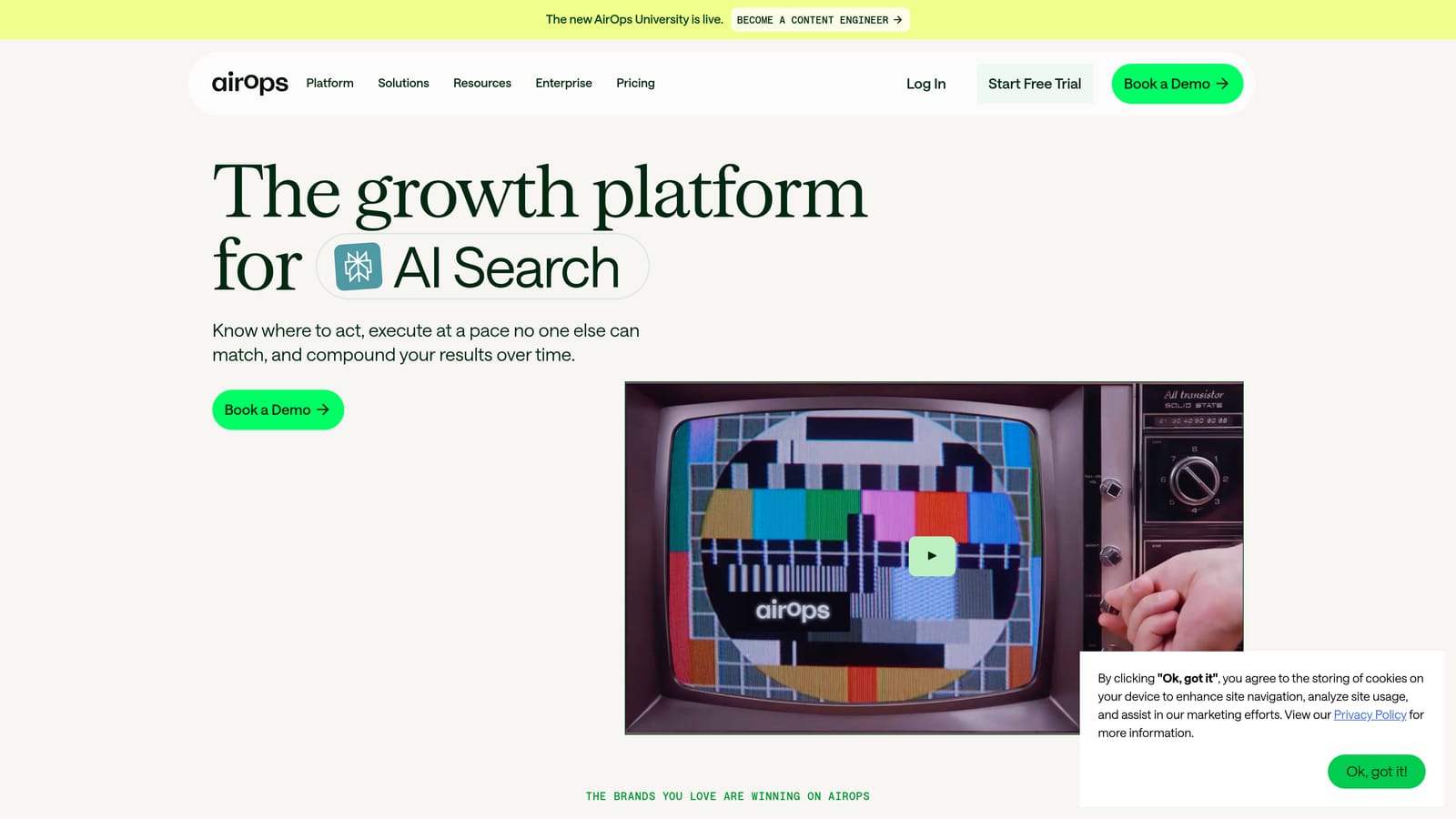
AirOps is a no-code AI workflow automation platform that lets marketing and ops teams build custom content pipelines connecting LLMs to their existing data sources, CMS platforms, and APIs.
Where This Tool Shines
AirOps occupies a different position in the market than most AI writing tools. Rather than offering a fixed content creation interface, it gives teams the infrastructure to build their own custom content workflows. Think of it like building with Lego blocks: you define the inputs, the AI processing steps, and the outputs, then run that workflow repeatedly at scale.
This makes AirOps particularly compelling for agencies managing multiple client content programs or enterprise marketing teams with complex, repeatable content operations. If your team produces structured content from data sources like product feeds, spreadsheets, or CRM data, AirOps can automate that pipeline in ways that general-purpose writing tools cannot.
Key Features
No-Code Workflow Builder: Visual interface for building custom AI content pipelines without engineering resources.
Data Source Connections: Integrates with spreadsheets, databases, CMS platforms, and external APIs to pull in structured data.
Multi-LLM Support: Use multiple LLM providers within a single workflow for flexibility and cost optimization.
Version Control: Workflow versioning and monitoring tools for maintaining content quality across large-scale operations.
Scalable Operations: Designed for repeatable, high-volume content operations at agency or enterprise scale.
Best For
AirOps is best suited for marketing ops professionals, growth engineers, and agencies that need to build and automate custom content workflows. It's less focused on end-to-end SEO optimization and better suited to teams that need workflow flexibility over out-of-the-box content templates.
Pricing
Pricing varies by usage and team size. Check current plans at airops.com.
4. Profound
Best for: Brands that need analytics and measurement for their AI answer engine presence.
Profound is an AI answer engine analytics platform that helps brands measure and improve how they appear in AI-generated responses across major AI search platforms.

Where This Tool Shines
Profound takes an analytics-first approach to AI visibility. Rather than helping you create content, it helps you understand what's happening to your brand inside AI-generated answers. For marketing teams that have been publishing content and wondering whether it's actually influencing AI model responses, Profound provides a structured way to find out.
The share-of-voice metrics and competitor comparison features are particularly useful for brands operating in competitive categories where AI search presence is becoming a meaningful traffic driver. It's a measurement and strategy tool, and it does that job well.
Key Features
AI Visibility Tracking: Monitors brand presence across AI answer engines and generative search results.
Share of Voice Analytics: Dashboard showing how your brand's AI search presence compares to competitors.
Competitor Comparison: Side-by-side analysis of AI search visibility across competing brands.
Content Recommendations: Identifies visibility gaps and surfaces content opportunities informed by AI search data.
Stakeholder Reporting: Reporting tools for communicating AI search performance to leadership and clients.
Best For
Profound is a strong fit for brand and SEO managers who need to report on AI search performance and identify where content strategy needs to shift. It complements content creation tools rather than replacing them, making it a natural addition to an existing martech stack.
Pricing
Check current pricing at profound.co.
5. Peec
Best for: Marketers who need competitive intelligence on brand mentions within AI model responses.
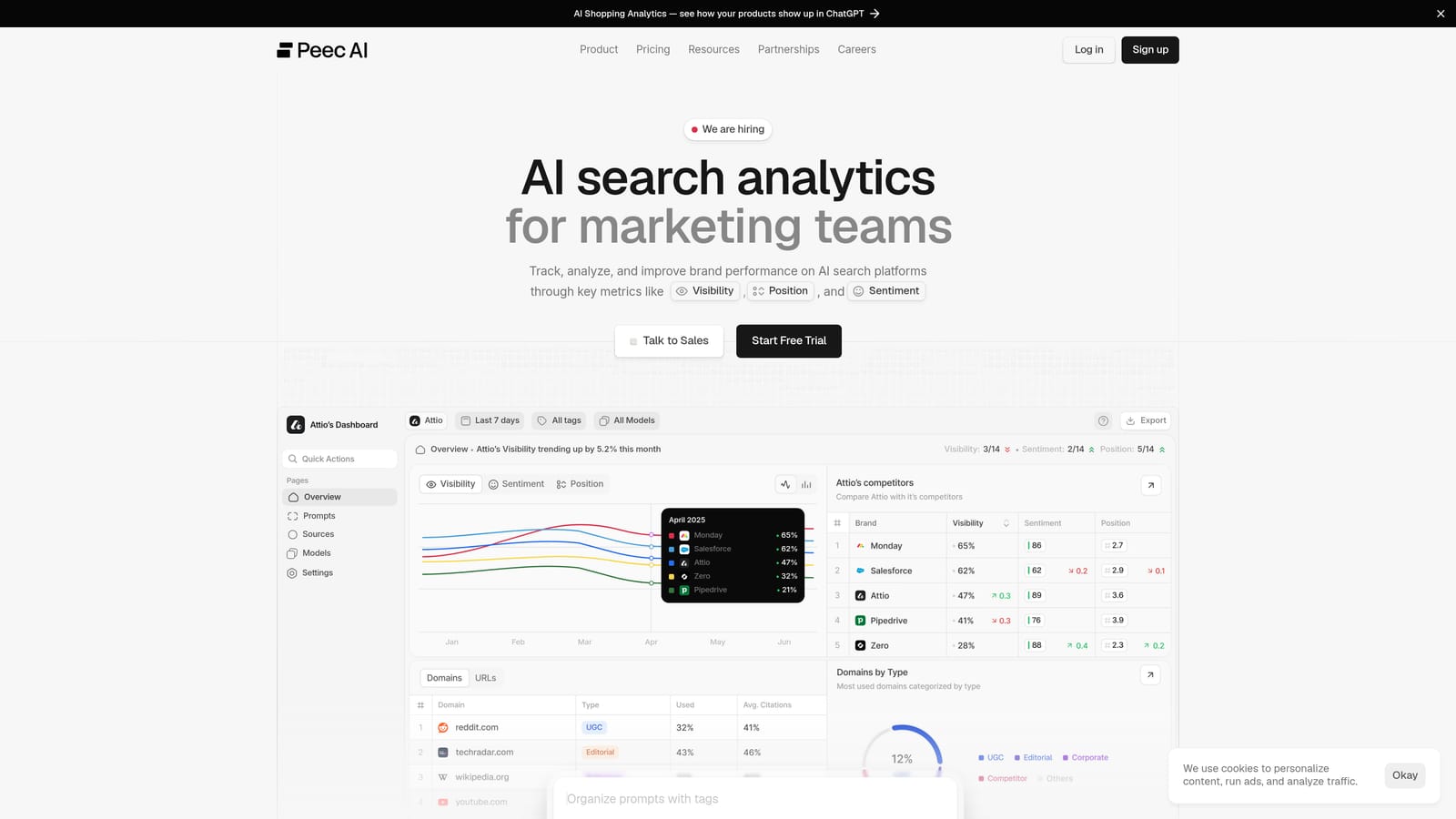
Peec is an AI mention monitoring tool that tracks how brands and competitors are cited within AI model responses, helping marketers understand their AI search footprint.
Where This Tool Shines
Peec is focused squarely on monitoring. It answers a specific question that more and more marketing teams are asking: "When someone asks an AI model about my category, does my brand come up?" That question is harder to answer than it sounds, because AI model responses vary by prompt phrasing, user context, and model version.
The competitive angle is where Peec adds particular value. Knowing which prompts surface a competitor and not your brand points directly to content gaps worth addressing. For teams running GEO strategies, that kind of prompt-level intelligence is actionable in a way that general analytics often aren't.
Key Features
Brand and Competitor Monitoring: Tracks mentions of your brand and key competitors across AI model outputs.
Prompt-Level Tracking: Identifies which query types and prompts surface your brand versus competitors in AI responses.
Citation Alerts: Notifications for changes in AI model citation patterns that could signal shifts in visibility.
Competitive Intelligence: Structured data for understanding your AI search footprint relative to the competitive landscape.
GEO Strategy Support: Monitoring focus complements content creation platforms for teams running structured GEO campaigns.
Best For
Peec suits SEO strategists and content marketers who want prompt-level visibility into how AI models reference their brand and competitors. It's a monitoring and intelligence tool, so it works best alongside a content creation platform rather than as a standalone solution.
Pricing
Check current pricing at peec.ai.
6. Promptwatch
Best for: Teams running structured GEO experiments that need to measure how content changes affect AI citations.
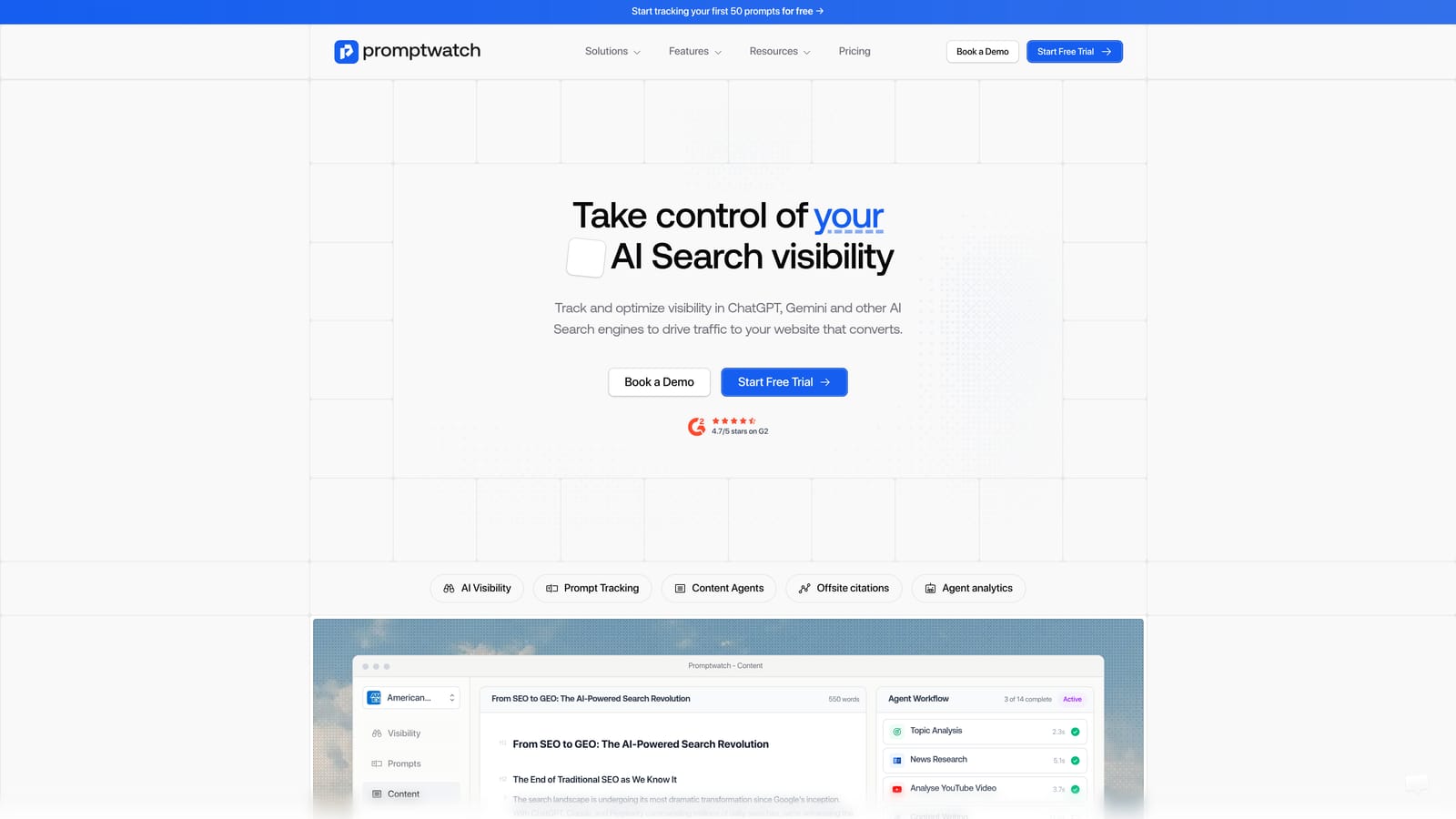
Promptwatch is a prompt tracking and testing tool that monitors how specific prompts return brand mentions across AI models over time, enabling structured AI visibility experiments.
Where This Tool Shines
Promptwatch is the most experiment-oriented tool on this list. Its core value is historical comparison: you can track how AI model responses to specific prompts change over time, which makes it possible to test whether publishing a particular piece of content actually shifted how an AI model references your brand.
That kind of before-and-after measurement has been largely missing from GEO workflows. Most teams publish content and then guess at whether it moved the needle in AI search. Promptwatch gives you a more structured way to validate those efforts with real data.
Key Features
Prompt Response Tracking: Monitors how specific prompts return brand mentions across AI models over time.
Historical Comparison: Tracks changes in AI model responses to measure how content updates affect citation patterns.
GEO Experiment Support: Structured framework for testing: publish content, then measure AI response shifts against a baseline.
Prompt Library Management: Organizes and manages prompt sets for ongoing monitoring campaigns across multiple topics or brands.
Trend Visibility: Surfaces trends in AI citation behavior over time to inform long-term content strategy.
Best For
Promptwatch is best for SEO and content strategists who want to run disciplined GEO experiments and validate whether their content investments are improving AI search visibility. It's a specialized tool that adds the most value when paired with a content creation platform that can act on the insights it surfaces.
Pricing
Check current pricing at promptwatch.io.
Which Platform Is Right for Your Marketing Team?
The right tool depends heavily on where your biggest gap is right now. Here's a quick way to think through it.
If you need to produce SEO and GEO-optimized content at scale while also tracking how AI models talk about your brand, Sight AI is the most complete solution on this list. It's the only platform that combines content creation, AI visibility tracking, and automated indexing in one place, which eliminates a lot of tool-switching and data fragmentation for marketing teams.
If your primary need is high-volume content production across multiple formats, Writesonic offers one of the broader template libraries available, with the added benefit of real-time web access through Chatsonic. For agencies and marketing ops teams that need to build custom, repeatable content pipelines from structured data sources, AirOps gives you the workflow flexibility that off-the-shelf writing tools can't match.
If you're further along in your GEO strategy and need measurement rather than creation, Profound, Peec, and Promptwatch each serve a distinct monitoring role. Profound is strongest for share-of-voice analytics and stakeholder reporting. Peec excels at prompt-level competitive intelligence. Promptwatch is the best choice for teams running structured before-and-after experiments to validate whether content changes are moving the needle in AI search.
One thing is clear across all of these tools: the AI search landscape is shifting fast. Brands that treat AI visibility as an afterthought are already losing ground to competitors who are actively optimizing for it. The question isn't whether to invest in this area, but which tools fit your workflow and budget right now.
For teams that want to tackle content creation and AI visibility in a single platform, start tracking your AI visibility today and see exactly where your brand appears across the top AI platforms — and what it's going to take to show up more.