As AI search tools like ChatGPT, Perplexity, and Claude become primary discovery channels for buyers and decision-makers, the rules of content strategy have fundamentally shifted. Ranking on page one of Google still matters, but it's no longer the whole game. Your brand also needs to appear in the answers AI models generate when your target audience asks relevant questions.
AI content gap analysis is the process of identifying where your content is missing, weak, or misaligned with the topics, questions, and formats that AI systems use to form their responses. Unlike traditional keyword gap analysis, it looks at how AI models currently represent your brand and your competitors, then surfaces the specific content opportunities that can change that picture.
For marketers, founders, and agencies managing organic growth, this discipline is quickly becoming a core part of the content planning workflow. The brands that show up consistently in AI-generated answers aren't there by accident. They've built content that directly answers the questions AI models are trained to respond to.
This guide covers seven actionable strategies for conducting AI content gap analysis, from auditing your current AI visibility to building a systematic publishing pipeline that closes the gaps you find. Whether you're starting from scratch or refining an existing content operation, these strategies will help you uncover real opportunities and turn them into measurable results.
1. Audit Your Current AI Visibility Before Analyzing Gaps
The Challenge It Solves
Many content teams jump straight into gap identification without first understanding where they currently stand. The result is a sprawling list of "missing" topics that may include content you've already published, topics where you're already well-represented, and gaps that don't actually matter to your audience. Without a baseline, gap analysis has no anchor.
The Strategy Explained
Before you can identify what's missing, you need a clear picture of what AI models currently say about your brand. This means systematically querying ChatGPT, Claude, and Perplexity with prompts that a real buyer might use when looking for your category of product or service.
Think of it like a listening audit. You're not asking AI models to evaluate your website — you're asking them the same questions your prospects ask, then observing whether your brand surfaces, how it's described, and whether the context is accurate and favorable.
Document every result. Note which platforms mention you, which prompts trigger a mention, what language is used to describe you, and crucially, which queries return no mention of your brand at all. That last category is the foundation of your gap analysis.
Implementation Steps
1. Identify 20 to 30 high-priority queries that a buyer in your category would realistically ask an AI assistant, covering awareness, consideration, and decision stages.
2. Run each prompt across ChatGPT, Claude, and Perplexity separately, and record the full response for each platform in a structured spreadsheet.
3. Tag each result: brand mentioned, brand not mentioned, brand mentioned but inaccurately, or competitor mentioned instead.
4. Calculate a rough "AI mention rate" by platform to establish your baseline before any gap-closing work begins.
Pro Tips
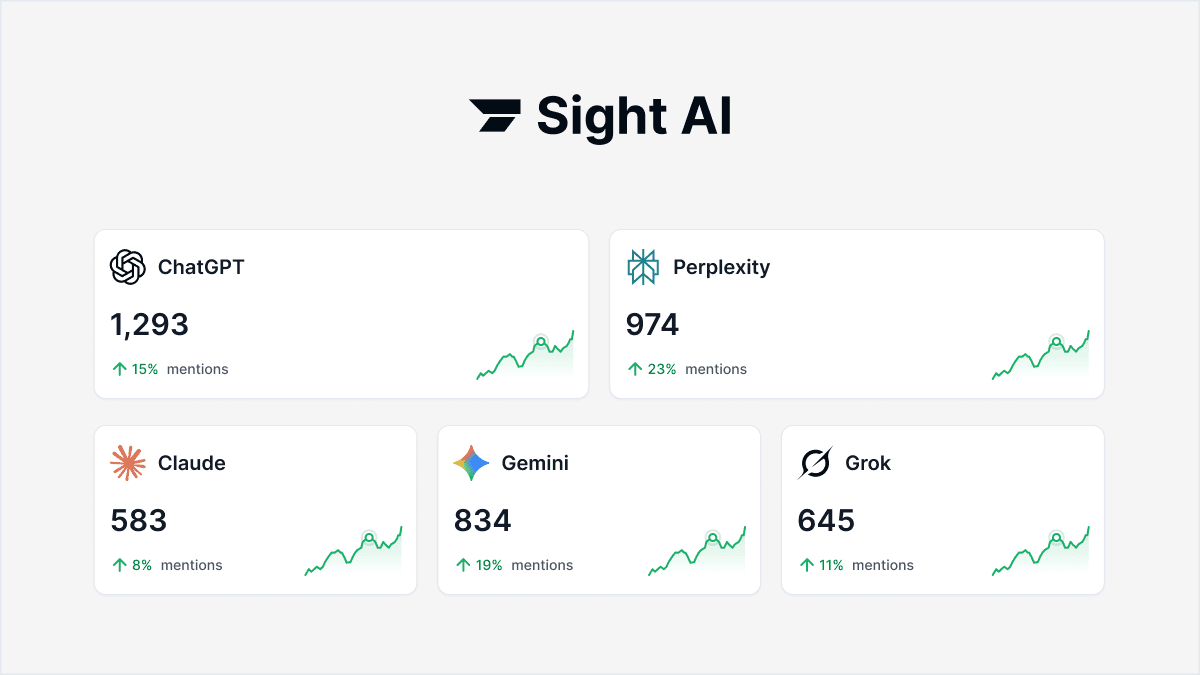
Use a dedicated tool like Sight AI to automate this audit across multiple platforms simultaneously. Manual testing is a useful starting point, but it doesn't scale, and AI model responses can vary between sessions. Automated tracking gives you consistency and a repeatable baseline you can return to after publishing new content.
2. Map Competitor AI Mentions to Expose Your Blind Spots
The Challenge It Solves
Your brand's absence from an AI response is only meaningful when you understand who is filling that space instead. Without competitive context, you're looking at gaps in isolation. Mapping competitor AI mentions transforms abstract absence into a concrete, prioritized list of opportunities where a competitor currently holds ground that you don't.
The Strategy Explained
Run the same structured prompt library you built during your visibility audit, but this time focus specifically on which competitors appear in the responses where your brand does not. Build a gap matrix: a simple table with your key queries on one axis and the brands that appear in responses on the other.
This matrix will quickly reveal patterns. You might find that one competitor dominates comparison queries while another consistently appears in "best tool for" recommendations. You might discover that certain query types, like implementation guides or use case explanations, are owned entirely by competitors because you have no content in those formats.
The goal isn't to copy competitors. It's to understand which content investments are already paying off for them in AI visibility, so you can make informed decisions about where to direct your own publishing efforts.
Implementation Steps
1. Identify your top five to eight competitors and include them in your tracking scope alongside your own brand.
2. Run your prompt library across all three major AI platforms and record which brands appear in each response.
3. Build a gap matrix in a spreadsheet, marking each cell with the brand mentioned, leaving your brand's cells blank where you don't appear.
4. Sort the matrix by query importance and competitor mention frequency to identify your highest-priority blind spots.
Pro Tips
Pay particular attention to queries with strong commercial intent, such as "best [category] tool for [use case]" or "how to choose between [X] and [Y]." These are the queries where AI visibility has the most direct connection to purchase decisions. Closing gaps here typically delivers faster business impact than closing gaps on purely informational queries.
3. Build a Prompt Library That Mirrors Real Buyer Questions
The Challenge It Solves
Most content gap analyses are built around keywords pulled from SEO tools. These keywords reflect what people type into search boxes, not how they phrase questions to conversational AI. The result is a content plan that optimizes for the wrong channel. If your prompt library doesn't reflect how real buyers actually talk to AI assistants, your gap analysis will miss the most important opportunities.
The Strategy Explained
A prompt library is a structured collection of natural-language questions organized by buyer stage and topic cluster. The difference between a keyword list and a prompt library is conversational specificity. Instead of "content gap analysis tool," a prompt library entry might read: "What's the best way to find content gaps for a B2B SaaS company that's trying to show up in AI search results?"
Source your prompts from places where real buyer language lives: sales call recordings, customer support tickets, community forums like Reddit and LinkedIn, and the "people also ask" sections in Google search results. These sources give you the authentic phrasing that buyers use, which is much closer to how they'll phrase questions to AI assistants.
Organize your prompt library by funnel stage: awareness prompts that explore the problem space, consideration prompts that compare solutions, and decision prompts that ask for specific recommendations. This structure ensures your gap analysis covers the full buyer journey, not just the top of the funnel.
Implementation Steps
1. Collect 50 to 100 real questions from sales conversations, support channels, and community forums related to your category.
2. Rewrite each question as a natural-language AI prompt, preserving the original phrasing as much as possible.
3. Tag each prompt by buyer stage (awareness, consideration, decision) and primary topic cluster.
4. Test a representative sample across ChatGPT, Claude, and Perplexity to validate that the prompts return substantive responses before committing the full library to ongoing tracking.
Pro Tips
Refresh your prompt library quarterly. Buyer language evolves, new use cases emerge, and AI models shift in how they interpret certain query types. A stale prompt library produces stale gap analysis. Treating it as a living document keeps your content strategy aligned with how your audience actually thinks and searches.
4. Classify Gaps by Content Type, Not Just Topic
The Challenge It Solves
Identifying that you have a "gap" around a topic like "AI content strategy" is only half the insight. The more important question is: what kind of content is missing? AI models retrieve and cite content differently depending on the query intent, and publishing the wrong format, even on the right topic, often fails to close the gap.
The Strategy Explained
Once you've identified gaps from your prompt testing, go one level deeper and classify each gap by content type. Common gap categories include: missing definitions (the AI can't find a clear, authoritative explanation of a term you should own), absent comparison content (no structured head-to-head analysis exists on your site), lack of how-to guides (procedural queries return competitors because you have no step-by-step content), and insufficient depth (you have content on the topic, but it's too thin for AI models to extract meaningful answers from).
This classification step is what separates a useful content backlog from a generic topic list. When you know that a gap is a "missing definition" gap, you know exactly what to write: a clear, structured definition with context, examples, and related concepts. When you know it's a "comparison content" gap, you know to create a structured comparison page with a clear verdict.
AI models tend to favor content that directly matches the format of the query. A "what is" question is best answered by a well-structured definition. A "how to" question is best answered by a numbered process. Matching your content type to query intent is one of the highest-leverage decisions in GEO-optimized content planning.
Implementation Steps
1. Review your gap matrix from Strategy 2 and add a "content type" column to each identified gap.
2. Use these categories as your classification framework: definition, comparison, how-to guide, use case explanation, FAQ cluster, and in-depth explainer.
3. For each gap, identify whether the issue is absence (no content exists) or depth (content exists but is too thin to be cited).
4. Group gaps by content type to identify patterns, which will inform your content production workflow and template choices.
Pro Tips
Don't overlook the "depth" category. Many brands have content on important topics that simply isn't detailed enough for AI models to extract useful answers from. Sometimes the fastest path to closing a gap is expanding and restructuring an existing article rather than writing something new from scratch.
5. Prioritize Gaps Using an SEO + GEO Scoring Framework
The Challenge It Solves
After running a thorough gap analysis, most teams end up with more opportunities than they can realistically address. Without a principled prioritization framework, content backlogs get ordered by whoever argued loudest in the last planning meeting. A dual SEO and GEO scoring framework replaces that guesswork with a structured ranking based on actual business impact.
The Strategy Explained
Traditional SEO prioritization uses metrics like search volume, keyword difficulty, and click-through potential. These remain relevant, but they don't capture the full picture for AI visibility. GEO prioritization adds a second layer: how frequently do competitors appear in AI responses for this query, how closely does the query match your core value proposition, and how close is the query to a conversion decision?
Score each gap on both dimensions. For SEO factors, use your preferred keyword research tool to pull search volume and difficulty scores. For GEO factors, assign a score based on competitor AI mention frequency (how often did a competitor appear in this query during your testing), query relevance to your core offering, and conversion proximity (is this an awareness query or a decision-stage query?).
Combine both scores into a single priority ranking. Gaps that score high on both SEO and GEO dimensions should move to the top of your content backlog. Gaps that score high on GEO but low on SEO are still worth addressing for AI visibility, but with less urgency. Gaps that score high on SEO but show no AI activity may be purely traditional search opportunities.
Implementation Steps
1. Build a prioritization spreadsheet with each identified gap as a row and columns for SEO score, GEO score, and combined priority rank.
2. Assign SEO scores using search volume and difficulty data from a tool like Ahrefs, Semrush, or similar.
3. Assign GEO scores manually based on your prompt testing results, using a simple 1-to-5 scale for competitor mention frequency, query relevance, and conversion proximity.
4. Calculate a combined score and sort your backlog accordingly. Review the top 20 gaps with your team to validate the ranking before beginning content production.
Pro Tips
Revisit your scoring framework every quarter. As you close gaps and publish new content, the competitive landscape in AI responses will shift. Gaps that were low priority six months ago may become high priority as competitors publish more content and AI models update their retrieval behaviors. Treat prioritization as a living process, not a one-time exercise.
6. Create and Publish GEO-Optimized Content to Close Priority Gaps
The Challenge It Solves
Identifying gaps is only valuable if you act on them. The challenge most teams face is the production bottleneck: gap analysis surfaces dozens of content opportunities, but writing, editing, and publishing quality content at that scale is slow. The answer isn't to lower your quality bar. It's to build a production workflow that combines AI-assisted content generation with structural best practices for GEO optimization.
The Strategy Explained
GEO-optimized content is written with the specific goal of being cited or referenced by AI models. The structural choices that support this are well-established among practitioners: clear, direct definitions early in the content; numbered steps for procedural content; explicit answers to the question before elaborating; comparison tables with clear verdicts; and authoritative depth that covers the topic comprehensively rather than superficially.
These choices also happen to align well with traditional SEO best practices, which means GEO-optimized content tends to perform well across both channels. The key difference is intentionality: you're writing to answer a specific question in a specific format because your gap analysis told you that format is what's missing.
Speed of publication also matters. AI models discover and incorporate new content over time, but that process starts with indexing. Using tools with IndexNow integration ensures that newly published content is submitted to search engines immediately, reducing the lag between publication and discovery. Sight AI's platform combines AI content generation with automatic indexing, which means you can move from gap identification to published, indexed content without switching between multiple tools.
Implementation Steps
1. For each priority gap, write a content brief that specifies the target query, the content type (from Strategy 4), the required format elements, and the key questions the content must answer.
2. Use an AI content writer to generate a first draft, then review and edit for accuracy, depth, and brand voice. Sight AI's 13+ specialized AI agents are built specifically for SEO and GEO-optimized content formats.
3. Structure the final content with clear headings, direct answers near the top, and at least one format element that AI models can easily extract: a definition, a numbered process, or a comparison summary.
4. Publish and trigger immediate indexing via IndexNow integration to minimize the discovery lag.
Pro Tips
Don't publish and move on. Set a reminder to re-test the specific prompts associated with each piece of content four to six weeks after publication. This tells you whether the content is beginning to influence AI responses, and if not, it gives you an early signal to revisit the depth or structure of the piece.
7. Track, Measure, and Iterate Your Gap-Closing Progress
The Challenge It Solves
Without a measurement system, AI content gap analysis becomes a one-time project rather than a compounding competitive advantage. The challenge is that traditional analytics tools weren't built to measure AI visibility. You need a framework that connects your content publishing activity to changes in AI mention frequency, and ultimately to business outcomes like organic traffic and conversions.
The Strategy Explained
Treat AI content gap analysis as a continuous cycle with four phases: audit, publish, measure, and re-analyze. After completing the first six strategies, you enter the measurement phase. This means re-running your prompt library across AI platforms on a regular cadence, typically monthly, and comparing current AI mention rates to your baseline from Strategy 1.
Track changes at the query level, not just overall. A piece of content published to close a specific gap should increase your mention rate for the prompts associated with that gap. If it doesn't, that's a signal to investigate: is the content indexed? Is it structured clearly enough? Is a competitor's content significantly more authoritative on the topic?
Connect AI visibility metrics to downstream business outcomes where possible. If a cluster of queries is associated with a particular product use case, monitor whether organic traffic to related pages increases after you close the gaps in that cluster. This connection between AI visibility and traffic is often indirect, but tracking it over time builds the business case for continued investment in GEO-focused content.
Implementation Steps
1. Set a monthly tracking cadence: re-run your full prompt library across ChatGPT, Claude, and Perplexity and update your gap matrix with current results.
2. Calculate month-over-month changes in AI mention rate by platform and by query cluster to identify which content investments are paying off.
3. Review sentiment alongside mention frequency: are AI models describing your brand accurately and favorably, or are there inaccuracies that need to be addressed through updated content?
4. Re-run your full gap analysis quarterly to surface new gaps as AI models evolve and as competitors publish new content.
Pro Tips
Use Sight AI's AI Visibility Score and sentiment analysis features to automate the monthly tracking step. Manual re-testing at scale is time-consuming and inconsistent, and small variations in how you phrase a prompt can produce different results. Automated tracking with consistent prompts gives you data you can actually act on.
Putting It All Together
AI content gap analysis gives marketers, founders, and agencies a structured way to stop guessing and start systematically building the content that earns AI visibility. The seven strategies covered here form a complete workflow: establish your baseline, expose competitor advantages, build a realistic prompt library, classify gaps by type, prioritize with a dual SEO and GEO framework, publish optimized content, and measure your progress continuously.
The most important thing to recognize is that this is not a one-time audit. It's an ongoing discipline. AI models update their training data and retrieval behaviors regularly, which means the content landscape shifts. Brands that build a repeatable gap analysis process will consistently outpace those that treat it as a quarterly checkbox.
If you're ready to start, begin with Strategy 1: run a structured audit of your current AI visibility across the major platforms. That baseline will make every subsequent step more focused and more actionable.
Sight AI's platform combines AI visibility tracking, content generation, and automatic indexing in one place, so you can move from identifying gaps to closing them without switching between a dozen tools. Track how AI models talk about your brand, generate GEO-optimized content to fill the gaps, and ensure every new article gets indexed fast. Start tracking your AI visibility today and see exactly where your brand appears across top AI platforms.